

What Is the Difference Between Die Cut and Kiss Cut Stickers? A Practical Guide for Buyers
Many buyers think die cut stickers and kiss cut stickers are almost the same because both are custom-shaped adhesive products. But when you move from simple sticker design to real production, the difference becomes important.
The wrong cutting method can affect peeling, application speed, packaging, material waste, edge quality, customer experience, and total production cost.
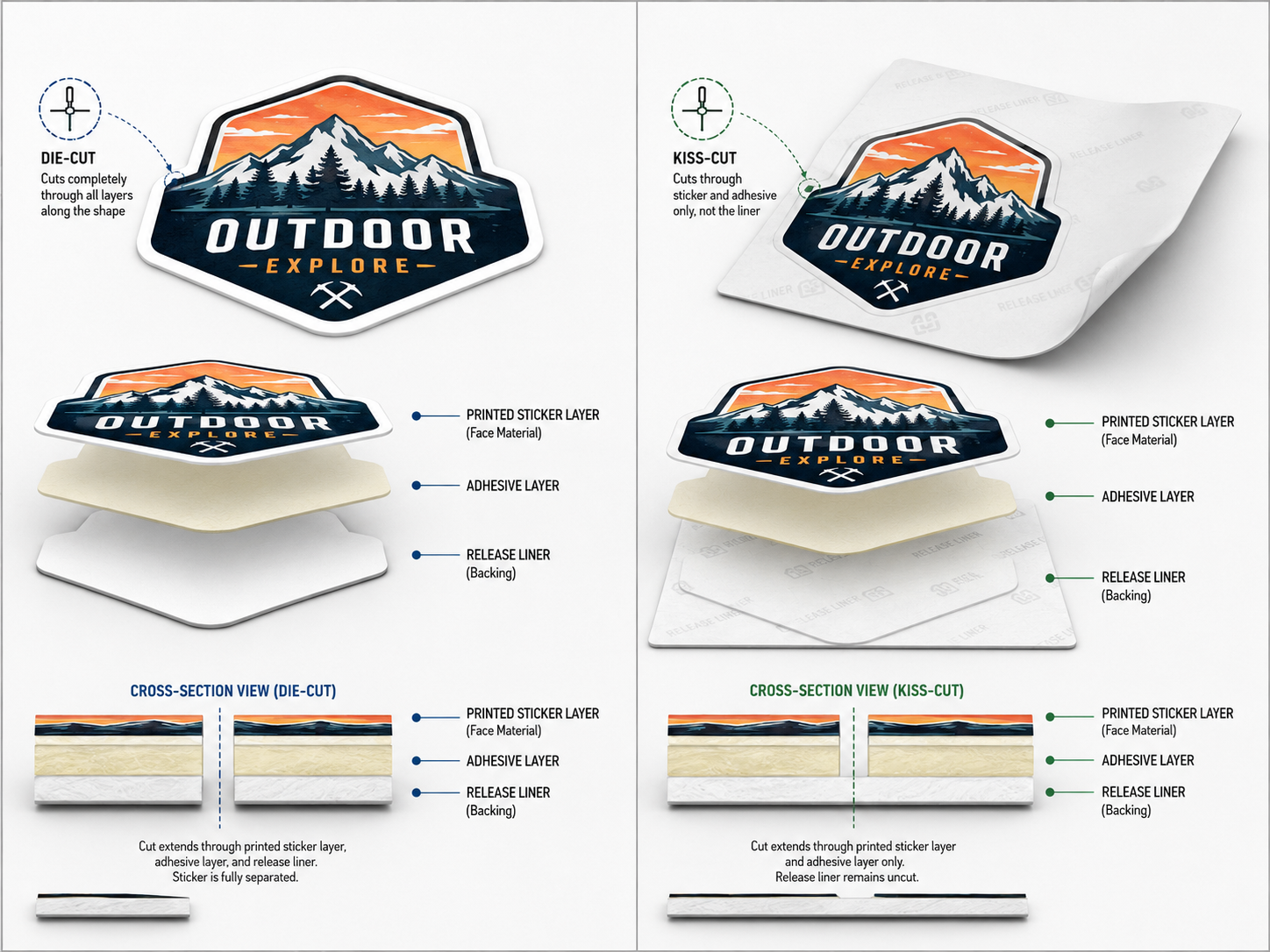
Die cut stickers are cut through both the sticker material and backing liner, creating a finished sticker in the exact outer shape. Kiss cut stickers are cut only through the top sticker layer, while the backing liner remains intact. Both methods are useful, but they serve different purposes.
At Sanken Manufacturing, we help OEM customers process adhesive materials, films, foams, labels, protective pads, and functional die-cut components. Whether the project is a decorative sticker, protective film, gasket, insulation pad, or adhesive-backed industrial part, the cutting method must match the final application.
What Is a Die Cut Sticker?
A die cut sticker is cut through all layers of the sticker structure.
That usually includes:
- Printed surface layer
- Adhesive layer
- Release liner or backing paper
The final sticker shape follows the design outline exactly.
For example, if the artwork is a circle, the entire sticker and backing are cut into a circle. If the artwork is a custom logo shape, the whole sticker becomes that custom shape.
Die cut stickers are popular because they look clean, professional, and finished.
They are commonly used for:
- Brand logos
- Product labels
- Promotional stickers
- Packaging decoration
- Custom merchandise
- Retail sticker sheets in single-piece form
The main advantage is appearance.
A die cut sticker feels like a finished product immediately when the customer receives it.
What Is a Kiss Cut Sticker?
A kiss cut sticker is different.
The cutting blade cuts through the top sticker material but does not cut through the backing liner.
This means the sticker itself has a custom shape, but the backing remains larger, usually square or rectangular.
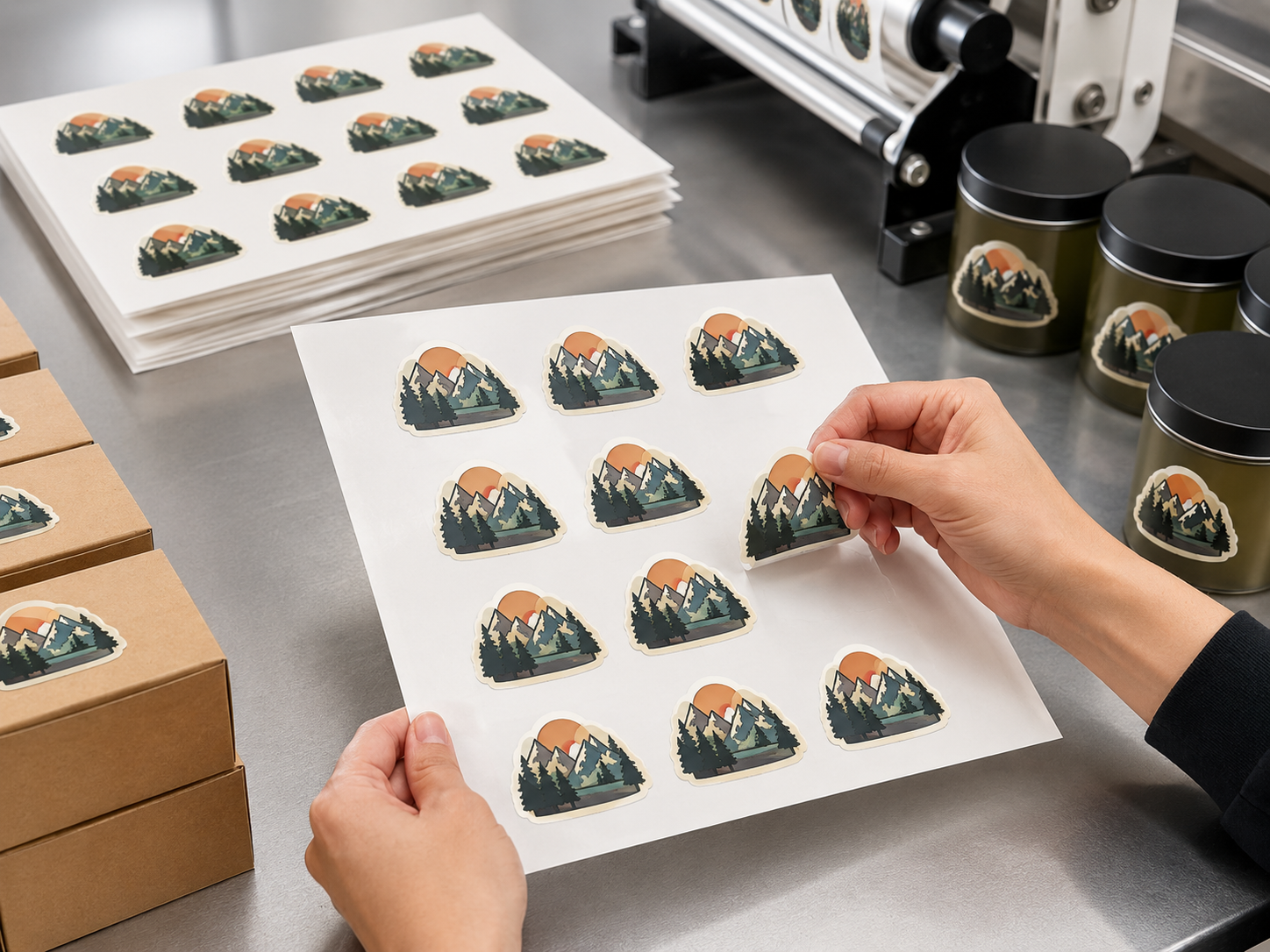
The customer peels the sticker from the backing sheet.
Kiss cut stickers are commonly used when:
- The sticker is small
- The shape is complex
- Easy peeling is important
- Multiple stickers are placed on one sheet
- The sticker needs extra protection during handling
- Automated or manual application requires a stable liner
For buyers, the biggest advantage is usability.
Kiss cut stickers are usually easier to peel and apply, especially when the design has thin lines, sharp corners, or delicate details.
Die Cut vs Kiss Cut: Main Difference
The simplest difference is this:
| Feature | Die Cut Sticker | Kiss Cut Sticker |
|---|---|---|
| Cutting depth | Cuts through sticker and liner | Cuts only sticker layer |
| Backing shape | Same as sticker shape | Usually larger than sticker |
| Peeling | Can be harder for small parts | Easier to peel |
| Appearance | More premium as a finished piece | More practical for application |
| Best for | Single custom stickers | Sheets, small stickers, complex shapes |
| Handling protection | Lower | Higher |
| Production use | Branding and retail | Labels, decals, industrial adhesive parts |
Both are “custom cut,” but they are not the same manufacturing result.
Which One Looks Better?
Die cut stickers usually look more premium.
Because the liner follows the same shape as the sticker, the final product feels more customized and polished.
This is why die cut stickers are often used for:
- Brand giveaways
- Logo stickers
- Laptop stickers
- Retail packaging inserts
- Promotional products
If your goal is visual impact, die cut stickers are often better.
However, better appearance does not always mean better functionality.
If the sticker is very small or has complex edges, users may find it difficult to peel from the backing.
That is where kiss cut stickers become more practical.
Which One Is Easier to Use?
Kiss cut stickers are usually easier to peel.
The larger liner gives users something to hold. This reduces damage during peeling and makes application faster.
This is especially useful for:
- Small warning labels
- Electronic device labels
- Product identification stickers
- Multi-sticker sheets
- Thin decorative decals
- Industrial adhesive-backed parts
In OEM production, ease of application can be more important than appearance.
If workers need to apply thousands of adhesive parts per day, a kiss cut format can reduce handling time and improve efficiency.
Which One Costs More?
The cost depends on size, material, cutting complexity, production volume, and packaging requirement.
Die cut stickers may require more precise cutting through the full material stack. They can also be harder to stack or pack if the shape is irregular.
Kiss cut stickers can be more efficient when multiple stickers are placed on one sheet or roll.
For industrial production, kiss cutting may reduce handling difficulty because the release liner stays intact.
Buyers should not compare only unit price.
They should also consider:
- Material waste
- Application speed
- Packaging method
- Labor cost
- Defect rate
- Peeling convenience
- Final customer experience
Sometimes the sticker with the slightly higher unit cost can reduce total assembly cost.
Why Cutting Depth Matters
Cutting depth is the most important technical difference.
For die cut stickers, the blade must cut through every layer cleanly.
For kiss cut stickers, the blade must stop at the liner without cutting through it.
This requires careful control.
If kiss cutting is too shallow, the sticker will not peel cleanly.
If kiss cutting is too deep, the liner may break.
This can create problems such as:
- Difficult peeling
- Torn backing paper
- Adhesive lifting
- Poor edge quality
- Misalignment during application
At Sanken, cutting pressure, tool sharpness, material thickness, adhesive behavior, and liner strength are all considered before confirming the process.
Why Material Selection Matters
Not all sticker materials behave the same during cutting.
Common materials include:
- PET film
- PVC film
- PP film
- Paper label stock
- Foam adhesive materials
- Double-sided adhesive tape
- Protective films
- Specialty laminates
Soft materials may deform during cutting.
Thin films may stretch.
Thick adhesive materials may create edge overflow.
Some liners may tear if kiss cutting pressure is not controlled well.
This is why professional converting experience matters.
A good supplier does not simply “cut the shape.”
A good supplier understands how the whole adhesive structure behaves.
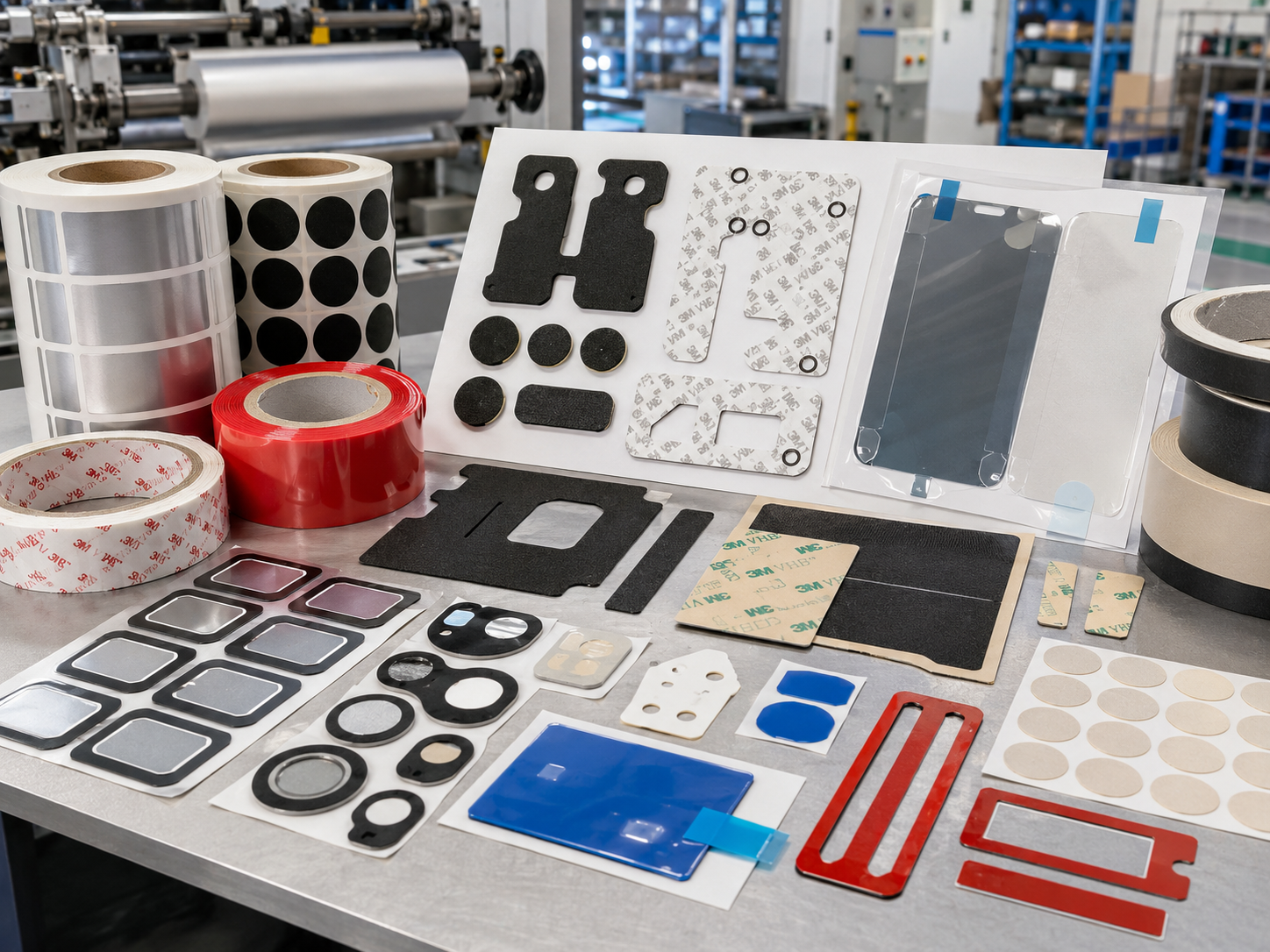
Industrial Applications Beyond Stickers
Although this topic uses stickers as an example, the same difference applies to many industrial adhesive parts.
Kiss cutting is often used for:
- Double-sided tape parts
- Protective film shapes
- Foam adhesive pads
- Electronic insulation parts
- Medical adhesive components
- Automotive adhesive-backed spacers
Die cutting is often used for:
- Finished foam pads
- Gaskets
- Sealing parts
- Insulation sheets
- Custom packaging inserts
- Functional material components
For OEM buyers, this is important because the “sticker” may not be decorative at all. It may be a functional adhesive component inside a product.
When Should You Choose Die Cut Stickers?
Choose die cut stickers when you need:
- A premium finished look
- Individual sticker pieces
- Custom outer shape
- Strong visual branding
- Retail-ready presentation
- Simple peeling requirement
Die cut stickers are ideal when the customer experience starts with appearance.
They are especially good for logos, promotional stickers, and branded packaging.
When Should You Choose Kiss Cut Stickers?
Choose kiss cut stickers when you need:
- Easy peeling
- Multiple stickers on one sheet
- Complex sticker shapes
- Small adhesive parts
- Better handling protection
- Faster application
- Roll or sheet production
Kiss cut stickers are better when usability and application efficiency matter more than the appearance of the backing liner.
For production teams, this can reduce labor time and application mistakes.
Common Buyer Mistakes
Many buyers send a drawing and say, “We need custom stickers,” but they do not specify die cut or kiss cut.
This can create confusion.
Common mistakes include:
- Choosing die cut for very small stickers that are hard to peel.
- Choosing kiss cut but expecting the backing to match the sticker shape.
- Ignoring adhesive thickness during cutting.
- Not confirming liner strength.
- Using the wrong material for tight-radius shapes.
- Focusing only on unit price instead of application efficiency.
These mistakes can delay production and increase cost.
What Should Buyers Confirm Before Ordering?
Before choosing die cut or kiss cut stickers, buyers should confirm:
- Is the sticker decorative or functional?
- Will it be applied by hand or machine?
- Is easy peeling important?
- Does the sticker need to stay on a sheet?
- Is the design small or complex?
- What material and adhesive are required?
- What tolerance is needed?
- Will the parts be packed individually, on sheets, or on rolls?
- Does the product need waterproof, heat-resistant, or aging-resistant performance?
- Is this for prototype testing or mass production?
Clear answers help the supplier recommend the right cutting method.
How Sanken Helps Customers Choose the Right Cutting Method
At Sanken Manufacturing, we work with adhesive tapes, films, foams, non-woven fabrics, rubber materials, and multilayer laminates.
For sticker-like and adhesive-backed components, we help customers decide:
- Die cut or kiss cut
- Sheet format or roll format
- Liner type
- Adhesive structure
- Cutting tolerance
- Material thickness
- Edge quality requirement
- Packaging method
Our capabilities include:
- Precision die cutting
- Kiss cutting
- Adhesive tape converting
- Film laminating
- Foam converting
- Material assembly
- Custom OEM component manufacturing
Our goal is not only to make parts match a drawing.
Our goal is to help customers reduce application problems, improve production efficiency, and avoid unnecessary cost.
Conclusion
Die cut stickers and kiss cut stickers are different because of cutting depth. Die cut stickers are cut through both the sticker and backing liner, creating a finished custom-shaped piece. Kiss cut stickers are cut only through the sticker layer, leaving the backing liner intact for easier peeling and handling.
For branding, die cut stickers often look more premium. For production, small shapes, complex designs, and easy application, kiss cut stickers are often more practical. At Sanken Manufacturing, we help OEM customers choose the right cutting method and convert adhesive materials into reliable, ready-to-use components for packaging, electronics, automotive, medical, and industrial applications.