
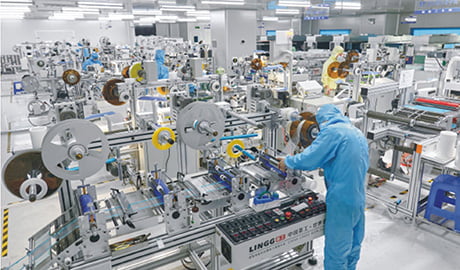
Understanding Rotary Die Cutting?
Manufacturers often struggle to balance speed, accuracy, and cost in precision material converting. Traditional cutting methods slow production. Rotary die cutting solves this with continuous high-speed processing and repeatable results.
Rotary die cutting is a continuous material converting process that uses cylindrical dies to cut flexible materials into precise shapes at high speed. It enables accurate multilayer processing and supports large-volume production efficiently.
%(Rotary die cutting machine overview diagram)
What Is Rotary Die Cutting and How Does It Work?
Rotary die cutting is a continuous roll-to-roll cutting process that uses hardened cylindrical dies mounted on rotating rollers. As material moves through the machine, the die cuts shapes without stopping the web flow.
Unlike flatbed die cutting, which presses vertically, rotary die cutting operates with synchronized rotation. This motion improves consistency and production speed.
Typical workflow includes:
| Step | Process Description |
|---|---|
| Unwinding | Material feeds from roll |
| Web guiding | Alignment control ensures precision |
| Rotary cutting | Cylindrical die shapes material |
| Matrix removal | Scrap material separates |
| Rewinding | Finished parts collected |
Because the process remains continuous, manufacturers achieve better repeatability and throughput.
Dive Deeper: Why Continuous Motion Improves Cutting Stability
Continuous rotary motion eliminates impact shock created by stamping presses. That reduces deformation in soft materials like foam, adhesive tape, and nonwoven fabric.
This stability helps maintain:
- consistent dimensional tolerance
- smooth edge quality
- reliable adhesive performance
- predictable sealing behavior
These advantages make rotary die cutting ideal for electronics insulation parts, automotive sealing components, and medical wearable assemblies.
%(Rotary die cutting process workflow illustration)
What Materials Can Be Processed Using Rotary Die Cutting?
Rotary die cutting supports a wide range of flexible industrial materials used in modern OEM manufacturing.
Common materials include:
| Material | Application Example |
|---|---|
| Double-sided adhesive tape | Electronics bonding |
| EVA / PE foam | Cushioning and sealing |
| PET film | Electrical insulation |
| Rubber sheets | Gaskets |
| Nonwoven fabric | Medical wearables |
| Conductive foil | EMI shielding |
Because pressure remains controlled across the rotating cylinder, multilayer laminated structures can also be processed efficiently.
Dive Deeper: Why Multilayer Converting Is Increasingly Important
Modern functional components rarely use a single material layer. Instead, they combine structural and functional materials together.
Examples include:
- automotive NVH foam + adhesive layers
- smartphone insulation films + release liners
- medical electrode laminates with hydrogel structures
Rotary die cutting allows inline processing of these multilayer stacks without repositioning materials between operations.
This reduces handling time and improves yield consistency.
%(Multilayer rotary die cut components example)
Rotary Die Cutting vs Flatbed Die Cutting: What Is the Difference?
Selecting the correct die cutting method depends mainly on production volume and part complexity.
Here is a practical comparison:
| Feature | Rotary Die Cutting | Flatbed Die Cutting |
|---|---|---|
| Cutting motion | Continuous rotation | Vertical stamping |
| Production speed | Very high | Moderate |
| Repeatability | Excellent | Good |
| Setup flexibility | Moderate | High |
| Ideal batch size | Medium to high volume | Prototype to low volume |
Rotary systems perform best in automated roll-to-roll environments where production efficiency matters most.
Dive Deeper: Choosing the Right Method for Your Production Stage
Flatbed die cutting works well for prototypes or frequently changing geometries because tooling costs remain lower.
However, rotary die cutting becomes more economical when:
- volumes increase
- tolerances tighten
- multilayer structures are required
- automation integration becomes necessary
For long-term production programs, rotary die cutting often reduces total manufacturing cost despite higher initial tooling investment.
%(Rotary vs flatbed comparison chart)
What Are the Advantages of Rotary Die Cutting in Precision Manufacturing?
Rotary die cutting plays a major role in high-performance component manufacturing across multiple industries.
Key advantages include:
High production speed
Continuous web processing allows fast output rates suitable for large-scale programs.
Consistent dimensional accuracy
Rotary tooling maintains stable cutting depth during long production runs.
Inline processing capability
Multiple converting operations can occur simultaneously, including:
- lamination
- slitting
- perforating
- kiss cutting
Reduced material waste
Stable pressure distribution improves material utilization.
Automation compatibility
Rotary systems integrate easily into automated converting lines.
Dive Deeper: Why Repeatability Matters More Than Speed in OEM Supply Chains
Many buyers focus only on production speed. However, repeatability directly affects downstream assembly performance.
Stable tolerance improves:
- adhesive bonding reliability
- insulation spacing consistency
- sealing effectiveness
- EMI shielding stability
These improvements reduce defect rates and increase long-term product reliability.
%(High-speed rotary converting production line)
When Should Manufacturers Choose Rotary Die Cutting?
Rotary die cutting is the preferred solution when production requires both precision and scalability.
It works best for:
| Scenario | Recommendation |
|---|---|
| Prototype stage | Flatbed cutting |
| Small batch production | Flatbed cutting |
| Medium volume programs | Rotary die cutting |
| Mass production lines | Rotary die cutting |
Manufacturers typically transition to rotary processing once product geometry stabilizes and annual volume increases.
This shift helps reduce per-unit processing cost while improving quality consistency.
%(Industrial rotary die cutting line example)
FAQ: Understanding Rotary Die Cutting
What is rotary die cutting used for?
Rotary die cutting is used to convert flexible materials like adhesive tapes, foams, films, and rubber sheets into precise functional components.
How accurate is rotary die cutting?
Rotary die cutting provides excellent repeatability because cutting pressure stays consistent throughout continuous operation.
Is rotary die cutting suitable for multilayer materials?
Yes. It is especially effective for laminated material stacks requiring alignment accuracy and inline processing.
What industries commonly use rotary die cutting?
Automotive, electronics, medical devices, and industrial sealing industries rely heavily on rotary die cutting technology.
When is rotary die cutting better than flatbed cutting?
Rotary die cutting becomes more efficient when production volumes increase and tolerance stability becomes critical.
Conclusion
Rotary die cutting enables fast, repeatable, and scalable precision converting for multilayer flexible materials in modern manufacturing.