
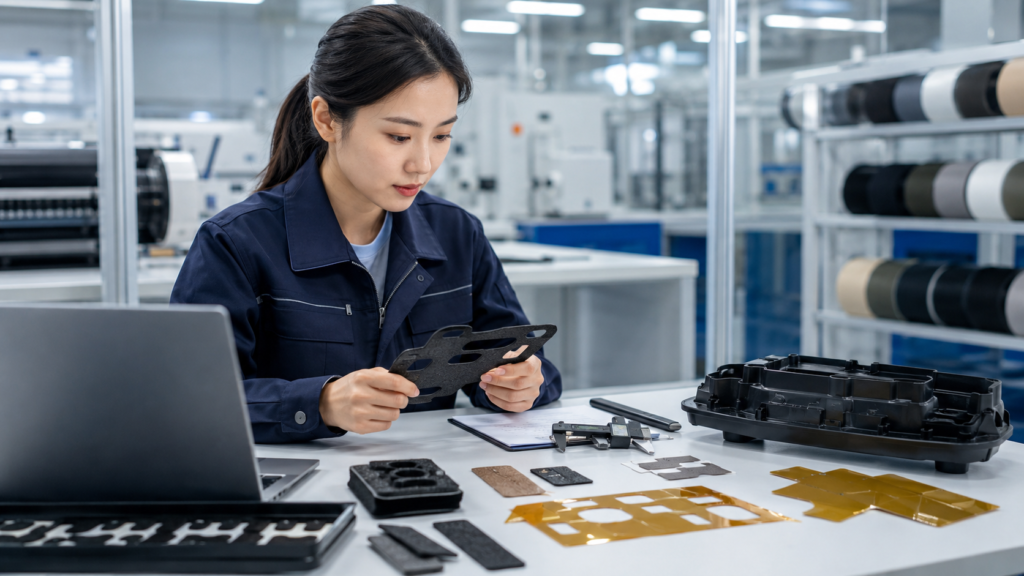
The cost of automotive die cut parts in OEM manufacturing is affected by material type, thickness, adhesive structure, part complexity, tolerance, tooling, production volume, quality requirements, packaging, and assembly format. A simple foam pad may look inexpensive, while a multilayer automotive die cut part with adhesive backing, liner control, tight holes, clean edges, and inspection requirements may cost much more.
For OEM engineers and purchasing teams, the lowest unit price is not always the best choice. Automotive die cut parts must fit the final assembly, meet quality expectations, and remain stable across production batches. If the part causes adhesive lifting, poor sealing, fiber shedding, assembly mismatch, or rework, the real cost becomes much higher than the quoted price.
At Sanken, we support OEM customers with precision die cutting, adhesive lamination, foam gaskets, non-woven felt NVH parts, PET and PI insulation films, rubber pads, protective films, double-sided tape parts, sealing components, and multilayer converted materials for automotive interiors, automotive electronics, EV battery-related assemblies, displays, sensors, and industrial vehicles.
Why Automotive Die Cut Part Cost Is Not Only About Size
Many buyers assume that die cut part cost is mainly determined by part size. Size matters, but it is only one factor.
A small adhesive-backed PET insulation film may cost more than a larger simple foam pad because it requires tighter tolerance, cleaner edges, controlled liner release, and more careful packaging. A non-woven felt NVH strip may require fiber shedding control. A foam gasket may require specific compression performance. A rubber damping pad may require hardness control and clean cutting.
Cost is usually affected by the complete structure and production difficulty, not only by the material area.
1. Material Type
Material choice is one of the biggest cost factors.
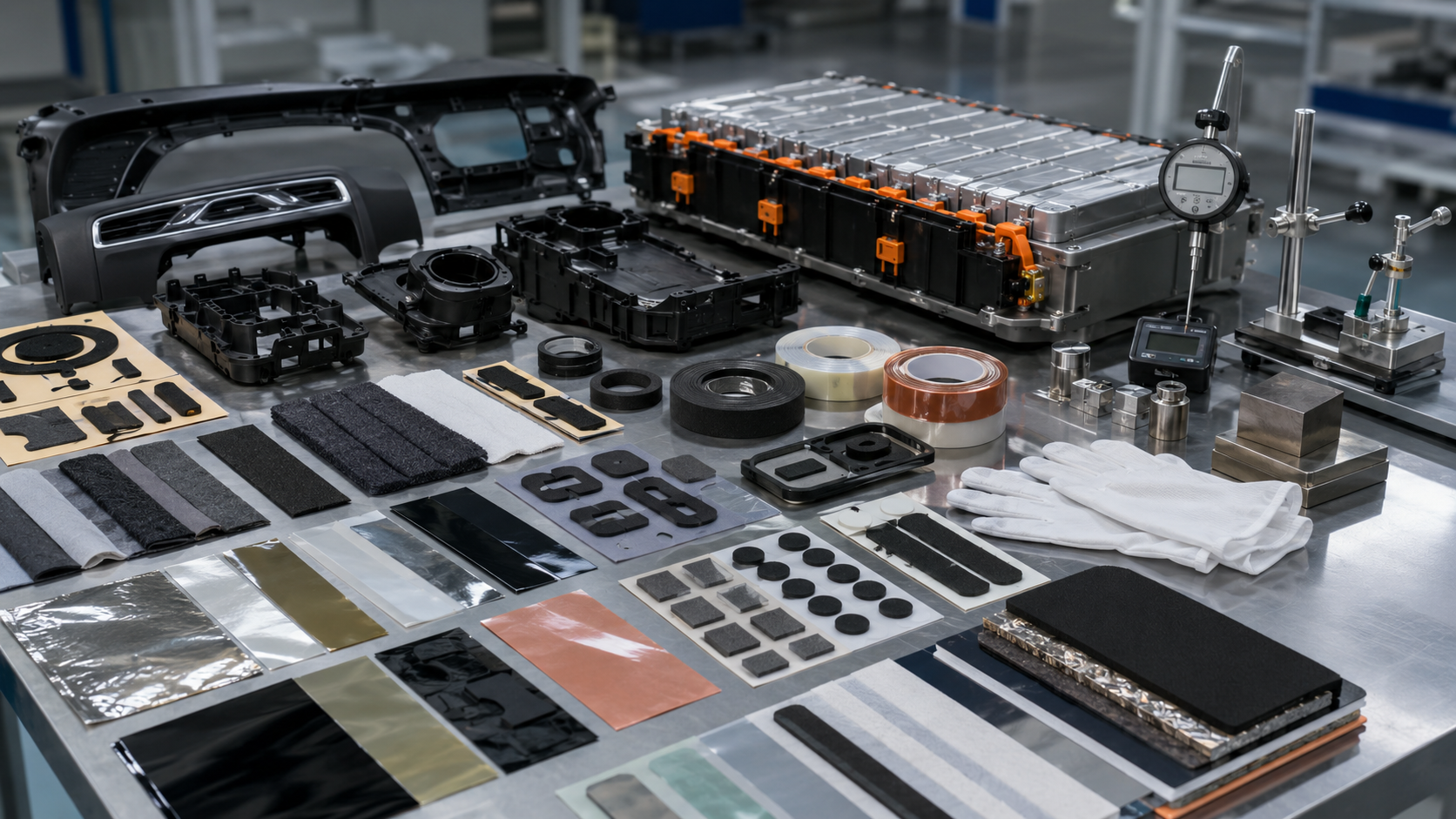
Automotive die cut parts may use:
- PE foam
- PU foam
- EVA foam
- EPDM foam
- Silicone foam
- Rubber sheets
- Non-woven felt
- PET film
- PI film
- PC film
- Protective film
- Double-sided adhesive tape
- Transfer adhesive
- Light-blocking film
- Multilayer laminated materials
Different materials have different costs because they offer different functions. For example, standard foam may be used for cushioning, while EPDM or silicone foam may be selected for sealing or higher environmental resistance. PET film may be used for insulation, while PI film may be selected when higher temperature resistance is needed.
For automotive NVH parts, non-woven felt material may be chosen for anti-rattle, anti-squeak, sound absorption, or soft contact protection. For automotive electronics, PET or PI films may be used for insulation and safety spacing.
The more demanding the material performance, the higher the cost is likely to be.
2. Material Thickness and Density
Thickness directly affects material cost and die cutting difficulty.
A thicker foam gasket uses more material and may require stronger cutting pressure. A high-density foam may cost more than a lower-density foam because it provides different compression behavior. A thicker rubber pad may be harder to cut cleanly and may require more careful tooling.
For foam and rubber parts, cost may be affected by:
| Factor | Cost Impact |
|---|---|
| Thickness | More material and harder cutting |
| Density | Affects compression and material price |
| Hardness | Affects cutting and assembly performance |
| Compression requirement | May require special material |
| Recovery performance | Higher performance materials may cost more |
| Adhesive backing | Adds lamination and material cost |
In automotive assembly, thickness cannot be selected only by price. If a foam gasket is too thin, it may not seal. If it is too thick, it may create assembly pressure or housing deformation.
3. Adhesive Structure
Many automotive die cut parts are adhesive-backed. Adhesive structure can significantly affect cost.
Adhesive-related cost factors include:
- Single-sided adhesive
- Double-sided adhesive
- Transfer adhesive
- Foam tape structure
- PET carrier adhesive
- High-bond adhesive
- Removable adhesive
- Heat-resistant adhesive
- Liner type
- Pull tab design
- Kiss cutting requirement
- Adhesive lamination process
A simple non-adhesive foam part is usually less expensive than an adhesive-backed foam gasket with liner, tab, and clean peel requirements.
Adhesive selection should match the bonding surface. Automotive parts may bond to plastic, metal, painted surfaces, coated surfaces, fabric, rubber, or glass. If the adhesive does not match the surface, the part may lift during assembly or fail during use.
4. Part Shape and Complexity
Part geometry also affects cost.
Simple rectangles, strips, and pads are usually easier to produce. Complex shapes with thin walls, narrow borders, small holes, sharp corners, internal windows, and tight spacing may increase tooling difficulty and waste removal time.
Cost increases when parts include:
- Very small holes
- Narrow adhesive frames
- Thin gasket walls
- Complex inner cutouts
- Multiple windows
- Tight corner radii
- Long thin strips
- Fragile shapes
- Difficult waste removal areas
- High part density on liner sheets
For example, a simple automotive foam pad is easier to cut than a narrow foam gasket frame around an electronic housing. A PET insulation film with many small holes requires more precise tooling and inspection.
5. Tolerance Requirements
Tolerance is one of the most important cost drivers in OEM die cutting.
Automotive die cut parts may need to align with screw posts, clips, connectors, sensors, display frames, battery covers, plastic housings, and assembly fixtures. If the tolerance is too loose, the part may not fit. If the tolerance is too tight, production becomes more difficult and inspection cost increases.
Common tolerance-related cost factors include:
| Requirement | Why It Affects Cost |
|---|---|
| Tight hole position | Requires more precise tooling and inspection |
| Narrow gasket width | Higher risk of deformation or waste removal issues |
| Thin film alignment | Requires stable material handling |
| Multilayer registration | Needs lamination and process control |
| Critical dimensions | Requires more inspection time |
| Soft material tolerance | Foam, rubber, and felt are harder to control than rigid film |
Buyers should define which dimensions are truly critical. Not every dimension needs the tightest tolerance. Overly strict tolerance on non-critical areas can increase cost without improving product performance.
6. Tooling and Die Type
Tooling affects both initial cost and production stability.
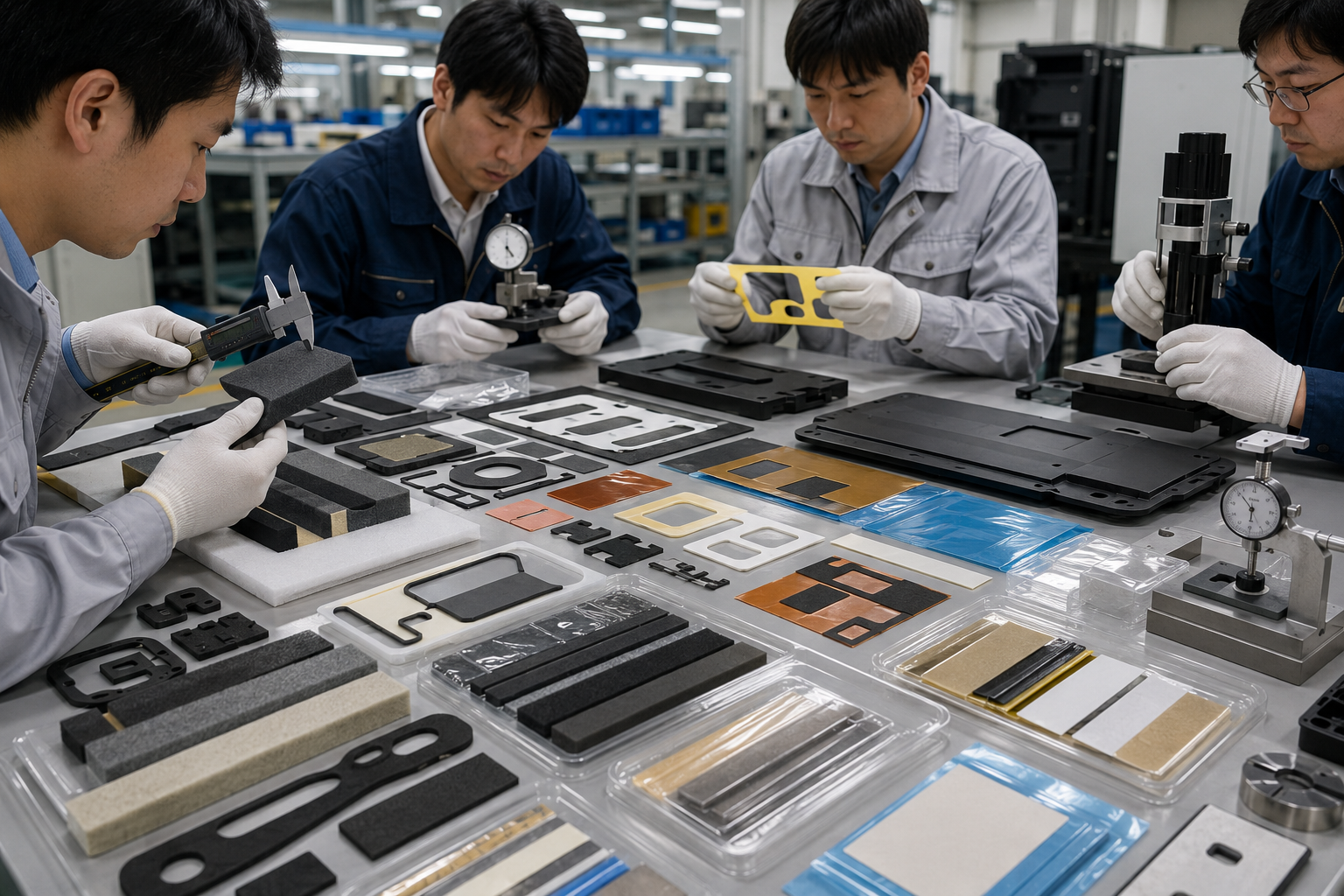
Different projects may use different cutting methods depending on material, volume, tolerance, and part structure.
Tooling cost may depend on:
- Part size
- Shape complexity
- Number of cavities
- Flatbed or rotary cutting method
- Kiss cutting or through cutting
- Multilayer cutting
- Prototype tooling
- Production tooling
- Tool life requirement
- Cutting accuracy
A low-volume sample project may use simpler tooling. A high-volume automotive OEM project may require more durable tooling and more stable process control.
Good tooling may cost more at the beginning, but it can reduce burrs, poor edges, adhesive overflow, liner damage, and mass production instability.
7. Production Volume
Production quantity strongly affects unit cost.
Higher production volume usually lowers unit cost because tooling, setup time, material preparation, and process adjustment can be spread across more parts. Low-volume production may have higher unit cost because setup and tooling costs are shared by fewer pieces.
| Production Situation | Cost Characteristic |
|---|---|
| Prototype samples | Higher unit cost |
| Small batch trial | Higher setup cost per piece |
| Pilot production | Useful for validation |
| Mass production | Lower unit cost at scale |
| Long-term repeat orders | Better cost stability |
However, buyers should not move to mass production too early. If the design is still changing, repeated tooling changes may increase total cost.
8. Material Utilization and Waste
Material utilization has a direct impact on cost.
If the part shape creates too much waste, the material cost increases. Long strips, large windows, irregular shapes, and wide spacing between parts may reduce material efficiency.
Waste is especially important when using higher-cost materials such as specialty foam, PI film, high-performance adhesive tape, or multilayer laminated structures.
A good supplier may suggest layout optimization to improve material usage without changing the functional design. This can reduce cost while maintaining quality.
9. Cleanliness and Edge Quality Requirements
Automotive electronics, displays, sensors, and EV battery-related assemblies may require cleaner die cut parts than general interior components.
Cleanliness requirements may increase cost because they require better material handling, sharper tooling, surface inspection, anti-static control, packaging protection, and more careful waste removal.
Important quality concerns include:
- Foam dust
- Felt fibers
- Rubber burrs
- PET film particles
- Adhesive strings
- Edge lifting
- Surface scratches
- Dust contamination
- Liner debris
For automotive NVH felt parts, fiber shedding must be controlled. For automotive electronics insulation films, clean edges and accurate holes are critical. For adhesive tape parts, adhesive overflow and liner release must be controlled.
10. Inspection Requirements
Inspection level affects cost.
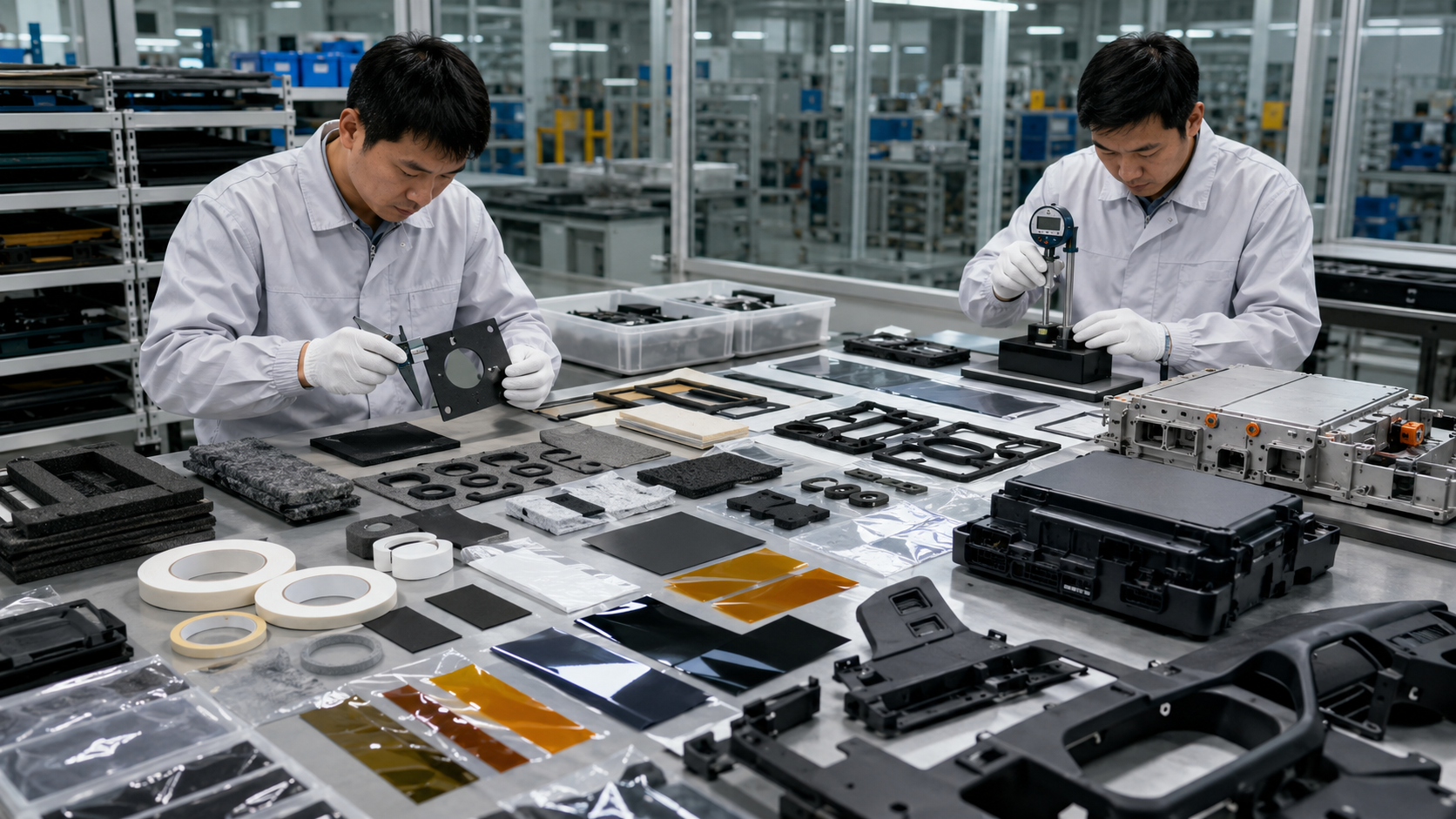
Automotive OEM projects may require dimensional inspection, first article inspection, material confirmation, adhesive checks, liner release review, visual inspection, packaging checks, and batch traceability.
Common inspection items include:
| Inspection Item | Purpose |
|---|---|
| Outer dimensions | Confirms fit |
| Hole alignment | Prevents assembly mismatch |
| Material thickness | Controls compression or insulation |
| Adhesive position | Prevents bonding failure |
| Liner release | Supports assembly efficiency |
| Edge cleanliness | Reduces contamination |
| Foam compression | Confirms sealing or cushioning |
| Rubber hardness | Confirms damping function |
| Felt fiber shedding | Reduces contamination risk |
| Packaging condition | Prevents deformation and damage |
Higher inspection requirements add time, labor, and documentation cost. However, proper inspection helps reduce customer-side rejection and production delays.
11. Packaging and Delivery Format
Packaging is often underestimated, but it can affect both cost and assembly efficiency.
Automotive die cut parts may be delivered as:
- Loose pieces
- Rolls
- Sheets
- Kiss-cut liner sheets
- Tray-packed parts
- Protective bags
- Kitted component sets
- Assembly-ready formats
Soft foam parts should not be over-compressed. Thin PET or PI films should remain flat. Adhesive parts should stay clean and easy to peel. Rubber parts should not deform. Felt parts should be protected from contamination.
Better packaging may increase unit cost slightly, but it can reduce handling time, assembly errors, and incoming quality issues.
12. Supplier Engineering Support
A supplier that only quotes based on drawing size may miss important risks.
A strong die cutting partner should review:
- Application function
- Material choice
- Adhesive structure
- Bonding surface
- Foam compression
- Rubber hardness
- Film thickness
- Felt shedding risk
- Tolerance requirements
- Tooling method
- Assembly process
- Packaging format
- Inspection standards
Engineering review may not always reduce the first quotation, but it can reduce repeated samples, tooling changes, assembly failure, and long-term quality cost.
How Sanken Helps Control Cost Without Sacrificing Quality
Sanken Manufacturing Co., Ltd. supports automotive OEM customers with custom die cut and converted components.
Our support includes:
- Automotive foam gaskets
- Non-woven felt NVH parts
- Adhesive-backed felt strips
- PET and PI insulation films
- Protective films
- Double-sided tape components
- Rubber damping pads
- Sealing components
- Light-blocking films
- Multilayer laminated parts
- Sample development
- Quality inspection
- Assembly-ready packaging
For each project, we review material function, thickness, adhesive structure, tolerance, tooling method, edge quality, liner release, packaging, and final assembly requirements.
Our goal is to help customers avoid unnecessary cost while maintaining reliable performance in automotive OEM manufacturing.
Buyer Checklist Before Requesting a Quote
To receive a more accurate quotation, buyers should provide:
- 2D drawing
- Material requirement
- Thickness requirement
- Adhesive requirement
- Application area
- Bonding surface
- Critical dimensions
- Tolerance requirements
- Cleanliness requirement
- Packaging preference
- Expected quantity
- Annual demand estimate
- Sample or reference part if available
- Testing or inspection requirements
Clear information helps the supplier recommend a practical material and process instead of quoting blindly.
Conclusion
The cost of automotive die cut parts in OEM manufacturing depends on much more than part size. Material type, thickness, adhesive structure, shape complexity, tolerance, tooling, production volume, waste, cleanliness, inspection, packaging, and engineering support all affect the final price.
For OEM buyers, the best goal is not simply to find the lowest quotation. The better goal is to choose a die cutting solution that balances cost, quality, assembly efficiency, and long-term reliability.
At Sanken, we help automotive OEM customers develop die cut foam, felt, rubber, film, tape, and multilayer components that are practical, accurate, clean, assembly-ready, and stable from prototype to mass production.