
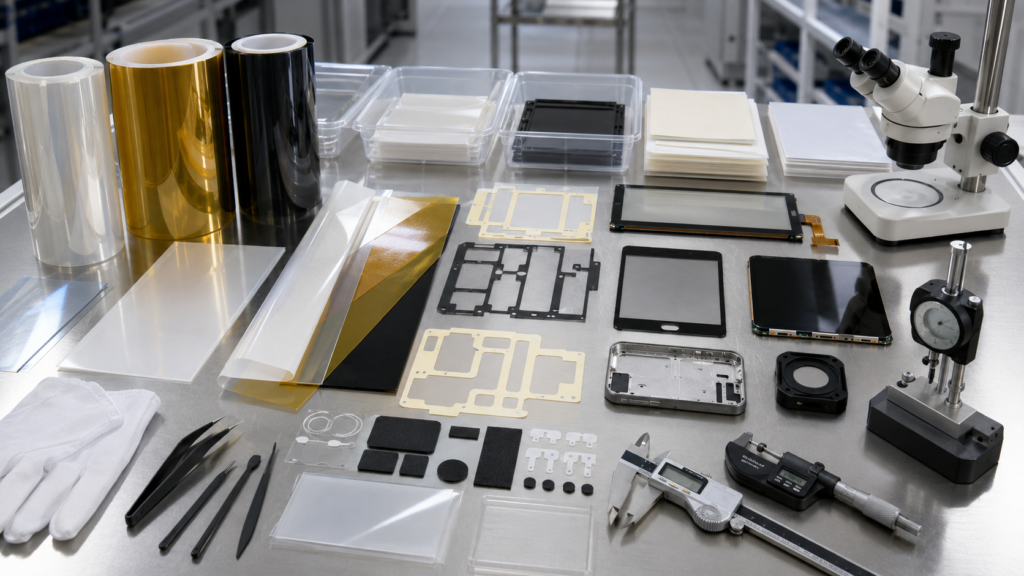
Precision die cutting supports optical films, protective films, and display modules by converting thin functional materials into clean, accurate, assembly-ready components. In display manufacturing, even a small film part can affect bonding quality, surface protection, optical clarity, insulation, light control, and final assembly yield.
For OEM engineers and purchasing teams, die cut films are not only simple plastic sheets. They often require tight dimensional control, clean edges, dust prevention, stable liner release, accurate window alignment, adhesive control, and proper packaging. If these details are not managed well, display modules may face scratches, bubbles, adhesive overflow, light leakage, poor fit, or inspection failure.
At Sanken, we support OEM customers with precision die cutting, adhesive lamination, PET and PI insulation films, protective films, light-blocking films, double-sided adhesive tape parts, OCA-related adhesive structures, foam spacers, rubber pads, liner-backed parts, and multilayer converted components for display modules, optical modules, sensors, automotive displays, consumer electronics, and industrial devices.
Why Precision Die Cutting Matters for Display Modules
Display modules are compact layered assemblies. A typical module may include cover glass, touch panel, LCD or OLED structure, backlight unit, optical films, sensor windows, camera openings, adhesive layers, insulation films, foam spacers, rubber pads, and protective films.
Precision die cutting helps each material fit the correct position.
It supports:
- Accurate outer profiles
- Clean optical windows
- Stable adhesive frames
- Consistent insulation film shapes
- Protective film tabs and windows
- Light-blocking borders
- Foam spacer alignment
- Rubber pad positioning
- Liner-backed assembly formats
- Clean packaging for production use
In display modules, cutting accuracy is important, but it is not the only requirement. Cleanliness, flatness, adhesive behavior, and liner release are also critical.
Optical Films Need Clean and Accurate Conversion
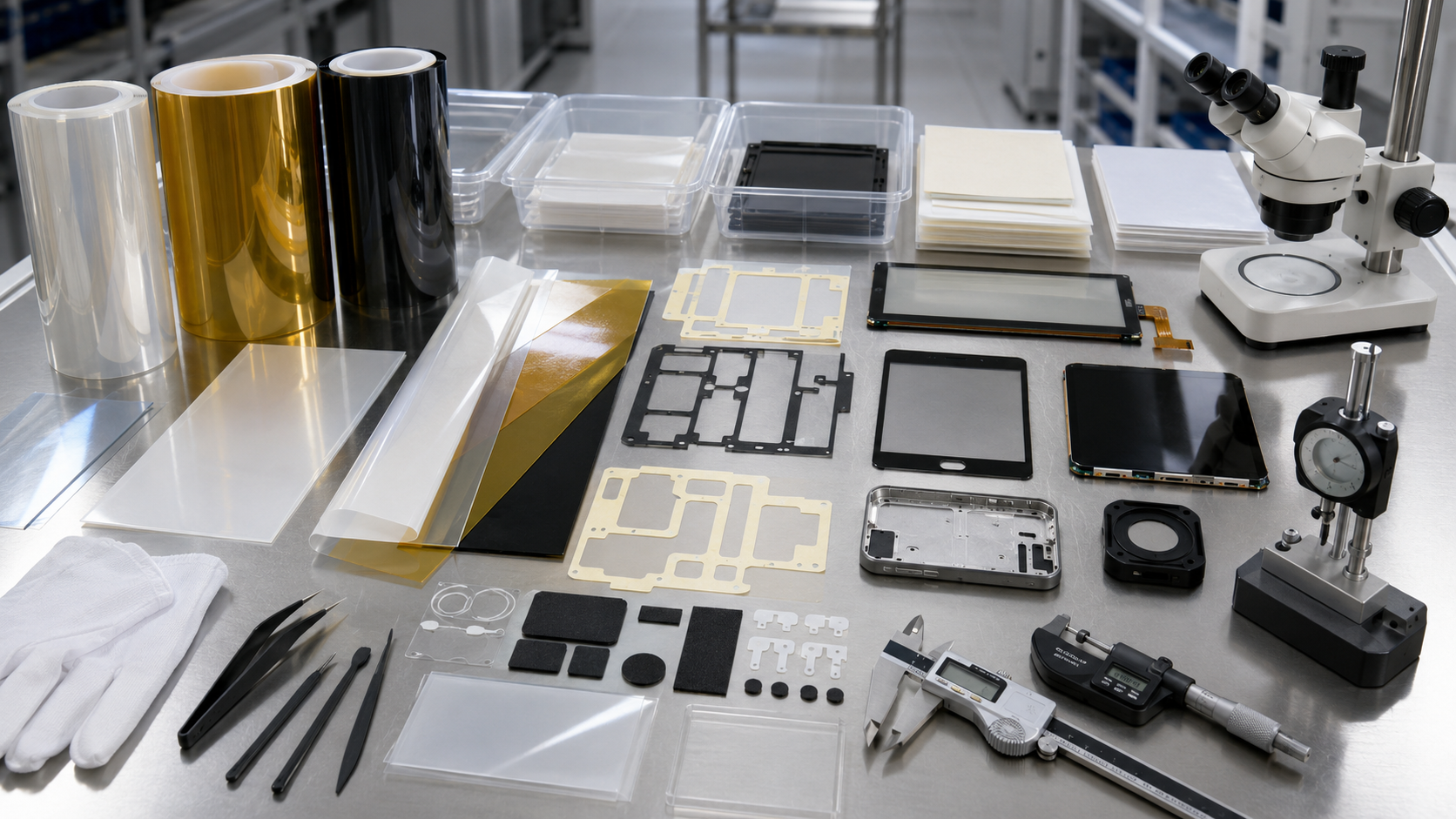
Optical films are used in display and sensor-related assemblies where light transmission, light blocking, clarity, or visual appearance matters.
Common optical film-related parts include:
| Material or Part | Common Function |
|---|---|
| Transparent PET film | Protection, spacing, support |
| OCA-related adhesive film | Transparent bonding |
| Black light-blocking film | Reduces light leakage |
| Protective film | Prevents scratches and dust |
| Adhesive film frame | Bonds display layers or frames |
| Release liner film | Supports clean handling |
| Multilayer film structure | Combines bonding, protection, and insulation |
These parts may be used around display borders, touch panels, camera holes, sensor windows, backlight structures, optical lenses, or automotive display frames.
A small misalignment can block an optical area or leave a gap that causes light leakage. A small particle can become visible after bonding. A scratch can cause display rejection. This is why optical film die cutting requires both precision and clean handling.
Protective Films Prevent Surface Damage
Protective films are used to protect display glass, touch panels, coated surfaces, plastic frames, optical windows, and finished modules during production, transport, and assembly.
A good protective film should:
- Apply smoothly
- Stay stable during handling
- Remove cleanly
- Leave no residue
- Avoid bubbles
- Avoid scratches
- Match the display shape
- Include tabs or windows if needed
- Maintain clean surface quality
Precision die cutting allows protective films to be supplied in custom shapes with holes, windows, tabs, or extended liners. These details improve assembly efficiency and reduce operator handling problems.
For example, a protective film with a pull tab can be removed more easily. A film with accurate windows can protect sensitive areas without covering functional openings. A liner-backed format can help operators peel and apply the part consistently.
Light-Blocking Films Help Control Display Appearance
Light leakage is a common issue in display modules, camera openings, sensor windows, LED areas, and backlight edges. Black light-blocking films and shading adhesive parts are used to control unwanted light.
These materials may be used around:
- Display borders
- Backlight edges
- Camera holes
- Sensor openings
- Touch panel frames
- Automotive display bezels
- Wearable optical windows
- LED light paths
Precision die cutting is important because the light-blocking part must match the optical area. If the part is too narrow, light leakage may remain. If it is too wide, it may block the active display or sensor window.
Clean edges are also important. Rough film edges may create particles or interfere with bonding.
Adhesive Film Frames Require Process Control
Many display module parts use adhesive-backed films or double-sided tape frames. These parts bond glass, plastic frames, metal frames, touch panels, backlight units, sensor windows, or display housings.
Important control points include:
| Control Point | Why It Matters |
|---|---|
| Adhesive thickness | Controls bonding gap and flatness |
| Die cut accuracy | Ensures frame and window alignment |
| Adhesive overflow | Prevents contamination |
| Liner release | Supports smooth application |
| Kiss cutting depth | Prevents liner damage |
| Edge cleanliness | Reduces particles and adhesive strings |
| Surface compatibility | Prevents lifting or bonding failure |
| Packaging flatness | Reduces curling and bubbles |
Adhesive parts may fail even when their dimensions look correct. Poor liner release, adhesive strings, dust, curling, or weak bonding can slow assembly and increase rejection.
Sanken reviews adhesive structure, bonding surface, liner selection, cutting method, and packaging format before mass production.
PET and PI Insulation Films Support Electronics Inside Displays
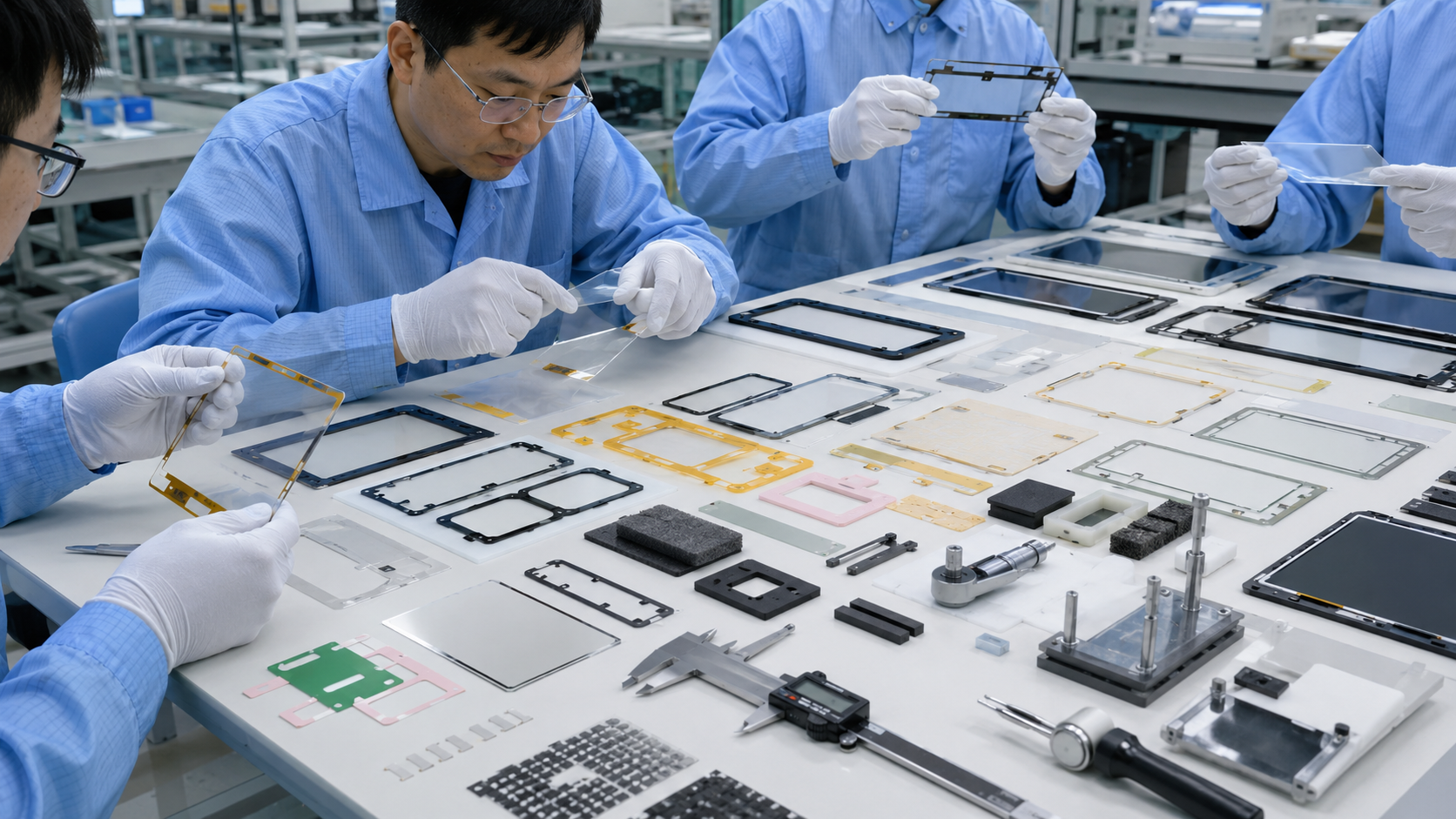
Display modules often include flexible circuits, connectors, PCB areas, sensors, and compact electronic structures. PET and PI films are commonly used for electrical insulation and protection.
PET film is often used for general insulation, spacing, backing, and protective structures. PI film is used when higher temperature resistance or stronger insulation performance is required.
Common applications include:
- Connector insulation
- Flexible circuit protection
- PCB area protection
- Display module insulation
- Battery-related display electronics
- Automotive display electronics
- Sensor module insulation
- Thin protective layers
For PET and PI die cut parts, hole alignment and edge quality are especially important. Burrs, particles, rough edges, or misaligned holes can create assembly risks in compact electronic modules.
Foam Spacers and Rubber Pads Work With Films
Display modules often use film, adhesive, foam, and rubber components together.
Foam spacers may provide cushioning, gap filling, dust sealing, or compression support. Rubber pads may provide damping, shock absorption, or stable contact. These components are often placed near optical films, protective films, adhesive frames, or plastic housings.
Examples include:
| Component | Function in Display Module |
|---|---|
| Foam spacer | Maintains gap and cushions fragile parts |
| Foam gasket | Helps seal dust-sensitive areas |
| Rubber pad | Supports damping and shock absorption |
| PET film | Provides insulation and spacing |
| Protective film | Prevents scratches during handling |
| Adhesive tape frame | Bonds and positions layers |
| Black film | Controls light leakage |
If these parts are designed separately, assembly problems may appear later. A foam spacer may be too thick. A protective film may curl. A PET film may not align with posts. An adhesive frame may interfere with a rubber pad.
A complete converting review helps reduce these risks.
Cleanliness Is Critical
Display and optical module parts are sensitive to dust, fibers, scratches, static, and adhesive contamination.
Common contamination risks include:
- Dust on film surfaces
- Particles from rough edges
- Adhesive strings
- Scratches from stacking
- Static attraction
- Fingerprints
- Liner debris
- Foam dust
- Felt fibers near optical areas
- Poor packaging cleanliness
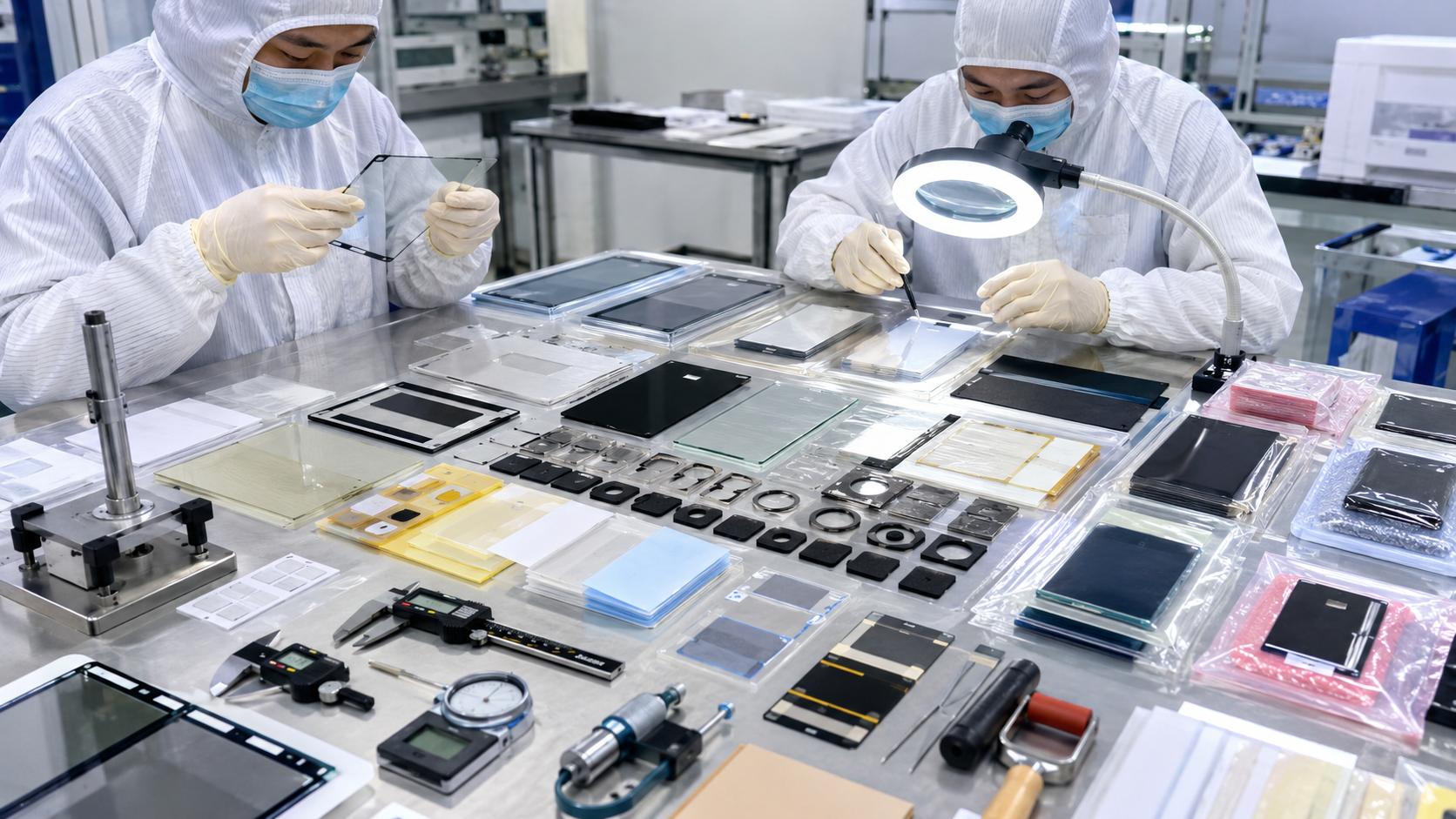
Precision die cutting for display-related materials should include clean material handling, suitable tooling, stable waste removal, surface inspection, anti-static handling, and protective packaging.
For visible display areas and transparent adhesive parts, cleanliness can directly affect final product acceptance.
Packaging Protects the Part Before Assembly
Packaging is not only for shipping. It protects die cut films and adhesive parts before they reach the assembly line.
Good packaging helps prevent:
- Film curling
- Surface scratches
- Dust contamination
- Adhesive edge damage
- Liner shifting
- Foam compression
- Rubber deformation
- Mixed parts
- Poor operator handling
Common delivery formats include sheets, rolls, liner-backed parts, trays, protective bags, and assembly-ready kits.
Thin optical films and transparent adhesive parts need packaging that keeps them flat and clean. Foam and rubber parts should not be compressed in a way that affects their function. Adhesive frames should remain protected until application.
Key Quality Control Items
Quality control should match the function of the display material.
| Inspection Item | Purpose |
|---|---|
| Outer dimension | Confirms module fit |
| Hole alignment | Matches posts, screws, connectors, or fixtures |
| Optical window position | Prevents display or sensor interference |
| Material thickness | Controls spacing and bonding gap |
| Film flatness | Reduces bubbles and lifting |
| Surface scratches | Protects display appearance |
| Dust and particles | Reduces visual defects |
| Edge cleanliness | Prevents contamination |
| Adhesive overflow | Avoids bonding problems |
| Liner release | Improves application efficiency |
| Foam compression | Confirms spacing support |
| Packaging condition | Protects parts before use |
Critical-to-quality points should be confirmed before sampling. For display projects, these may include optical windows, active display areas, sensor openings, adhesive borders, connector clearances, visible surfaces, and bonding areas.
Common Problems and Prevention Methods
| Problem | Possible Cause | Prevention |
|---|---|---|
| Bubbles | Dust, poor flatness, wrong adhesive | Improve cleanliness and adhesive selection |
| Light leakage | Incorrect black film size | Review optical border and tolerance |
| Scratches | Poor handling or packaging | Use clean handling and protective packaging |
| Adhesive overflow | Wrong cutting depth or adhesive structure | Control lamination and die cutting |
| Poor liner release | Wrong liner or kiss cut depth | Review liner and tab design |
| Film curling | Material stress or poor storage | Control material and packaging |
| Misalignment | Poor registration or tooling | Define critical dimensions early |
| Particles | Rough edge or poor waste removal | Use suitable tooling and clean inspection |
Most display film problems can be reduced before mass production through drawing review, material selection, sample validation, cleanliness control, and packaging design.
How Sanken Supports Display Module Die Cutting Projects
Sanken Manufacturing Co., Ltd. supports OEM customers with precision die cut optical films, protective films, adhesive parts, foam spacers, rubber pads, and related display module materials.
Our support includes:
- PET insulation films
- PI insulation films
- Protective films
- Black light-blocking films
- OCA-related adhesive structures
- Double-sided tape frames
- Foam spacers and gaskets
- Rubber pads
- Release liner structures
- Multilayer laminated components
- Adhesive lamination
- Kiss cutting and through cutting
- Sample development
- Quality inspection
- Assembly-ready packaging
For each project, we review material function, thickness, adhesive structure, optical window position, bonding surface, liner release, edge cleanliness, dust risk, packaging method, and final assembly process.
Our goal is to help customers reduce bubbles, light leakage, scratches, adhesive lifting, poor liner release, dust contamination, film curling, misalignment, repeated sampling, and unstable mass production.
What Buyers Should Provide Before Starting a Project
To develop reliable precision die cut films for display modules, buyers should provide:
- 2D drawing
- Display module application
- Film material requirement
- Adhesive requirement
- Thickness requirement
- Optical window position
- Display active area information
- Bonding surface
- Critical dimensions
- Cleanliness requirement
- Liner preference
- Packaging format
- Assembly method
- Expected quantity
- Sample or reference part if available
Clear information helps the supplier choose the correct material, cutting method, liner design, and packaging format.
FAQ
How does precision die cutting support optical films?
Precision die cutting converts optical films into accurate shapes with clean windows, controlled edges, stable dimensions, and assembly-ready formats for display and optical modules.
What protective films are used in display modules?
Protective films are used on display glass, touch panels, lens covers, coated surfaces, plastic frames, and finished modules to prevent scratches, dust, fingerprints, and handling damage.
Why are light-blocking films die cut?
Light-blocking films need accurate borders and windows to reduce light leakage without blocking active display areas, camera holes, or sensor openings.
Why is liner release important for adhesive display parts?
Good liner release helps operators peel and apply adhesive parts smoothly without stretching the film, damaging adhesive edges, or causing misalignment.
What materials can Sanken die cut for display modules?
Sanken supports PET films, PI films, protective films, light-blocking films, adhesive tapes, OCA-related adhesive structures, foam spacers, rubber pads, release liners, and multilayer converted components.
Why is cleanliness important in display module die cutting?
Dust, scratches, particles, adhesive strings, and fibers can cause bubbles, visible defects, light leakage, poor bonding, or final inspection failure.
Conclusion
Precision die cutting plays an important role in optical films, protective films, and display module assembly. It helps convert thin functional materials into clean, accurate, easy-to-apply components that support bonding, insulation, light control, surface protection, spacing, cushioning, and assembly efficiency.
For OEM display projects, successful die cutting requires more than accurate shape cutting. It also requires clean material handling, adhesive control, liner release review, edge quality control, film flatness, packaging protection, and final assembly understanding.
At Sanken, we help OEM customers develop precision die cut optical films, protective films, adhesive parts, foam spacers, rubber pads, and multilayer materials that are clean, accurate, assembly-ready, and stable from prototype to mass production.