
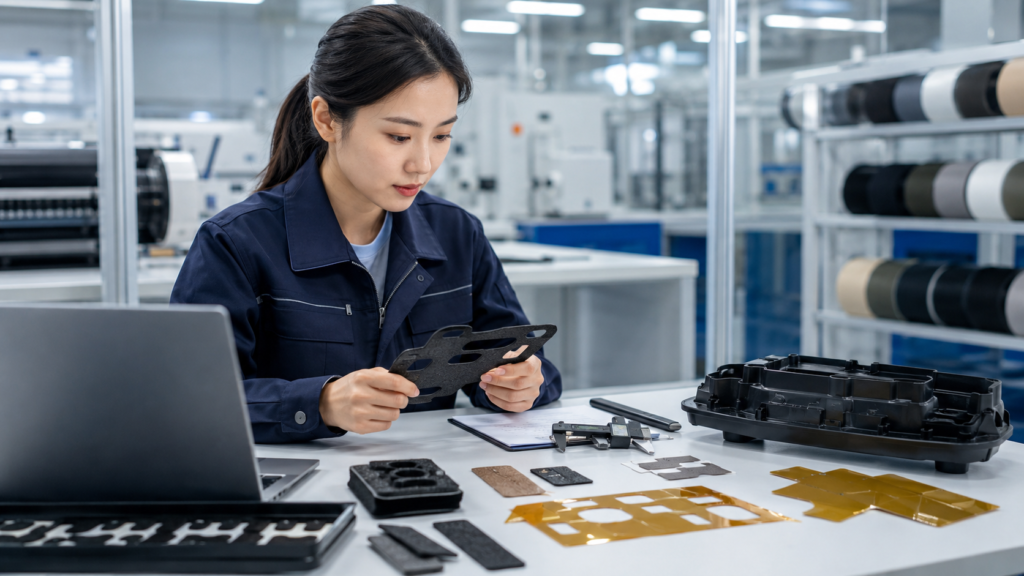
Automotive manufacturers are under constant pressure to improve performance while reducing cost.
They need quieter cabins, lighter materials, better sealing, and higher assembly efficiency.
But in real projects, I often see one hidden problem.
Material instability in nonwoven supply chains.
When nonwoven materials come from external suppliers, even small variations can create big problems in die cut automotive parts.
At Sanken, we solve this problem differently.
We control nonwoven production in-house.
And this changes everything.
Why Nonwoven Materials Are Critical in Automotive Die Cut Parts
Nonwoven materials are not simple fillers.
They are functional engineering materials used in:
- NVH noise reduction systems
- Interior vibration damping
- Air and dust sealing
- Battery insulation layers
- Wire harness protection
- Thermal separation layers
- Interior surface protection
If the material fails, the system fails.
Even small variation can lead to:
- noise issues
- sealing failure
- vibration increase
- assembly mismatch
- product rejection
This is why OEMs struggle with consistency.
The Real Problem: External Nonwoven Supply Variation
When nonwoven is outsourced:
- different suppliers = different fiber structure
- different batches = different density
- different processing = different compression behavior
Even if drawings are identical, performance is not.
This creates hidden risks in automotive production.
Theme: Automotive Nonwoven Die Cut Materials

How In-House Nonwoven Production Changes the Game
At Sanken, we produce nonwoven materials internally.
This gives us full control over:
- fiber structure
- density distribution
- bonding strength
- thickness consistency
- roll stability
- compression behavior
So die cutting starts from a stable base material, not a variable one.
1. Improved Die Cut Precision
Stable material = stable cutting results.
We control:
- fiber alignment
- roll tension
- bonding temperature
- curing process
This results in:
- cleaner edges
- stable geometry
- consistent thickness
- better dimensional accuracy
2. Better NVH Performance Stability
NVH performance depends on material behavior.
We control:
- damping characteristics
- compression response
- vibration absorption
- rebound stability
Result:
- consistent cabin comfort
- stable acoustic performance
- reduced noise variation
3. Stronger Adhesive Lamination Performance
Many automotive die cut parts are multi-layer structures:
- nonwoven + adhesive
- nonwoven + foam
- nonwoven + PET film
If nonwoven is unstable:
- adhesive bonding weakens
- delamination risk increases
- bubbles appear
With in-house production:
- surface energy is controlled
- porosity is optimized
- bonding stability improves
Theme: Automotive NVH Die Cut Applications

4. Faster Automotive Development Cycles
Time is critical in automotive programs.
External sourcing causes:
- long sampling cycles
- supplier delays
- material mismatch re-testing
In-house production allows:
- faster material adjustment
- faster sampling
- direct engineering changes
Result:
👉 30–50% faster development cycles
5. Lower Total Project Cost
Even if in-house production seems expensive, total cost is lower.
Because we reduce:
- scrap rate
- rework cost
- assembly failure cost
- material mismatch loss
Better stability = less waste.
6. Full Automotive Traceability (IATF-Level Control)
We support automotive-grade traceability:
- raw fiber batch tracking
- production parameter records
- roll-to-roll identification
- die cut batch control
This aligns with:
- IATF 16949 requirements
- ISO 9001 systems
7. Better Compression Set Control
Compression stability is critical for automotive parts.
We control:
- fiber density
- thermal bonding structure
- elasticity recovery
Result:
- stable long-term sealing
- reduced deformation
- improved durability
Automotive Applications We Support
Interior Systems
- NVH insulation pads
- door trim damping
- dashboard noise control
Electrical Systems
- wire harness protection
- ECU insulation
- connector isolation
EV Battery Systems
- insulation layers
- vibration pads
- thermal barriers
Sealing Systems
- dust sealing layers
- multi-layer gasket support
Why OEMs Prefer Integrated Suppliers
Modern OEMs do not just want suppliers.
They want control + stability + speed.
In-house nonwoven production provides:
- stable materials
- stable die cutting
- stable assembly behavior
- stable supply chain
This is the real value.
How Sanken Supports Automotive Die Cut Projects
At Sanken (三肯), we combine:
- in-house nonwoven production
- precision die cutting
- foam and rubber converting
- adhesive lamination
- multi-layer assembly
- automotive PPAP support
We serve:
- automotive OEMs
- Tier 1 suppliers
- EV battery manufacturers
- interior system suppliers
Featured Snippet Summary
In-house nonwoven production improves automotive die cut performance by stabilizing material properties, improving NVH behavior, enhancing adhesive bonding, reducing development time, lowering total cost, and ensuring automotive-grade traceability.
Conclusion
Automotive die cut performance does not start at cutting.
It starts at the material level.
With in-house nonwoven production, we ensure:
- stable material behavior
- consistent NVH performance
- reliable adhesive bonding
- faster development cycles
- lower total cost
That is why OEMs choose integrated manufacturing partners like Sanken.
👉 Stability is not optional in automotive manufacturing.
It is the foundation.