
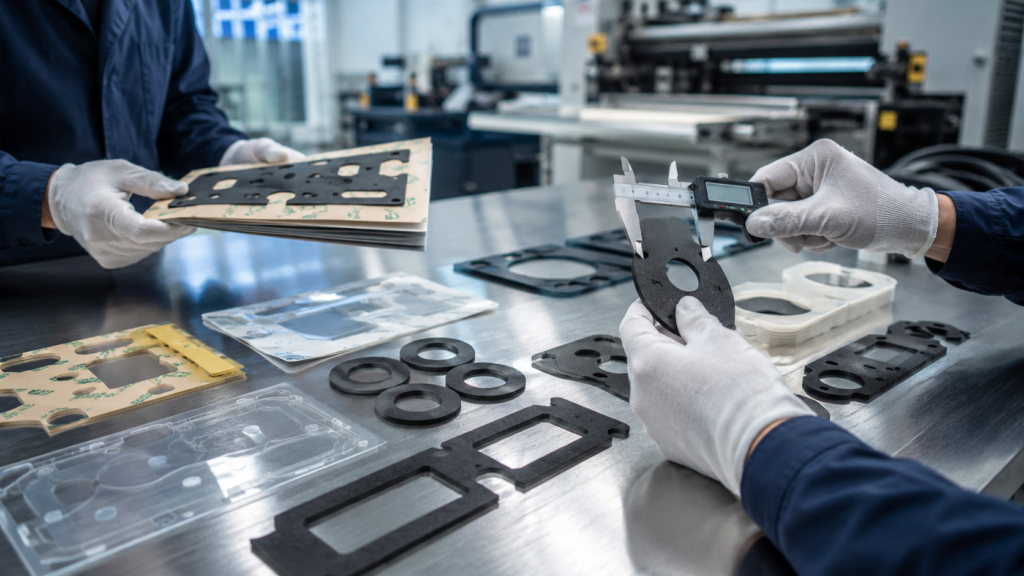
What Should Buyers Check Before Ordering Custom Die Cut Parts from a Manufacturer?
Ordering custom die cut parts looks easy until the first batch fails. The drawing seems clear. The sample looks fine. Then mass production starts, and problems appear: loose tolerances, adhesive overflow, rough edges, wrong material behavior, poor fit, or delayed delivery. I have seen buyers lose weeks because they checked price first and engineering details last ([custom die cut parts guide](placeholder link)).
Before ordering custom die cut parts, buyers should check the material, tolerance, adhesive structure, tooling plan, sample verification, quality inspection method, packaging format, and supplier’s mass production capability. A reliable die cutting manufacturer should not only cut parts according to a drawing. It should help you prevent sealing failure, bonding problems, assembly delays, and unnecessary cost before production begins. At Sanken, we focus on solving these risks early.
A cheap quotation can be tempting. I understand that. But in OEM manufacturing, the lowest price often becomes the most expensive lesson.
Why Should Buyers Review the Application Before Asking for a Quote?
Before we quote a custom die cut part, we always want to understand the real application.
Not just the shape.
Not just the thickness.
Not just the material name.
We want to know what the part must do.
Is it used for sealing?
Bonding?
Insulation?
Cushioning?
Vibration reduction?
EMI shielding?
Thermal protection?
A foam pad used inside automotive interiors is different from a PET insulation film used inside electronics. A rubber gasket used for waterproof sealing is different from an adhesive tape part used for quick assembly.
If the supplier does not understand the application, the quote may look fast, but the risk is high.
What Material Should Buyers Confirm First?
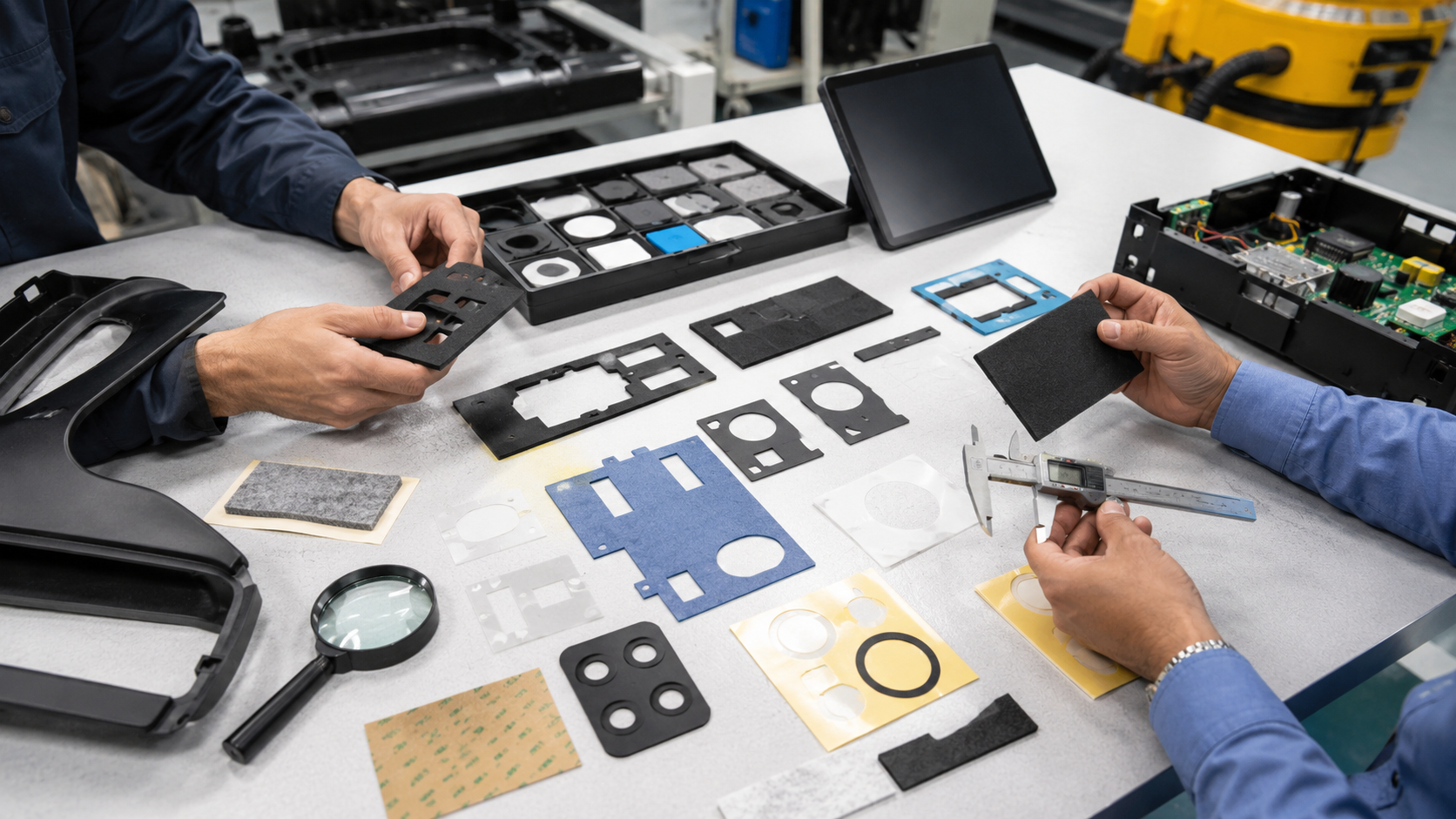
Material selection is one of the biggest factors behind die cut part performance.
Buyers should confirm:
- Material type
- Thickness
- Density
- Hardness
- Compression behavior
- Temperature resistance
- Aging performance
- Flame resistance
- Adhesive compatibility
At Sanken, we process materials such as foam, rubber, PET film, non-woven fabric, silicone, conductive materials, double-sided tape, and protective films.
Each material behaves differently during die cutting.
Foam compresses.
Film stretches.
Adhesive flows.
Rubber may create burrs.
Non-woven fabric may release fibers.
This is why material experience matters. Many suppliers can cut material. Fewer suppliers understand how that material behaves during production and final use.
What Tolerance Should Buyers Specify?
Tolerance is not a small detail.
It decides whether the part fits correctly.
Before ordering, buyers should confirm:
| Item | Why It Matters |
|---|---|
| Outer dimension | Controls assembly fit |
| Inner opening | Prevents blocking or leakage |
| Hole position | Supports screw or pin alignment |
| Thickness | Affects compression and bonding |
| Adhesive position | Prevents overflow and misalignment |
| Edge quality | Affects sealing and cleanliness |
One good sample does not prove stable mass production.
That is where many suppliers fail.
They can make a nice sample by hand adjustment. But when the quantity becomes 10,000 or 1,000,000 pieces, dimensions begin to drift.
At Sanken, we pay attention to mass production stability, not only sample appearance.
Should Buyers Check Adhesive Structure?
Yes.
Especially for die cut tape parts, foam tape gaskets, bonding pads, protective films, and multilayer materials.
Adhesive failure can cause:
- Edge lifting
- Peeling
- Shifting
- Glue overflow
- Liner damage
- Assembly contamination
- Poor bonding strength
Buyers should confirm the bonding surface before choosing adhesive.
Metal, glass, ABS, PC, PP, PE, silicone rubber, powder-coated surfaces, and painted parts all require different adhesive thinking ([adhesive selection reference](placeholder link)).
At Sanken, we check surface energy, temperature range, peel force, shear force, liner release, and long-term aging requirements.
Sticky is not enough.
Reliable bonding is engineering.
Why Is Tooling Review Important?
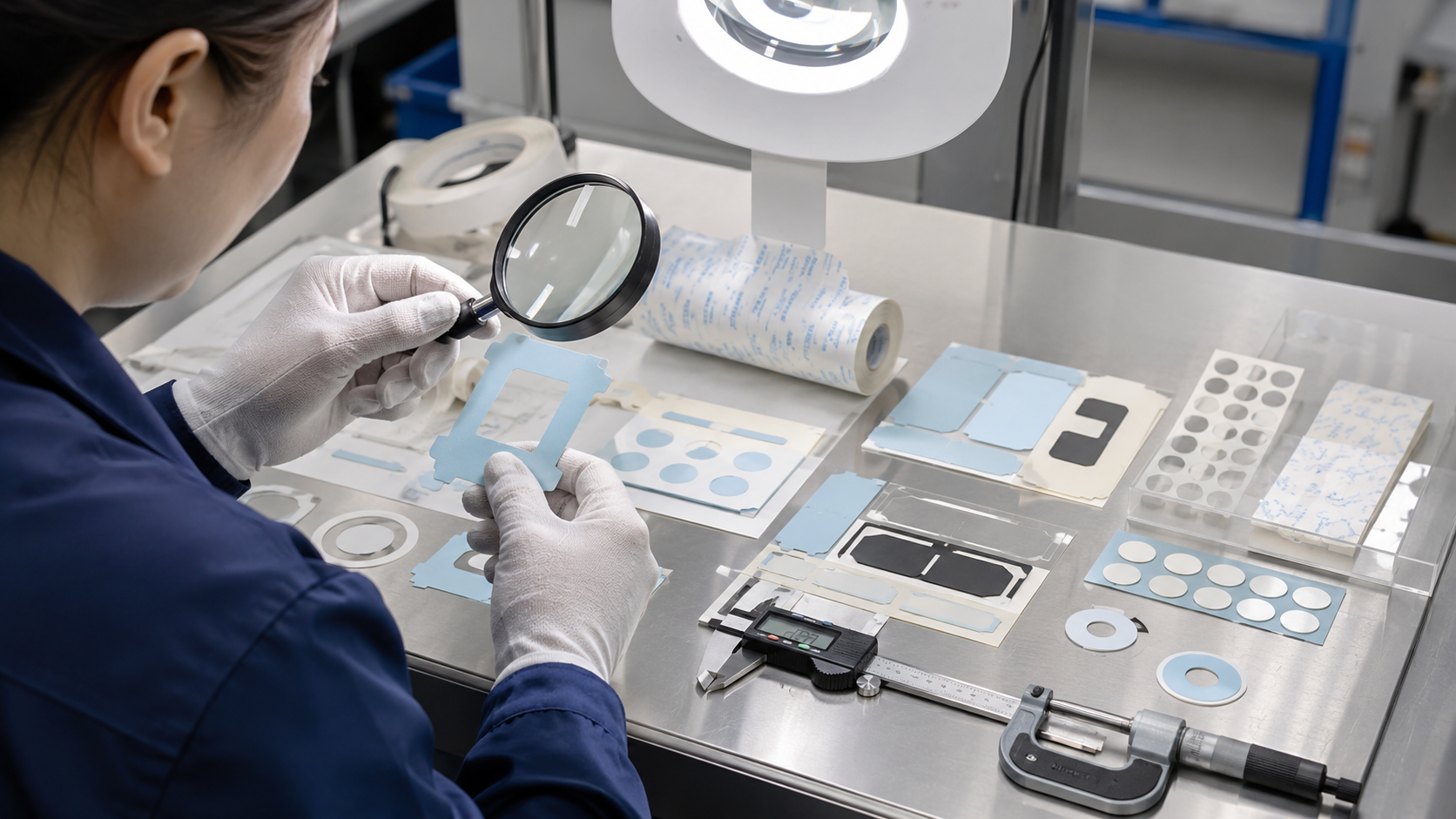
The die tool directly affects cutting quality.
Poor tooling causes:
- Rough edges
- Burrs
- Adhesive dragging
- Material deformation
- Hole misalignment
- Dimensional instability
Buyers should ask whether the supplier will use flatbed die cutting, rotary die cutting, kiss cutting, steel rule dies, precision tooling, or another process.
Different materials need different tooling strategies.
For example, thick foam may require a different process from thin PET film. Adhesive tape may require precise kiss cutting so the tape layer is cut while the release liner stays intact.
At Sanken, we design the tooling process around the material and application. We do not force every part into the same production method.
Should Buyers Request Samples Before Mass Production?
Absolutely.
Skipping samples is like driving at night without headlights. Maybe you arrive safely. Maybe not.
A proper sample process helps verify:
- Material performance
- Cutting accuracy
- Adhesive bonding
- Assembly fit
- Compression behavior
- Liner release
- Packaging method
For custom die cut parts, sample verification is not a waste of time. It is the cheapest insurance before mass production.
At Sanken, we support prototype development, drawing review, material recommendation, sample production, and pre-production verification.
This helps customers avoid repeated tooling changes and production delays.
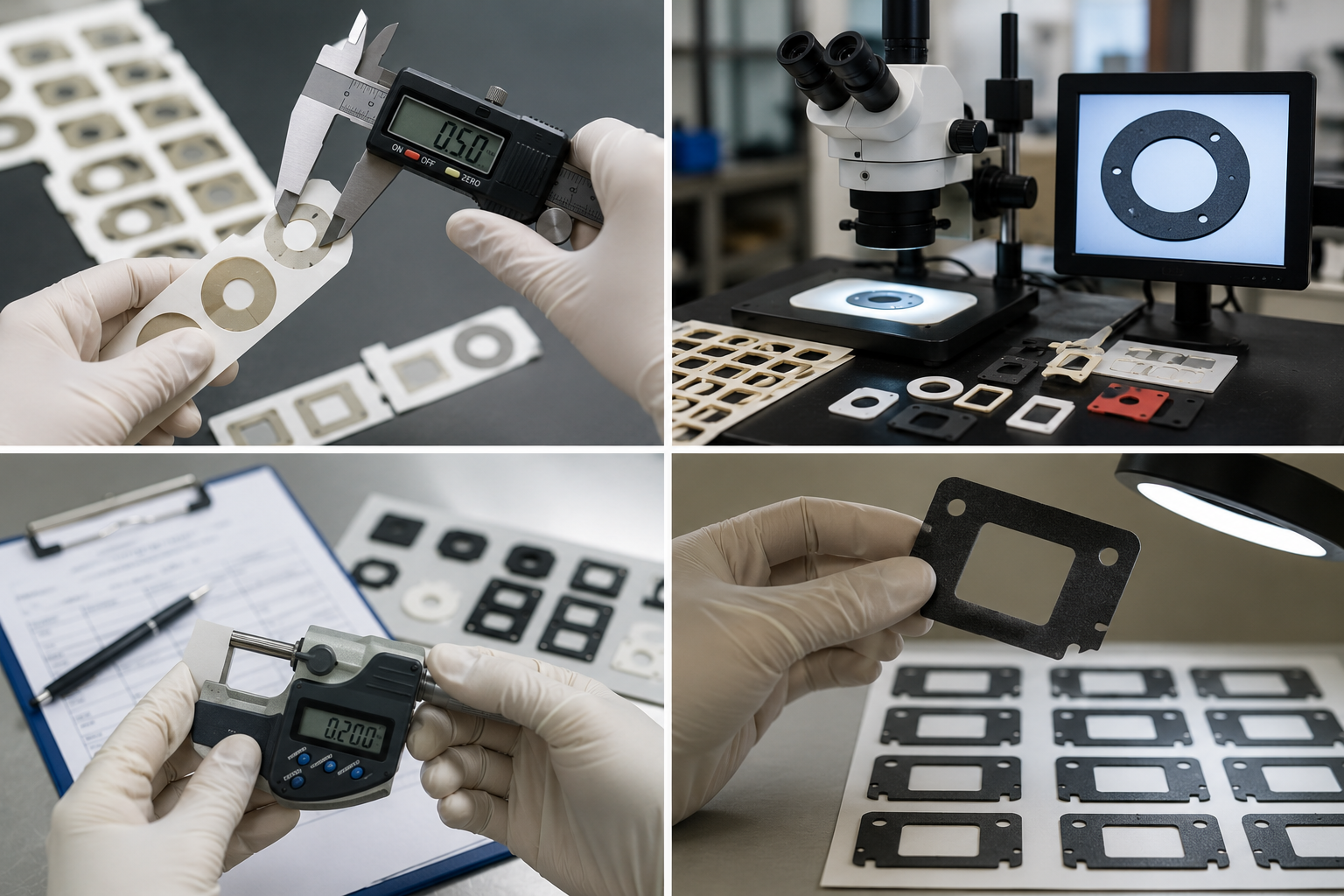
What Quality Inspection Should Buyers Require?
Buyers should not only ask, “Can you make this?”
They should ask, “How do you inspect this?”
Important inspection items include:
- Dimensions
- Thickness
- Hole position
- Edge quality
- Adhesive condition
- Surface cleanliness
- Layer alignment
- Packing condition
For automotive, electronics, medical, and industrial OEM projects, quality inspection must be built into production.
Not added at the end when it is already too late.
At Sanken, our production management follows quality systems such as ISO 9001, ISO 14001, and IATF 16949 where applicable ([quality system reference](placeholder link)).
That helps us support customers who need repeatable quality and stable batch control.
Why Should Buyers Check Packaging and Delivery Format?
Packaging is often ignored.
Then parts arrive curled, dusty, deformed, stuck together, or difficult to use on the assembly line.
Buyers should confirm:
- Sheet or roll format
- Liner type
- Release direction
- Part orientation
- Labeling method
- Packaging quantity
- Moisture protection
- Dust protection
For adhesive die cut parts, packaging affects assembly efficiency.
For foam and rubber parts, packaging affects deformation.
For clean electronic parts, packaging affects contamination control.
At Sanken, we customize delivery formats based on customer assembly needs. Good packaging saves time on the production line.
How Can Buyers Judge Whether a Supplier Is Professional?
A professional die cutting manufacturer should ask questions before quoting.
If a supplier only says, “Send drawing, we make,” be careful.
A serious supplier should ask about:
- Application environment
- Material requirement
- Tolerance requirement
- Adhesive surface
- Quantity and delivery schedule
- Assembly method
- Testing requirement
- Packaging format
These questions are not delays.
They are protection.
They help prevent mistakes before they become expensive.
Why Do OEM Customers Choose Sanken?
At Sanken, we are not just a cutting supplier.
We provide one-stop material converting solutions.
Our capabilities include:
- Precision die cutting
- Rotary die cutting
- Adhesive laminating
- Kiss cutting
- Foam converting
- Rubber converting
- Film converting
- Hot pressing
- Spraying and gluing
- Silk screen printing
- Injection molding support
This matters because many custom die cut parts require more than one process.
If buyers manage many suppliers separately, communication cost increases. When problems happen, each supplier may blame the other.
We prefer one responsible manufacturing system.
That saves time, reduces risk, and makes production easier for OEM customers.
What Information Should Buyers Send for an Accurate Quote?
To receive a serious quote, buyers should prepare:
- 2D or 3D drawing
- Material specification
- Thickness requirement
- Tolerance requirement
- Adhesive requirement
- Application environment
- Annual quantity
- Sample quantity
- Packaging requirement
- Testing requirement
The more complete the information, the more accurate the quote.
A vague inquiry can only create a vague price.
And vague prices usually create future arguments. Nobody enjoys those. I certainly do not.
Conclusion
Before ordering custom die cut parts, buyers should check material, tolerance, adhesive, tooling, samples, inspection, packaging, and supplier capability. At Sanken, we help OEM customers reduce risk, save development time, and build more reliable die cut components through precision manufacturing and material expertise.