
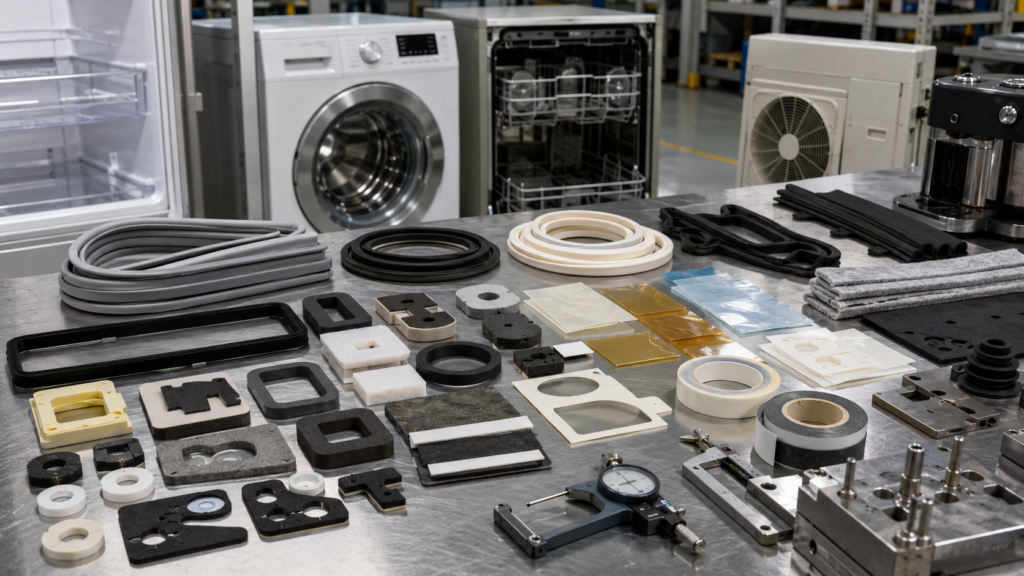
Modern home appliances rely on far more than motors, compressors, electronic controls, and plastic housings. Hidden inside refrigerators, washing machines, dishwashers, air conditioners, coffee machines, water purifiers, microwave ovens, vacuum cleaners, and smart home devices are numerous precision die cut foam, rubber, and adhesive components that improve sealing, reduce vibration, insulate electrical parts, simplify assembly, and protect critical components.
Although these die cut parts are often small and invisible after assembly, they directly influence product quality, operating noise, energy efficiency, durability, and manufacturing consistency.
For OEM engineers and sourcing teams, selecting the right die cut material requires evaluating compression performance, temperature resistance, chemical resistance, adhesive compatibility, dimensional tolerance, and long-term reliability.
At Sanken, we manufacture precision die cut foam gaskets, rubber seals, PET and PI insulation films, adhesive tape components, protective films, non-woven materials, vibration pads, and multilayer laminated parts for household appliances, HVAC equipment, consumer electronics, and industrial products.
Why Home Appliances Need Precision Die Cut Parts
Modern appliances combine mechanical structures, motors, pumps, electronic control boards, displays, sensors, compressors, fans, wiring harnesses, and plastic housings into compact assemblies.
Precision die cut components help provide:
- Water sealing
- Dust sealing
- Air sealing
- Vibration isolation
- Noise reduction
- Electrical insulation
- Thermal insulation
- Component positioning
- Surface protection
- Assembly support
Without properly designed die cut parts, appliances may experience:
- Water leakage
- Dust ingress
- Air leakage
- Increased operating noise
- Excessive vibration
- Electrical failures
- Loose internal components
- Reduced energy efficiency
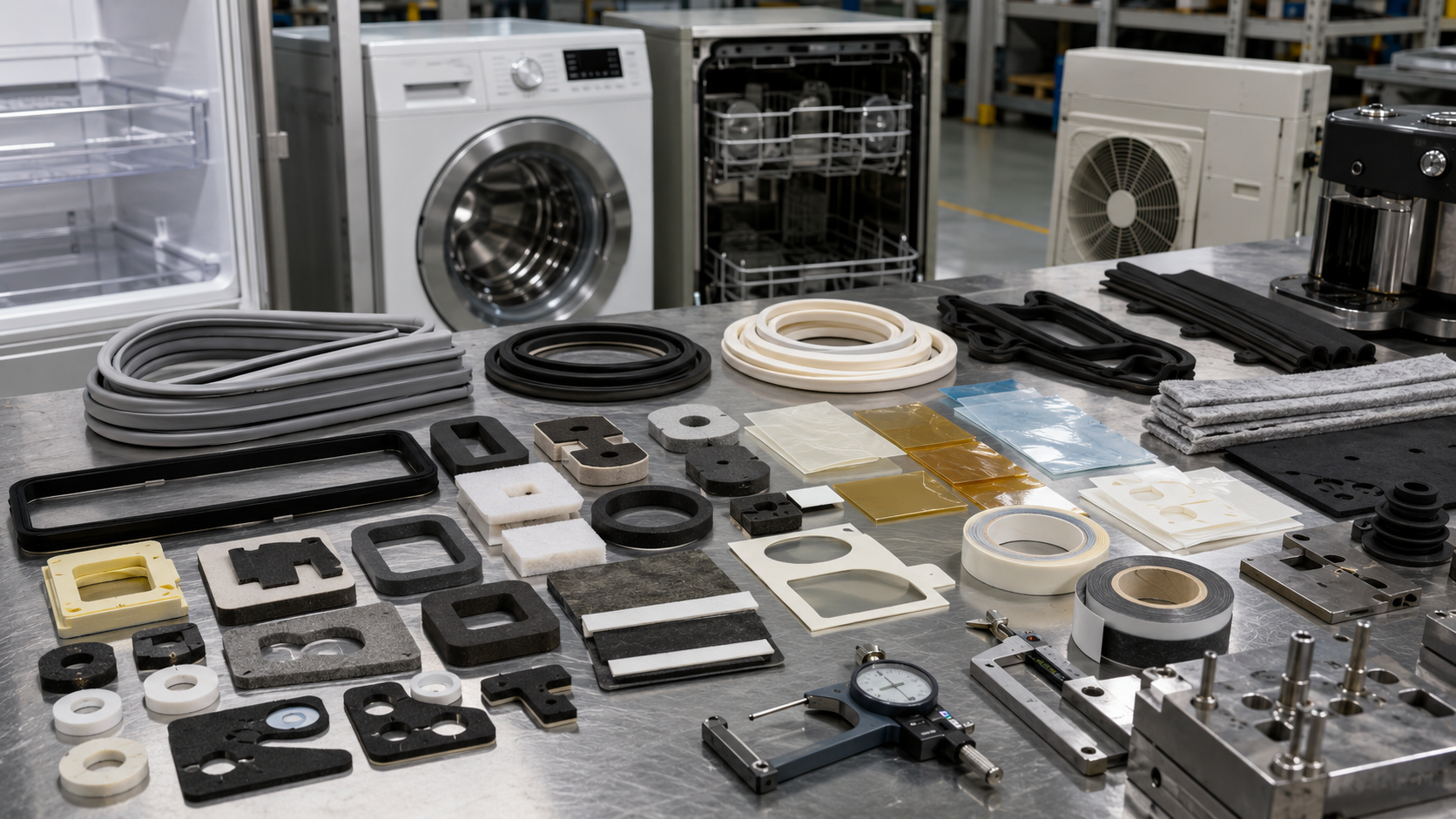
Common Die Cut Materials Used in Home Appliances
Different appliance applications require different material combinations.
| Material | Main Function |
|---|---|
| EVA Foam | Cushioning and sealing |
| PE Foam | Gap filling and vibration reduction |
| EPDM Foam | Waterproof sealing |
| Silicone Foam | High-temperature sealing |
| EPDM Rubber | Long-term environmental sealing |
| Silicone Rubber | Heat-resistant sealing |
| PET Film | Electrical insulation |
| PI Film | High-temperature insulation |
| Double-Sided Adhesive Tape | Bonding and positioning |
| Transfer Adhesive | Thin bonding applications |
| Protective Film | Surface protection |
| Non-Woven Felt | Noise reduction and anti-rattle |
| Multilayer Laminates | Combined sealing and insulation |
Material selection depends on the appliance type, operating temperature, moisture exposure, vibration level, and assembly process.
Foam Gaskets for Sealing and Cushioning
Foam gaskets are among the most common die cut components used in home appliances.
Typical applications include:
- Refrigerator door sealing
- Air conditioner housings
- Washing machine covers
- Dishwasher enclosures
- Water purifier assemblies
- Coffee machine sealing
- Small appliance housings
Foam gaskets provide:
- Air sealing
- Water resistance
- Dust protection
- Compression sealing
- Gap filling
- Vibration cushioning
Common foam materials include:
- EVA foam
- PE foam
- EPDM foam
- Silicone foam
- Polyurethane foam
Selection factors include:
- Thickness
- Density
- Compression set
- Recovery performance
- Water absorption
- Temperature resistance
- Aging resistance
Proper compression allows the gasket to maintain sealing performance throughout the appliance's service life.
Rubber Seals for Long-Term Durability
Rubber die cut parts are selected when higher durability and environmental resistance are required.
Common rubber materials include:
- EPDM rubber
- Silicone rubber
- CR rubber
- NBR
Typical applications include:
- Pump seals
- Water valve seals
- Compressor sealing
- HVAC systems
- Outdoor appliance sealing
- Cable entry sealing
Compared with foam, rubber generally provides:
- Better weather resistance
- Higher chemical resistance
- Longer service life
- Excellent compression recovery
- Better sealing under harsh environments
Engineers should evaluate hardness, thickness, rebound, compression force, and assembly pressure before selecting rubber materials.
Adhesive Tape Components Simplify Assembly
Many appliance manufacturers replace screws, clips, and rivets with precision die cut adhesive components.
Applications include:
- Display mounting
- Decorative panel bonding
- Sensor attachment
- Wire harness fixing
- Foam gasket positioning
- Plastic housing assembly
- Nameplate attachment
Common adhesive materials include:
- Acrylic adhesive
- Double-sided tape
- Foam tape
- Transfer adhesive
- PET carrier tape
The adhesive should match the bonding surface, which may include metal, coated steel, aluminum, ABS, PC, PP, glass, or painted plastic.
Liner release performance is equally important because poor liner removal can slow production and increase assembly errors.
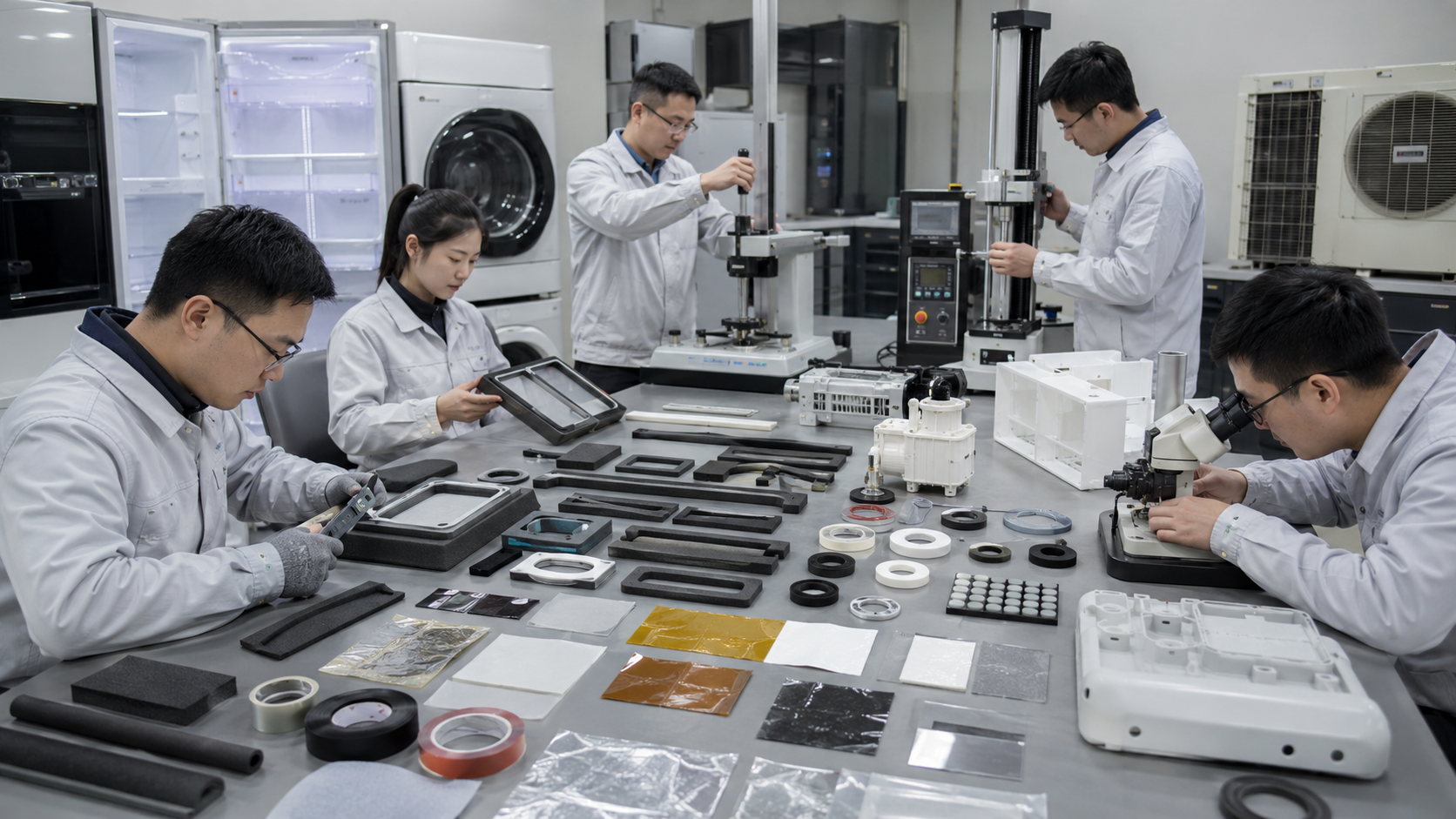
PET and PI Films for Electrical Insulation
Modern appliances contain increasingly complex electronic systems.
PET insulation films are commonly used for:
- PCB insulation
- Connector protection
- Display insulation
- Wire harness protection
- Motor insulation
PI insulation films are selected where higher temperature resistance is required, such as:
- Heating modules
- Power control boards
- High-temperature electronics
- Motor-related components
Both PET and PI films can be supplied with adhesive backing, precision holes, windows, tabs, and multilayer laminated structures.
Non-Woven Felt for Noise Reduction
Consumers expect appliances to operate quietly.
Die cut non-woven felt materials help reduce:
- Plastic-to-plastic contact noise
- Metal contact noise
- Cable rattling
- Fan vibration
- Motor vibration
- Cabinet resonance
Typical applications include:
- Washing machines
- Refrigerators
- Dishwashers
- Air conditioners
- Vacuum cleaners
Non-woven materials provide excellent sound absorption while remaining lightweight and easy to convert.
Protective Films for Surface Protection
Protective films prevent scratches, fingerprints, dust, and handling damage during appliance manufacturing and transportation.
Common applications include:
- Stainless steel panels
- Glass displays
- Plastic housings
- Decorative trim
- Painted metal surfaces
- Appliance control panels
A good protective film should provide stable adhesion during production and clean removal without adhesive residue before final delivery.
Multilayer Die Cut Components
Many appliance components combine multiple materials into one die cut part.
Examples include:
| Structure | Function |
|---|---|
| Foam + Adhesive | Sealing and positioning |
| PET + Adhesive + Liner | Electrical insulation |
| Rubber + Adhesive | Damping and mounting |
| Protective Film + Pull Tab | Surface protection |
| Non-Woven + Adhesive | Noise reduction |
| PI Film + Adhesive | High-temperature insulation |
Multilayer converting reduces assembly time while improving consistency and positioning accuracy.
Quality Control for Appliance Die Cut Parts
Reliable appliance components require strict inspection before shipment.
Key inspection items include:
| Inspection Item | Purpose |
|---|---|
| Material verification | Confirms approved material |
| Thickness | Controls sealing and compression |
| Dimensions | Ensures assembly fit |
| Hole alignment | Matches product structure |
| Adhesive position | Improves bonding accuracy |
| Compression recovery | Confirms long-term sealing |
| Edge cleanliness | Prevents contamination |
| Surface quality | Maintains appearance |
| Packaging condition | Prevents shipping damage |
Stable production quality helps reduce assembly defects and warranty claims.
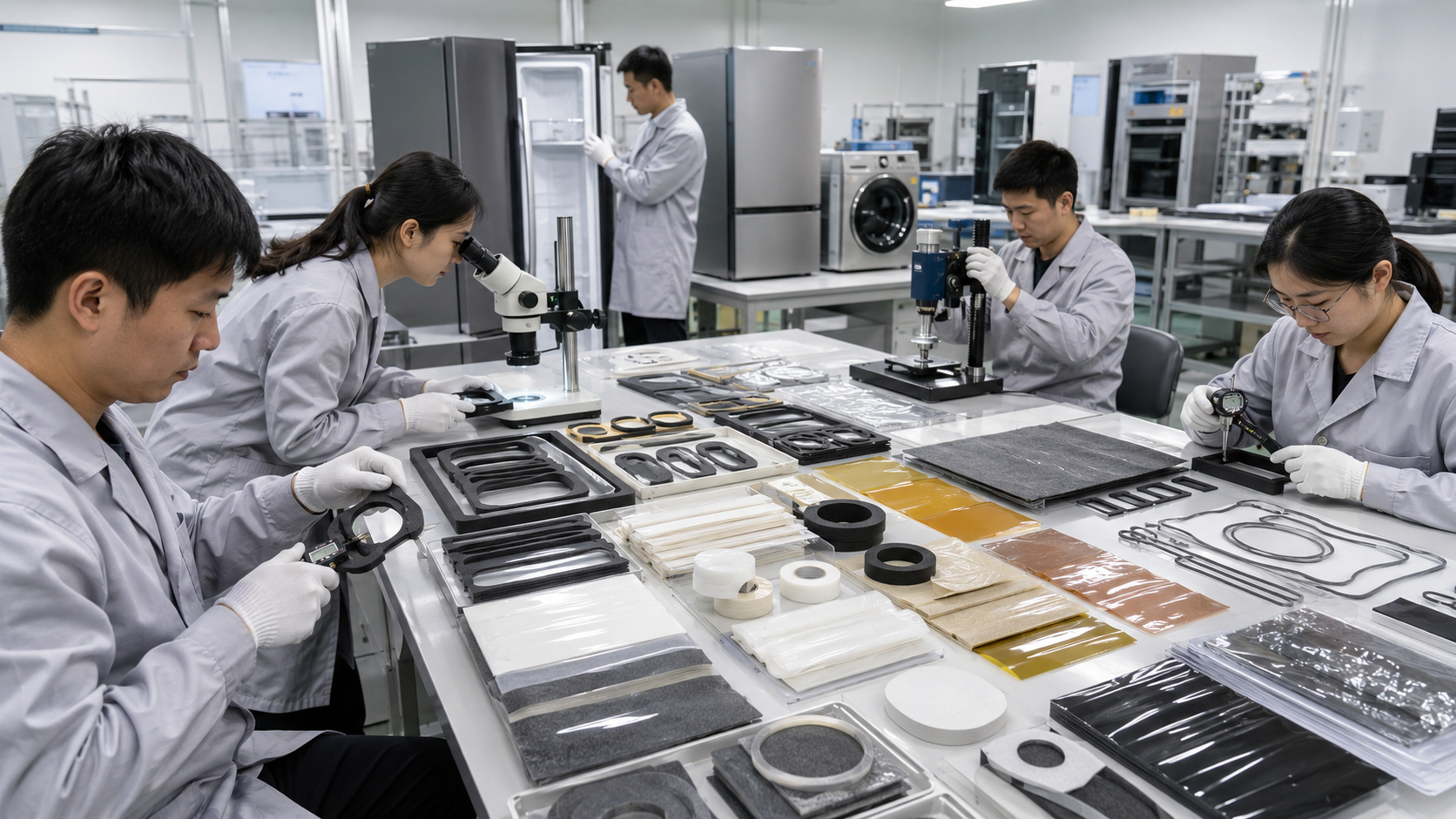
How Sanken Supports Home Appliance OEM Manufacturers
Sanken provides custom die cut solutions for global appliance OEMs.
Our capabilities include:
- Foam gasket converting
- Rubber gasket manufacturing
- PET insulation films
- PI insulation films
- Double-sided adhesive tape converting
- Transfer adhesive converting
- Protective films
- Non-woven felt converting
- Multilayer lamination
- Precision die cutting
- Sample development
- Quality inspection
- Assembly-ready packaging
For every project, we review material function, compression performance, operating temperature, adhesive compatibility, dimensional tolerance, packaging method, and final assembly process.
Our goal is to help customers reduce leakage, vibration, assembly difficulty, adhesive failure, repeated sampling, and unstable mass production.
Buyer Checklist Before Requesting Samples
To develop reliable die cut appliance components, buyers should provide:
- 2D drawing
- 3D CAD model (if available)
- Appliance application
- Material preference
- Thickness requirement
- Temperature range
- Compression requirement
- Adhesive requirement
- Bonding surface
- Environmental testing requirement
- Packaging format
- Expected annual quantity
- Existing sample (if available)
Providing complete engineering information helps optimize material selection and shorten development time.
FAQ
What die cut materials are commonly used in home appliances?
Common materials include EVA foam, PE foam, EPDM foam, silicone foam, EPDM rubber, silicone rubber, PET films, PI films, adhesive tapes, protective films, non-woven felt, and multilayer laminated materials.
Why are foam gaskets widely used in appliances?
Foam gaskets provide sealing, cushioning, vibration isolation, thermal insulation, and tolerance compensation while remaining lightweight and economical.
Why are rubber seals used instead of foam?
Rubber is selected when stronger durability, chemical resistance, weather resistance, or long-term compression recovery is required.
What are adhesive die cut parts used for?
They are used for bonding displays, decorative panels, sensors, wire harnesses, foam gaskets, and plastic housings while improving assembly efficiency.
Why are PET and PI films used?
PET films provide electrical insulation for general applications, while PI films are used where higher temperature resistance is required.
Can Sanken manufacture custom appliance die cut parts?
Yes. Sanken manufactures custom foam gaskets, rubber seals, PET and PI insulation films, adhesive tape components, protective films, non-woven materials, and multilayer die cut parts for home appliance OEM manufacturers.
Conclusion
Home appliances depend on precision die cut foam, rubber, and adhesive components to improve sealing, reduce vibration, protect electronics, simplify assembly, and extend product life. Foam gaskets, rubber seals, insulation films, adhesive tapes, protective films, and multilayer structures all contribute to better appliance performance and manufacturing efficiency.
By selecting the right materials and precision converting process, OEM manufacturers can improve product quality, reduce warranty costs, and increase production consistency.
At Sanken, we help appliance manufacturers develop precision die cut solutions that support reliable performance from prototype development to high-volume production.