
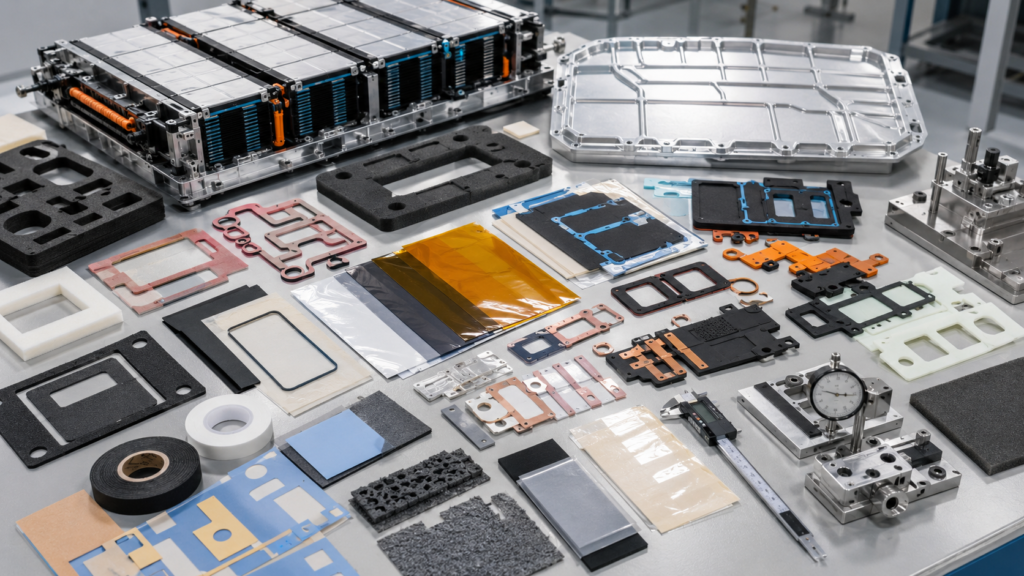
EV battery manufacturers need precision die cut solutions for sealing, insulation, thermal management, cushioning, bonding, vibration control, surface protection, and assembly support. These components help protect battery packs from water, dust, heat, electrical risks, vibration, and long-term reliability problems.
At Sanken, we manufacture custom die cut foam gaskets, rubber seals, PET and PI insulation films, thermal materials, adhesive tape components, protective films, non-woven cushioning materials, and multilayer laminated parts for EV battery packs, modules, BMS assemblies, automotive electronics, and charging systems.
Why EV Battery Manufacturers Need Die Cut Solutions
EV battery packs operate under high voltage, heat, vibration, humidity, dust, and strict safety requirements. A small material failure can cause sealing failure, insulation risk, thermal imbalance, adhesive lifting, or poor assembly fit.
Die cut solutions help provide:
- Electrical insulation
- Battery pack sealing
- Thermal protection
- Heat transfer
- Cell cushioning
- Vibration damping
- Component bonding
- Surface protection
- Gap filling
- Assembly positioning
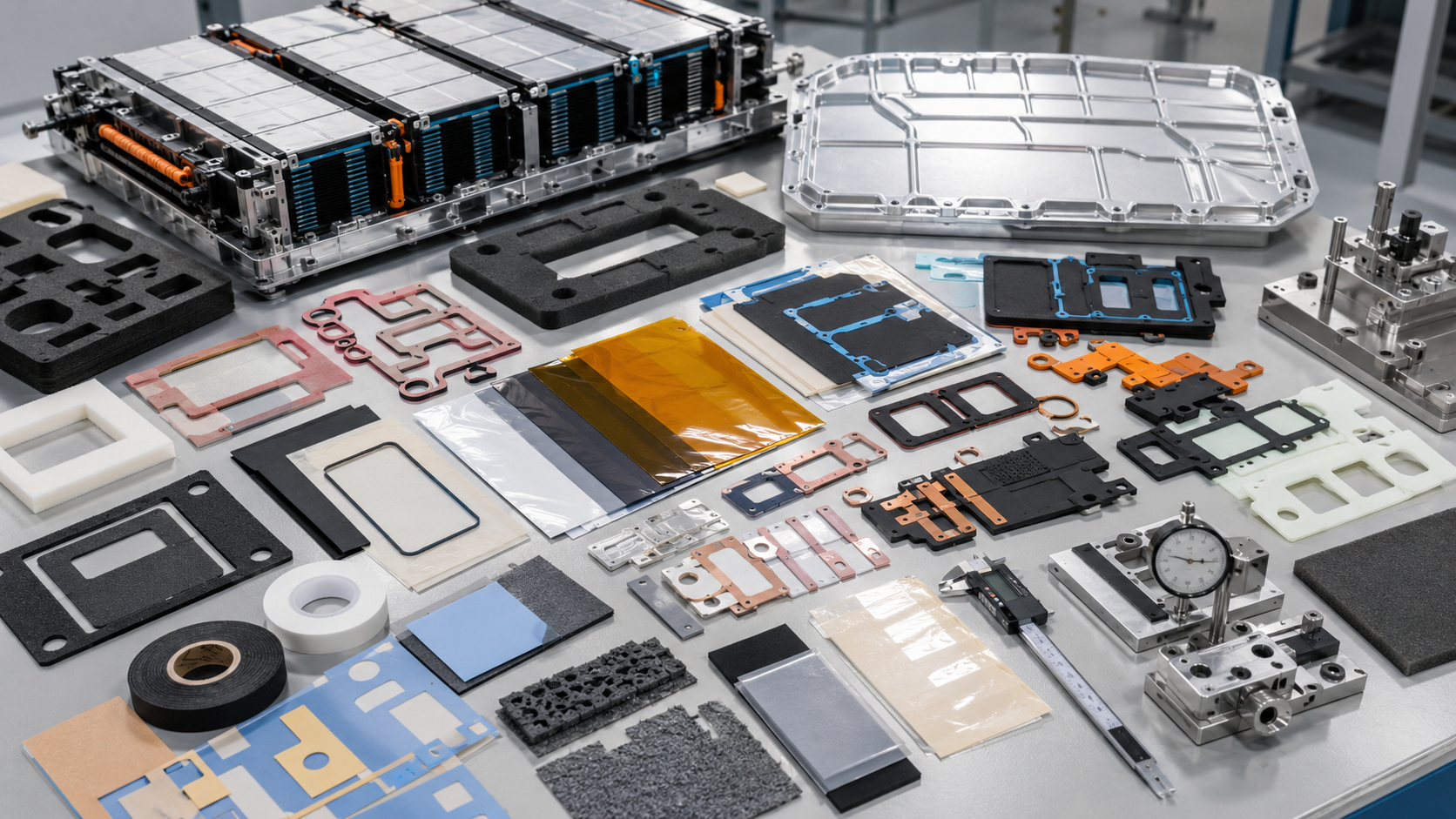
Main Die Cut Solutions for EV Batteries
| Solution | Main Function |
|---|---|
| Foam Gaskets | Sealing, cushioning, gap filling |
| Rubber Seals | Durable sealing and vibration damping |
| PET Films | Electrical insulation and protection |
| PI Films | High-temperature insulation |
| Thermal Gap Pads | Heat transfer and gap filling |
| Graphite Sheets | Heat spreading |
| Thermal Insulation Films | Heat isolation |
| Adhesive Tape Parts | Bonding and positioning |
| Protective Films | Surface protection |
| Non-Woven Materials | Cushioning and soft protection |
| Multilayer Laminates | Combined insulation, sealing, and bonding |
Foam Gaskets for Battery Pack Sealing
Foam gaskets are widely used for battery enclosure sealing, module sealing, connector sealing, cooling plate sealing, and cable entry protection.
Common materials include:
- EVA foam
- PE foam
- EPDM foam
- Silicone foam
- PU foam
- Microcellular polyurethane foam
Foam gaskets help compensate for housing tolerance while providing compression sealing, dust protection, water resistance, and vibration cushioning.
Rubber Seals for Long-Term Reliability
Rubber seals are used where stronger durability and sealing pressure are required.
Common rubber materials include:
- EPDM rubber
- Silicone rubber
- NBR
- CR rubber
Rubber seals are suitable for battery enclosures, cooling systems, connectors, cable entries, and vent areas. They provide stronger weather resistance, compression recovery, and long-term durability than many foam materials.
PET and PI Insulation Films
Electrical insulation is critical in EV battery systems.
PET insulation films are commonly used for:
- Cell insulation
- Module insulation
- Busbar protection
- Connector insulation
- PCB protection
- BMS assembly insulation
PI films are used where higher temperature resistance is required, such as busbars, flexible circuits, power electronics, and charging components.
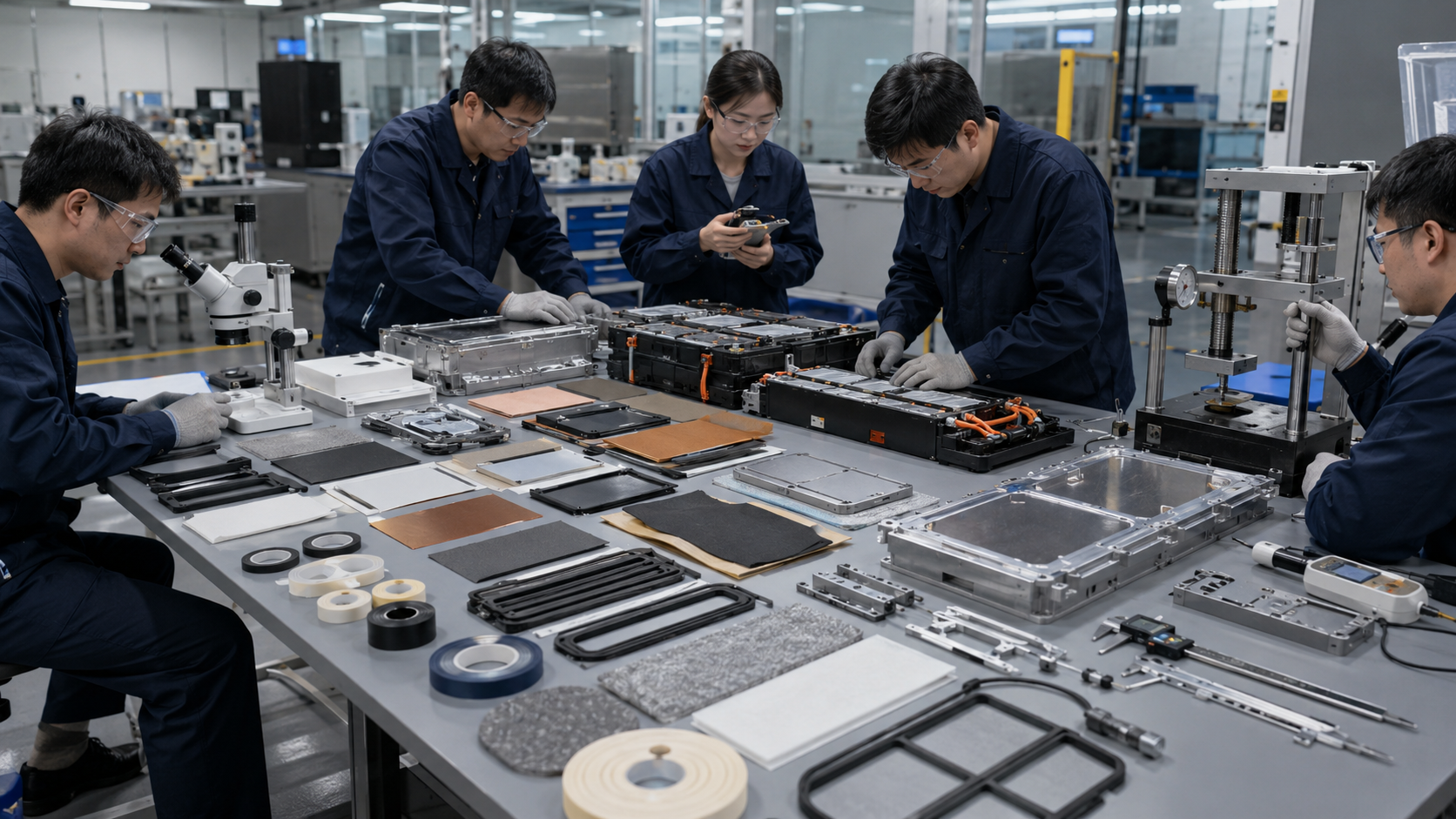
Thermal Management Die Cut Materials
EV battery manufacturers also need die cut thermal materials to control heat.
Common thermal solutions include:
- Thermal gap pads
- Silicone thermal pads
- Graphite sheets
- Thermal insulation films
- Adhesive-backed thermal materials
- Multilayer thermal structures
Thermal gap pads help transfer heat to cooling plates. Graphite sheets help spread heat. Thermal insulation films protect heat-sensitive areas.
Adhesive Tape Components
Adhesive die cut parts help improve assembly efficiency and positioning accuracy.
Applications include:
- Insulation film bonding
- Foam gasket positioning
- Thermal pad attachment
- Sensor mounting
- Wire harness fixing
- Protective film attachment
- Module assembly support
The adhesive must match the bonding surface, such as aluminum, coated metal, plastic housing, PET film, PI film, rubber, or battery module surface.
Protective Films and Cushioning Materials
Protective films prevent scratches, dust, fingerprints, and handling damage during battery manufacturing. They may be used on battery enclosures, cooling plates, metal frames, plastic housings, and electronic module surfaces.
Non-woven materials and foam cushioning parts help protect surfaces, reduce friction, and provide soft contact protection inside battery assemblies.
Multilayer Die Cut Components
Many EV battery parts require multilayer structures.
Examples include:
| Multilayer Structure | Function |
|---|---|
| PET + Adhesive + Liner | Electrical insulation and positioning |
| PI + Adhesive + Liner | High-temperature insulation |
| Foam + Adhesive | Sealing and cushioning |
| Rubber + Adhesive | Damping and positioning |
| Thermal Pad + Adhesive | Heat transfer and placement |
| Graphite + PET Film | Heat spreading and insulation support |
Multilayer die cut parts reduce assembly steps and improve production consistency.
Quality Control for EV Battery Die Cut Parts
EV battery manufacturers need stable quality from sample to mass production.
Important inspection items include:
- Material confirmation
- Thickness control
- Outer dimensions
- Hole and slot alignment
- Adhesive position
- Liner release
- Edge cleanliness
- Compression behavior
- Insulation quality
- Thermal material thickness
- Surface cleanliness
- Packaging condition
- Assembly fit
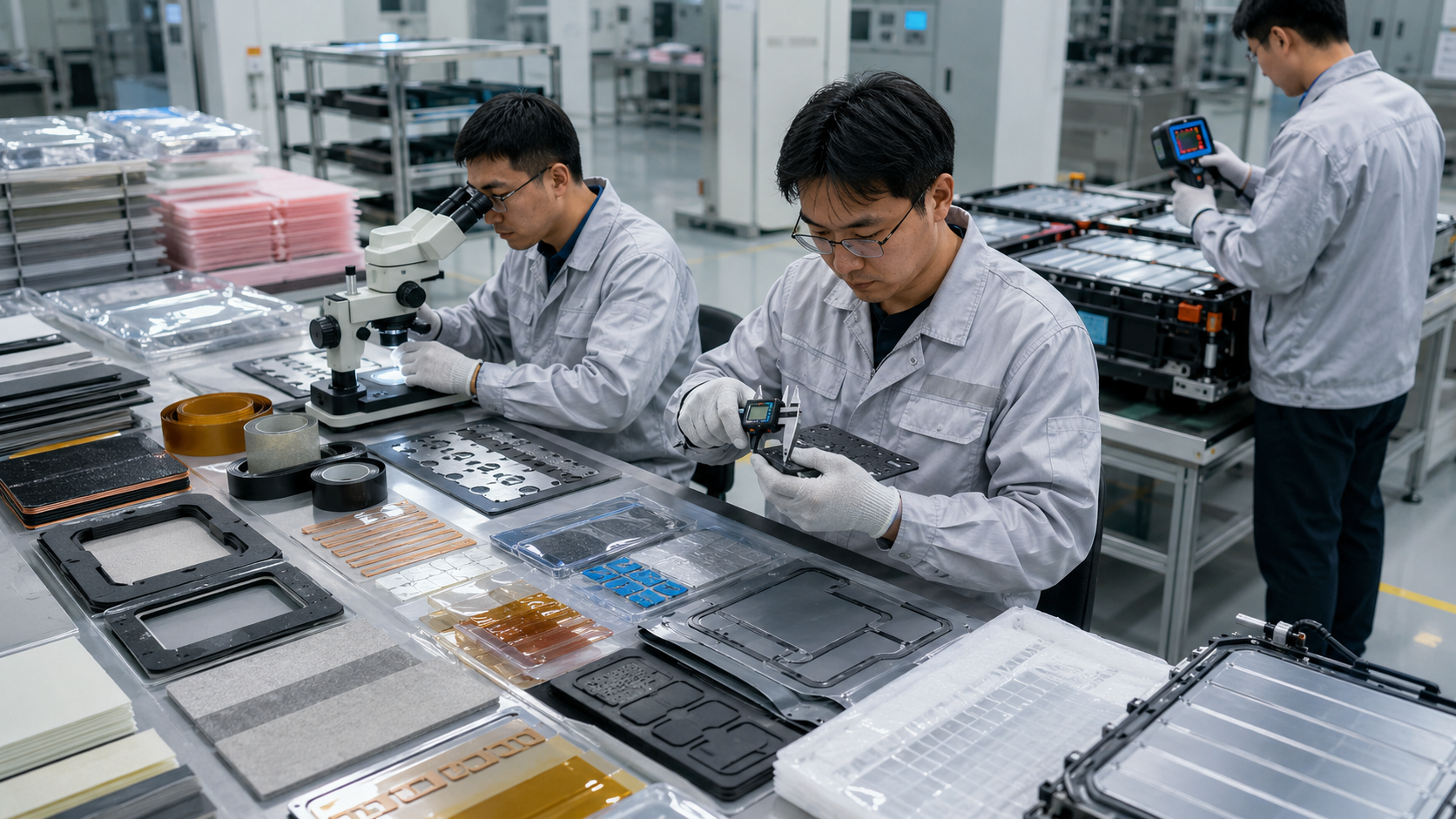
How Sanken Supports EV Battery Manufacturers
Sanken Manufacturing Co., Ltd. supports EV battery OEMs and Tier suppliers with custom precision die cut solutions.
Our support includes:
- Foam gasket converting
- Rubber sealing components
- PET insulation films
- PI insulation films
- Thermal gap pads
- Graphite sheets
- Thermal insulation materials
- Adhesive tape components
- Protective films
- Non-woven cushioning materials
- Multilayer laminated components
- Sample development
- Quality inspection
- Assembly-ready packaging
For each project, we review material function, thickness, compression, insulation requirement, thermal requirement, adhesive structure, die cut tolerance, packaging method, and final assembly process.
Buyer Checklist Before Starting a Project
EV battery manufacturers should provide:
- 2D drawing
- 3D structure if available
- Battery pack or module application
- Material preference
- Thickness requirement
- Voltage or insulation requirement
- Temperature range
- Compression requirement
- Thermal management requirement
- Adhesive requirement
- Bonding surface
- Environmental testing requirement
- Packaging format
- Expected quantity
- Existing sample if available
FAQ
What die cut solutions are used in EV batteries?
Common solutions include foam gaskets, rubber seals, PET films, PI films, thermal gap pads, graphite sheets, adhesive tapes, protective films, non-woven cushioning parts, and multilayer laminated materials.
Why do EV battery packs need foam gaskets?
Foam gaskets provide sealing, gap filling, vibration cushioning, and tolerance compensation for battery packs and modules.
Why are PET and PI films used in battery packs?
PET and PI films provide electrical insulation and protection. PET is suitable for general insulation, while PI is used for higher temperature areas.
What thermal materials are used in EV battery packs?
Common thermal materials include thermal gap pads, silicone thermal pads, graphite sheets, thermal insulation films, and adhesive-backed thermal materials.
Can EV battery die cut parts be adhesive-backed?
Yes. Foam gaskets, PET films, PI films, rubber pads, thermal materials, and protective films can be supplied with adhesive backing and release liners.
Can Sanken manufacture custom EV battery die cut solutions?
Yes. Sanken manufactures custom foam gaskets, rubber seals, PET and PI insulation films, thermal materials, adhesive tape components, protective films, non-woven cushioning parts, and multilayer die cut components for EV battery manufacturers.
Conclusion
EV battery manufacturers need die cut solutions that support sealing, insulation, thermal management, cushioning, bonding, vibration control, and surface protection. Foam gaskets, rubber seals, PET films, PI films, thermal pads, graphite sheets, adhesive tapes, protective films, and multilayer structures all play important roles in battery safety and assembly reliability.
At Sanken, we help EV battery manufacturers develop precision die cut solutions that are accurate, clean, assembly-ready, and stable from prototype to mass production.