
What Is Die Cut? Definition, Meaning, and Applications
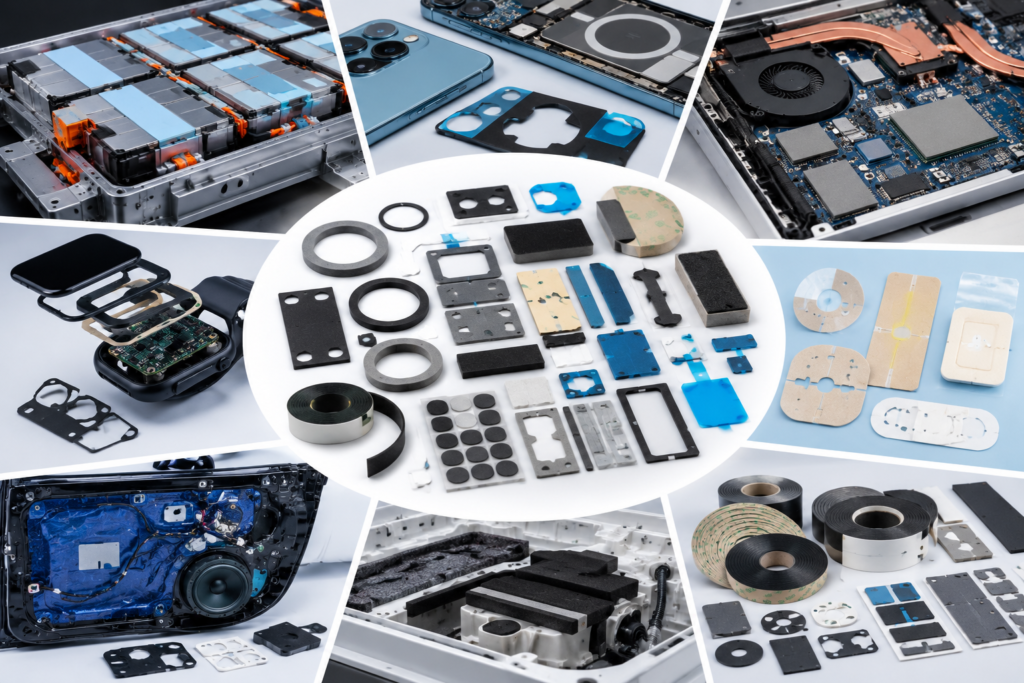
Die cut is a manufacturing or finishing process in which a material is cut into a specific custom shape using a specialized tool called a die. The process applies controlled pressure to cut precise outlines, holes, slots, perforations, or patterns from materials such as paper, foam, rubber, plastic film, adhesive tape, cardboard, and non-woven fabric.
A “die cut” product simply means the item has been shaped using this process instead of basic straight-line cutting.
Die cutting is widely used in:
- Packaging
- Labels and stickers
- Automotive components
- Electronics
- Medical products
- Foam gaskets
- Insulation materials
- Industrial converting applications
Simple Die Cut Definition
A die cut item is a product that has been cut into a custom shape using a die.
Examples include:
- Die cut stickers
- Foam seals
- Adhesive pads
- Packaging inserts
- Product labels
- Protective films
Instead of simple square or rectangular trimming, die cutting creates precise custom geometries.
What Is a Die?
A die is a specially engineered cutting tool designed to match a required shape or pattern.
The die functions like a template:
- It presses against the material
- Cuts the exact design
- Produces repeatable shapes consistently
This allows manufacturers to create large volumes of identical parts efficiently.
How Does Die Cutting Work?
The basic die cutting process includes:
- Feeding material into the machine
- Aligning the material accurately
- Applying pressure through the die
- Cutting the required shape
- Removing excess material
Depending on the application, additional processes may include:
- Kiss-cutting
- Through-cutting
- Perforating
- Scoring
- Laminating
The result is a clean, repeatable component ready for assembly or packaging.
Common Types of Die Cutting
Rotary Die Cutting
Rotary die cutting uses a cylindrical rotating die in a continuous roll-to-roll process.
Best for:
- Labels
- Adhesive tapes
- Thin films
- High-volume production
Advantages:
- High speed
- Excellent repeatability
- Automation compatibility
Flatbed Die Cutting
Flatbed die cutting uses vertical press force.
Best for:
- Foam
- Rubber
- Thick materials
- Complex geometries
Advantages:
- Strong cutting force
- Good dimensional accuracy
- Flexible for short or medium production runs
Digital Die Cutting
Digital die cutting uses computer-controlled blades or lasers without physical tooling.
Best for:
- Prototypes
- Samples
- Custom short runs
Advantages:
- No tooling cost
- Fast design changes
Common Materials Used in Die Cutting
Die cutting can process many industrial materials, including:
- Foam
- Rubber
- Paper
- Cardboard
- Plastic film
- Adhesive tape
- Non-woven fabric
- Insulation materials
Material behavior affects cutting quality, edge performance, and production stability.
Common Applications of Die Cutting
Die cutting is commonly used for:
- Die cut stickers
- Labels
- Packaging inserts
- Gaskets and seals
- Protective films
- Insulation pads
- Medical adhesive components
- Automotive parts
The process improves consistency, assembly speed, and manufacturing efficiency.
Why Is Die Cutting Important?
Die cutting provides several key manufacturing advantages:
Precision
Creates accurate custom shapes.
Repeatability
Produces identical parts consistently.
Efficiency
Supports high-volume production.
Reduced Labor
Improves assembly speed and reduces manual trimming.
Automation Compatibility
Supports roll-based automated systems.
For OEM manufacturing and packaging industries, die cutting is an essential production process.
Difference Between Die Cutting and Standard Cutting
| Feature | Standard Cutting | Die Cutting |
|---|---|---|
| Shape | Straight cuts | Custom shapes |
| Precision | Basic | High |
| Production speed | Moderate | High |
| Automation support | Limited | Excellent |
| Applications | Simple trimming | Industrial manufacturing |
Die cutting offers greater design flexibility and production consistency.
Featured Snippet Summary
Die cut is a manufacturing process that uses a custom-designed tool called a die to cut materials into precise shapes. It is commonly used for packaging, labels, foam parts, adhesive products, insulation materials, and industrial manufacturing applications.
Conclusion
Die cut refers to the process of cutting materials into custom shapes using a specialized die tool. The process enables precise, repeatable production for packaging, labels, foam components, adhesive assemblies, and industrial manufacturing applications.
When properly engineered, die cutting improves efficiency, consistency, and production quality across multiple industries.