
What Is Die Cut Material?
Many OEM manufacturers struggle with materials that are difficult to process, inconsistent in thickness, or impossible to fit into complex assemblies. I’ve seen projects delayed simply because the material could not be converted into precise functional parts. Poor cutting accuracy leads to waste, installation issues, and unstable product quality ([placeholder link]).
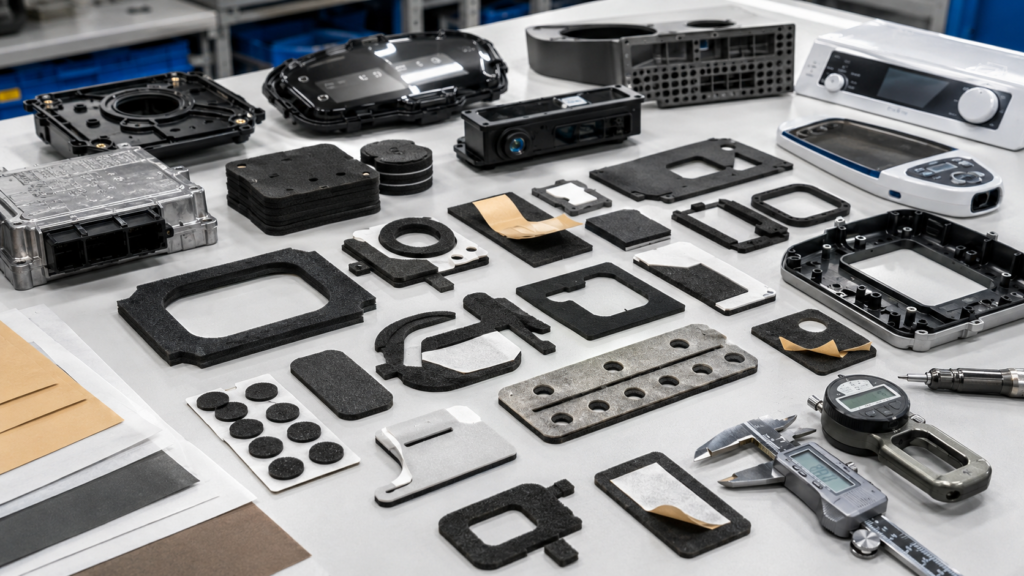
Die cut material refers to any material that has been precisely cut into custom shapes or patterns using a die cutting process. These materials are transformed into functional components such as gaskets, seals, insulation pads, adhesive layers, vibration dampers, EMI shielding parts, and protective films. Industries like automotive, electronics, medical, and industrial manufacturing rely heavily on die cut materials for consistent assembly performance ([placeholder link]).
At Sanken, we do not simply cut materials. We engineer material solutions that improve product performance, production efficiency, and long-term reliability.
What Materials Can Be Die Cut?
One of the biggest advantages of die cutting is flexibility.
We regularly process materials such as:
| Material Type | Common Applications |
|---|---|
| Foam | Cushioning, sealing, vibration reduction |
| Rubber | Gaskets, waterproof sealing |
| Non-Woven Fabric | Insulation and acoustic applications |
| Double-Sided Tape | Bonding and mounting |
| PET Film | Electrical insulation and protection |
| Conductive Materials | EMI shielding |
| Silicone | High-temperature sealing |
| Mineral Wool | Thermal and acoustic insulation |
Different industries require different material properties.
That is why material selection is just as important as the cutting process itself ([placeholder link]).
Why Are Die Cut Materials Important?
1. Precision Assembly
Modern products require extremely tight tolerances.
A poorly cut material can cause:
- Assembly gaps
- Adhesive failure
- Air leakage
- Vibration noise
- Thermal performance issues
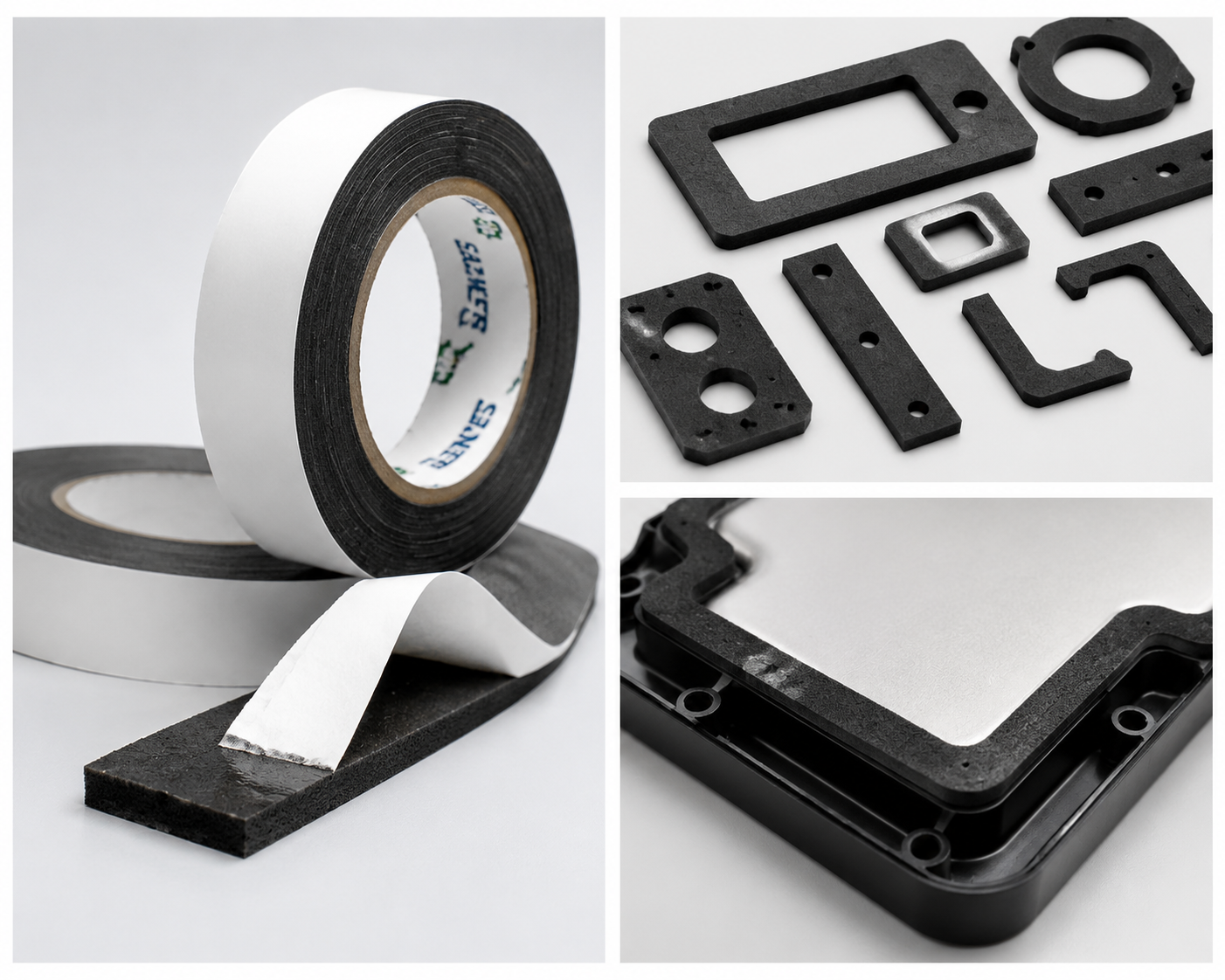
Precision die cut materials ensure every component fits correctly the first time.
2. Faster Production
Manual cutting slows production and increases inconsistency.
Die cutting allows high-speed manufacturing with repeatable accuracy.
This is especially critical for:
- Automotive production lines
- Electronics assembly
- Medical device manufacturing
3. Material Waste Reduction
At Sanken, we optimize nesting layouts and production methods to maximize material utilization.
This helps OEM customers reduce scrap and lower manufacturing costs.
How Does the Die Cutting Process Work?
The process typically includes:
- Material selection
- Adhesive lamination
- Precision die cutting
- Kiss cutting or multi-layer processing
- Inspection and verification
- Packaging and delivery
What many suppliers cannot handle is the complexity between these steps.
For example:
- Thin films may stretch during processing
- Foam may compress unevenly
- Adhesive materials may overflow
- Static electricity may affect delicate electronic films
This is where manufacturing experience matters.
Common Problems With Poor Die Cut Materials
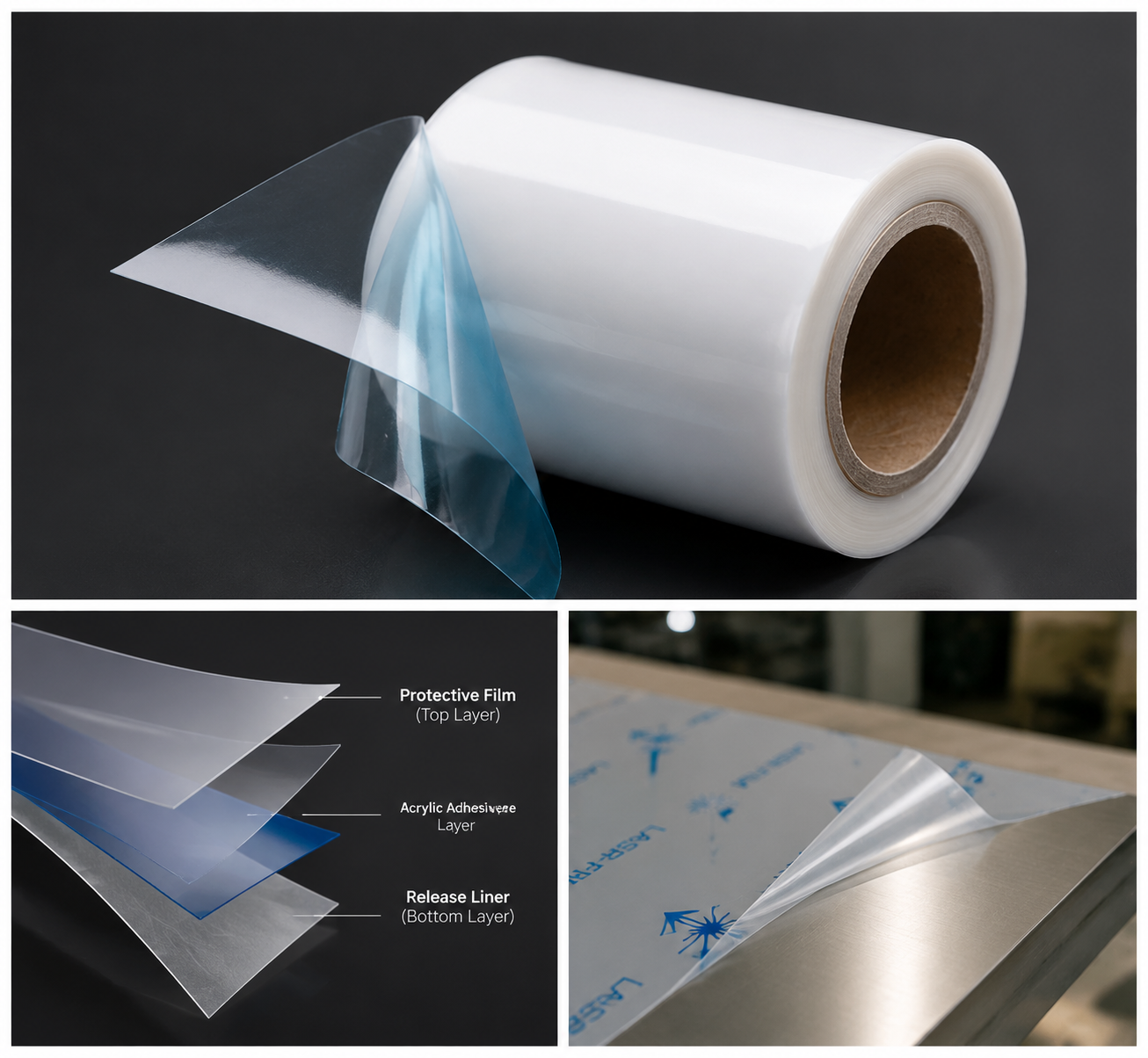
We often help customers solve problems caused by low-quality suppliers, including:
- Rough edges
- Dimensional instability
- Inconsistent adhesive performance
- Material deformation
- Layer misalignment
- Excessive burrs or dust contamination
These problems create expensive downstream failures.
For OEM manufacturers, even a small dimensional issue can stop an entire production line.
Why OEM Customers Choose Sanken
At Sanken, our strength is not only precision die cutting.
Our advantage comes from combining:
- Material R&D
- Precision die cutting
- Material conversion
- Laminating and bonding
- Hot pressing
- Spraying and gluing
- Silk screen printing
- One-stop multi-process manufacturing
We support customers from prototype development to mass production.
Our facilities also operate under strict quality systems including:
- IATF 16949
- ISO 9001
- ISO 14001
This ensures stable quality and consistent performance across every production batch ([placeholder link]).
How to Choose the Right Die Cut Material Supplier?
Before selecting a supplier, I always recommend evaluating:
- Can they recommend the right material, not just process it?
- Do they understand adhesive compatibility?
- Can they maintain tight tolerances consistently?
- Do they support rapid sampling and verification?
- Can they integrate multiple manufacturing processes?
Many suppliers only provide cutting services.
Very few can help customers reduce failure risks before production even starts.
That difference is what separates a normal supplier from a true manufacturing partner.
Conclusion
Die cut material is the foundation of countless industrial products, from automotive seals to electronic insulation components. At Sanken, we combine precision die cutting, advanced material conversion, and strict quality control to help OEM customers achieve reliable performance, lower costs, and smoother production.