
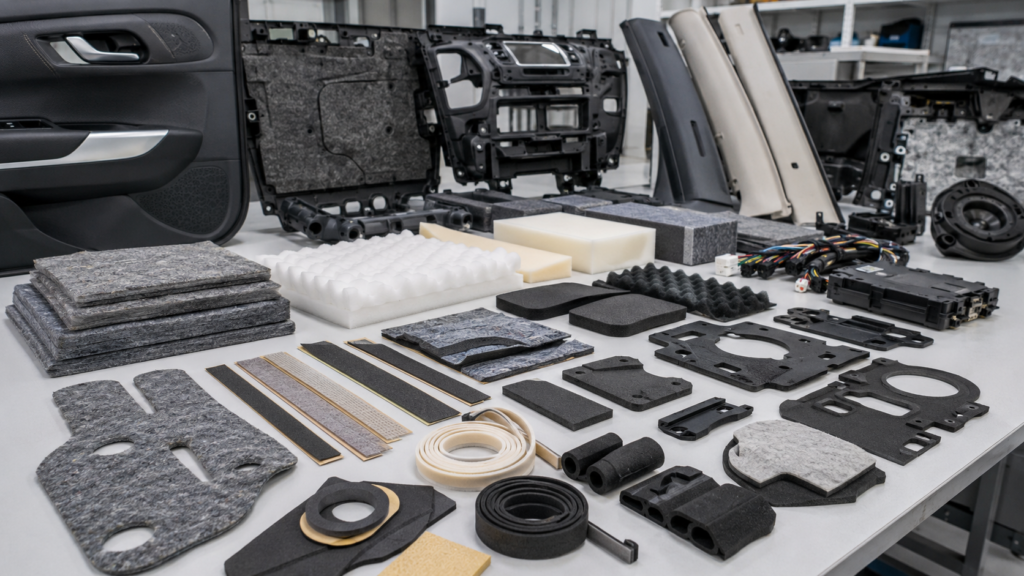
Die cutting in automotive OEM manufacturing is a converting process used to cut flexible materials into precise custom shapes for sealing, bonding, insulation, cushioning, NVH control, surface protection, vibration damping, and assembly support. These parts are often hidden inside vehicles, but they help improve comfort, reliability, safety, and production efficiency.
In automotive projects, die cut parts are not only simple cut pieces. They may be foam gaskets, adhesive-backed felt strips, PET insulation films, rubber damping pads, protective films, double-sided tape components, sealing strips, or multilayer converted materials designed for a specific vehicle area.
At Sanken, we support automotive OEM customers with custom precision die cutting, adhesive lamination, material converting, foam and rubber parts, non-woven felt NVH components, PET and PI insulation films, protective films, adhesive tape parts, and assembly-ready die cut components for automotive interiors, electronics, battery areas, sensors, displays, and industrial vehicle applications.
What Does Die Cutting Mean in Automotive Manufacturing?
Die cutting means using a cutting tool, die, or precision converting process to cut materials into repeatable shapes. In automotive OEM manufacturing, die cutting is used when a material must fit a real product structure, such as a housing, trim panel, battery module, sensor, speaker, display, or electronic control unit.
A die cut automotive part may include:
- Holes for screws or clips
- Slots for cables or connectors
- Windows for sensors or light paths
- Rounded corners to prevent lifting
- Adhesive backing for easy assembly
- Release liner for clean peeling
- Pull tabs for operator handling
- Multilayer structures for combined performance
The main goal is not only shape accuracy. The part must also be easy to assemble, stable in mass production, and suitable for the final automotive environment.
Why Automotive OEMs Use Die Cut Parts
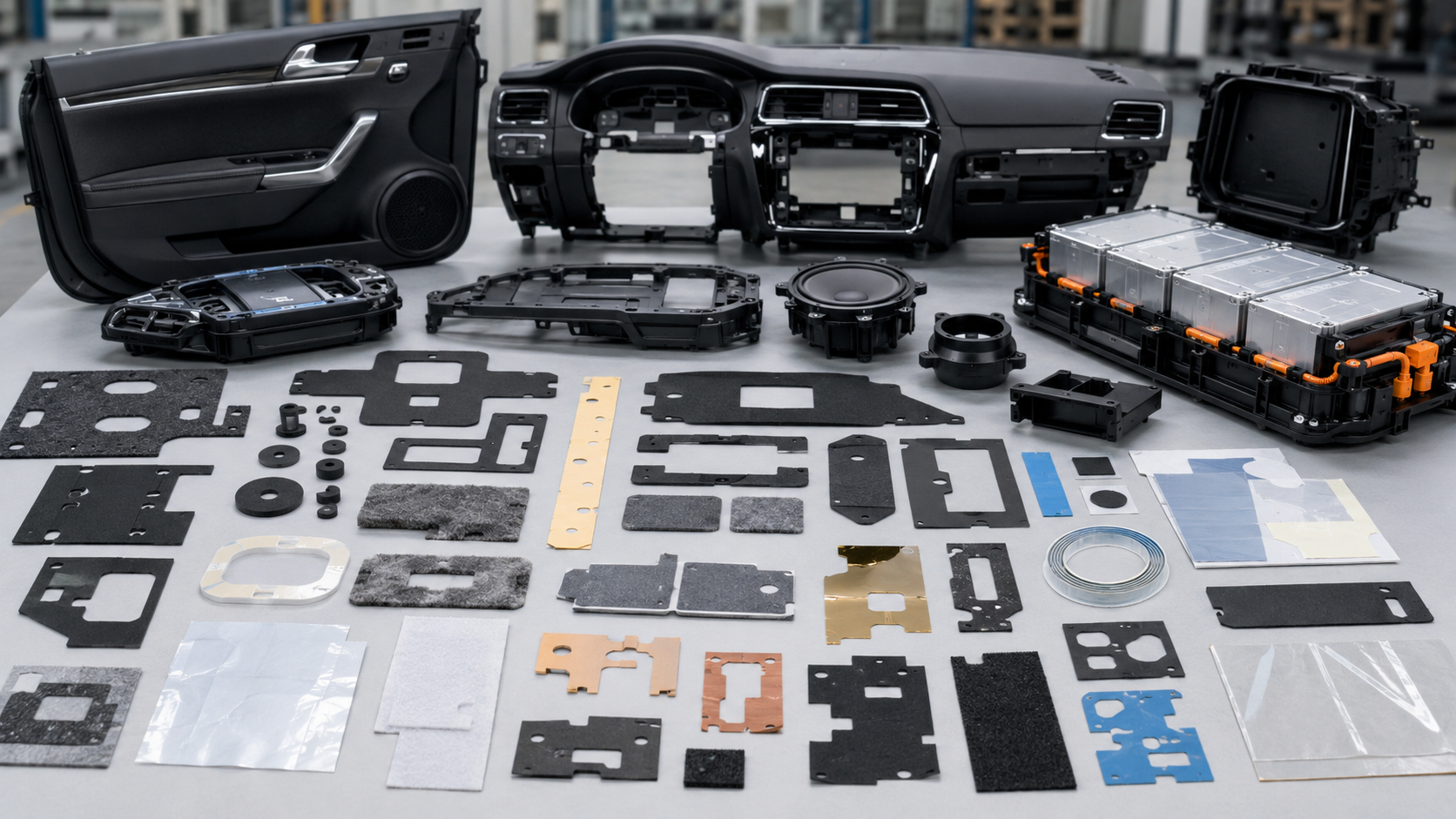
Automotive manufacturers use die cut parts because many vehicle components need thin, flexible, lightweight, and custom-shaped materials. Standard sheets or manually cut materials cannot meet the same repeatability, assembly speed, or design accuracy.
Die cut parts help automotive OEMs:
- Improve sealing performance
- Reduce vibration and rattling
- Control squeaks and friction noise
- Protect electronic components
- Insulate battery and electrical areas
- Bond parts without screws or liquid glue
- Protect surfaces during production
- Reduce manual trimming and rework
- Improve assembly consistency
- Support high-volume production
A small die cut part can prevent a much larger problem. For example, a foam gasket can prevent dust from entering an electronic housing. A felt strip can reduce interior rattle noise. A PET insulation film can help separate electrical contact areas. A rubber pad can reduce vibration between mechanical parts.
Common Materials Used in Automotive Die Cutting
Automotive die cut parts can be made from many flexible materials. The right material depends on the application, temperature, compression, bonding surface, tolerance, and testing requirement.
| Material Type | Main Function | Common Automotive Use |
|---|---|---|
| Non-woven felt | Anti-rattle, anti-squeak, light sound absorption | Door trim, dashboard, pillar trim, wire harness |
| Foam | Sealing, cushioning, gap filling, vibration control | Electronic housings, panels, speaker areas, battery covers |
| Rubber | Damping, impact resistance, sealing support | Pads, washers, stops, vibration control points |
| PET film | Electrical insulation, spacing, protection | Automotive electronics, battery modules, sensors |
| PI film | High-temperature insulation | Battery and electronic heat-sensitive areas |
| Protective film | Temporary surface protection | Displays, lenses, trim parts, panels |
| Double-sided tape | Bonding, positioning, lamination | Mounting, gasket attachment, module assembly |
| Light-blocking film | Optical shielding and light control | Displays, sensors, camera modules |
In many automotive projects, one material is not enough. A part may combine foam with adhesive tape, felt with PSA backing, PET film with adhesive, or rubber with liner. These multilayer die cut parts reduce customer assembly steps because the finished part arrives ready to use.
Non-Woven Felt Die Cut Parts for Automotive NVH
Non-woven felt is widely used in automotive interiors for NVH control. NVH means noise, vibration, and harshness. Felt parts help reduce squeaks, rattles, friction noise, and soft contact noise between interior components.
Custom die cut felt parts are commonly used in:
- Door trim panels
- Dashboard contact areas
- Pillar trim
- Center consoles
- Seat structure contact points
- Speaker housings
- Wire harness areas
- Plastic-to-plastic contact surfaces
Needle-punched non-woven felt can provide soft separation between hard surfaces. Adhesive-backed felt strips are especially useful because operators can peel and apply them directly during assembly.
For automotive felt parts, the supplier should review thickness, density, fiber shedding, edge cleanliness, adhesive backing, abrasion resistance, and long-term durability.
Foam Die Cut Parts for Sealing and Cushioning
Foam is one of the most common automotive die cut materials. It is used when a part needs to compress, seal, cushion, fill a gap, absorb shock, or reduce vibration.
Common foam materials include PE foam, PU foam, EVA foam, EPDM foam, silicone foam, and CR foam.
Foam die cut parts may be used as:
- Foam gaskets
- Dust sealing pads
- Cushioning pads
- Gap fillers
- Anti-rattle pads
- Speaker gaskets
- Battery support pads
- Automotive electronic housing seals
Foam selection should not be based only on thickness. Engineers should also review density, compression force, rebound, cell structure, adhesive backing, and aging behavior.
If foam is too soft, it may collapse. If it is too hard, it may create assembly stress. If the thickness is wrong, the gasket may not seal properly or may interfere with final assembly.
PET and PI Film Parts for Automotive Electronics and Battery Areas
PET and PI films are used in automotive electronics and EV battery-related areas for insulation, spacing, and protection.
PET film is commonly used for stable electrical insulation, clean die cutting, and dimensional control. PI film is used when higher temperature resistance is required.
Film die cut parts may be used for:
- Battery insulation films
- Electronic control unit insulation
- Connector protection
- Sensor insulation
- Spacer films
- Circuit protection
- Protective layers
- Display module films
For automotive electronics, film parts often require accurate holes, clean edges, low burrs, stable flatness, and careful packaging. A small hole shift or edge defect can create assembly risk.
Adhesive Tape Parts for Automotive Assembly
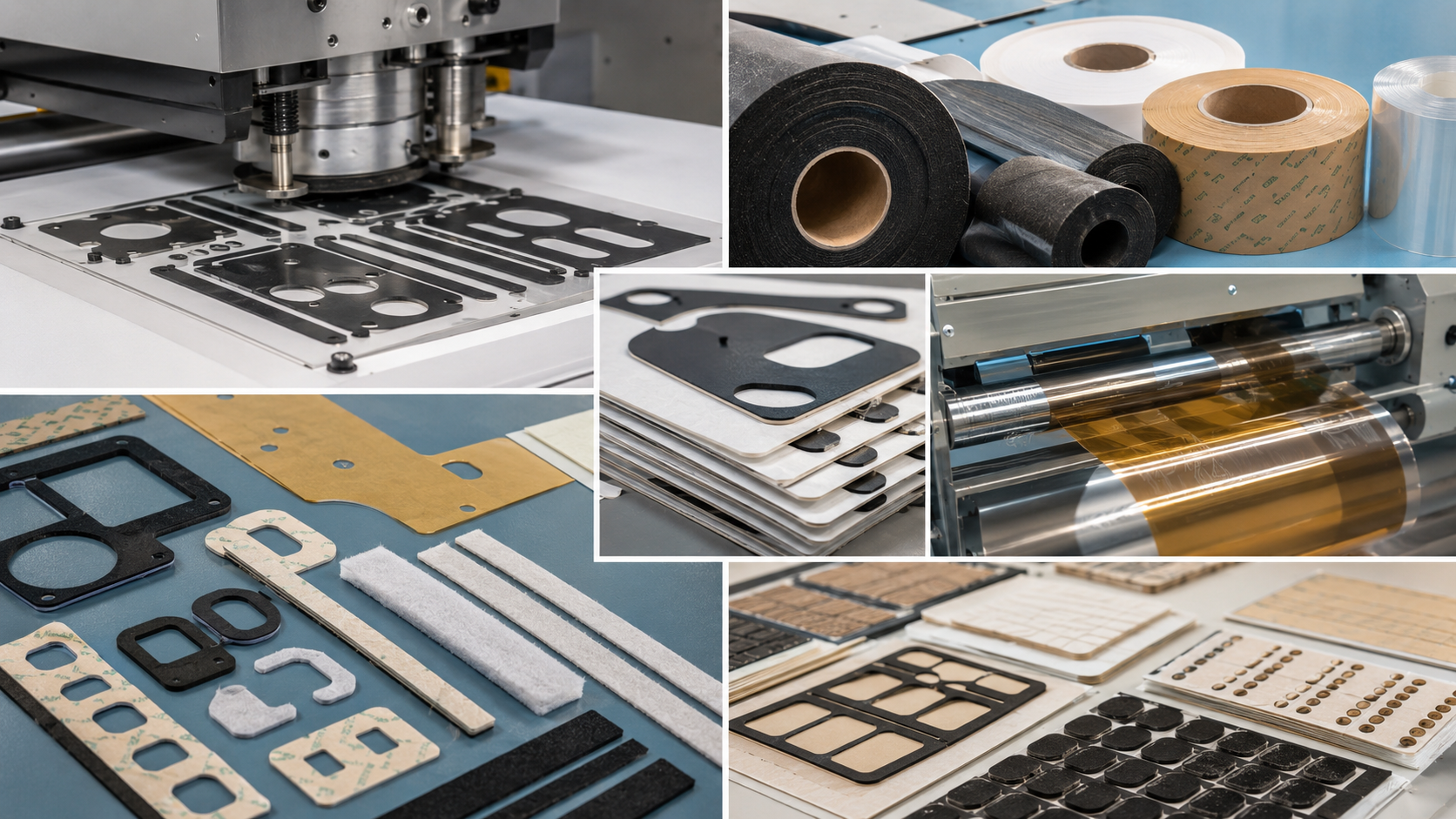
Adhesive die cut parts are used when automotive assembly needs clean, repeatable bonding or positioning.
Common adhesive materials include double-sided tape, transfer adhesive, foam tape, PET carrier tape, acrylic foam tape, and removable adhesive film.
Adhesive die cut parts are used for:
- Attaching foam gaskets
- Mounting displays
- Bonding plastic housings
- Fixing insulation films
- Holding protective films
- Positioning small components
- Supporting sensor and electronic module assembly
Adhesive selection must match the bonding surface. Automotive parts may use ABS, PC, PP, PE, painted metal, coated plastic, glass, rubber, fabric, or textured surfaces.
Liner release is also important. If the part is hard to peel, operators may stretch or damage it. If the liner is too loose, parts may shift during packaging or transportation.
Rubber Die Cut Parts for Damping and Durability
Rubber die cut parts are used when the application needs stronger damping, sealing pressure, anti-slip support, or mechanical durability.
Rubber parts may be used as:
- Vibration damping pads
- Rubber washers
- Sealing pads
- Anti-slip feet
- Cushioning spacers
- Contact protection pads
- Mechanical support pads
Rubber is usually more durable than foam, but it may need higher compression force. Engineers should review hardness, thickness, rebound, temperature resistance, oil resistance, edge quality, and tolerance behavior.
For precision die cut rubber parts, rebound after cutting should be considered because rubber may slightly change shape after the blade passes through.
Main Die Cutting Processes Used for Automotive Parts
Automotive die cut parts can be produced by different processes depending on material, quantity, shape, and tolerance.
| Process | Best For | Key Advantage |
|---|---|---|
| Flatbed die cutting | Foam, rubber, felt, thicker materials | Flexible for custom shapes and samples |
| Rotary die cutting | Roll-fed tape, film, thin foam | High-speed repeatability |
| Kiss cutting | Adhesive-backed materials on liner | Easy peeling and assembly |
| Through cutting | Individual pieces or full-cut parts | Complete part separation |
| Lamination | Multilayer structures | Combines foam, film, tape, felt, and liner |
| Slitting | Roll width preparation | Improves material converting efficiency |
For adhesive-backed automotive parts, kiss cutting is very important. The blade must cut the top material and adhesive layer without cutting too deeply into the release liner. If the cut is too deep, the liner may tear. If it is too shallow, the part may not release cleanly.
Automotive Applications of Custom Die Cut Parts
Custom die cut parts are used across many automotive systems.
| Automotive Area | Common Die Cut Parts |
|---|---|
| Interior trim | Felt strips, foam pads, anti-rattle parts |
| Dashboard | Foam cushions, felt pads, adhesive strips |
| Door panels | Sound insulation felt, foam gaskets, sealing parts |
| Wire harness | Felt wrapping, anti-rattle pads, protective films |
| Speakers | Foam gaskets, rubber damping pads |
| Displays | Protective films, light-blocking films, adhesive tapes |
| Sensors | Foam gaskets, PET films, light-shielding materials |
| Automotive electronics | PET insulation films, foam seals, adhesive pads |
| EV battery areas | PET/PI insulation films, foam pads, rubber spacers |
| Industrial vehicles | Sealing gaskets, cushioning pads, vibration parts |
The best die cut part depends on the application environment, assembly method, bonding surface, and required performance.
What Makes Automotive Die Cut Parts Fail?
Automotive die cut parts can fail when material selection, tolerance, adhesive structure, or assembly conditions are not properly reviewed.
Common problems include:
- Foam gasket not sealing
- Felt shedding fibers
- Adhesive lifting after assembly
- PET film holes not aligning
- Rubber pads too hard or too soft
- Protective film leaving residue
- Part curling after peeling
- Liner tearing during application
- Rough edges causing contamination
- Packaging causing deformation
These issues can increase inspection work, rework, assembly delay, and total cost.
A reliable supplier should review material, drawing, tolerance, adhesive, liner release, die cutting process, and packaging before mass production.
How Sanken Supports Automotive OEM Die Cutting Projects
Sanken Manufacturing Co., Ltd. supports automotive OEM customers with precision die cutting, adhesive lamination, material converting, foam and rubber components, non-woven felt NVH parts, PET and PI insulation films, protective films, adhesive tape parts, and custom multilayer components.
For automotive die cutting projects, we review:
- Part function
- Vehicle application area
- Material type
- Thickness and density
- Foam compression
- Rubber hardness
- Felt fiber shedding risk
- Film stability
- Adhesive structure
- Bonding surface
- Liner release
- Die cut tolerance
- Hole alignment
- Edge cleanliness
- Packaging format
- Assembly method
- Testing requirement
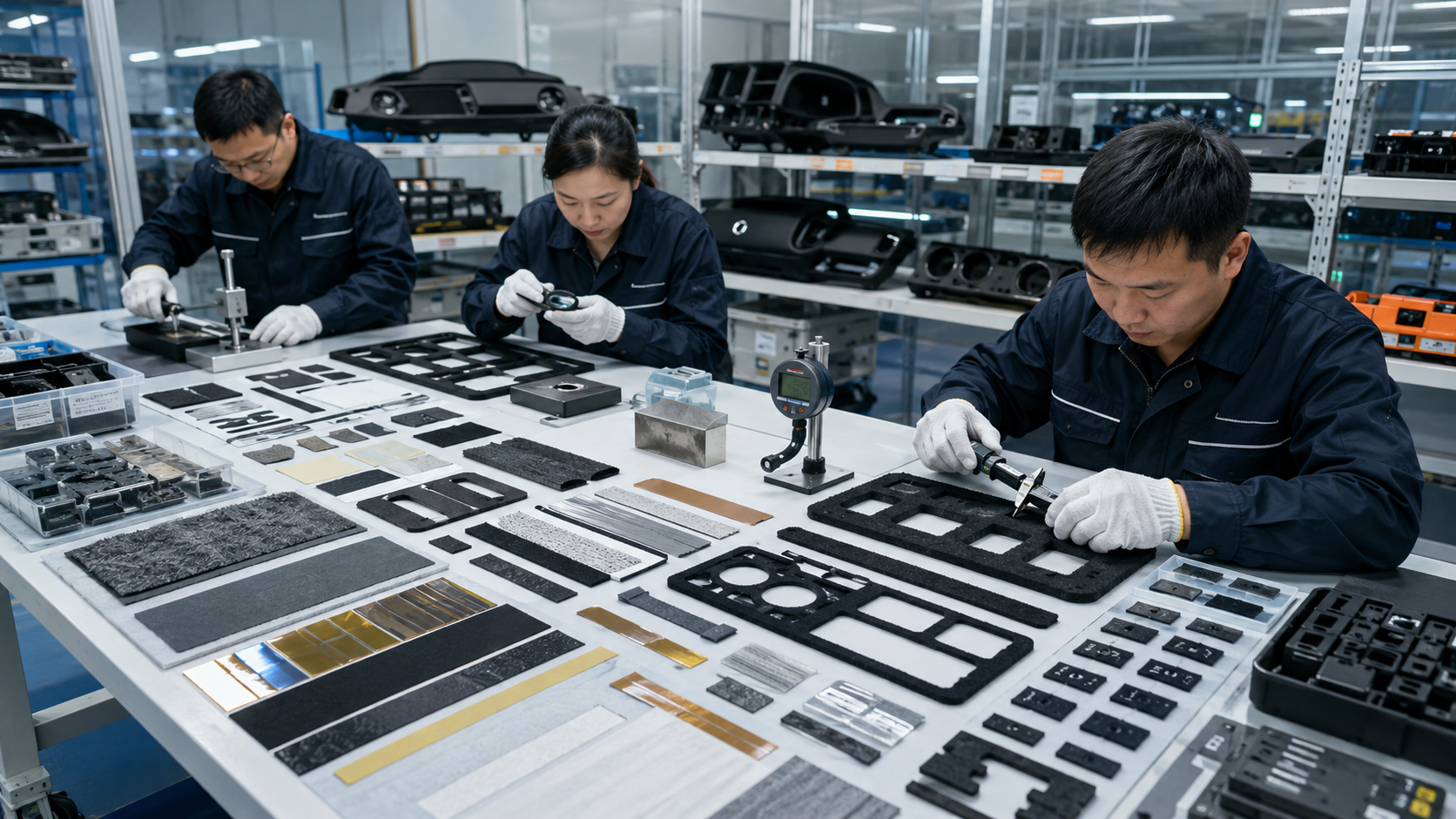
Our goal is to help customers reduce poor fit, adhesive lifting, fiber shedding, liner release problems, inspection failure, repeated samples, and unstable mass production.
A good automotive die cut part should be clean, accurate, easy to handle, easy to assemble, and stable throughout vehicle production.
Conclusion
Die cutting in automotive OEM manufacturing converts foam, rubber, non-woven felt, PET film, PI film, protective film, adhesive tape, and multilayer materials into custom components that support sealing, bonding, insulation, cushioning, NVH control, surface protection, and assembly efficiency.
The right automotive die cut part depends on material performance, tolerance, adhesive structure, edge quality, cleanliness, packaging, and final vehicle application.
At Sanken, we help automotive OEM customers develop reliable die cut parts that are clean, accurate, easy to assemble, and stable from sample development to mass production.