
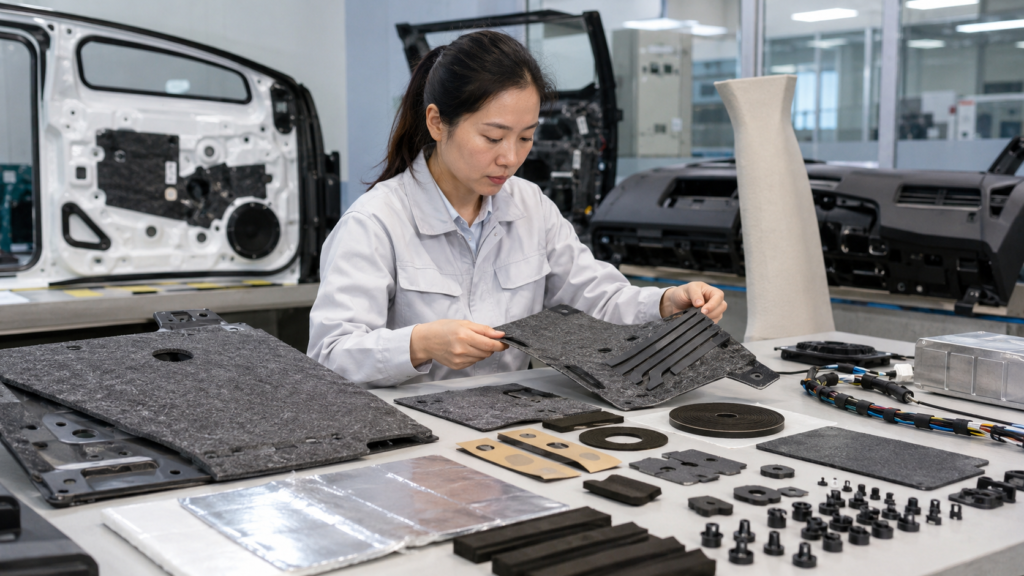
Heat-pressed felt products are widely used in automotive, industrial, and electronic applications because they provide excellent sound absorption, vibration damping, and structural stability. However, many engineers assume that once felt is heat-pressed into shape, it can function as a complete standalone solution.
In reality, most felt components still require die cut auxiliary parts to achieve full performance, precise assembly, and long-term reliability.
At Sanken , we often see that the final performance of felt assemblies depends not only on the heat-pressed structure itself, but also on how well it integrates with precision die-cut supporting components.
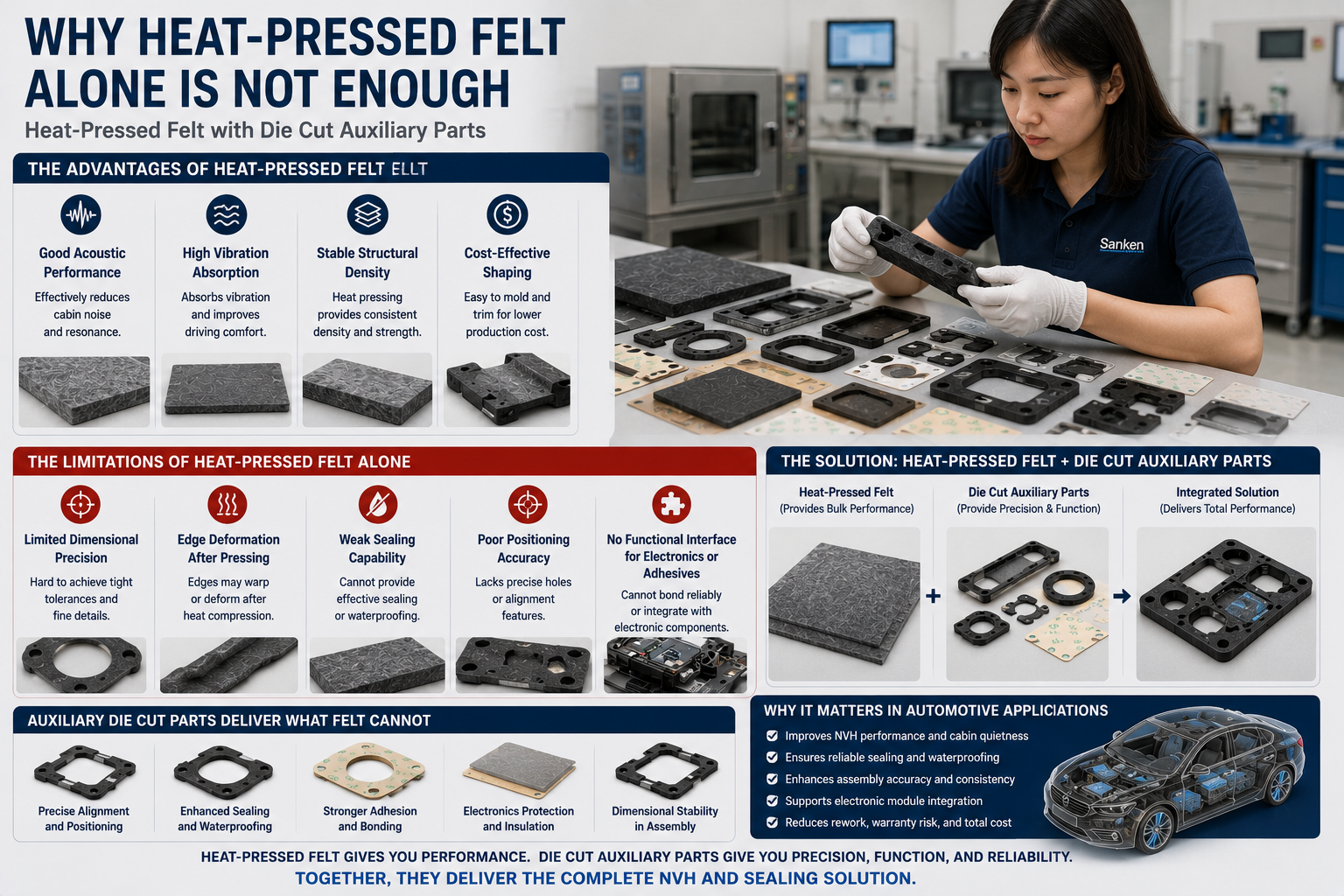
Why Heat-Pressed Felt Alone Is Not Enough
Heat-pressed felt has strong advantages:
- Good acoustic performance
- High vibration absorption
- Stable structural density
- Cost-effective shaping
But it also has limitations:
- Limited dimensional precision
- Edge deformation after pressing
- Weak sealing capability
- Poor positioning accuracy in assembly
- No functional interface for electronics or adhesives
This is where auxiliary die cut parts become necessary.
Theme: Heat-Pressed Felt with Die Cut Auxiliary Parts
1. Die Cut Parts Provide Precision Positioning
Heat-pressed felt is flexible by nature.
That flexibility creates a problem in assembly:
- misalignment
- shifting during installation
- inconsistent positioning
Die cut auxiliary parts solve this by adding:
- positioning holes
- alignment edges
- mechanical reference geometry
This ensures every felt part installs in the same position.
2. Improving Sealing and Edge Control
Felt alone cannot create a tight sealing structure.
In automotive and electronics applications, gaps cause:
- air leakage
- dust intrusion
- vibration noise
Die cut auxiliary parts such as:
- foam gaskets
- adhesive frames
- sealing rings
help close those gaps and stabilize the assembly.
3. Enhancing Adhesion Performance
Heat-pressed felt surfaces are not always suitable for direct bonding.
Common issues include:
- weak adhesive grip
- uneven bonding surface
- fiber shedding
Die cut adhesive components provide:
- controlled bonding areas
- stable adhesive layers
- clean installation surfaces
This improves long-term reliability.
Theme: Automotive Felt and Die Cut Hybrid Structure
4. Supporting Multi-Layer Functional Design
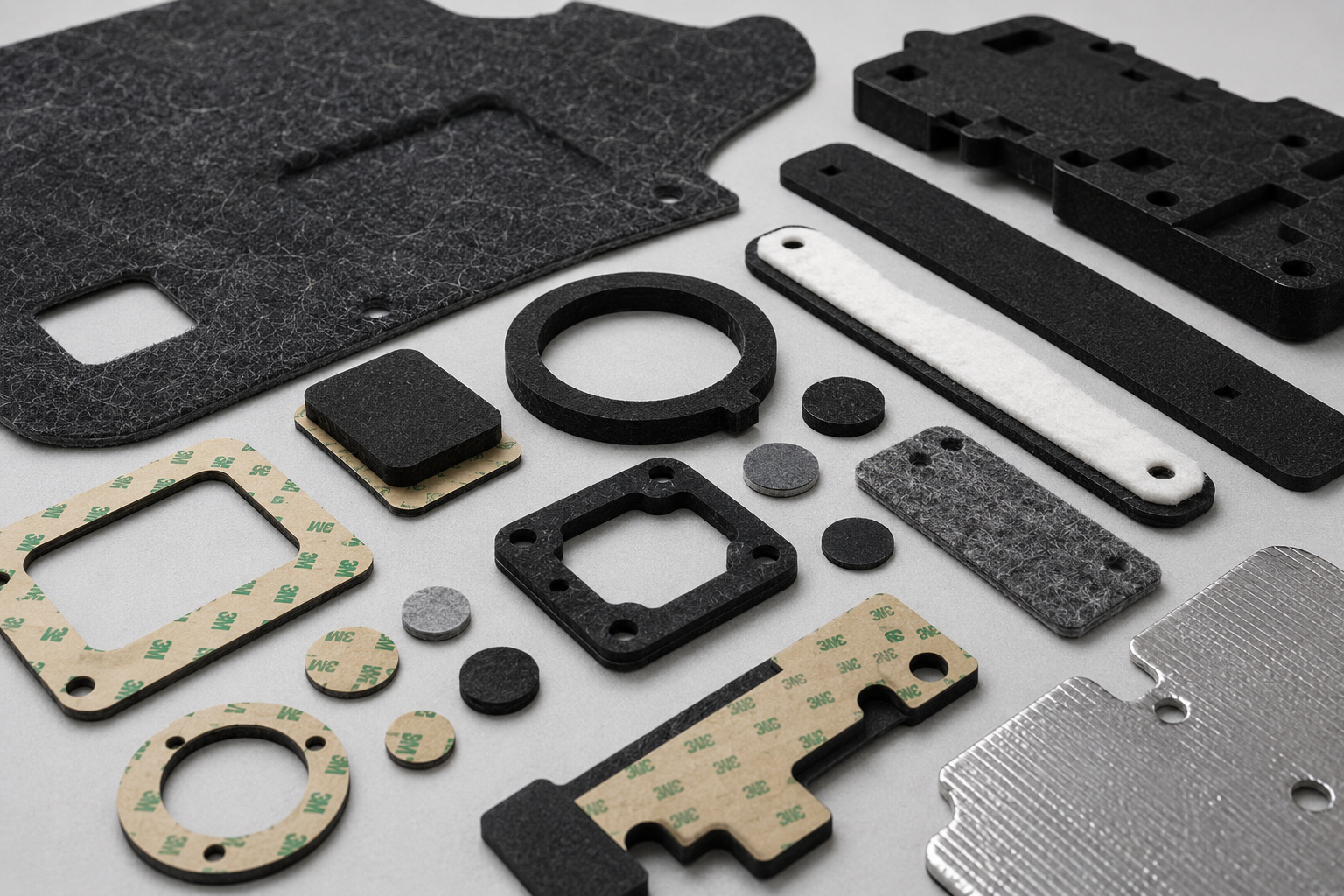
Modern automotive NVH systems are no longer single-layer designs.
They often combine:
- heat-pressed felt
- foam layers
- adhesive tapes
- PET films
- rubber spacers
Die cut auxiliary parts allow these layers to work together as a system.
Benefits include:
- better vibration control
- improved acoustic tuning
- stronger structural integrity
5. Compensating for Manufacturing Tolerances
Heat-pressed felt naturally has:
- thickness variation
- edge deformation
- compression differences
Die cut parts compensate for these variations by:
- filling gaps
- controlling compression zones
- stabilizing assembly pressure
This improves consistency in mass production.
6. Improving Assembly Efficiency
Without die cut auxiliary parts, assembly requires:
- manual positioning
- trimming adjustments
- re-alignment during installation
With die cut components:
- faster installation
- fewer errors
- repeatable assembly process
This is critical for automotive OEM production lines.
7. Enabling Functional Integration
Die cut auxiliary parts can integrate multiple functions:
- sealing + cushioning
- insulation + positioning
- vibration + adhesive bonding
This reduces total part count and simplifies design.
Common Applications in Automotive Industry
Heat-pressed felt with die cut auxiliary parts is widely used in:
Interior NVH Systems
- door panels
- dashboards
- roof liners
Electrical Systems
- wire harness protection
- ECU insulation
EV Battery Systems
- vibration damping layers
- thermal isolation
How Sanken Supports Felt + Die Cut Solutions
At Sanken, we combine:
- heat-pressed felt production
- precision die cutting
- foam and rubber converting
- adhesive lamination
- multi-layer assembly
We provide integrated NVH and insulation solutions for:
- automotive OEMs
- Tier 1 suppliers
- EV battery manufacturers
- industrial equipment producers
Featured Snippet Summary
Heat-pressed felt products still need die cut auxiliary parts to improve positioning accuracy, sealing performance, adhesion strength, and assembly consistency in automotive and industrial applications.
Conclusion
Heat-pressed felt provides excellent acoustic and vibration performance, but it is not a complete engineering solution on its own.
Die cut auxiliary parts enhance:
- precision
- sealing
- adhesion
- assembly efficiency
- system integration
Together, they form a complete functional system for modern automotive and industrial applications.
At Sanken, we don’t treat felt as a single material.
👉 We engineer it as a system with precision die cut components.