
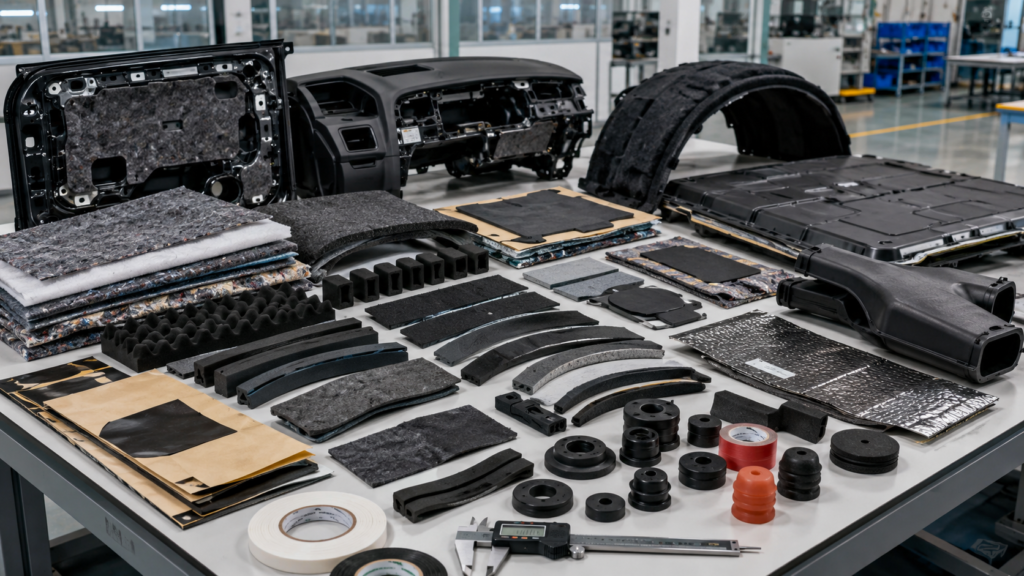
As consumers expect quieter, smoother, and more comfortable vehicles, automotive manufacturers are placing greater emphasis on NVH (Noise, Vibration, and Harshness) performance. Whether in conventional vehicles, hybrids, or electric vehicles (EVs), precision NVH materials play a critical role in reducing unwanted noise, isolating vibration, preventing rattles, and improving overall driving quality.
Behind every quiet cabin are hundreds of precision die cut foam, felt, rubber, and adhesive components. Although these parts are often hidden inside the vehicle, they significantly influence acoustic performance, assembly quality, durability, and customer satisfaction.
At Sanken, we manufacture precision die cut non-woven felt, foam gaskets, rubber isolators, adhesive tape components, PET insulation films, protective films, and multilayer laminated NVH components for automotive interiors, battery systems, doors, dashboards, HVAC modules, body structures, and electronic assemblies.
Why Automotive NVH Materials Matter
Every vehicle generates unwanted noise and vibration from multiple sources, including:
- Engine or electric motor
- Road surface
- Tires
- Wind
- HVAC systems
- Cooling fans
- Compressors
- Battery systems
- Plastic trim
- Door panels
- Wiring harnesses
Without proper NVH solutions, these vibrations and noises can reach the passenger cabin, reducing comfort and perceived vehicle quality.
Precision die cut NVH materials help provide:
- Noise absorption
- Vibration isolation
- Anti-rattle protection
- Air sealing
- Dust sealing
- Component cushioning
- Surface protection
- Assembly positioning
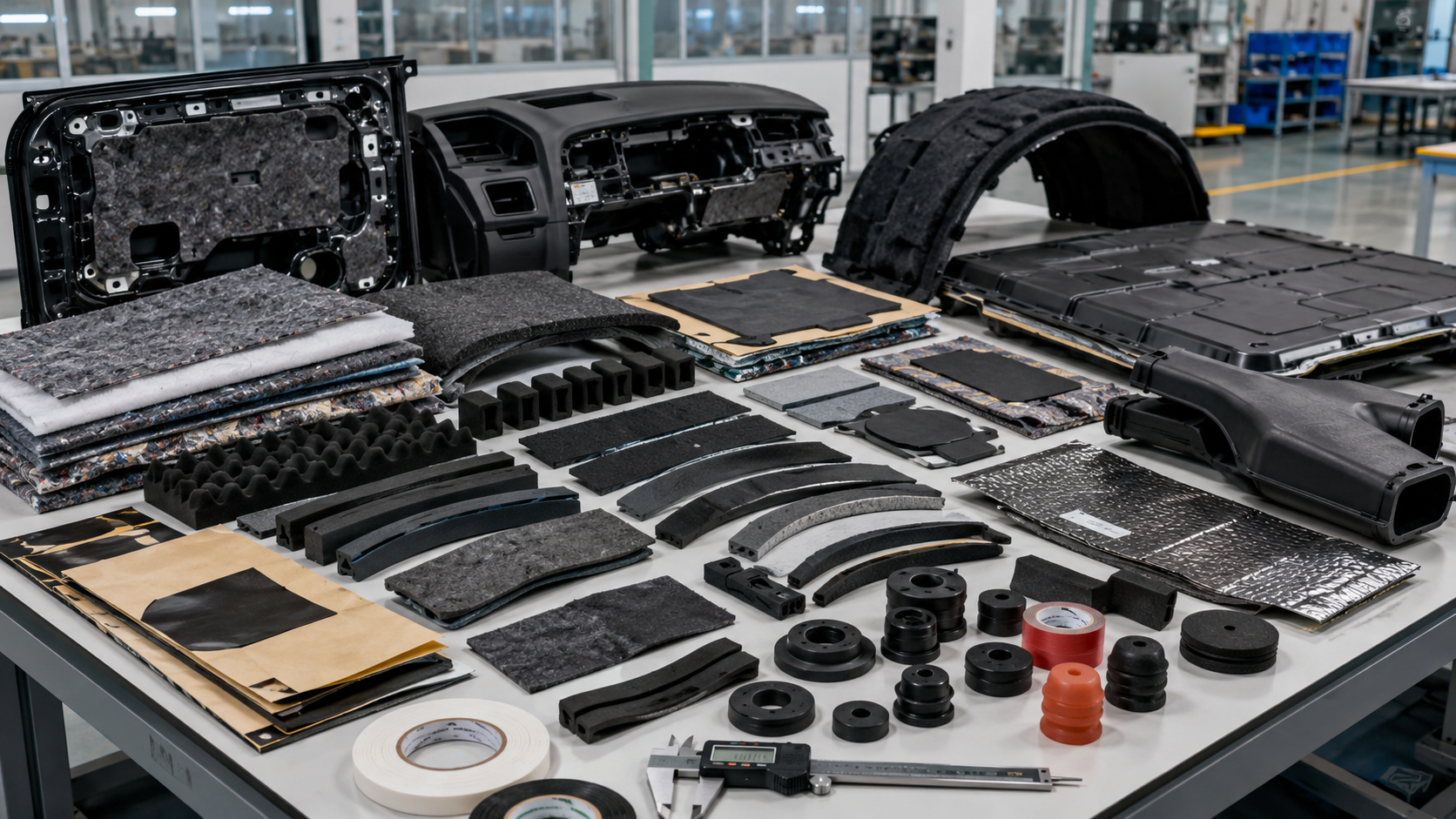
Common Automotive NVH Materials
Different vehicle locations require different combinations of NVH materials.
| Material | Primary Function |
|---|---|
| Non-Woven Felt | Noise absorption and anti-rattle |
| EVA Foam | Cushioning and sealing |
| PE Foam | Gap filling and vibration isolation |
| EPDM Foam | Environmental sealing |
| PU Acoustic Foam | Sound absorption |
| EPDM Rubber | Vibration damping |
| Silicone Rubber | High-temperature isolation |
| PET Insulation Film | Electrical insulation |
| Double-Sided Adhesive Tape | Bonding and positioning |
| Protective Film | Surface protection |
| Multilayer Laminates | Combined acoustic and sealing performance |
Material selection depends on installation location, operating temperature, moisture exposure, vibration frequency, and assembly method.
Non-Woven Felt for Noise Reduction
Needle-punched non-woven felt is one of the most widely used automotive NVH materials because of its excellent sound absorption and lightweight construction.
Typical applications include:
- Door panels
- Instrument panels
- Center consoles
- Headliners
- Pillar trim
- Wheel arch liners
- Trunk trim
- Battery covers
- Wiring harness protection
Non-woven felt helps:
- Absorb airborne noise
- Prevent plastic squeaks
- Eliminate rattles
- Reduce panel resonance
- Protect contacting surfaces
- Improve cabin comfort
Selection should consider:
- Thickness
- Density
- Fiber weight
- Compression resistance
- Wear resistance
- Flame resistance
- Moisture resistance
Higher density is not always better. Material selection should match the target frequency range and installation environment.
Foam Materials for Sealing and Vibration Control
Foam materials perform multiple NVH functions while maintaining low weight.
Common foam materials include:
- EVA foam
- PE foam
- EPDM foam
- PU foam
- Silicone foam
Typical applications include:
- Door sealing
- Dashboard cushioning
- HVAC sealing
- Battery pack cushioning
- Electronic module protection
- Interior trim support
- Air duct sealing
Foam materials provide:
- Gap filling
- Compression sealing
- Shock absorption
- Vibration isolation
- Noise reduction
- Tolerance compensation
Selection factors include compression set, recovery performance, density, water resistance, operating temperature, and long-term aging.
Rubber Materials for High-Durability Applications
Rubber materials are commonly selected where stronger vibration isolation and long service life are required.
Common rubber materials include:
- EPDM rubber
- Silicone rubber
- NBR
- CR rubber
Typical applications include:
- Engine compartment assemblies
- HVAC modules
- Battery systems
- Electronic modules
- Cable protection
- Chassis components
- Mounting pads
Compared with foam, rubber generally provides:
- Better compression recovery
- Superior weather resistance
- Higher chemical resistance
- Longer service life
- Stronger vibration damping
Rubber hardness should be selected carefully to balance vibration isolation with structural support.
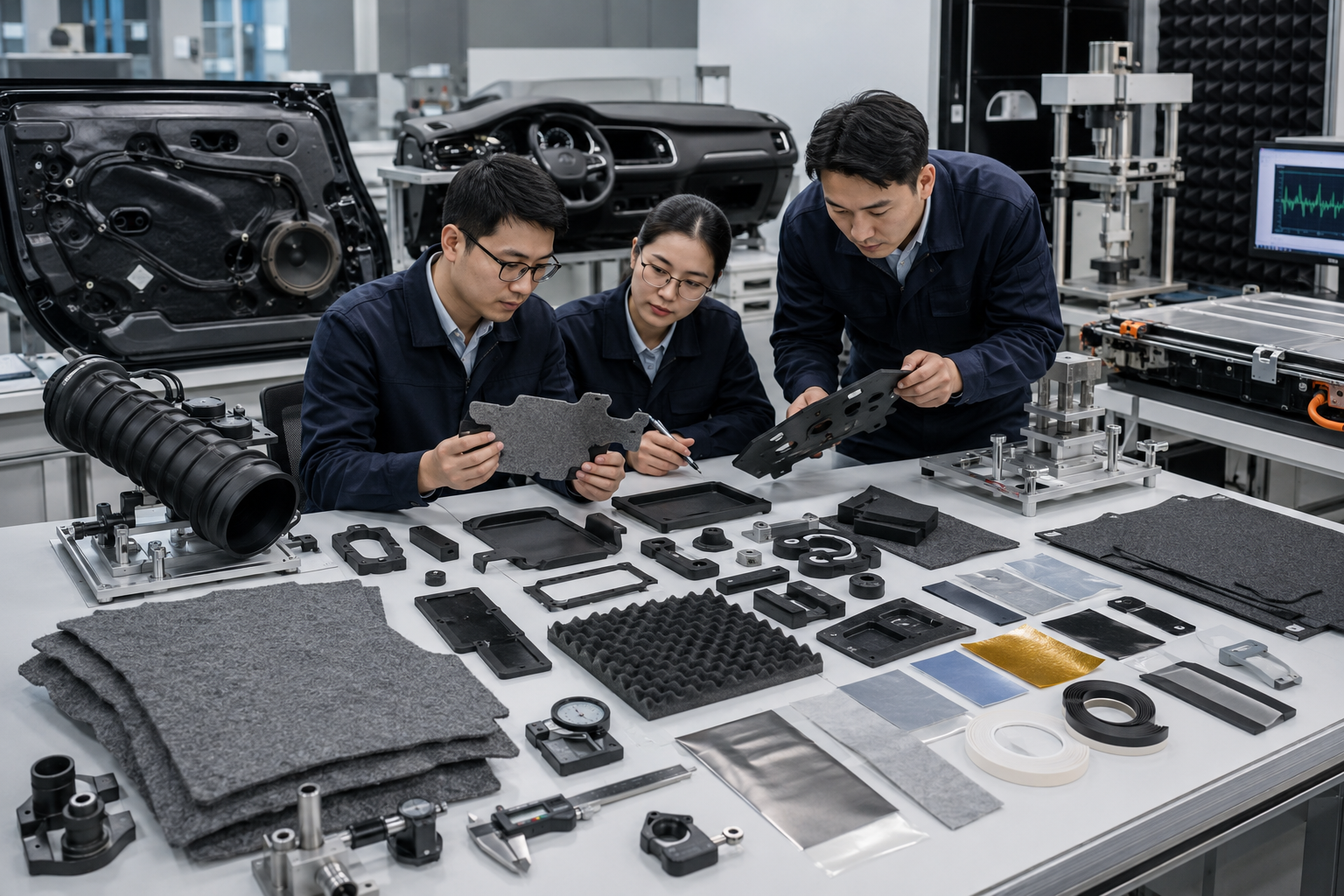
Adhesive Components Improve Assembly Efficiency
Many automotive NVH materials are supplied with pressure-sensitive adhesive backing.
Adhesive-backed components help:
- Improve positioning accuracy
- Support automated assembly
- Prevent component movement
- Reduce assembly time
- Improve manufacturing consistency
Common adhesive systems include:
- Acrylic adhesive
- Double-sided tape
- Foam tape
- Transfer adhesive
- PET carrier tape
The adhesive should match the installation surface, including painted metal, aluminum, composite materials, plastics, textiles, or coated surfaces.
Proper liner release also improves production efficiency.
Multilayer NVH Components
Many automotive NVH parts combine multiple materials into one precision die cut component.
Examples include:
| Multilayer Structure | Function |
|---|---|
| Felt + Adhesive | Noise absorption and positioning |
| Foam + Adhesive | Sealing and vibration isolation |
| Rubber + Adhesive | Durable damping |
| PET Film + Foam | Insulation and cushioning |
| Felt + Foam + Adhesive | Acoustic absorption and sealing |
| Rubber + Felt + Adhesive | Vibration damping and anti-rattle |
Multilayer converting reduces assembly steps while improving positioning accuracy and production consistency.
Choosing the Right NVH Material
When selecting automotive NVH materials, engineers should consider:
| Selection Factor | Why It Matters |
|---|---|
| Noise frequency | Determines acoustic material performance |
| Vibration level | Influences damping requirements |
| Installation location | Determines environmental exposure |
| Compression requirement | Affects sealing and cushioning |
| Temperature resistance | Supports long-term durability |
| Moisture resistance | Prevents material degradation |
| Adhesive compatibility | Improves assembly reliability |
| Weight | Supports vehicle lightweighting |
| Die cut tolerance | Ensures accurate assembly |
Material selection should always be based on the actual application rather than material cost alone.
Precision Die Cutting Improves Component Performance
Material quality alone cannot guarantee NVH performance.
Precision die cutting provides:
- Tight dimensional tolerances
- Clean cutting edges
- Stable thickness
- Accurate hole positioning
- Precise adhesive placement
- Assembly-ready components
Poor die cutting can cause:
- Misalignment
- Loose parts
- Adhesive lifting
- Poor sealing
- Increased vibration
- Production delays
Consistent manufacturing is essential for automotive quality standards.
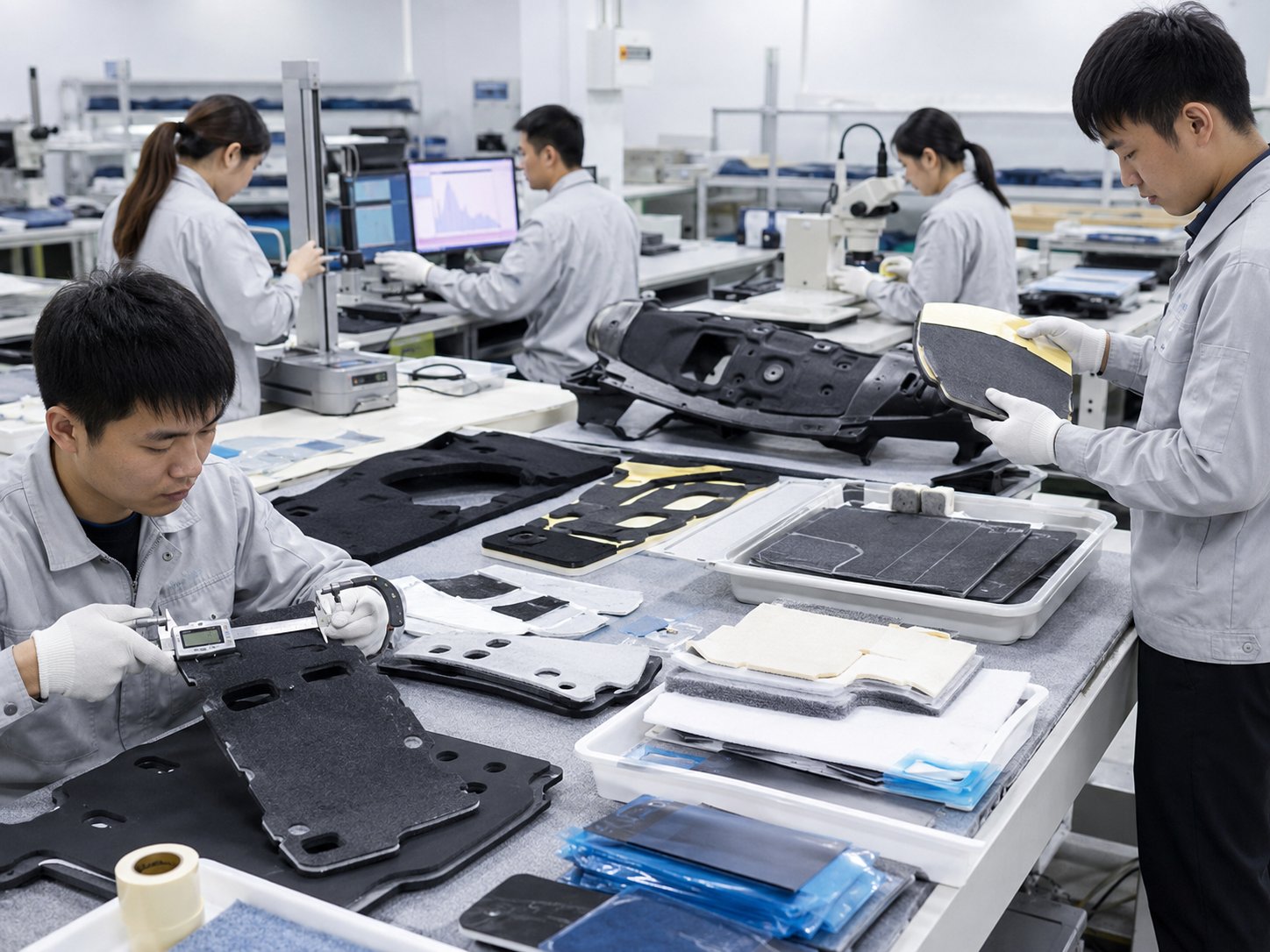
Quality Control for Automotive NVH Components
Automotive NVH parts require comprehensive inspection before shipment.
Important inspection items include:
| Inspection Item | Purpose |
|---|---|
| Material verification | Confirms approved material |
| Dimensions | Ensures assembly accuracy |
| Thickness | Controls compression |
| Adhesive position | Improves installation |
| Compression recovery | Confirms long-term durability |
| Edge cleanliness | Prevents contamination |
| Surface quality | Maintains appearance |
| Packaging condition | Prevents deformation |
Stable quality helps reduce assembly defects while improving long-term vehicle reliability.
How Sanken Supports Automotive NVH Projects
Sanken provides custom precision die cut NVH solutions for automotive OEMs and Tier 1 suppliers.
Our capabilities include:
- Needle-punched non-woven felt converting
- Foam gasket converting
- Rubber vibration isolators
- PET insulation films
- Double-sided adhesive tape converting
- Protective films
- Multilayer lamination
- Precision die cutting
- Sample development
- Quality inspection
- Assembly-ready packaging
Every project is evaluated according to acoustic performance, vibration isolation, compression behavior, environmental resistance, adhesive compatibility, dimensional tolerance, and production efficiency.
Our goal is to help customers reduce cabin noise, eliminate rattles, improve assembly consistency, and achieve stable high-volume production.
Buyer Checklist Before Requesting Samples
To develop effective automotive NVH components, buyers should prepare:
- 2D drawing
- 3D CAD model (if available)
- Vehicle application
- Installation location
- Material preference
- Thickness requirement
- Noise reduction target
- Vibration isolation requirement
- Operating temperature
- Adhesive requirement
- Bonding surface
- Environmental testing requirement
- Packaging format
- Annual production volume
- Existing sample (if available)
Providing complete engineering information helps optimize material selection and shorten development time.
FAQ
What are automotive NVH materials?
Automotive NVH materials reduce noise, vibration, and harshness inside vehicles. Common materials include non-woven felt, foam, rubber, adhesive tapes, insulation films, and multilayer laminated components.
Why is non-woven felt widely used in vehicles?
Non-woven felt absorbs sound, prevents rattles, protects contacting surfaces, and improves cabin comfort while remaining lightweight.
What foam materials are commonly used for automotive NVH?
Common materials include EVA foam, PE foam, EPDM foam, PU acoustic foam, and silicone foam for sealing, cushioning, and vibration isolation.
Why are adhesive-backed NVH components preferred?
They improve positioning accuracy, simplify installation, reduce assembly time, and support automated production.
What are multilayer NVH components?
They combine multiple materials such as felt, foam, rubber, films, and adhesives into a single assembly-ready component that improves performance and manufacturing efficiency.
Can Sanken manufacture custom automotive NVH components?
Yes. Sanken manufactures custom die cut non-woven felt, foam gaskets, rubber isolators, adhesive tape components, PET insulation films, and multilayer laminated NVH solutions for automotive OEMs and Tier suppliers.
Conclusion
Automotive NVH performance depends on selecting the right combination of foam, felt, rubber, and adhesive materials. Each material provides unique benefits for reducing noise, isolating vibration, improving sealing, and supporting efficient assembly.
By combining optimized material selection with precision die cutting, OEM manufacturers can improve cabin comfort, reduce warranty issues, simplify production, and deliver higher-quality vehicles.
At Sanken, we help automotive manufacturers develop precision die cut NVH solutions that provide reliable performance from prototype development through high-volume production.