
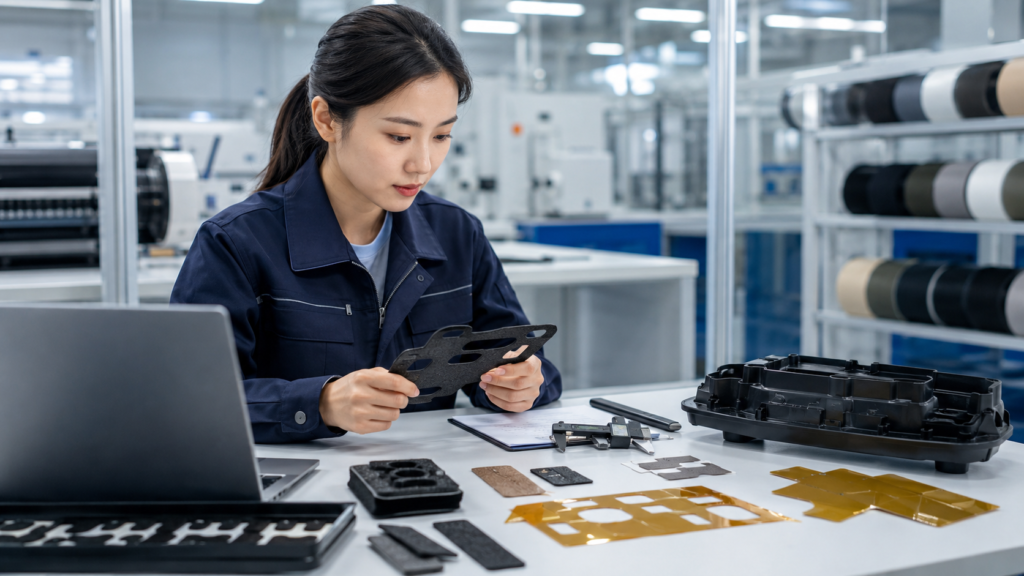
Adhesive foam die-cut gaskets are used when OEM products need sealing, cushioning, gap filling, dust protection, vibration reduction or assembly support.
They look simple.
A foam gasket with adhesive backing. A shape. A liner. Maybe a few holes.
But in real production, many things can go wrong: adhesive shift, poor liner release, foam deformation, thickness variation, edge burrs, compression failure and sealing leakage.
At Sanken, we manufacture adhesive foam gaskets through precision die cutting, material converting, lamination, kiss cutting, inspection and packaging control.
For OEM customers, the goal is not just a gasket that matches the drawing.
The goal is a gasket that seals reliably and works smoothly on the assembly line.
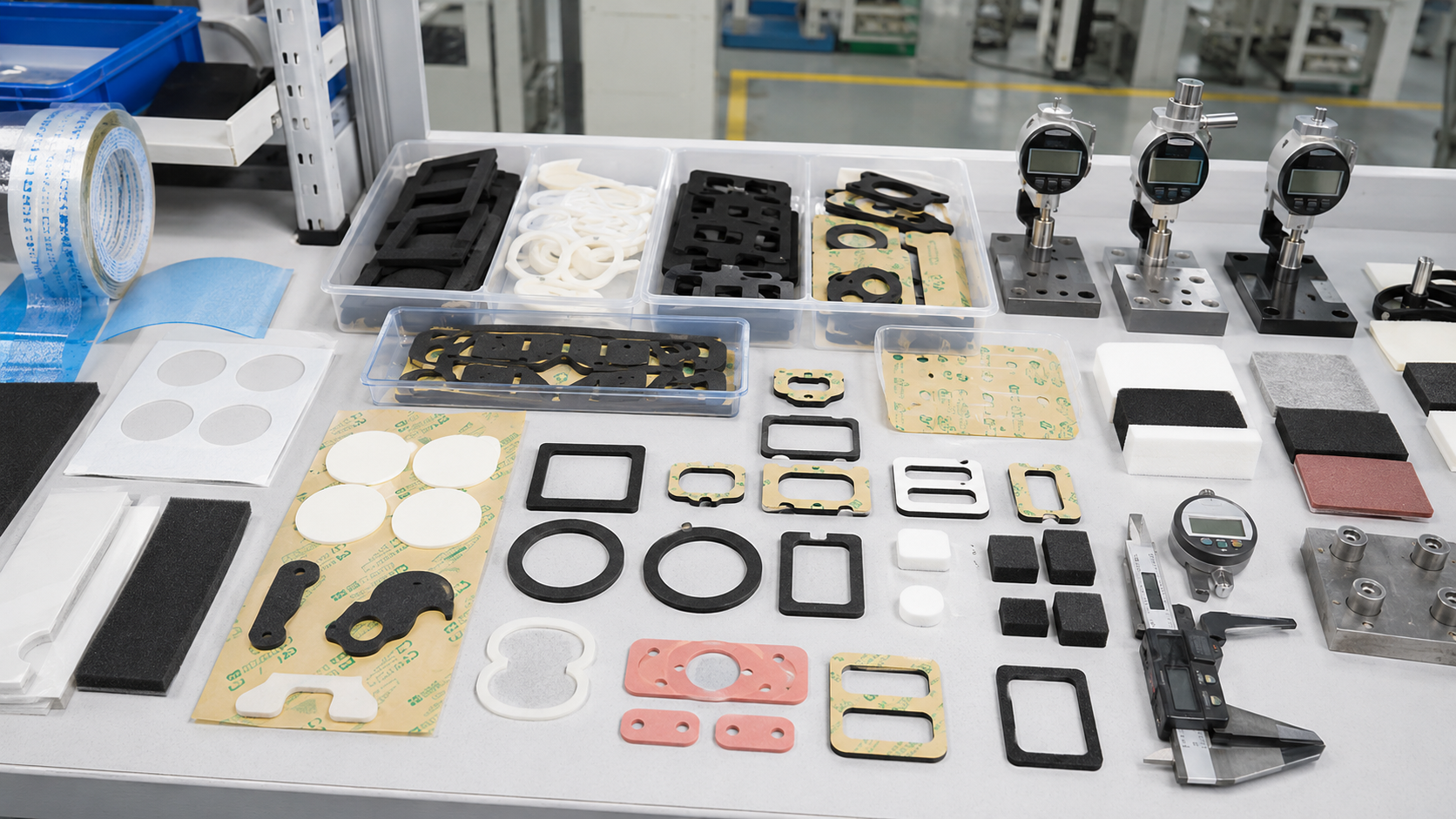
What Are Adhesive Foam Die-Cut Gaskets?
Adhesive foam die-cut gaskets are foam sealing parts with pressure-sensitive adhesive on one side or both sides.
They are usually supplied on release liner for easy peeling and assembly.
Common materials include:
| Material | Common Use |
|---|---|
| PE foam | General sealing, cushioning and gap filling |
| EVA foam | Cushioning, shock absorption and assembly support |
| PU foam | Soft sealing and compression applications |
| EPDM foam | Weather resistance, dust sealing and automotive sealing |
| Silicone foam | Heat-resistant sealing |
| Acrylic foam tape | Bonding, mounting and vibration control |
These gaskets are widely used in automotive electronics, appliances, displays, lighting modules, battery housings, HVAC systems, industrial equipment and medical device assemblies.
For sealing projects, foam gaskets and sealing components are often used to block dust, reduce vibration, prevent air leakage and protect sensitive components.
Step 1: Confirm the Sealing Application
Before manufacturing starts, we first review the application.
Foam gaskets are not selected by shape alone.
The gasket must match the sealing environment.
Important questions include:
- What does the gasket need to seal?
- Is it sealing air, dust, water or vibration?
- What is the compression space?
- What surface will the adhesive bond to?
- What temperature range will the part face?
- Does the gasket need flame resistance?
- Will the part be manually assembled or automatically applied?
- Should the part be supplied in sheets, rolls or kits?
This step is important because the wrong foam may still look correct in a sample.
But it may fail after compression, heat, aging or vibration.
That is the kind of surprise nobody wants in mass production.
Step 2: Choose the Foam Material
Foam material selection affects sealing performance.
A soft foam compresses easily, but it may lose recovery.
A dense foam keeps shape better, but it may be harder to assemble.
A foam with poor thickness stability may cause uneven sealing.
We usually review:
| Requirement | What We Check |
|---|---|
| Compression | Foam density, hardness and recovery |
| Sealing | Cell structure and surface condition |
| Thickness | Tolerance and assembly gap |
| Durability | Aging, heat and humidity resistance |
| Cleanliness | Particle control and edge quality |
| Bonding | Foam surface and adhesive compatibility |
For automotive, electronics and appliance OEM projects, stable material batches are important.
A gasket approved during sampling should not behave differently during mass production.
That is why material consistency matters as much as cutting accuracy.
Step 3: Select the Adhesive Structure
Adhesive selection is another key step.
The adhesive must match the bonding surface.
Plastic, metal, glass, painted surfaces and rubber surfaces all have different surface energy.
A strong adhesive on the wrong surface may still fail.
A weak adhesive may lift after assembly.
A poor liner may make peeling difficult for workers.
Common adhesive structures include:
- Single-sided adhesive foam
- Double-sided adhesive foam
- Foam tape with release liner
- PET-backed adhesive foam structure
- Transfer adhesive laminated to foam
- Foam gasket with pull tab
- Multilayer foam and film structure
For many OEM sealing applications, adhesive placement is critical.
If the adhesive shifts or overflows, the part may not fit correctly.
If the liner is too difficult to peel, assembly speed drops.
If the liner releases too easily, parts may lift during shipping.
Good adhesive foam gasket manufacturing is really a balance between bonding, peeling and handling.
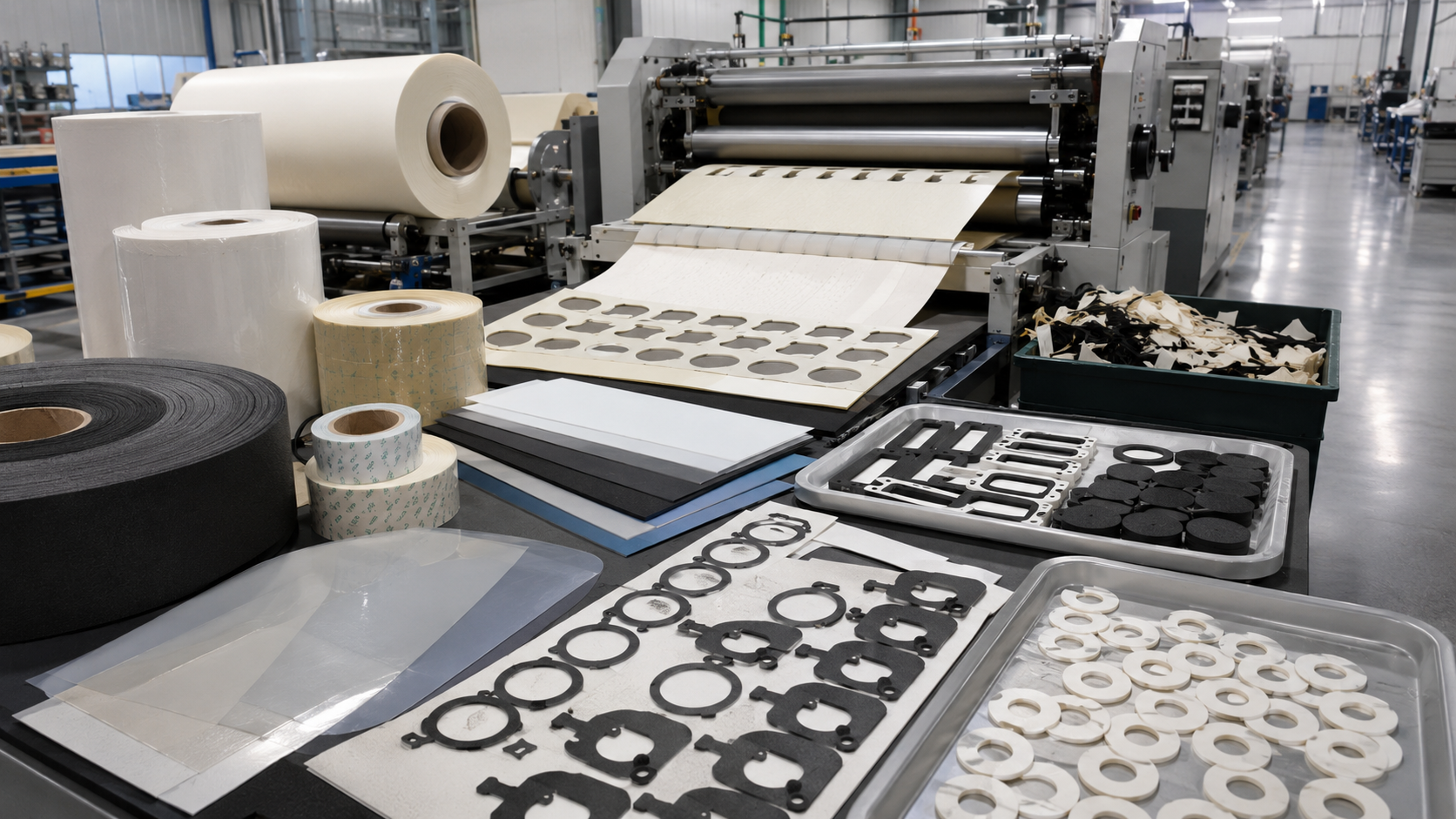
Step 4: Laminate Foam, Adhesive and Release Liner
After material selection, the foam is laminated with adhesive and release liner.
This step must be controlled carefully.
Poor lamination may cause wrinkles, bubbles, adhesive shift or uneven bonding.
For adhesive foam gaskets, lamination control affects final quality directly.
We focus on:
- Material tension
- Adhesive alignment
- Lamination pressure
- Bubble prevention
- Wrinkle control
- Liner matching
- Surface cleanliness
If the gasket uses multiple layers, each layer must stay aligned during converting.
For example, one gasket may combine foam, adhesive, PET film and release liner.
Another gasket may need a pull tab for easier assembly.
These details should be designed before mass production, not fixed after defects appear.
Step 5: Die Cut the Gasket Shape
After lamination, the material is die cut into the required gasket shape.
Depending on the project, we may use flatbed die cutting, rotary die cutting, kiss cutting or half cutting.
For roll materials and high-volume adhesive foam parts, roll-to-roll die cutting can improve efficiency and repeatability.
For thicker foam materials or sheet-based production, flatbed die cutting may be more suitable.
The cutting process must control:
| Cutting Point | Why It Matters |
|---|---|
| Outer shape | Ensures correct fit |
| Inner holes | Supports positioning and assembly |
| Cut depth | Protects release liner |
| Edge quality | Prevents particles and poor sealing |
| Adhesive edge | Reduces glue overflow |
| Waste removal | Keeps parts clean and usable |
| Part spacing | Improves peeling and assembly |
For adhesive foam gaskets, kiss cutting is often used.
This means the foam and adhesive layer are cut, but the release liner stays intact.
The customer can peel the gasket from the liner during assembly.
Simple idea.
Very useful in real production.
Step 6: Remove Waste and Control Liner Release
After cutting, the waste material around the gasket is removed.
This is called waste matrix removal.
For adhesive foam gaskets, this step must be stable.
If the waste tears, production slows down.
If the gasket lifts with the waste, parts may be damaged.
If the liner release is poor, the customer may struggle during assembly.
We usually check:
- Waste removal direction
- Gasket shape stability
- Liner release force
- Pull-tab design
- Adhesive edge condition
- Small-hole waste removal
- Part spacing on liner
This is especially important for thin foam frames, narrow gasket walls and small adhesive-backed parts.
A gasket that passes dimension inspection but is difficult to peel is still not a good production part.
Step 7: Inspect the Finished Gaskets
Inspection is critical for OEM sealing parts.
A gasket may fail because of a small issue.
Too thin.
Too thick.
Wrong hole position.
Adhesive shift.
Dirty surface.
Damaged edge.
Poor liner release.
We usually inspect key points such as:
| Inspection Item | Purpose |
|---|---|
| Dimensions | Ensure correct assembly fit |
| Thickness | Control compression and sealing |
| Hole alignment | Prevent positioning problems |
| Adhesive placement | Improve bonding reliability |
| Edge quality | Reduce particles and poor sealing |
| Surface cleanliness | Prevent contamination |
| Compression behavior | Confirm sealing performance |
| Liner release | Improve assembly efficiency |
| Packaging condition | Prevent deformation during shipping |
For automotive sealing, electronic housings, battery packs and display modules, these details matter.
A foam gasket is small.
A sealing failure is not.
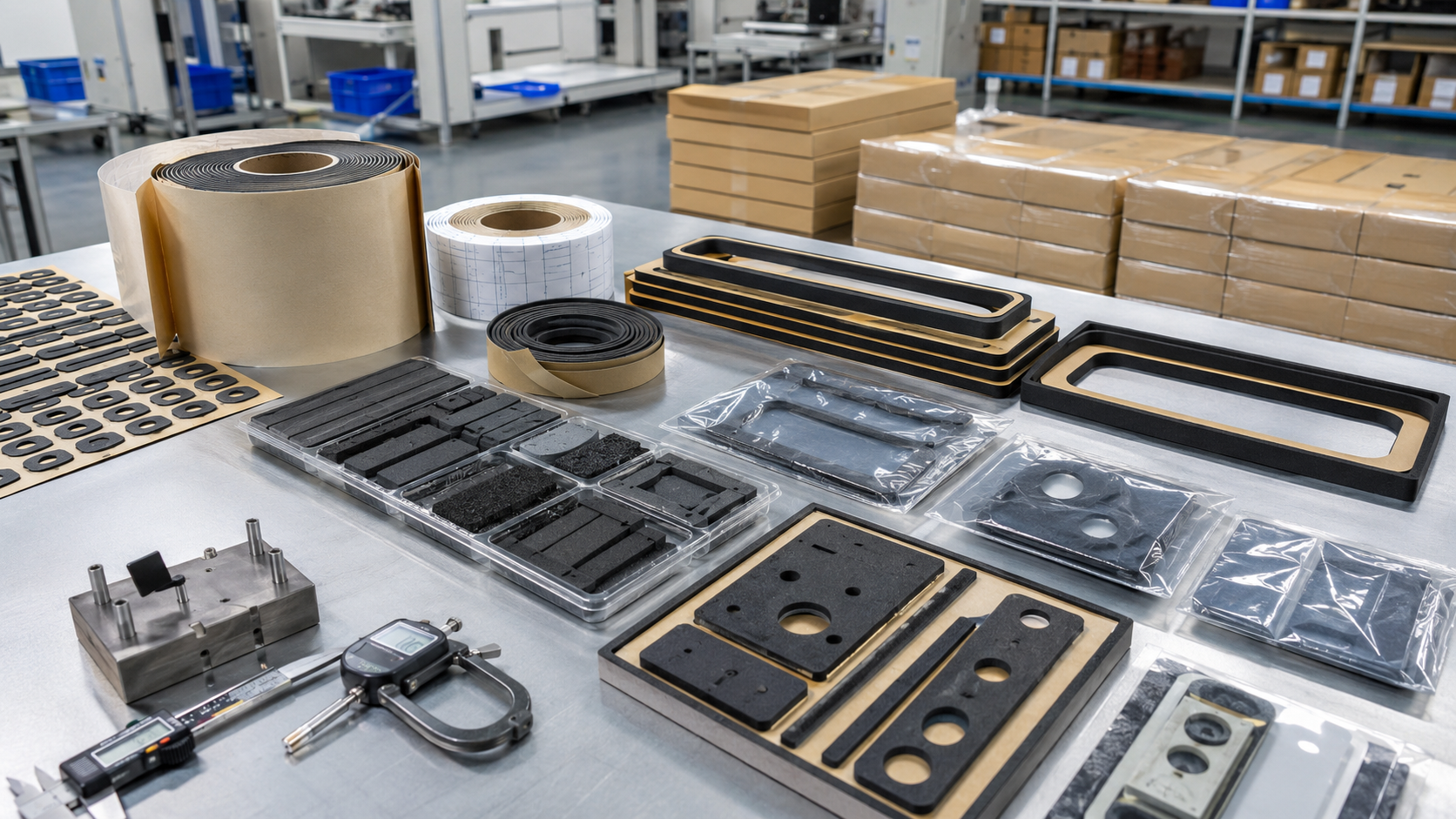
Step 8: Choose the Right Delivery Format
The delivery format affects customer assembly speed.
Some adhesive foam gaskets are supplied as individual pieces.
Some are supplied in sheets.
Some are supplied on rolls.
Some are supplied as kits with related parts.
For manual assembly, die cut parts supplied in sheets may be easier for operators to pick and place.
For automated assembly, roll format may improve speed and consistency.
For multi-part OEM assemblies, kits can reduce missing parts and simplify production.
| Delivery Format | Suitable Application |
|---|---|
| Sheets | Manual picking and organized assembly |
| Rolls | Automated application and high-volume use |
| Kiss-cut liner | Adhesive-backed foam gaskets |
| Individual pieces | Simple assembly or low-volume projects |
| Kits | Multi-part OEM assembly |
| Trays or bags | Parts needing deformation protection |
A good gasket should arrive ready to use.
Not ready to create more work.
Common OEM Sealing Applications
Adhesive foam die-cut gaskets are used in many OEM products.
| Industry | Common Applications |
|---|---|
| Automotive | ECUs, EV batteries, lighting, HVAC, doors, displays |
| Electronics | Housings, displays, sensors, connectors, control panels |
| Appliances | Air conditioners, refrigerators, washers, control panels |
| Optical | Display modules, protective films, light-blocking parts |
| Medical devices | Equipment housings, pads, protection and sealing |
| Industrial equipment | Enclosures, panels, vibration control and dust sealing |
For automotive assembly, automotive die cut components often include adhesive foam gaskets for sealing, cushioning, bonding and NVH control.
For optical or display-related projects, optical film die cut components may be used together with foam spacers, adhesive frames, protective films and light-blocking films.
What Buyers Should Provide Before Quotation
To make a correct adhesive foam gasket, we need more than a size.
Helpful project information includes:
- Drawing or sample
- Foam type or performance requirement
- Thickness
- Adhesive side
- Bonding surface
- Compression gap
- Application location
- Temperature range
- Water, dust or air sealing requirement
- Flame-retardant requirement
- Tolerance
- Annual volume
- Delivery format
- Packaging preference
If the material is not confirmed, we can help review options.
If the design is not final, we can also discuss gasket width, hole position, pull tab, liner type and assembly method.
Before starting a new OEM project, buyers can also review how to choose the right die cutting manufacturer for sample development and mass production.
Need Adhesive Foam Die-Cut Gaskets for OEM Sealing?
Adhesive foam die-cut gaskets are manufactured through material selection, adhesive lamination, precision cutting, waste removal, inspection and controlled packaging.
The process looks simple only after it is done well.
If you need custom die cut parts for OEM assembly, send us your drawing, sample, material requirement, adhesive structure, tolerance, application location, compression requirement, annual volume and packaging preference.
Sanken can help review foam selection, adhesive structure, die cutting method, liner design, inspection points and delivery format before mass production.
Conclusion
Adhesive foam die-cut gaskets are used for sealing, cushioning, dust protection, vibration reduction and OEM assembly support. To manufacture them well, foam, adhesive, liner, tooling, kiss cutting, inspection and packaging must work together. A good gasket does not only fit the drawing. It seals reliably in real production.