
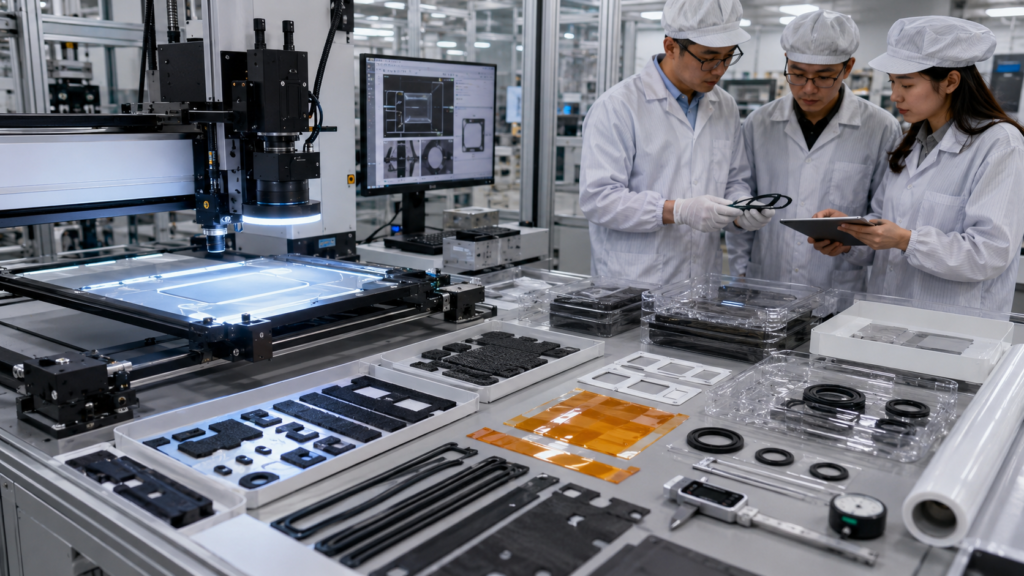
Automotive OEM parts must be accurate, repeatable and ready for assembly.
That sounds simple.
But when a part is made from foam, rubber, adhesive tape, PET film, PI film, protective film, non-woven felt or laminated material, small process changes can create big problems.
At Sanken, we use precision die cutting and material converting to produce custom parts for automotive sealing, insulation, bonding, NVH control, vibration reduction and electronic protection.
Automation helps us make these parts more stable from sample approval to mass production.
It does not replace engineering judgment.
It makes good engineering easier to repeat.
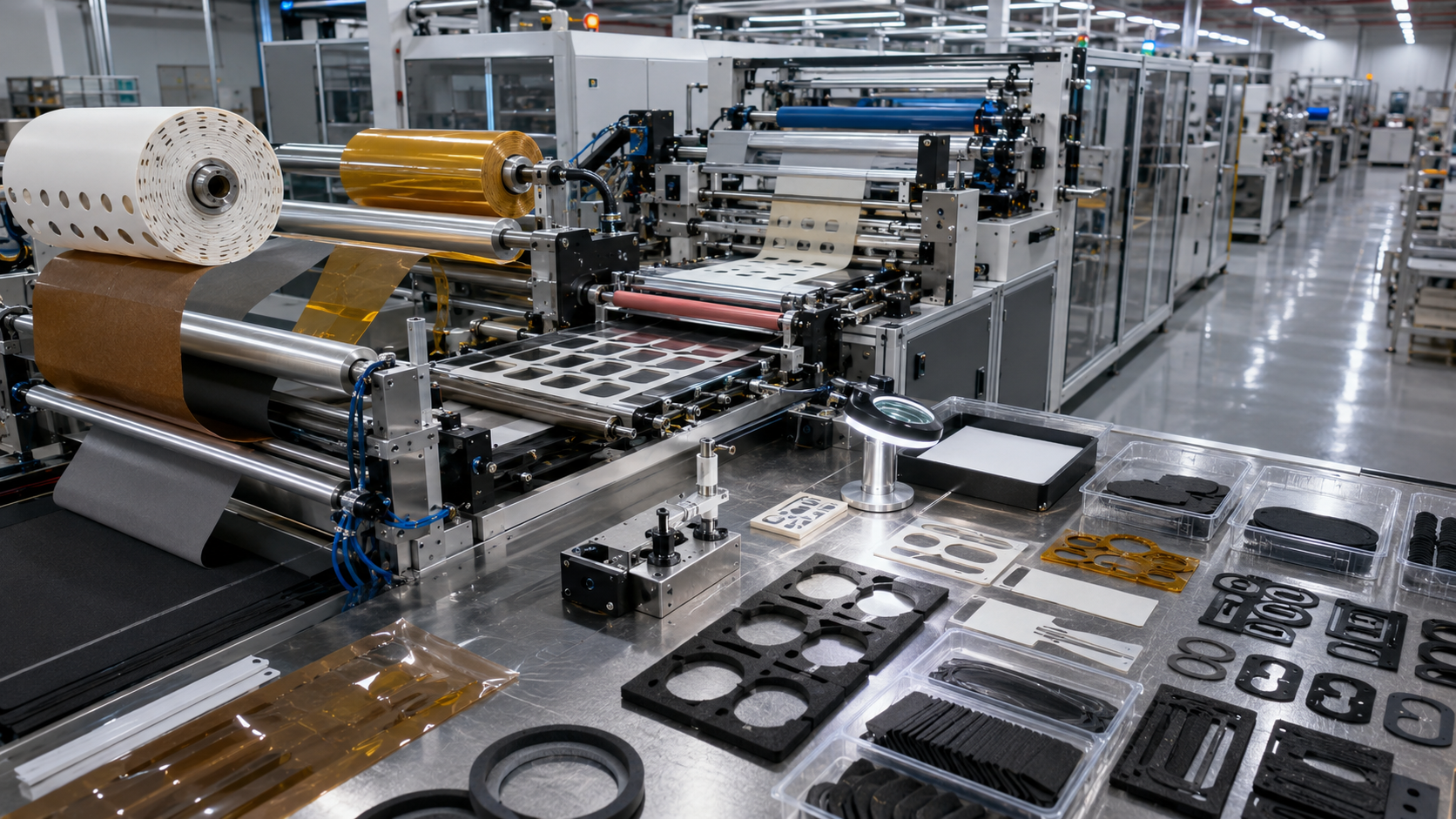
Why Automation Matters in Automotive Die Cutting
Automotive die cut parts are often hidden inside the vehicle.
But they still affect safety, comfort and reliability.
A foam gasket may seal an ECU housing.
A PET film may insulate a battery area.
A rubber pad may reduce vibration.
A non-woven felt part may reduce cabin noise.
An adhesive tape frame may bond a display module.
For automotive die cut components, the challenge is not only cutting the correct shape.
The challenge is repeating that shape thousands or millions of times with stable quality.
Automation helps reduce variation caused by manual feeding, material shifting, inconsistent pressure, poor alignment and unstable waste removal.
In automotive manufacturing, repeatability is not a luxury.
It is the starting point.
Where Automation Improves the Process
Automation can support many steps in die cutting and material converting.
| Process Area | How Automation Helps |
|---|---|
| Material feeding | Reduces material shifting and tension variation |
| Lamination | Improves layer alignment and adhesive placement |
| Cutting | Supports stable pressure, position and repeatability |
| Kiss cutting | Controls cut depth for adhesive and liner structures |
| Waste removal | Reduces manual handling and contamination risk |
| Inspection | Detects size, position and surface defects faster |
| Counting and packaging | Improves delivery accuracy and assembly readiness |
For automotive OEM projects, these improvements help reduce rework, sorting, line stoppages and inconsistent part performance.
Better Tolerance Control
Tolerance control is one of the biggest reasons OEM customers choose automated die cutting.
In automotive parts, a small size change can affect fit, bonding, sealing or electrical protection.
Automation helps control:
- Feeding distance
- Material tension
- Cutting position
- Tool pressure
- Layer alignment
- Registration accuracy
- Repeat cutting consistency
This is especially important for PET films, PI films, adhesive tape frames, foam gaskets and rubber seals.
If the part has holes, slots or thin borders, alignment becomes even more critical.
For battery insulation, display bonding and sensor protection parts, poor alignment can create assembly risk.
Automation helps keep the process stable instead of depending too much on manual adjustment.
More Stable Adhesive Tape Converting
Adhesive tape parts are widely used in automotive assembly.
They support bonding, mounting, sealing, vibration control and surface protection.
But adhesive tape is also easy to mishandle.
It may stretch, stick, shift, wrinkle or leave residue if the process is not controlled well.
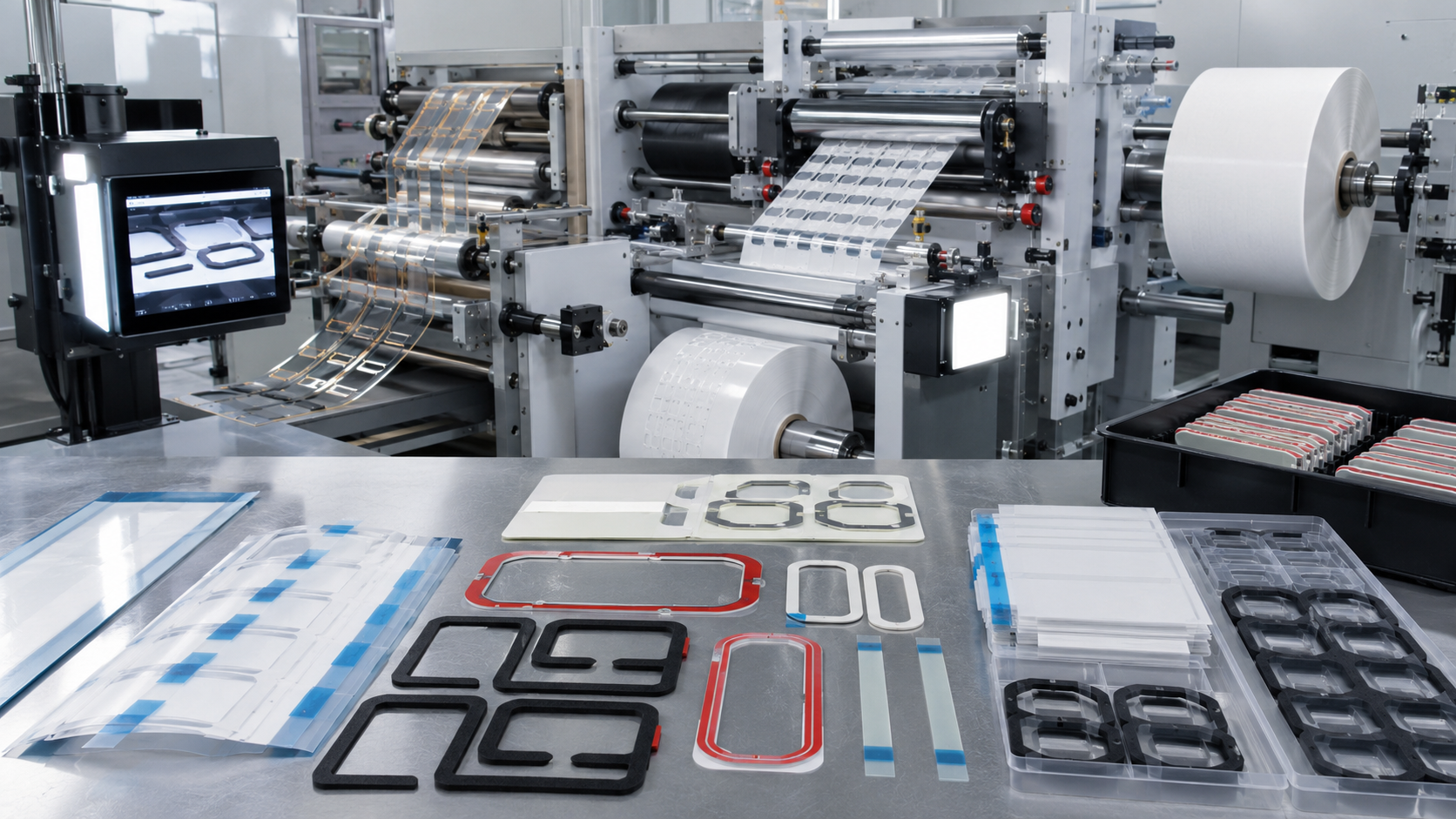
Automation helps control adhesive tape converting through:
- Stable roll feeding
- Accurate lamination
- Controlled kiss cutting
- Clean waste removal
- Better liner release control
- Consistent pull-tab positioning
- Repeatable part spacing
For roll materials and high-volume assembly, roll-to-roll die cutting can improve production efficiency and consistency.
This is useful for adhesive tape frames, protective films, PET-backed adhesive parts, foam tape gaskets and thin film components.
A good adhesive part should not only stick.
It should also peel smoothly, align correctly and help the customer assemble faster.
Better Foam Gaskets and Sealing Parts
Foam and rubber sealing parts are common in automotive electronics, lighting, HVAC systems, battery housings, doors and interior assemblies.
For sealing applications, foam gaskets and sealing components must have stable thickness, clean edges and controlled compression.
Automation helps improve sealing part quality by reducing:
- Uneven feeding
- Edge deformation
- Hole misalignment
- Adhesive offset
- Manual handling damage
- Part-to-part variation
- Packaging deformation
For foam gaskets, compression behavior is important.
If the part is too thin, sealing may fail.
If the part is too thick, assembly may become difficult.
If the adhesive backing shifts, the gasket may lift or bond poorly.
Automation helps keep the gasket shape and adhesive structure more consistent.
Improved Film and Insulation Part Quality
Automotive electronics and EV batteries use many die cut films.
Common materials include PET film, PI film, protective film, black PET film, flame-retardant film and adhesive-backed insulation film.
These parts may be used around:
- ECUs
- PCBs
- Connectors
- Sensors
- Battery modules
- Busbars
- Display modules
- Camera systems
Film parts often require clean edges, accurate holes, stable liner release and low contamination.
Automation helps reduce scratches, fingerprints, dust and misalignment.
It also improves consistency when films are laminated with adhesive or release liner.
For thin insulation parts, this matters a lot.
A small defect may not look serious at first.
But in an automotive electronic module, poor insulation coverage can become a real reliability issue.
Faster Production Without Losing Control
Speed matters in automotive manufacturing.
But speed without control is dangerous.
Automation helps increase production capacity while keeping the process stable.
This is useful when customers need repeated batches, tight delivery schedules and consistent parts for assembly lines.
| OEM Requirement | How Automation Supports It |
|---|---|
| Stable dimensions | Controlled feeding and cutting |
| Fast delivery | Higher production efficiency |
| Consistent quality | Repeatable process parameters |
| Clean handling | Less manual contact |
| Assembly efficiency | Better part spacing and liner design |
| Lower defect risk | Automated inspection and process control |
| High-volume production | Continuous roll or sheet processing |
Automation is especially useful when parts are supplied on liners, in sheets, rolls or organized kits.
For many customers, die cut parts supplied in sheets are easier to use in manual assembly.
For automated production lines, rolls may be better.
For complex OEM projects, kits can reduce missing parts and improve assembly control.
Better Inspection and Defect Prevention
Automated inspection helps detect problems earlier.
This is important because automotive die cut parts often have strict quality requirements.
Common inspection points include:
| Inspection Item | Why It Matters |
|---|---|
| Dimensions | Ensures correct fit |
| Hole position | Prevents assembly misalignment |
| Edge quality | Reduces particles and poor fit |
| Thickness | Controls compression and spacing |
| Adhesive position | Supports bonding reliability |
| Surface cleanliness | Reduces contamination risk |
| Liner release | Improves assembly efficiency |
| Packaging condition | Prevents deformation and damage |
Automation can support visual inspection, counting, positioning checks and defect detection.
But we still combine machine control with human process judgment.
Machines are good at repeatability.
Engineers are good at understanding why a problem happens.
Both are needed.
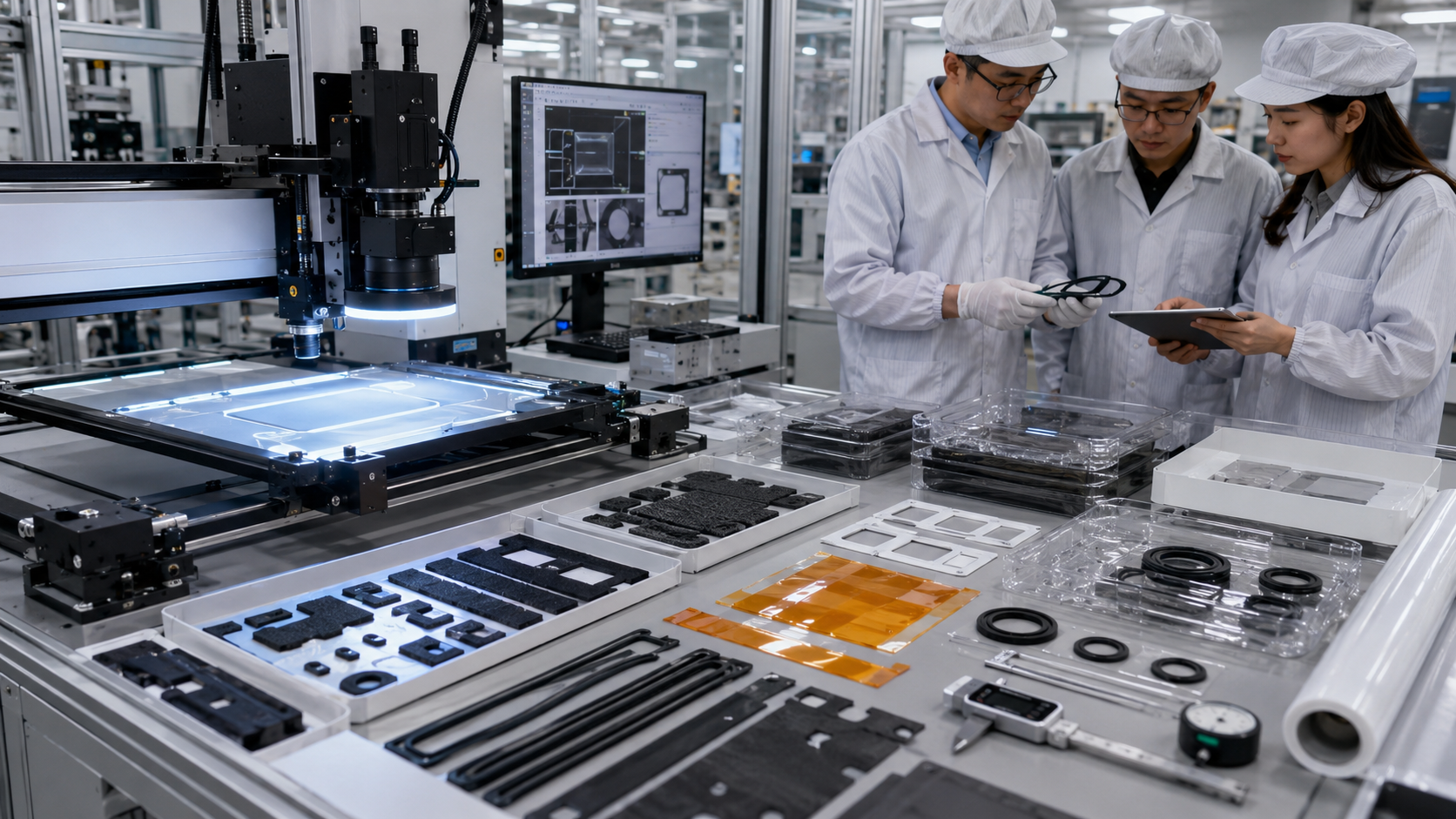
Automation Helps From Prototype to Mass Production
Automation is not only useful after mass production starts.
It also helps during project development.
During sampling, we can review:
- Material behavior
- Cutting method
- Lamination structure
- Adhesive performance
- Liner release
- Tolerance risk
- Waste removal
- Packaging format
- Assembly convenience
This helps customers avoid problems before production volume increases.
A part may pass a simple sample check.
But if it is difficult to peel, easy to deform or unstable during repeated production, it may create problems later.
That is why we review both the part and the process.
When Automation Is Most Valuable
Automation is especially valuable for automotive die cut parts with strict consistency requirements.
| Application | Why Automation Helps |
|---|---|
| EV battery insulation | Accurate coverage and stable film placement |
| ECU foam seals | Consistent gasket shape and compression |
| Display adhesive frames | Clean edges and stable adhesive position |
| Camera sensor parts | Small size and high alignment requirement |
| HVAC foam seals | Repeatable air sealing performance |
| NVH felt pads | Stable shape and thickness |
| Wire harness protection | Efficient roll or sheet supply |
| Lighting module seals | Better dust and moisture protection |
The more repeated the part is, the more automation matters.
For one sample, manual work may look acceptable.
For mass production, process stability decides whether the project runs smoothly.
What Buyers Should Provide Before Production
Before starting an automated die cutting project, we usually ask for clear project details.
Helpful information includes:
- Drawing or sample
- Material type
- Thickness
- Adhesive structure
- Tolerance requirement
- Application location
- Working temperature
- Compression requirement
- Surface material
- Annual volume
- Delivery format
- Packaging preference
- Inspection requirement
This helps us recommend the right die cutting method, material structure and automation approach.
For new projects, buyers can also review how to choose the right die cutting manufacturer before moving from sample to mass production.
Need Automated Precision Die Cutting for Automotive OEM Parts?
Automation improves precision die cutting by making quality more repeatable, production faster and assembly more reliable.
But automation works best when it is built around the correct material, tooling, lamination structure, inspection method and delivery format.
If you need custom die cut parts for OEM assembly, send us your drawing, sample, material requirement, adhesive structure, tolerance, application location, temperature range, annual volume and packaging preference.
Sanken can help review material selection, die cutting process, automation method, inspection points and delivery format before mass production.
Conclusion
Automation improves precision die cutting for automotive OEM parts by reducing variation, improving tolerance control, stabilizing adhesive placement, increasing production efficiency and supporting better inspection. For foam, rubber, tape, film and laminated materials, the best results come from combining automation with strong material knowledge and process control.