

Can All Laser Engravers Cut Foam? Even Tabletop Ones?
Not all laser engravers can cut foam, and not every foam is safe to cut with a laser. Some tabletop laser engravers can cut thin EVA foam, PE foam, PU foam, or craft foam, but the result depends on the laser type, machine power, foam chemistry, thickness, density, ventilation, and fire-control setup.
For buyers, engineers, and product developers, the real question is not only “Can this laser engraver cut foam?” The better question is: “Can this machine cut this specific foam safely, cleanly, and consistently for my final product?”
This matters because foam is not one single material. EVA foam, PE foam, PU foam, EPDM foam, rubber foam, adhesive-backed foam, and laminated foam all behave differently under heat. Some foam melts. Some burns. Some releases unpleasant fumes. Some cuts well in samples but performs poorly in mass production.
At Sanken Manufacturing, we help OEM customers choose the right foam processing method, including precision die cutting, kiss cutting, adhesive lamination, slitting, hot pressing, and custom material converting for automotive, electronics, packaging, medical equipment, and industrial applications.
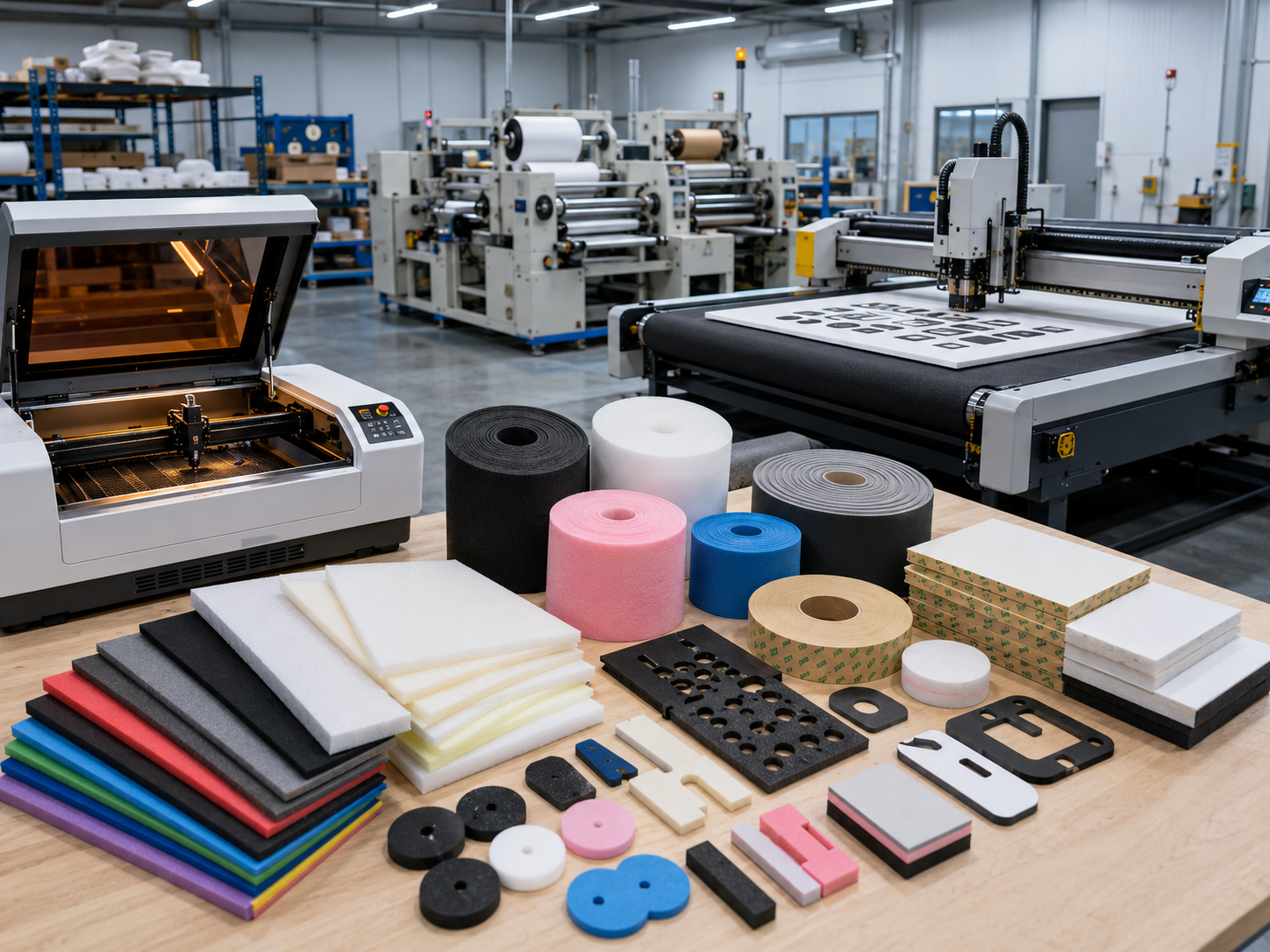
Can Laser Engravers Cut Foam?
Yes, some laser engravers can cut foam.
But “can cut” does not always mean “should cut.”
Laser cutting uses heat to burn, melt, or vaporize material along the cutting path. Foam is lightweight and porous, so it may react quickly to heat. Thin foam may cut easily, while thick foam may melt, shrink, char, or ignite.
A successful foam laser-cutting project depends on:
| Factor | Why It Matters |
|---|---|
| Laser type | CO₂, diode, and fiber lasers interact differently with foam |
| Laser power | Low-power machines may only engrave or shallow cut |
| Foam type | EVA, PE, PU, PVC, and rubber foam behave differently |
| Thickness | Thin foam is easier to cut than thick foam |
| Density | Dense foam may need more power and slower speed |
| Ventilation | Foam cutting creates smoke and fumes |
| Air assist | Helps reduce burning and improves edge quality |
For simple prototypes, a laser engraver may be useful. For production foam parts, buyers need to consider safety, repeatability, edge quality, and total cost.
Can Tabletop Laser Engravers Cut Foam?
Some tabletop laser engravers can cut thin foam, especially if the foam is laser-safe and the machine has enough power.
A tabletop laser may work for:
- Thin EVA foam sheets
- Craft foam
- Simple packaging prototypes
- Low-volume sample parts
- Basic insert shapes
- Small decorative foam pieces
However, tabletop machines usually have limitations.
They may have:
- Lower laser power
- Smaller cutting area
- Weaker smoke extraction
- Limited air assist
- Slower cutting speed
- Less stable repeatability
- Higher risk of edge burning
This means a tabletop laser may be acceptable for testing shape and fit, but not ideal for high-volume OEM foam components.
For example, if a customer only needs five prototype foam inserts, laser cutting may be practical. But if the customer needs 50,000 adhesive-backed EVA foam pads for automotive assembly, precision die cutting is usually more stable and cost-effective.
Which Laser Type Works Best for Foam?
CO₂ Laser
CO₂ lasers are commonly used for cutting non-metal materials.
They are often more suitable for foam than diode or fiber lasers because many foam materials absorb CO₂ laser energy more effectively.
CO₂ lasers may cut:
- EVA foam
- PE foam
- Some PU foam
- Packaging foam
- Certain craft foam
However, buyers must still confirm material safety before cutting.
Diode Laser
Diode lasers are common in small tabletop engravers.
They may cut thin foam, but results vary.
Common problems include:
- Slow cutting
- Uneven edges
- Multiple passes required
- Poor cutting on light-colored foam
- Higher risk of melting on thicker foam
A diode laser may be useful for hobby projects or simple prototypes, but it is not always reliable for industrial foam parts.
Fiber Laser
Fiber lasers are usually designed for metals and some hard plastics.
They are generally not the first choice for foam cutting.
For most foam projects, CO₂ laser cutting or mechanical converting methods are more suitable.
Which Foam Materials Can Be Laser Cut?
Some foam materials can be laser cut, but buyers must be careful.
Potentially laser-cuttable foam materials include:
- EVA foam
- PE foam
- Some PU foam
- Certain packaging foams
- Some craft foams
However, the exact formulation matters.
Two foam sheets may both be called EVA, but they may contain different additives, fillers, pigments, or surface treatments. These differences can affect fumes, edge quality, and cutting behavior.
Before laser cutting, buyers should ask for material information or safety documents.
Unknown foam should not be laser cut.
Which Foam Materials Should Not Be Laser Cut?
Some materials are unsafe for laser cutting.
PVC Foam or Vinyl Foam
PVC and vinyl materials should not be laser cut.
When heated, they may release harmful and corrosive gases. These fumes can be dangerous to operators and can damage laser equipment.
Unknown Foam
If the material composition is unknown, do not laser cut it.
A foam sample may look harmless, but it may contain unsafe additives.
Adhesive-Backed Foam
Adhesive-backed foam can be difficult to laser cut cleanly.
The adhesive layer may:
- Melt
- Smoke
- Burn
- Leave sticky residue
- Shrink
- Cause edge contamination
For adhesive-backed foam parts, die cutting or kiss cutting is usually a better solution.
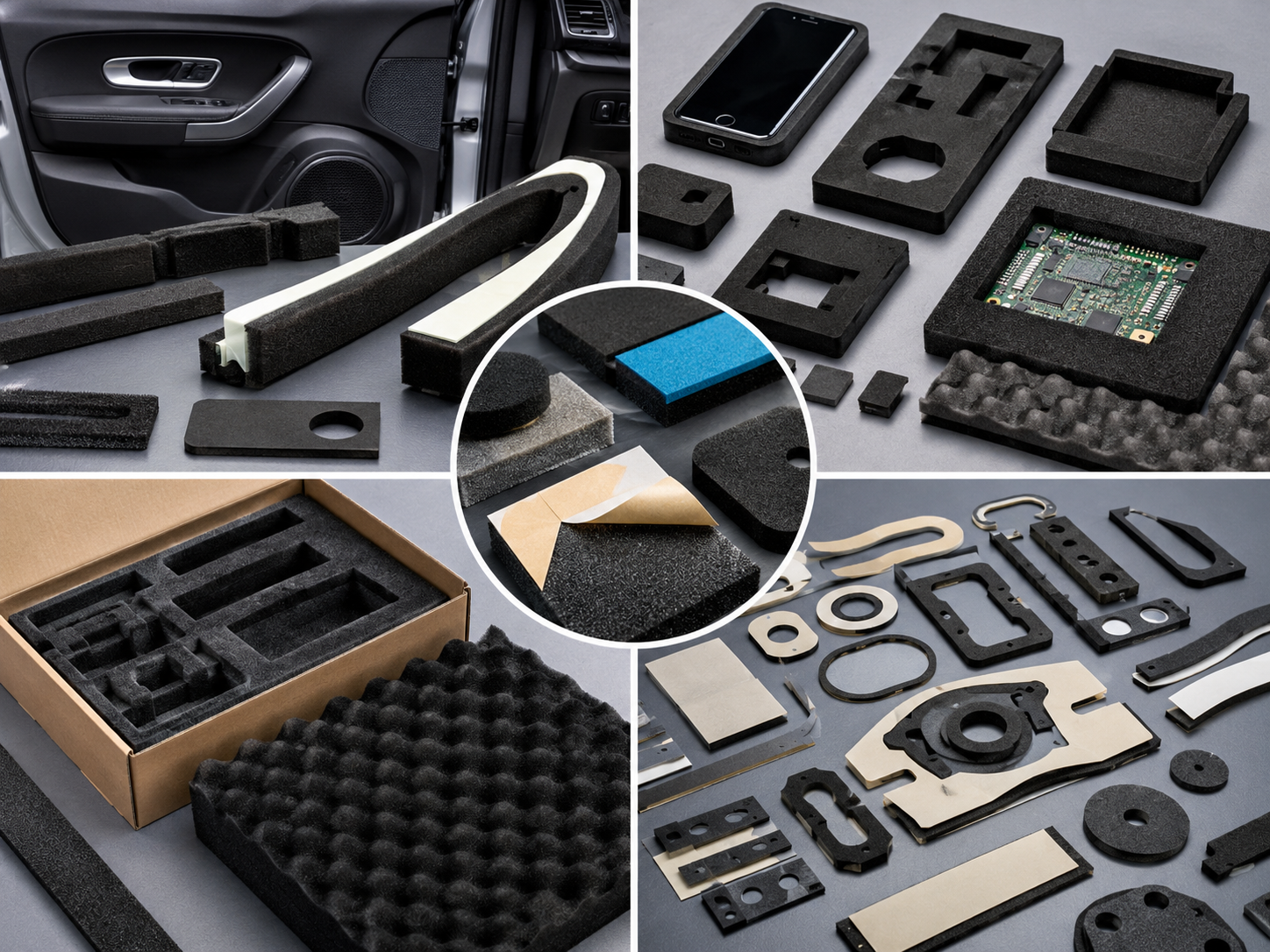
Why Laser Cutting Foam Can Be Risky
1. Smoke and Fumes
Laser cutting foam creates smoke.
Even if the foam is technically cuttable, the fumes may still be unpleasant or unsafe without proper ventilation.
A desktop machine without strong exhaust is risky for foam cutting.
2. Fire Risk
Foam can ignite if laser power is too high, speed is too slow, or air assist is poor.
Laser cutting foam should never be left unattended.
3. Melted or Hardened Edges
Some foam materials melt instead of cutting cleanly.
This can create:
- Hard edges
- Burn marks
- Shrinkage
- Uneven surfaces
- Poor appearance
- Dimensional error
For packaging, this may be acceptable in some cases. For automotive or electronics components, it may not be acceptable.
4. Dimensional Variation
Foam may shrink near the laser path because of heat.
This can affect tolerance.
For OEM applications, a small dimensional error can cause assembly problems.
5. Poor Adhesive Performance
If the foam has adhesive backing, laser heat may damage the adhesive edge.
This can lead to peeling, edge lifting, or weak bonding during assembly.
Laser Cutting vs Die Cutting Foam
Laser cutting and die cutting are both useful, but they are not the same.
| Requirement | Laser Cutting | Die Cutting |
|---|---|---|
| Prototype without tooling | Good | Tooling needed |
| Frequent design changes | Good | Less flexible |
| High-volume production | Slower | Strong |
| Adhesive-backed foam | Often difficult | Strong |
| Clean edges | Depends on foam | Usually stable |
| Heat-free processing | No | Yes |
| Repeatability | Moderate | Strong |
| Mass production cost | Can be high | Usually better |
Laser cutting is often useful during the early development stage.
Die cutting is usually better when the design is confirmed and the customer needs stable production.
At Sanken, we often recommend laser cutting or CNC cutting for prototypes, then precision die cutting for mass production.
When Should Buyers Use Laser Cutting?
Laser cutting may be suitable when:
- The project is still in the prototype stage
- Quantity is low
- The foam is thin
- The material is confirmed laser-safe
- The design may change
- Tooling cost should be avoided at the beginning
- Edge discoloration is acceptable
For sample development, laser cutting can save time.
It helps engineers test shape, size, and fit before investing in tooling.
When Should Buyers Avoid Laser Cutting?
Laser cutting may not be suitable when:
- Foam composition is unknown
- Material contains PVC or vinyl
- Foam is adhesive-backed
- Foam is thick or very dense
- Burn marks are unacceptable
- The edge must remain soft and clean
- The part requires tight tolerance
- The project is high-volume
- The product is used in automotive, electronics, or medical applications
In these cases, die cutting, kiss cutting, slitting, or other converting methods may be safer and more reliable.
Why Tabletop Laser Cutting Is Usually Not Enough for OEM Production
A tabletop laser can help with early ideas, but OEM production requires more than one good sample.
OEM buyers usually need:
- Stable dimensions
- Clean edges
- Repeatable quality
- Consistent adhesive performance
- Controlled packaging
- Low scrap rate
- Efficient production speed
- Reliable mass production support
A tabletop laser may not provide this level of control.
For automotive foam pads, electronics cushioning parts, medical device packaging, and industrial assembly components, production stability matters more than machine convenience.
What Should Buyers Confirm Before Cutting Foam?
Before choosing laser cutting or die cutting, buyers should confirm:
- What is the exact foam material?
- Is the foam safe for laser cutting?
- Does the foam contain PVC, vinyl, or unknown additives?
- What thickness and density are required?
- Does the part need adhesive backing?
- Is edge discoloration acceptable?
- What tolerance is required?
- Is this for prototype or mass production?
- Will the part be used in automotive, electronics, medical, packaging, or industrial products?
- Can the supplier support the right process from sample to production?
These questions help avoid safety risks, poor samples, and production delays.
How Sanken Helps Customers Choose the Right Foam Cutting Method
At Sanken Manufacturing, we do not assume every foam should be laser cut.
We review the full project requirement first:
- Material type
- Thickness
- Density
- Adhesive structure
- Tolerance
- Application environment
- Production volume
- Assembly method
- Long-term reliability needs
Then we recommend the suitable converting process.
Our capabilities include:
- Precision die cutting
- Kiss cutting
- Foam converting
- Adhesive lamination
- Slitting
- Hot pressing
- Multilayer assembly
- Prototype support
- Mass production support
For OEM buyers, this means fewer trials, fewer rejected parts, better assembly fit, and lower production risk.
Conclusion
Not all laser engravers can cut foam, and not every foam is safe for laser cutting. Some tabletop laser engravers can cut thin EVA, PE, PU, or craft foam, but results depend on laser type, power, foam chemistry, thickness, density, ventilation, and air assist.
Laser cutting can be useful for prototypes and small batches. However, for adhesive-backed foam, automotive foam parts, electronics protection, packaging inserts, and high-volume production, precision die cutting is often more stable, cleaner, and more cost-effective.
At Sanken Manufacturing, we help customers choose the right foam material and converting process so the final parts are safe, accurate, reliable, and ready for mass production.