
What Is Copper Foil Tape Used for Electronic Shielding?
As electronic devices become smaller, faster, and more integrated, electromagnetic interference (EMI) has become one of the most significant challenges facing product designers and manufacturers.
Modern electronics contain numerous components that generate electromagnetic signals, including processors, wireless communication modules, displays, sensors, batteries, and power circuits. Without proper shielding, these signals can interfere with one another, causing performance degradation, communication errors, reduced reliability, and regulatory compliance issues.
One of the most widely used EMI shielding materials is copper foil tape.
Due to its excellent electrical conductivity, flexibility, and ease of conversion, copper foil tape is extensively used across consumer electronics, automotive electronics, telecommunications equipment, medical devices, and industrial systems.
At Sanken Manufacturing Co., Ltd., we help OEM manufacturers convert copper foil materials into precision die-cut shielding components that improve electromagnetic compatibility and support reliable product performance.
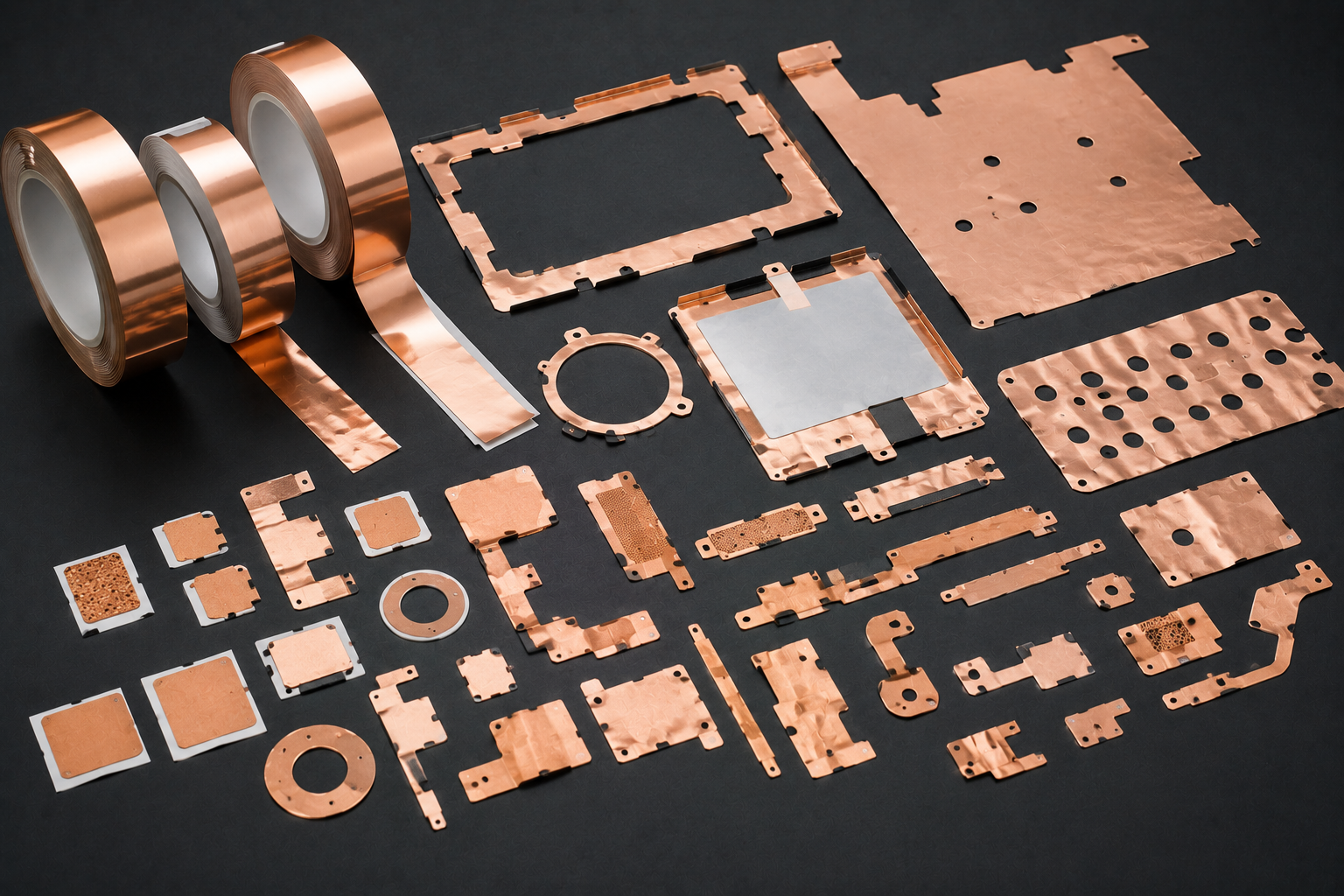
Copper foil tape provides a simple yet highly effective solution for managing electromagnetic interference in modern electronic assemblies.
What Is Copper Foil Tape?
Copper foil tape consists of a thin copper layer combined with a conductive or non-conductive adhesive backing.
The material offers excellent conductivity while remaining flexible enough to conform to complex product geometries.
Typical construction includes:
- Copper foil layer
- Conductive adhesive (optional)
- Release liner
Copper foil thickness typically ranges from:
- 12μm
- 18μm
- 25μm
- 35μm
- 50μm
Material selection depends on shielding requirements and product design.
Key Characteristics
Copper foil tape offers:
- High electrical conductivity
- Excellent EMI shielding performance
- Flexibility
- Corrosion resistance
- Easy die cutting
- Good thermal conductivity
These properties make it one of the most versatile shielding materials available.
Why Copper Is Effective for Shielding
Copper has one of the highest electrical conductivity levels among commonly used engineering metals.
This allows it to:
- Reflect electromagnetic waves
- Absorb interference signals
- Create grounding paths
- Protect sensitive circuits
Its conductivity makes copper particularly effective across a broad frequency range.
Understanding Electromagnetic Interference (EMI)
EMI occurs when unwanted electromagnetic energy disrupts the operation of electronic devices.
Common EMI sources include:
- Processors
- Switching power supplies
- Wireless modules
- Motors
- Displays
- Communication circuits
Without shielding, EMI can affect:
- Signal quality
- Wireless performance
- Sensor accuracy
- Product reliability
Managing EMI is essential for modern electronics.
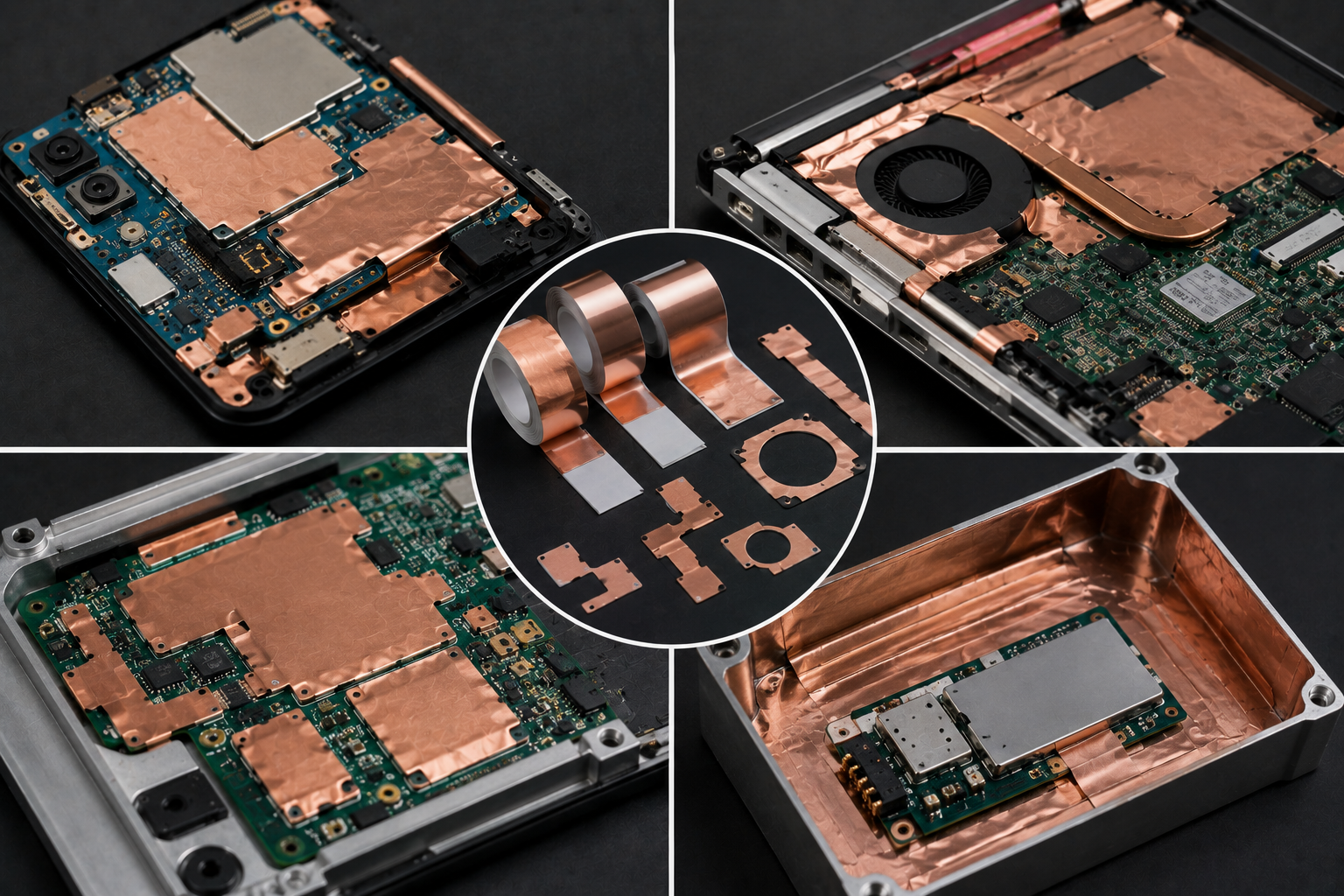
How Copper Foil Tape Provides Shielding
Copper foil tape creates a conductive barrier that blocks or redirects electromagnetic energy.
When properly installed, it helps:
- Reduce signal leakage
- Protect sensitive components
- Improve grounding performance
- Enhance electromagnetic compatibility
The tape can be applied directly to:
- Housings
- Covers
- Electronic modules
- Flexible circuits
This versatility makes it suitable for many product designs.
Reflection Shielding
Copper reflects electromagnetic waves away from sensitive electronics.
This mechanism is especially effective against:
- High-frequency interference
- Wireless communication noise
- External EMI sources
Absorption Shielding
Copper also absorbs portions of incoming electromagnetic energy.
This reduces the amount of interference that reaches critical circuits.
The combination of reflection and absorption improves overall shielding effectiveness.
Applications in Consumer Electronics
Consumer electronics represent one of the largest markets for copper foil tape.
Common applications include:
Smartphones
Copper shielding materials are used around:
- Processors
- Display modules
- Wireless antennas
- Camera systems
These applications help maintain signal integrity and product performance.
Tablets and Laptops
Copper foil tape supports:
- Grounding systems
- EMI control
- Thermal management
As electronic density increases, shielding becomes increasingly important.
Wearable Devices
Smartwatches and fitness trackers often contain:
- Bluetooth modules
- Sensors
- Wireless charging systems
Copper shielding helps prevent signal interference within compact device architectures.
Applications in Automotive Electronics
Modern vehicles contain hundreds of electronic systems.
Copper foil shielding is commonly used in:
- Infotainment systems
- ADAS modules
- Battery management systems
- Sensors
- Control units
Automotive environments generate significant electromagnetic noise.
Effective shielding improves reliability and system performance.
Electric Vehicle Applications
EV platforms contain high-power electrical systems that require extensive EMI management.
Copper foil components help protect:
- Communication systems
- Battery electronics
- Power control modules
Shielding is increasingly important as vehicle electrification expands.
Applications in Medical Devices
Medical equipment often contains highly sensitive electronics.
Examples include:
- Diagnostic devices
- Monitoring systems
- Imaging equipment
- Wearable medical products
Copper foil shielding helps ensure:
- Accurate measurements
- Reliable operation
- Regulatory compliance
Signal integrity is especially critical in healthcare environments.
Flexible Circuit Shielding
Flexible printed circuits are widely used in modern electronics.
Copper foil tape is commonly applied to:
- Flexible cables
- Foldable circuits
- Compact assemblies
Benefits include:
- Lightweight construction
- Excellent flexibility
- Effective EMI protection
These advantages make copper foil highly compatible with advanced electronic designs.
Grounding Applications
In addition to shielding, copper foil tape is frequently used for grounding.
Proper grounding helps:
- Dissipate unwanted electrical energy
- Reduce noise
- Improve system stability
Common grounding applications include:
- Enclosures
- Electronic housings
- PCB assemblies
- Display modules
Grounding and shielding often work together to achieve optimal EMI performance.
Why Die Cutting Is Important for Copper Foil Tape
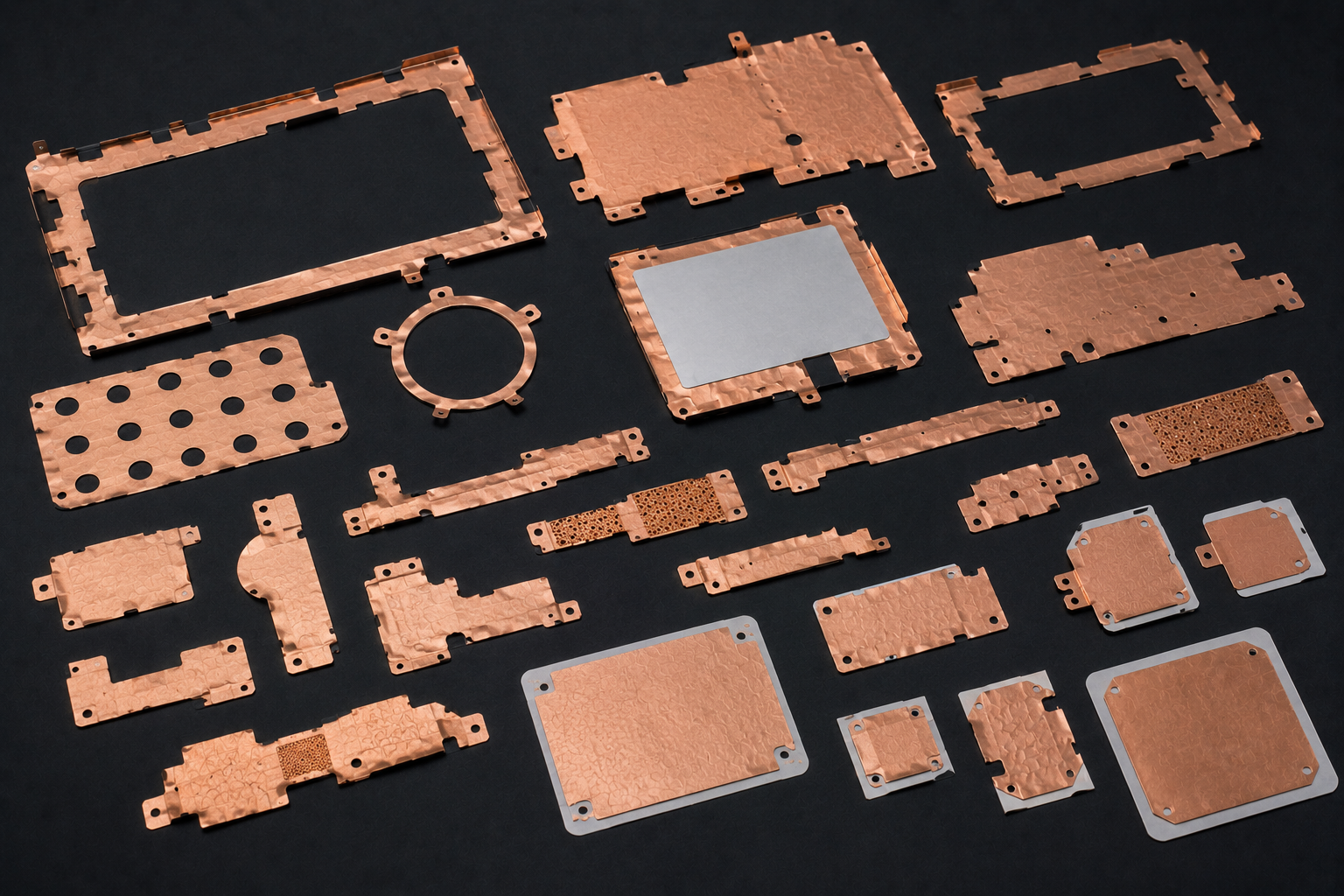
Electronic products rarely use copper foil directly from a roll.
Most applications require:
- Custom shapes
- Openings
- Mounting features
- Complex geometries
Precision die cutting converts copper foil into ready-to-install shielding components.
Benefits of Die-Cut Copper Foil
Advantages include:
- Faster assembly
- Improved positioning
- Consistent dimensions
- Reduced waste
Precision converting ensures reliable performance during mass production.
Conductive vs Non-Conductive Adhesive Systems
Copper foil tapes are available with different adhesive constructions.
Conductive Adhesives
Benefits include:
- Electrical continuity
- Grounding capability
- Enhanced shielding effectiveness
Applications often involve electrical contact requirements.
Non-Conductive Adhesives
Advantages include:
- Strong bonding
- Simpler installation
- Cost efficiency
These versions are suitable when mechanical attachment is the primary requirement.
Selecting Copper Foil Tape for EMI Shielding
Several factors influence material selection.
Important Considerations
| Factor | Importance |
|---|---|
| Shielding Effectiveness | High |
| Conductivity | High |
| Adhesive Type | High |
| Thickness | Medium |
| Flexibility | Medium |
| Corrosion Resistance | Medium |
Selecting the appropriate material ensures optimal performance.
Common Thickness Options
Thicker foils generally provide:
- Improved durability
- Higher conductivity
Thinner foils offer:
- Greater flexibility
- Easier forming
The optimal balance depends on the application.
How Sanken Supports EMI Shielding Projects
At Sanken Manufacturing Co., Ltd., we provide precision converting solutions for EMI shielding materials used in electronics, automotive systems, medical devices, and industrial equipment.
Our capabilities include:
- Precision die cutting
- Copper foil converting
- Aluminum foil converting
- Conductive adhesive lamination
- Multi-layer shielding assemblies
- Rapid prototyping
- High-volume manufacturing
We support applications including:
- Consumer electronics
- Automotive electronics
- Medical devices
- Telecommunications equipment
- Energy storage systems
By combining material expertise with precision converting technologies, we help customers improve electromagnetic compatibility and manufacturing efficiency.
Frequently Asked Questions
Why is copper foil used for EMI shielding?
Copper offers excellent electrical conductivity, making it highly effective at reflecting and absorbing electromagnetic interference.
Is copper foil tape conductive?
Yes. Copper itself is conductive, and some products also include conductive adhesive systems.
Can copper foil tape be die cut?
Yes. Precision die cutting is commonly used to create custom shielding components for electronic assemblies.
Is copper better than aluminum for shielding?
Copper generally provides higher conductivity and superior shielding performance, although aluminum may offer cost advantages in certain applications.
Conclusion
Copper foil tape remains one of the most effective materials for electronic shielding and grounding applications.
Its excellent conductivity, flexibility, and compatibility with precision die-cutting processes make it ideal for consumer electronics, automotive systems, medical devices, telecommunications equipment, and industrial electronics.
As electronic products continue to become more compact and complex, precision-converted copper foil shielding components play an increasingly important role in ensuring reliable performance and electromagnetic compatibility.
At Sanken, we help OEM manufacturers transform copper foil materials into precision-engineered EMI shielding solutions that support efficient assembly and long-term product reliability.