
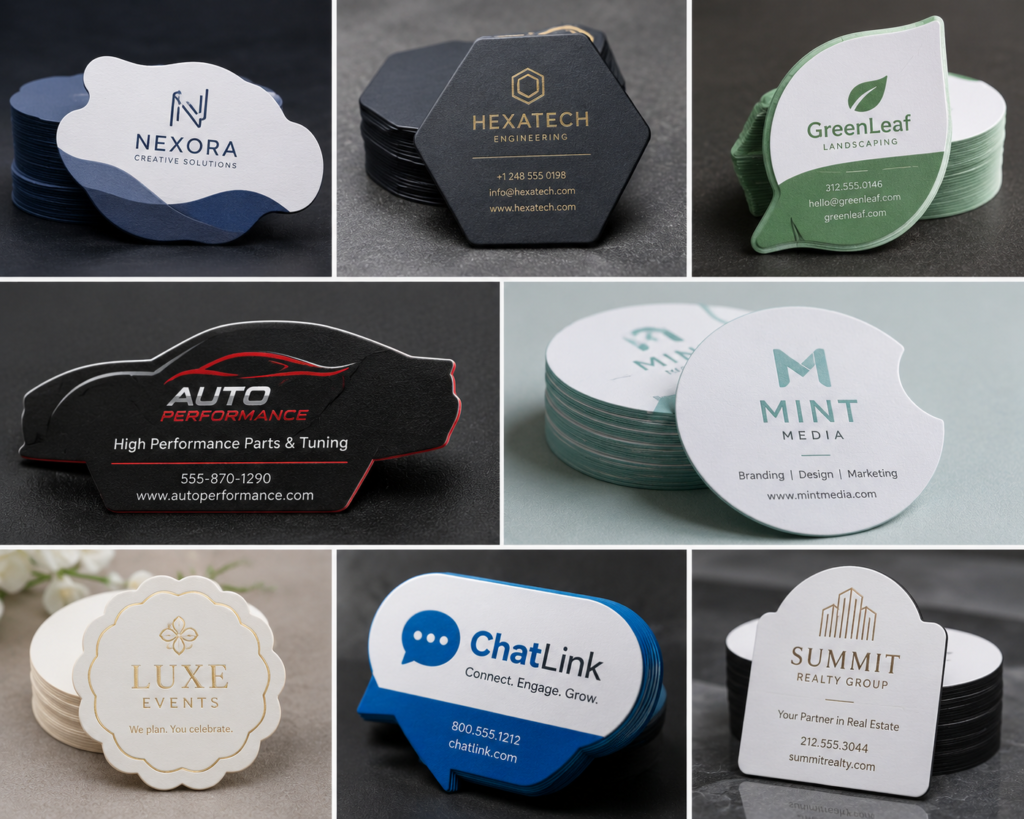
Yes, you can use custom shapes for business card printing. Instead of choosing a standard rectangle, you can create rounded corners, circles, ovals, product-shaped cards, tag-style cards, folded shapes, or fully custom die cut profiles. Custom-shaped business cards are usually made by die cutting, laser cutting, or digital cutting after the card has been printed.
For many companies, a custom-shaped business card can make the first impression more memorable. But for engineers, purchasing teams, designers, and manufacturers, the real question is not only whether the shape looks creative. The better question is whether the shape can be printed, cut, handled, packaged, and used without quality problems.
At Sanken, our main expertise is precision die cutting for OEM materials such as foam, rubber, PET film, adhesive tape, protective film, non-woven felt, and functional components. While business card printing is different from industrial component manufacturing, the same die cutting logic applies: material, shape, tolerance, edge quality, tooling, waste removal, and production consistency all matter.
Why Custom-Shaped Business Cards Are Popular
A standard rectangular business card is easy to print, easy to cut, and cost-effective. But it may not always help a brand stand out.
Custom-shaped business cards can help communicate:
- Brand personality
- Product category
- Industry identity
- Creative design style
- Premium positioning
- Technical capability
- Memorable first impression
For example, a camera company may use a card shaped like a camera. A coffee brand may use a cup-shaped card. A packaging company may use a folded card. A manufacturing company may use a clean technical die cut profile with rounded corners, slots, or product-inspired geometry.
The shape becomes part of the message.
However, custom shape does not automatically mean better design. A card that looks unique but is hard to read, hard to store, or easy to damage may reduce its value.
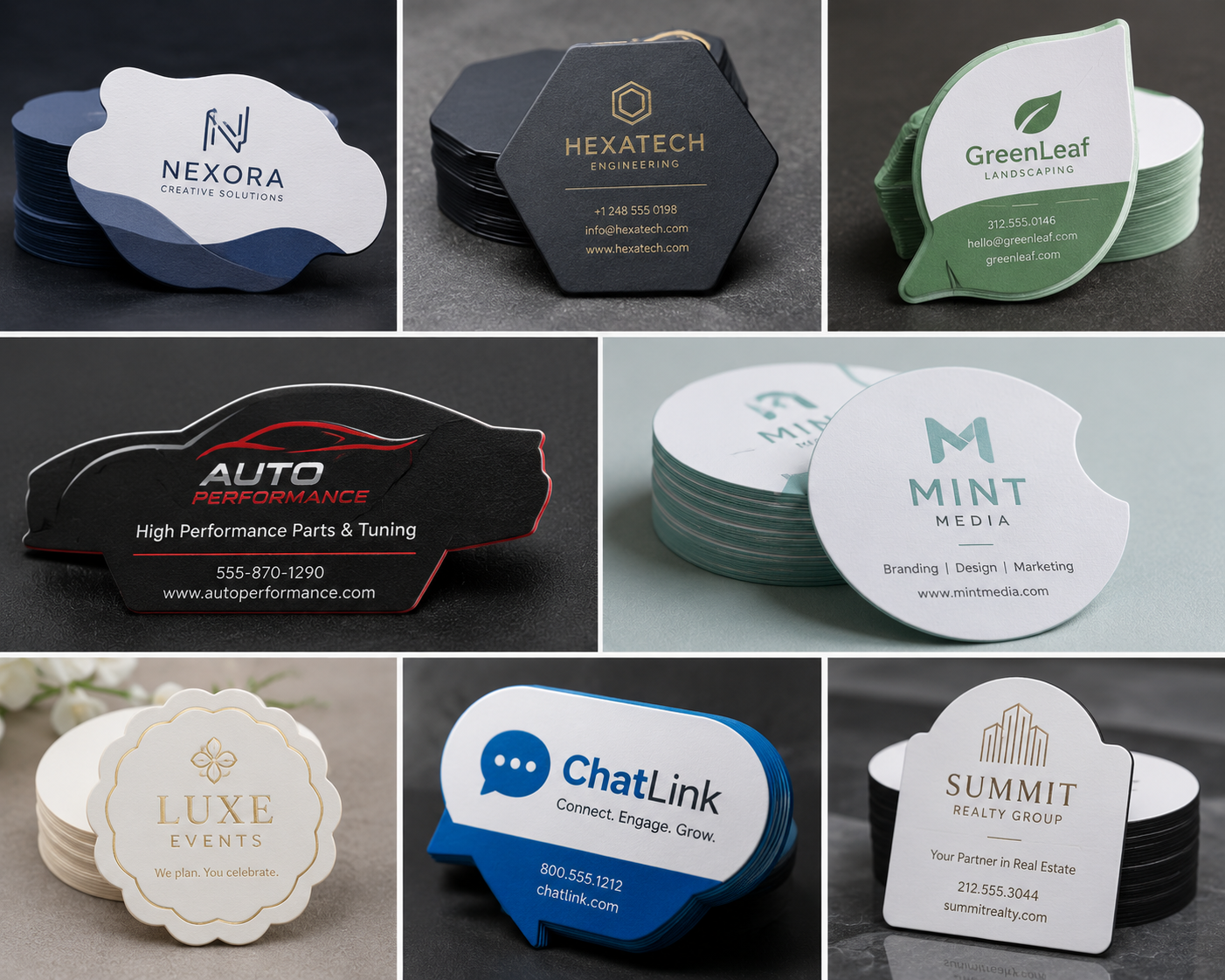
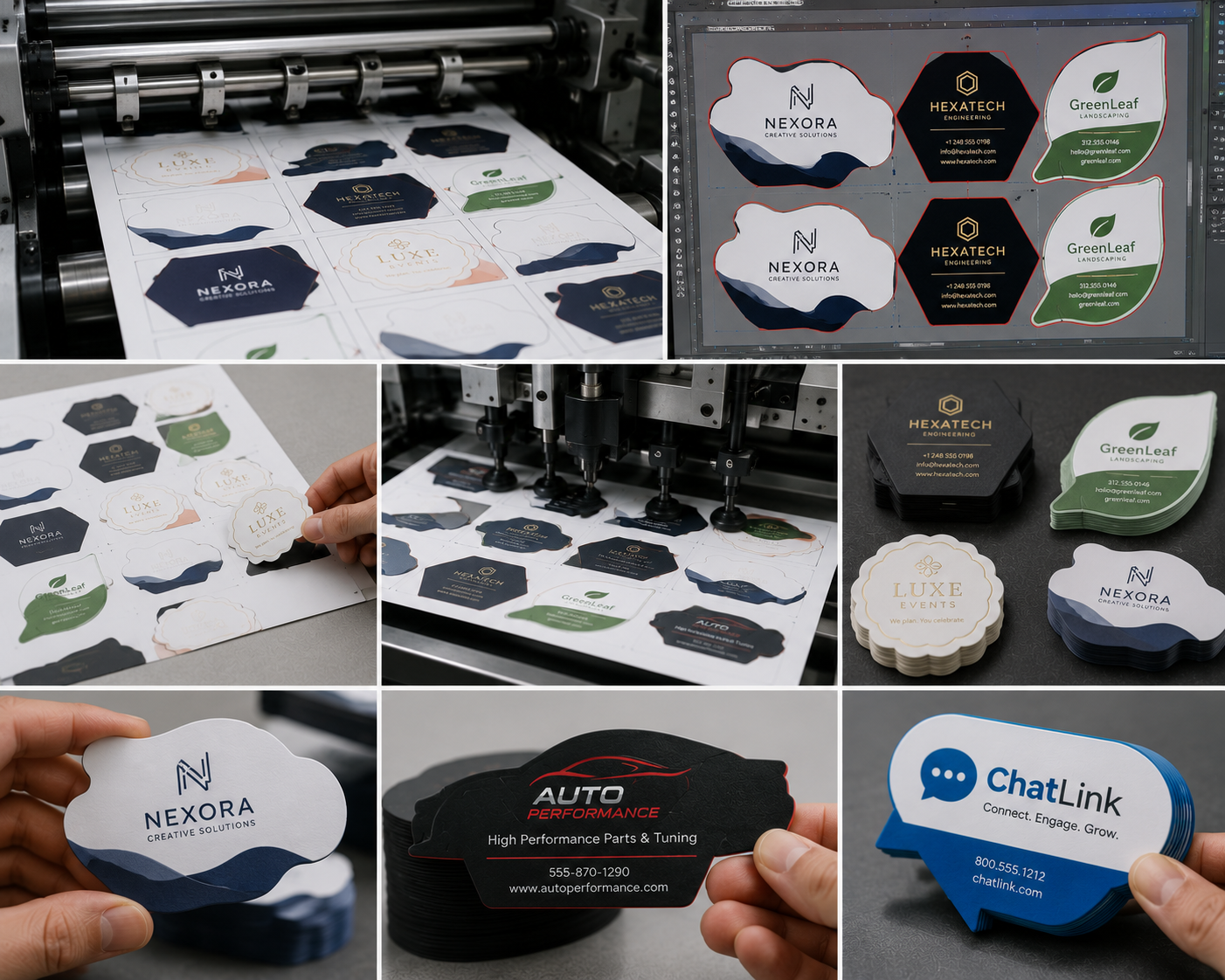
How Custom Shapes Are Made
Most custom-shaped business cards are produced by printing the design first, then cutting the printed sheets into the final shape.
Common methods include:
| Cutting Method | How It Works | Best For |
|---|---|---|
| Die cutting | A cutting die presses into the printed sheet | Medium to large quantity, repeatable shapes |
| Digital cutting | A blade cutter follows a digital path | Small batches and prototypes |
| Laser cutting | A laser cuts the shape | Fine details, but edge burn risk on paper |
| Guillotine cutting | Straight blade cutting | Standard rectangles only |
| Punch cutting | A fixed punch cuts repeated simple shapes | Small standard profiles |
Die cutting is one of the most common methods for custom shapes because it can produce consistent profiles in larger quantities.
In industrial manufacturing, die cutting is also used for foam gaskets, adhesive tape components, PET insulation films, rubber pads, protective films, and other custom parts. Business cards are simpler than many OEM components, but the basic principle is similar: a designed shape is cut from a flat material using a controlled cutting process.
What Shapes Can Be Used?
Many custom shapes are possible, but some are more practical than others.
Common business card shapes include:
- Rounded rectangle
- Circle
- Oval
- Square
- Tag shape
- Half-circle edge
- Leaf shape
- Product silhouette
- Mini brochure shape
- Folded card with custom edge
- Cards with cut-out windows
- Cards with slots or holes
The safest custom shapes usually have smooth edges, rounded corners, and enough material around narrow areas.
Very thin bridges, sharp tips, small internal holes, and complex outlines may look attractive in design software but become weak or expensive in production.
Design Rules for Custom Die Cut Business Cards
A good custom business card shape should balance creativity and manufacturability.
Important design rules include:
| Design Factor | Recommendation | Why It Matters |
|---|---|---|
| Corner shape | Use rounded corners where possible | Reduces bending and damage |
| Thin areas | Avoid very narrow bridges | Prevents tearing |
| Text position | Keep text away from cut edge | Avoids trimming problems |
| Bleed area | Extend background beyond cut line | Prevents white edges |
| Cut line | Provide a clear die line | Helps production accuracy |
| Internal holes | Keep holes large enough | Improves cutting stability |
| Card size | Keep it wallet-friendly | Improves usability |
| Material thickness | Choose suitable card stock | Supports stiffness and durability |
| Finish | Matte, gloss, soft touch, foil, embossing | Affects appearance and handling |
Designers should remember that the cut line is not only a visual outline. It is a production path.
If text or important graphics are too close to the cut edge, small cutting variation may make the card look misaligned.
Material Selection Matters
Custom-shaped business cards can be printed on many materials, including paper card stock, coated paper, kraft paper, textured paper, synthetic paper, PVC, PET, or specialty laminated materials.
Paper card stock is common and cost-effective. It is suitable for most business card designs.
Thicker card stock feels more premium but may require more cutting force.
Synthetic materials such as PET or PVC can offer better durability, water resistance, and a technical appearance, but printing, cutting, and environmental requirements should be reviewed.
Laminated cards can look more durable and premium, but lamination may affect cutting edge quality.
For a simple business card, paper may be enough. For a card that must feel like a durable product sample, plastic film or specialty material may be considered.
Common Problems in Custom Shape Printing
Custom shapes create more production risks than standard rectangular cards.
Common problems include:
| Problem | Common Cause | Result |
|---|---|---|
| White edge | Not enough bleed | Poor appearance |
| Rough edge | Dull die or unsuitable material | Low-quality finish |
| Misaligned cut | Poor registration | Design looks off-center |
| Bent corners | Sharp or weak geometry | Damage during handling |
| High cost | Complex shape or low quantity | Higher unit price |
| Slow lead time | Custom tooling required | Longer production schedule |
| Torn thin sections | Narrow shape design | Weak card structure |
| Difficult packaging | Irregular shape | More handling damage |
A custom-shaped card should be reviewed before production, especially if the outline is complex.
The supplier should confirm whether the design is suitable for die cutting, whether tooling is needed, and whether the shape can be packed safely.
Custom Shape vs Standard Rectangle
A custom shape is not always better than a standard card.
| Option | Advantages | Limitations |
|---|---|---|
| Standard rectangle | Low cost, fast production, easy storage | Less distinctive |
| Rounded rectangle | Professional, durable, still practical | Slightly higher cost |
| Fully custom shape | Memorable and brand-specific | Higher cost and production risk |
| Folded custom card | More space for information | More complex production |
| Plastic custom card | Durable and premium | Higher cost and material considerations |
If the business card will be handed out at trade shows, meetings, and sales visits, it should still be easy to carry, store, and read.
A very unusual shape may attract attention, but it may not fit into a wallet, card holder, or document folder.
The best design is usually distinctive but still practical.
When Custom Shapes Make Sense
Custom-shaped business cards are useful when the shape supports the brand message.
They work well for:
- Design agencies
- Packaging companies
- Manufacturers
- Product brands
- Technology companies
- Automotive suppliers
- Material suppliers
- Creative studios
- Exhibition marketing
- Premium product presentations
For example, a precision die cutting company may use a card with clean rounded corners, small cut-out details, or layered material samples to show converting capability.
A packaging supplier may use a folded or tag-shaped card to show paper engineering.
A plastic product manufacturer may use a synthetic card material to show durability.
The shape should make the company easier to remember.
When a Custom Shape May Not Be Worth It
Custom shape may not be necessary if the card is only used for basic contact information.
It may also not be ideal when:
- Budget is very limited
- Lead time is urgent
- Quantity is very small
- Design is not finalized
- Shape is too fragile
- The card must fit standard holders
- The print shop cannot control die cutting quality
In these cases, a standard card with better paper, clear typography, good color, and a premium finish may perform better than an unusual shape.
A simple rounded-corner business card can be a good middle option. It feels more refined than a standard rectangle while keeping cost and production risk under control.
How Die Cutting Knowledge Helps Improve Custom Shapes
Whether the project is a business card or an OEM component, die cutting quality depends on the relationship between design, material, tooling, and production process.
In business card printing, the focus is appearance, brand identity, print alignment, and edge quality.
In industrial die cutting, the focus may include sealing, insulation, bonding, cushioning, liner release, adhesive control, and dimensional stability.
At Sanken, we work with more technical die cut materials such as PET film, adhesive tape, foam, rubber, protective film, non-woven felt, and multilayer structures. These parts are used in automotive electronics, consumer electronics, medical devices, battery modules, appliances, and industrial assemblies.
The same manufacturing mindset is useful for custom-shaped printed products: the shape must be attractive, but it must also be manufacturable, repeatable, and suitable for real use.
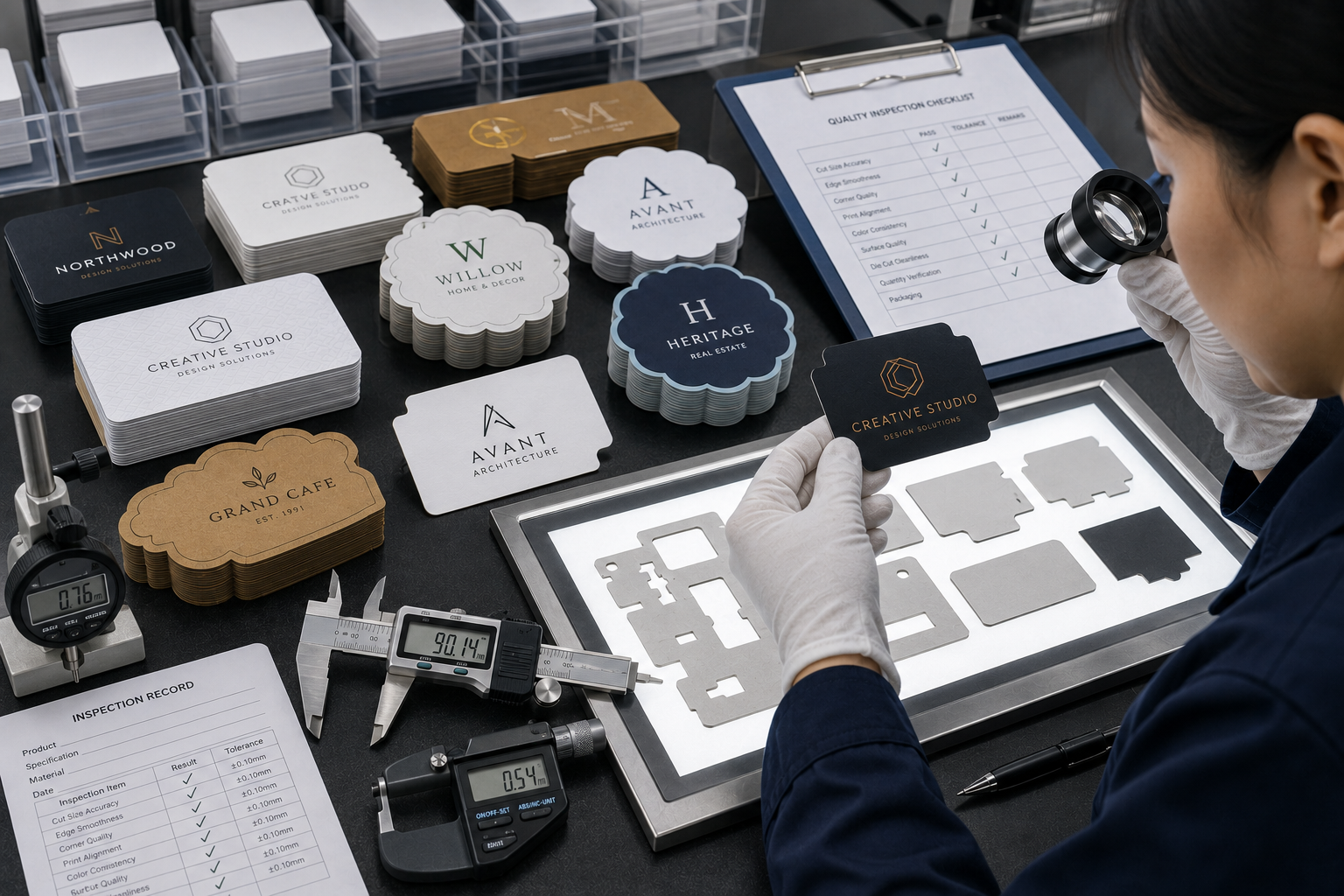
What to Ask Your Supplier Before Ordering
Before ordering custom-shaped business cards, ask the supplier:
- Can you make this shape by die cutting or digital cutting?
- Do you need a separate die line file?
- What bleed and safe margin do you require?
- What minimum line width or narrow area should I avoid?
- What card stock thickness works best?
- Will there be a tooling cost?
- Can you provide a sample before mass production?
- How will the cards be packed to prevent edge damage?
- Can the shape fit standard business card storage?
- What finish works best with this material?
These questions help prevent design mistakes and unexpected production costs.
FAQ
Can business cards be printed in custom shapes?
Yes. Business cards can be printed in custom shapes using die cutting, digital cutting, or laser cutting after printing.
Are custom-shaped business cards more expensive?
Usually, yes. Custom shapes may require additional cutting setup, custom tooling, more production time, and more careful packaging.
What is the best shape for a custom business card?
The best shape is one that supports your brand while remaining easy to read, carry, and store. Rounded rectangles, tag shapes, circles, and product-inspired profiles are common options.
Do custom business cards need bleed?
Yes. Custom-shaped business cards should include bleed beyond the cut line to avoid white edges after cutting.
Can I use holes or cut-outs in a business card?
Yes, but holes and cut-outs should be large enough and positioned carefully. Very small cut-outs may increase cost and cutting difficulty.
What file should I provide for custom shape printing?
Most suppliers require a print file and a separate die line or cut path. The die line should clearly show the final cutting shape.
Is die cutting only used for paper cards?
No. Die cutting is also widely used for foam, rubber, adhesive tape, PET film, protective film, non-woven felt, labels, insulation films, and many OEM components.
Conclusion
You can use custom shapes for business card printing, and the result can be more memorable than a standard rectangle. The key is to design the shape with production in mind. Rounded corners, proper bleed, safe text margins, suitable material thickness, and realistic cutting details will help improve final quality.
For simple promotional cards, a professional print shop or online card printer may be enough. For more technical die cut materials, adhesive-backed parts, films, foams, gaskets, and OEM components, a precision die cutting manufacturer such as Sanken can help review material, cutting process, tolerance, edge quality, and production stability.