
Automotive manufacturers rely on die-cut components for sealing, insulation, vibration control, bonding, and electrical protection. Although these components are often small, they play a critical role in vehicle quality and assembly efficiency. Even a minor issue—such as a misaligned foam gasket, an incorrectly selected adhesive, or inconsistent material thickness—can result in production delays, rework, warranty claims, or customer complaints.
To avoid assembly problems with automotive die-cut components, manufacturers should focus on proper material selection, precise dimensional control, optimized adhesive performance, design for manufacturability (DFM), and strict quality control throughout the production process. Working with an experienced die-cutting supplier also helps identify potential issues before mass production begins.
By addressing assembly challenges early in the design phase, OEMs and Tier 1 suppliers can improve production efficiency, reduce costs, and ensure long-term product reliability.
Why Assembly Problems Occur
Automotive assemblies involve hundreds of precision components working together.
Common causes of assembly problems include:
- Incorrect material selection
- Dimensional variation
- Poor adhesive performance
- Misaligned die-cut parts
- Inconsistent compression
- Surface contamination
- Material deformation during handling
These issues may lead to:
- Water leakage
- Wind noise
- Component movement
- Electrical failures
- Cosmetic defects
- Increased assembly time
Preventing these problems starts long before production begins.
Theme: Automotive Precision Die Cut Components
Choose the Right Material for the Application
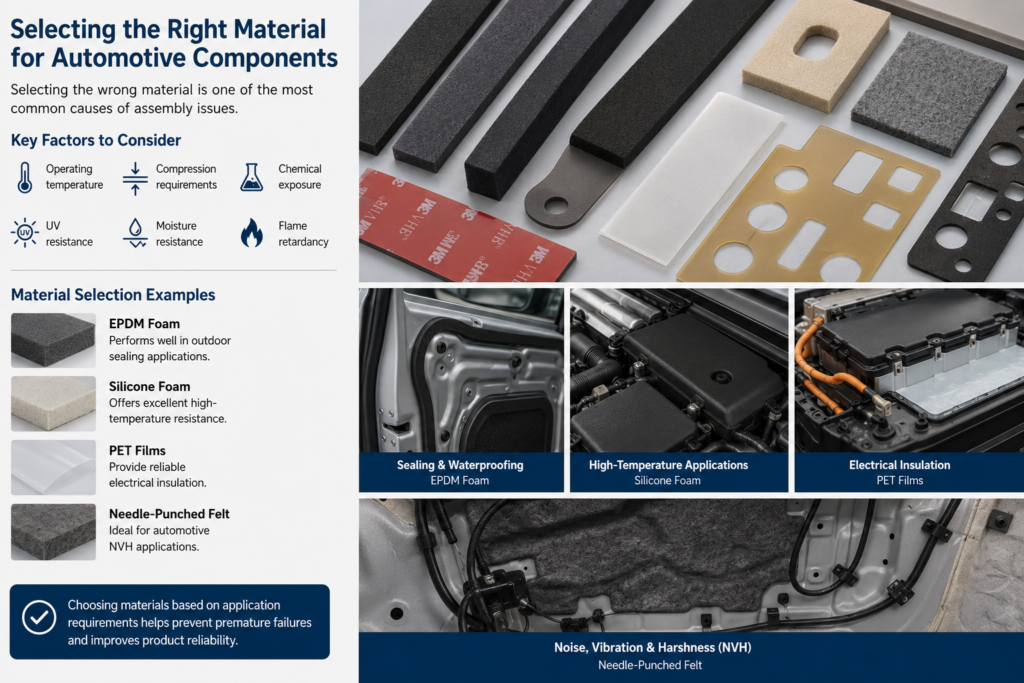
Selecting the wrong material is one of the most common causes of assembly issues.
Consider factors such as:
- Operating temperature
- Compression requirements
- Chemical exposure
- UV resistance
- Moisture resistance
- Flame retardancy
For example:
- EPDM foam performs well in outdoor sealing applications.
- Silicone foam offers excellent high-temperature resistance.
- PET films provide reliable electrical insulation.
- Needle-punched felt is ideal for automotive NVH applications.
Choosing materials based on application requirements helps prevent premature failures.
Design Components for Easy Assembly
A well-designed die-cut part should be easy to install consistently.
Helpful design features include:
- Alignment holes
- Positioning tabs
- Rounded internal corners
- Pull tabs
- Split liners
- Assembly guides
These features reduce operator errors while improving installation speed.
Designing for manufacturability also simplifies automated assembly.
Ensure Accurate Dimensions and Tolerances
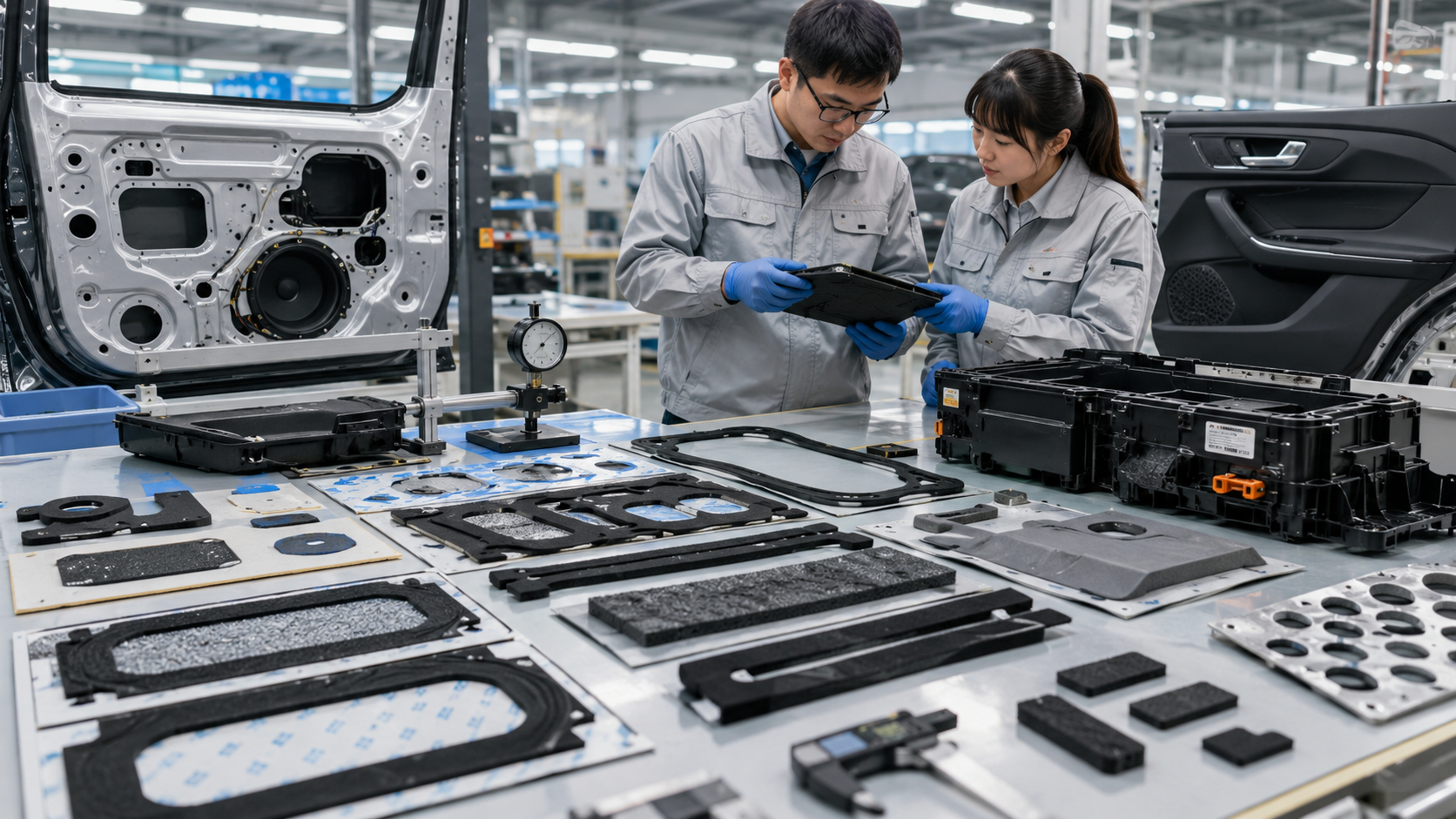
Automotive assemblies often require tight dimensional tolerances.
Poor dimensional accuracy can cause:
- Gap variation
- Improper sealing
- Difficult installation
- Excessive compression
Precision die cutting helps maintain:
- Consistent thickness
- Accurate profiles
- Repeatable dimensions
- Stable part quality
Tight process control minimizes assembly variation across large production volumes.
Theme: Precision Automotive Assembly
Select the Correct Adhesive System
Adhesive performance is just as important as the base material.
Factors to evaluate include:
- Surface energy
- Bond strength
- Temperature resistance
- Humidity resistance
- Long-term aging
Choosing the wrong adhesive may result in:
- Edge lifting
- Bond failure
- Assembly rework
- Reduced product life
Testing adhesive compatibility before production helps avoid costly problems.
Control Compression and Gap Dimensions
Many automotive foam gaskets depend on controlled compression.
Over-compression may:
- Damage foam cells
- Reduce sealing performance
- Shorten service life
Under-compression may:
- Cause water leakage
- Allow dust intrusion
- Increase vibration
Proper gasket thickness and spacer design help maintain the correct compression range.
Keep Components Clean During Manufacturing
Contamination can significantly affect adhesive and sealing performance.
Potential contaminants include:
- Dust
- Oil
- Fibers
- Moisture
- Fingerprints
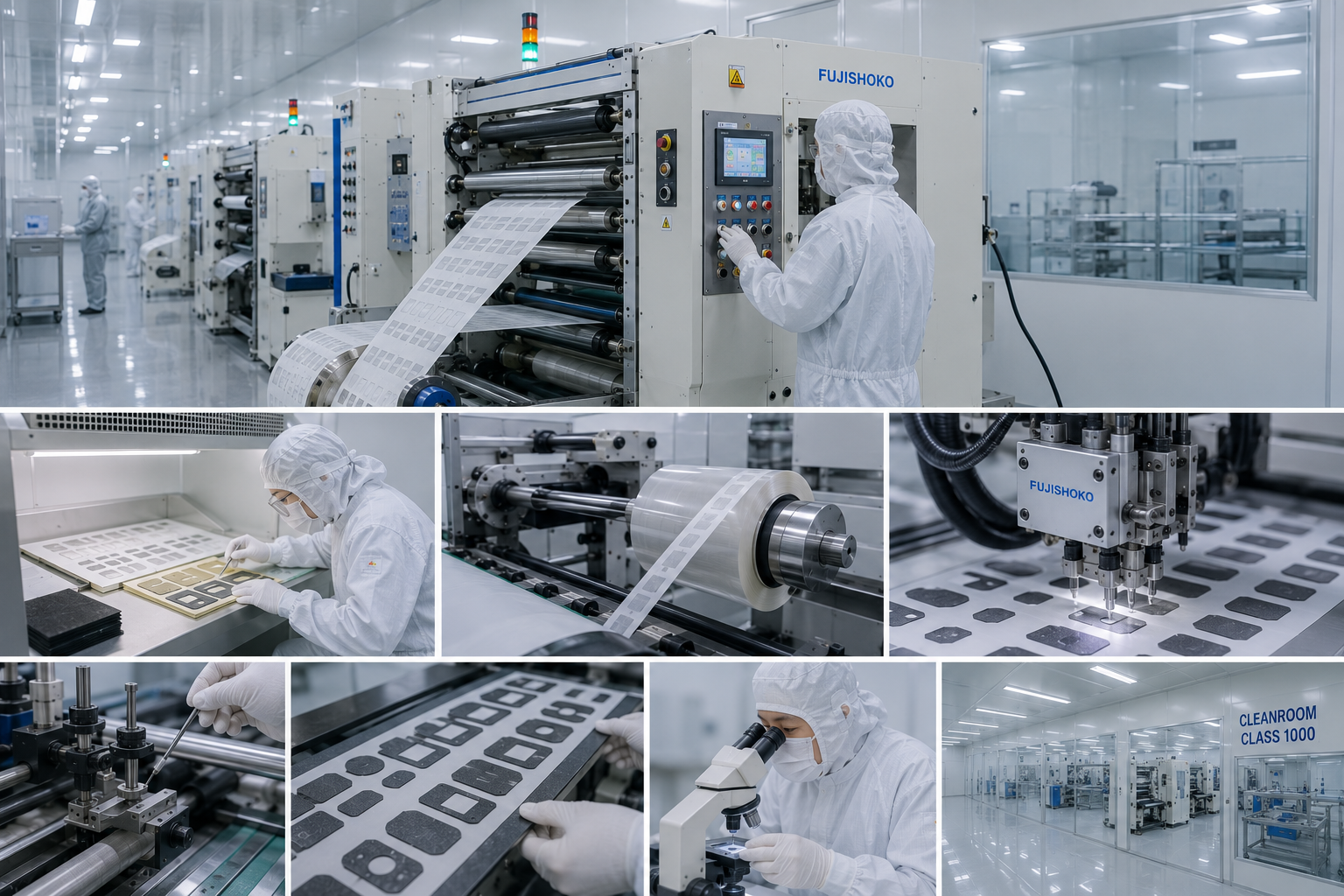
Cleanroom production or controlled manufacturing environments are recommended for:
- Optical components
- Automotive electronics
- Battery systems
- High-performance adhesive products
Maintaining clean surfaces improves bonding reliability.
Theme: Cleanroom Automotive Die Cutting
Validate Parts Before Mass Production
Prototype testing helps identify problems before full-scale production.
Recommended validation includes:
- Fit testing
- Assembly trials
- Compression testing
- Adhesion testing
- Environmental aging
- Thermal cycling
- Vibration testing
Early validation reduces engineering changes and production delays.
Support Automated Assembly
Many automotive production lines rely on automation.
Die-cut parts should be designed for:
- Pick-and-place equipment
- Robotic handling
- Vision alignment systems
- Automated dispensing
Roll, sheet, or kit packaging should match the customer's assembly process.
Automation-friendly components improve production speed while reducing operator variation.
Perform Design for Manufacturability (DFM)
DFM reviews help identify potential production issues before tooling begins.
Typical DFM considerations include:
- Material selection
- Cutting tolerances
- Adhesive layout
- Corner radii
- Hole size
- Part spacing
- Waste optimization
Addressing these factors early reduces tooling modifications and improves production efficiency.
Common Automotive Die-Cut Applications
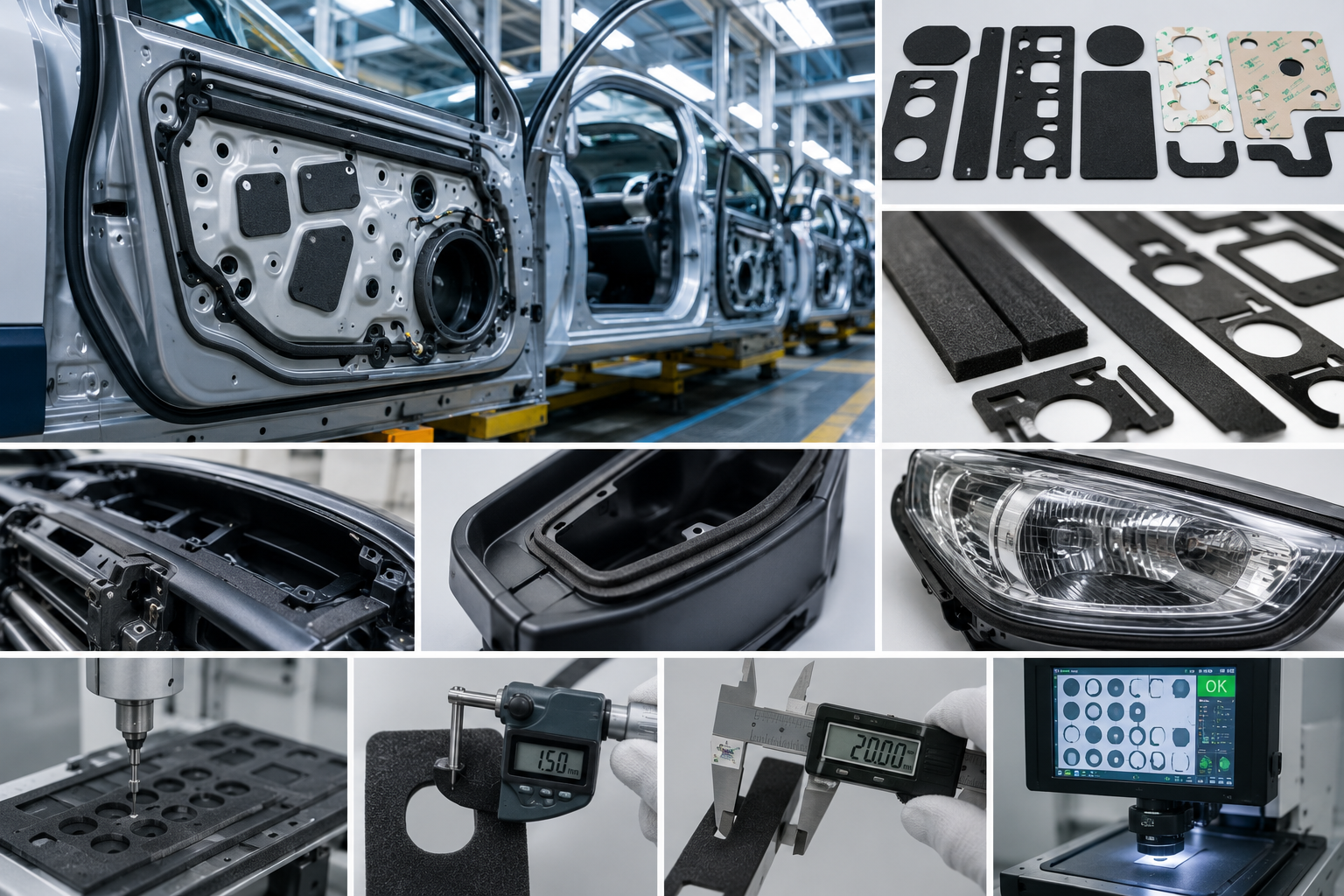
Precision die-cut components are widely used in:
- Door sealing systems
- Battery insulation
- Interior NVH parts
- Wire harness protection
- Camera modules
- Sensor assemblies
- Display systems
- HVAC sealing
- Lighting systems
Each application requires different material and process considerations.
How Sanken Manufacturing Supports Automotive OEMs
Dongguan Sanken Electronics Manufacturing Co., Ltd. specializes in precision die-cut components for automotive manufacturers and Tier 1 suppliers.
Our capabilities include:
- Precision die cutting
- Foam converting
- PET insulation film processing
- Rubber gasket manufacturing
- Adhesive laminating
- Multi-layer component assembly
- Cleanroom precision production
Key Advantages
- OEM and ODM customization
- ISO 9001 certified quality management
- RoHS and REACH compliant materials
- Domestic and overseas production bases
- DFM engineering support
- Tool development from drawings or samples
We help automotive customers improve assembly efficiency, reduce production risks, and achieve consistent product quality.
Featured Snippet Summary
Assembly problems with automotive die-cut components can be avoided through proper material selection, precise dimensional control, optimized adhesive systems, clean manufacturing, DFM reviews, and prototype validation. These practices improve assembly efficiency, reduce defects, and increase long-term product reliability.
Conclusion
Automotive assembly quality depends on more than accurate drawings. Material performance, adhesive selection, manufacturing precision, and assembly-friendly design all influence the final result.
By partnering with an experienced die-cut manufacturer and addressing potential risks early in product development, OEMs can reduce assembly problems, shorten production cycles, lower warranty costs, and deliver more reliable vehicles.