
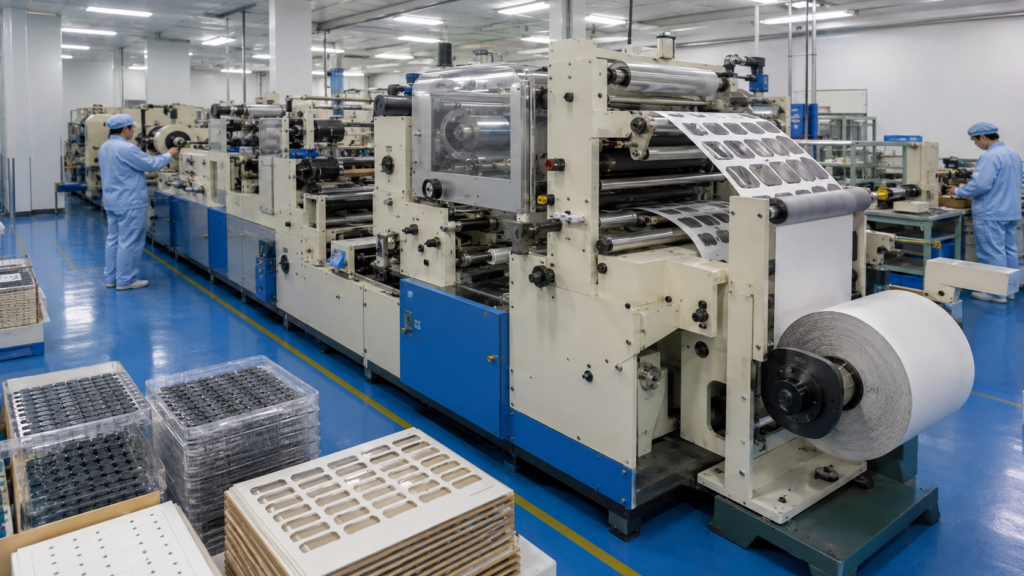
As manufacturing volumes continue to grow, OEMs are under increasing pressure to produce more parts in less time while maintaining consistent quality. Traditional sheet-fed die cutting works well for low- to medium-volume production, but it often becomes a bottleneck when millions of identical components are required. This is why many manufacturers choose roll-to-roll die cutting for large-scale production.
Roll-to-roll die cutting improves high-volume production by processing continuous material rolls at high speed, reducing material handling, minimizing waste, supporting automation, and delivering highly consistent die-cut parts. It enables manufacturers to increase production efficiency while lowering overall manufacturing costs.
Today, roll-to-roll die cutting is widely used to manufacture adhesive tapes, foam gaskets, insulation films, protective films, EMI shielding materials, optical components, and medical adhesive products.
What Is Roll-to-Roll Die Cutting?
Roll-to-roll die cutting, also called web die cutting, is a continuous converting process in which flexible materials are fed directly from one roll through multiple converting stations before being rewound or cut into finished products.
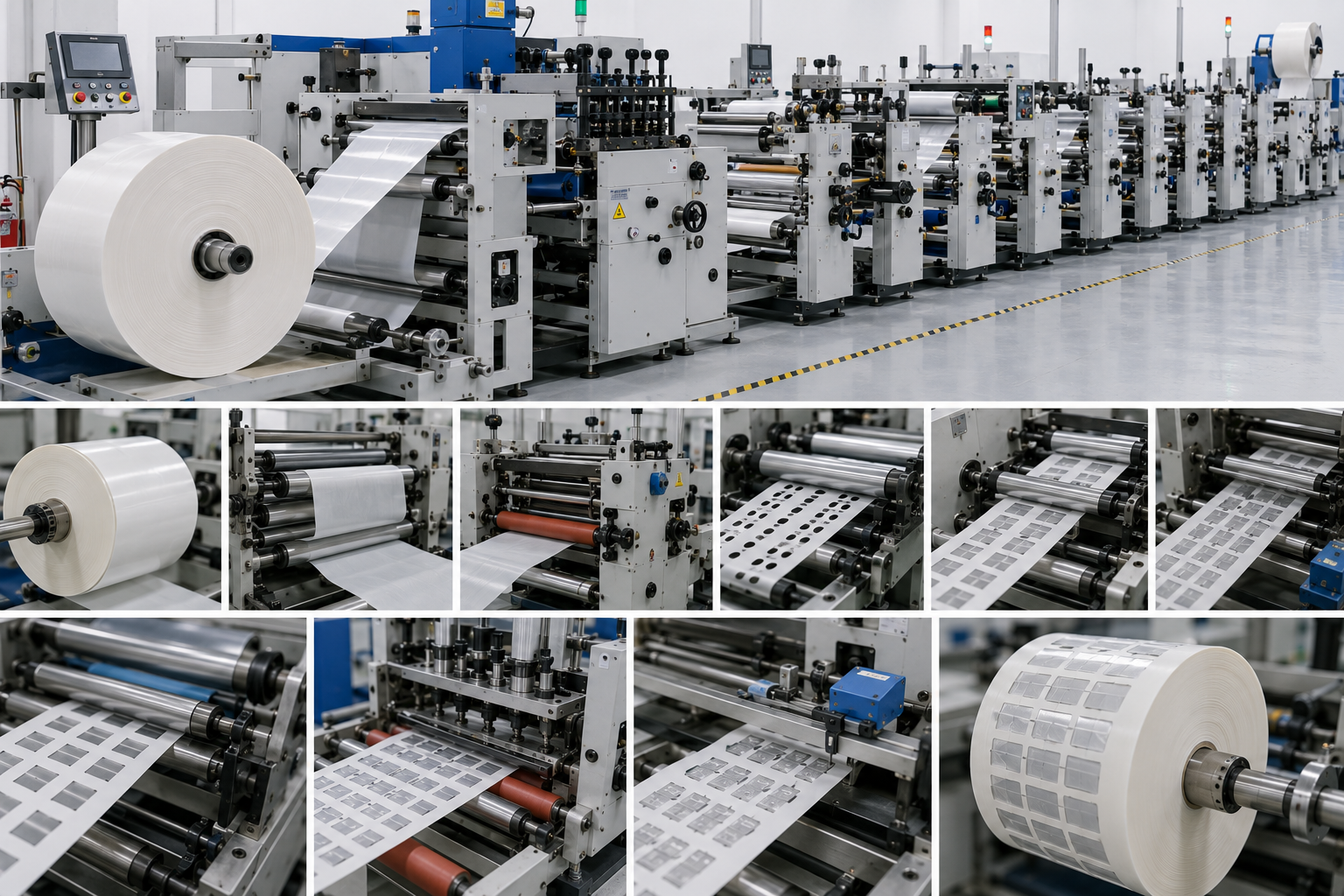
Depending on the application, the production line may include:
- Material unwinding
- Lamination
- Rotary die cutting
- Kiss cutting
- Hole punching
- Waste removal
- Inspection
- Rewinding or sheeting
Because the material moves continuously, production is significantly faster than handling individual sheets.
Theme: Roll-to-Roll Die Cutting Production
Why High-Volume Manufacturing Requires Continuous Processing
Large production volumes create several manufacturing challenges:
- Higher labor costs
- Longer production times
- Material handling delays
- Increased risk of human error
- Inconsistent product quality
Roll-to-roll processing addresses these challenges by maintaining a continuous production flow.
Instead of stopping to load individual sheets, the equipment processes thousands of meters of material without interruption.
This dramatically improves productivity.
Faster Production Speed
One of the biggest advantages of roll-to-roll die cutting is speed.
Continuous processing allows manufacturers to:
- Increase output
- Reduce machine downtime
- Improve equipment utilization
- Shorten production cycles
For products manufactured in millions of pieces annually, even small improvements in cycle time generate substantial cost savings.
Supporting Automated Manufacturing
Modern production lines increasingly rely on automation.
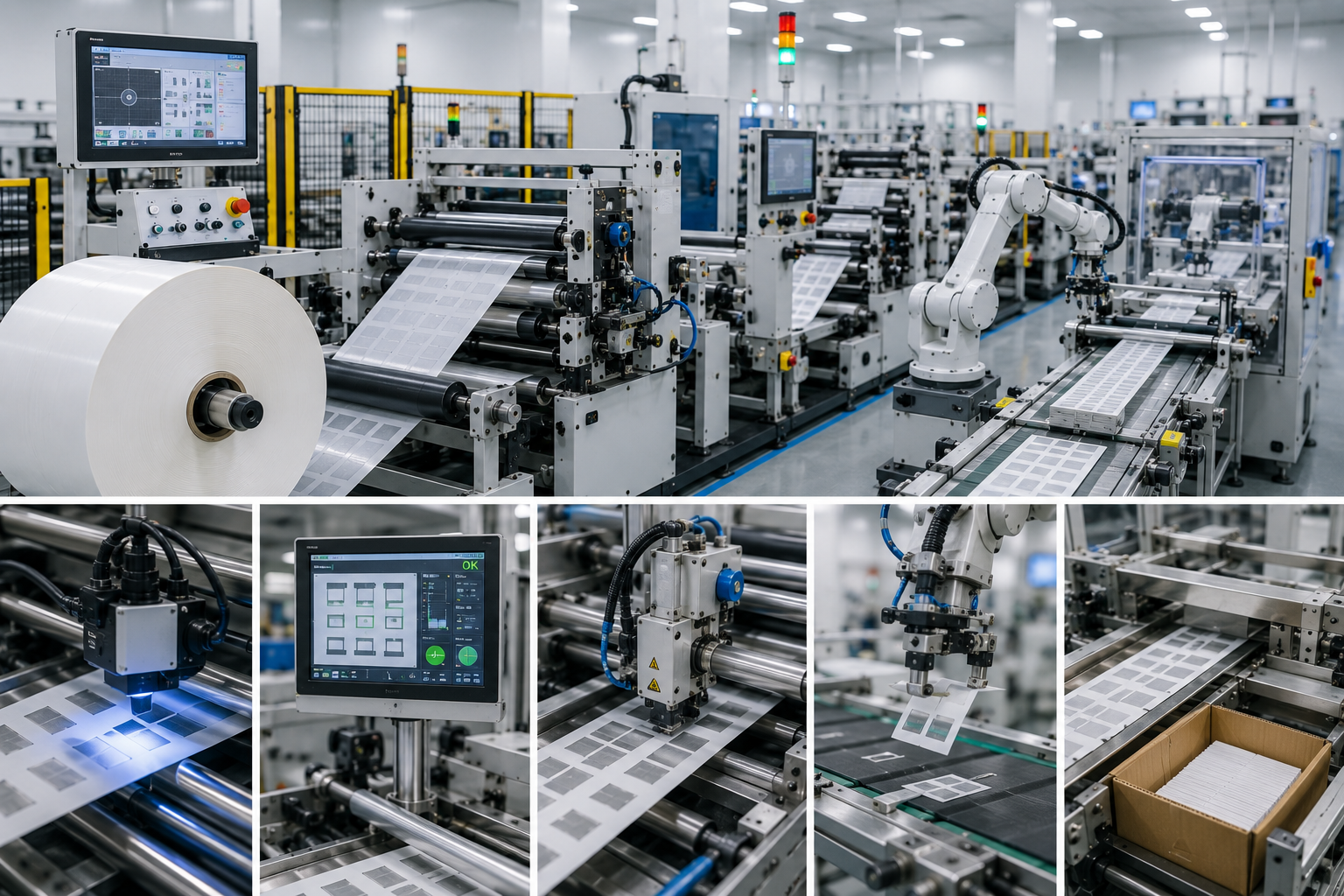
Roll-to-roll die cutting integrates easily with:
- Automatic laminators
- Vision inspection systems
- Pick-and-place equipment
- Robotic assembly
- Automated packaging
Continuous material flow makes automation more reliable because every part remains in a predictable position.
This improves manufacturing consistency while reducing operator involvement.
Theme: Automated Roll-to-Roll Converting
Improving Dimensional Consistency
High-volume manufacturing requires every component to be identical.
Roll-to-roll die cutting provides:
- Stable web tension
- Accurate registration
- Consistent cutting depth
- Repeatable dimensions
This is particularly important for:
- Optical films
- Display adhesives
- Battery insulation films
- Medical adhesive components
- Automotive electronics
Consistent dimensions reduce assembly variation and improve finished product quality.
Reducing Material Waste
Material utilization has a significant impact on production cost.
Roll-to-roll systems help reduce waste through:
- Optimized nesting
- Precise web control
- Automated waste removal
- Accurate registration
Reduced material waste lowers raw material consumption while improving overall manufacturing efficiency.
Processing Multiple Materials in One Production Line
Many modern die-cut components consist of multiple laminated materials.
Examples include:
- Foam + adhesive
- PET film + adhesive
- TPU + release liner
- EMI shielding material + conductive adhesive
- Nonwoven felt + foam
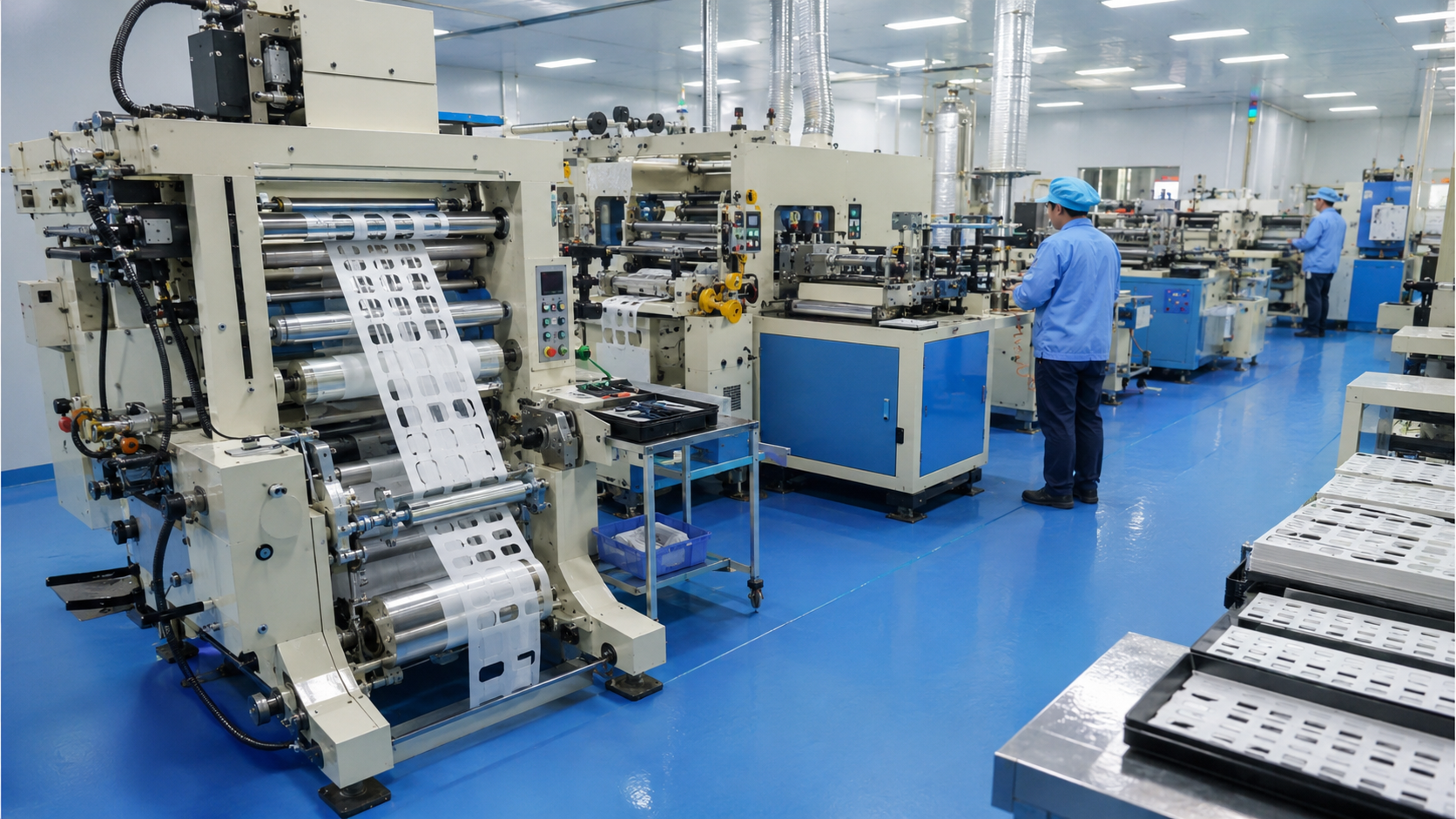
Roll-to-roll production allows these materials to be laminated and converted in one continuous process.
Benefits include:
- Fewer handling steps
- Better alignment
- Higher throughput
- Improved product consistency
Theme: Multi-Layer Roll-to-Roll Die Cutting
Supporting Kiss Cutting and Complex Converting
Roll-to-roll production is compatible with many advanced converting processes.
These include:
- Kiss cutting
- Through cutting
- Perforation
- Slitting
- Rewinding
- Pull-tab production
- Multi-layer lamination
Combining multiple operations into one production line reduces manufacturing time and simplifies downstream assembly.
Typical Applications
Consumer Electronics
Used for:
- Display adhesives
- Battery insulation
- Protective films
- Light-blocking components
Automotive Industry
Applications include:
- Foam gaskets
- NVH materials
- Sensor sealing
- Battery pack insulation
Medical Devices
Used for:
- Medical adhesive tapes
- Diagnostic components
- Wearable medical products
Industrial Equipment
Applications include:
- Sealing gaskets
- Electrical insulation
- EMI shielding
- Protective films
Roll-to-roll processing supports the consistent production volumes these industries require.
Why Precision Process Control Matters
High-speed production only delivers value when quality remains consistent.
Roll-to-roll die cutting requires precise control of:
- Web tension
- Cutting pressure
- Registration accuracy
- Lamination alignment
- Waste removal
Advanced process control helps ensure every component meets dimensional and performance requirements.
How Sanken Manufacturing Supports High-Volume Production
Dongguan Sanken Electronics Manufacturing Co., Ltd. specializes in precision roll-to-roll die cutting and material converting solutions for global OEM manufacturers.
Our capabilities include:
- Roll-to-roll die cutting
- Rotary die cutting
- Kiss cutting
- Adhesive laminating
- Foam converting
- PET and TPU film processing
- Multi-layer material assembly
- Cleanroom precision production
Key Advantages
- OEM and ODM customization
- ISO 9001 certified quality management
- RoHS and REACH compliant materials
- Domestic and overseas production bases
- High-speed automated production lines
- Tool development from drawings or samples
We support automotive, consumer electronics, medical devices, optical products, industrial equipment, and wearable technology manufacturers worldwide.
Featured Snippet Summary
Roll-to-roll die cutting improves high-volume production by processing continuous material rolls at high speed while reducing waste, improving dimensional consistency, supporting automation, and lowering manufacturing costs. It is widely used for adhesive tapes, foam gaskets, insulation films, optical components, medical products, and automotive electronics.
Conclusion
As manufacturing volumes continue to increase, production efficiency becomes just as important as product quality. Roll-to-roll die cutting provides an effective solution by combining continuous processing, automation compatibility, material efficiency, and precision converting in one streamlined operation.
For OEM manufacturers seeking faster production, lower costs, and consistent quality, roll-to-roll die cutting is one of the most efficient converting technologies available.