
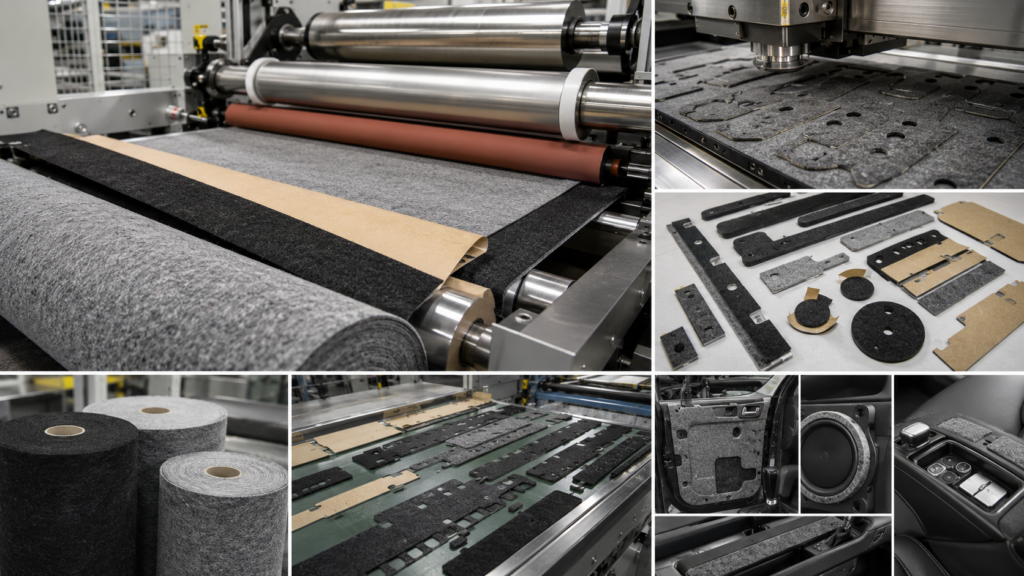
Custom needle-punched nonwoven felt for automotive sound absorption is widely used to reduce cabin noise, vibration-related sound, friction noise, and unwanted resonance inside vehicles. For automotive OEMs and Tier suppliers, felt is not just a soft textile material. It is a functional acoustic and anti-rattle component that must match the vehicle structure, installation position, compression requirement, adhesive surface, die cut shape, and long-term durability needs.
The best automotive sound absorption felt should be selected based on density, thickness, fiber structure, acoustic performance, compression behavior, adhesive backing, edge quality, and assembly method. If any of these factors are ignored, the felt part may fail to reduce noise, shed fibers, lift from the surface, deform during installation, or become unstable in mass production.
At Sanken, we help automotive customers develop custom needle-punched nonwoven felt parts, adhesive-backed felt strips, acoustic pads, anti-rattle components, precision die cut felt gaskets, foam and rubber parts, PET insulation films, and multilayer material solutions for automotive interiors, electronics, and industrial assemblies.
Why Automotive Sound Absorption Felt Matters
Modern vehicles are becoming quieter, lighter, and more electronically controlled. As a result, small noises inside the cabin are easier for drivers and passengers to notice.
Noise may come from:
- Door trim vibration
- Dashboard gaps
- Plastic panel friction
- Speaker cavity resonance
- Wire harness movement
- Seat component contact
- Center console vibration
- Pillar trim looseness
- Electronic module vibration
- Interior panel rubbing
A small custom die cut felt part can help reduce these problems by absorbing sound, separating hard surfaces, cushioning contact points, and controlling friction.
Unlike visible decorative parts, many sound absorption felt components are hidden behind panels, trims, covers, and housings. Even though they are not visible, they can strongly affect the perceived quality of the vehicle.
If the felt part is too thin, it may not absorb enough sound. If it is too soft, it may collapse after compression. If it is too dense, it may not fit the assembly gap. If the adhesive is wrong, the felt may lift or shift during vehicle use.
This is why automotive sound absorption felt should be engineered as a functional component, not purchased only by thickness and price.
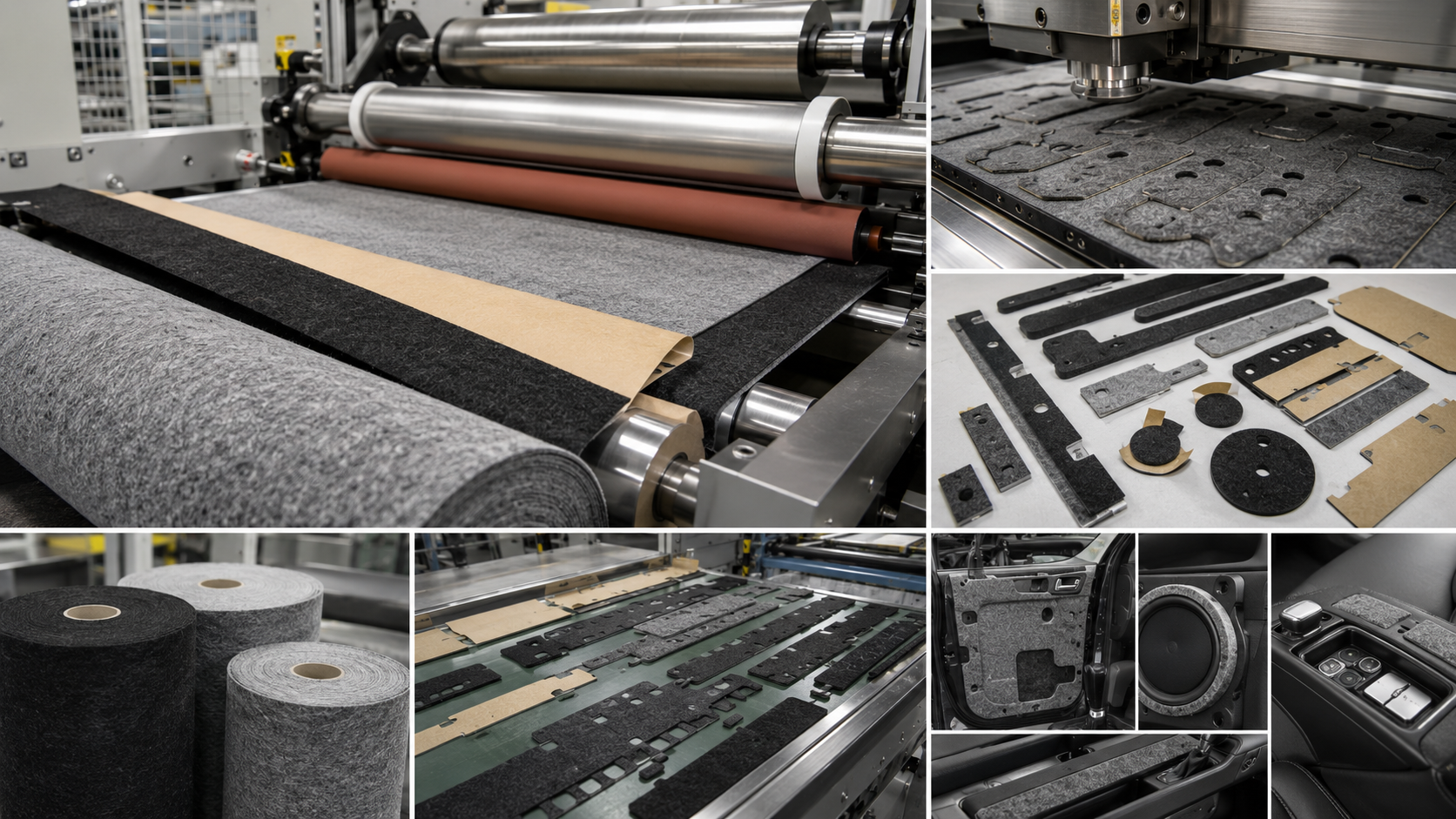
How Needle-Punched Nonwoven Felt Absorbs Sound
Needle-punched nonwoven felt is made by mechanically entangling fibers through repeated needle punching. This creates a porous fiber network with controlled thickness, density, and flexibility.
The fiber structure helps sound absorption in several ways.
First, sound waves enter the porous felt structure and interact with the fibers. This helps convert part of the sound energy into small amounts of heat through friction.
Second, the soft felt layer reduces direct contact between hard plastic, metal, or composite surfaces. This helps reduce squeak, rattle, and buzz noise.
Third, felt can fill small gaps between parts. A properly compressed felt pad can reduce looseness and prevent vibration from becoming audible noise.
Fourth, adhesive-backed felt can be placed precisely in the required position during assembly, improving repeatability and installation efficiency.
For automotive applications, felt performance depends on the balance between acoustic absorption, compression, dimensional stability, and assembly fit.
Common Automotive Applications
Custom needle-punched nonwoven felt can be used in many automotive sound absorption and anti-noise applications.
| Application Area | Common Felt Component | Main Function |
|---|---|---|
| Door trim | Felt strips, pads, edge parts | Reduce panel vibration and friction noise |
| Dashboard | Gap-filling felt pads | Reduce rattle and improve fit |
| Pillar trim | Die cut felt pads | Reduce vibration and looseness |
| Speaker area | Acoustic felt pads | Help control sound and resonance |
| Center console | Cushioning strips | Reduce plastic contact noise |
| Seat components | Friction pads | Reduce squeak and rubbing |
| Wire harness | Felt wraps or strips | Reduce movement noise |
| Electronic housings | Felt pads or liners | Cushion and reduce vibration |
| Battery covers | Felt cushioning parts | Reduce impact and contact noise |
| Interior panels | Custom felt gaskets | Improve assembly stability |
Different areas require different felt structures.
A speaker area may need better acoustic absorption. A dashboard pad may need stable compression. A door trim felt strip may need strong adhesive. A wire harness felt wrap may need flexibility and abrasion resistance.
The same felt material is not always suitable for every automotive position.
Common Problems and Production Risks
Automotive felt parts may look simple, but many issues can happen during sampling, cutting, assembly, and long-term use.
| Problem | Common Cause | Automotive Risk |
|---|---|---|
| Poor sound absorption | Wrong density or thickness | Noise problem remains |
| Fiber shedding | Poor felt structure or rough cutting | Contamination and quality concern |
| Weak adhesive bonding | Wrong adhesive for plastic or coated surface | Felt shifts or falls off |
| Thickness variation | Unstable felt material | Inconsistent gap filling |
| Edge fraying | Poor die cutting process | Loose fibers and poor appearance |
| Compression loss | Felt too soft or low-density | Reduced long-term performance |
| Poor shape accuracy | Weak tolerance control | Assembly mismatch |
| Liner peeling difficulty | Wrong release liner or kiss cut depth | Slow production |
| Curling or deformation | Poor packaging or material tension | Difficult installation |
Many of these problems are not visible in the first sample. They often appear after vibration testing, heat aging, humidity exposure, compression, or actual vehicle assembly.
For automotive OEM projects, the supplier must control both the material and the converting process.
What Buyers or Engineers Should Check First
Before ordering custom needle-punched nonwoven felt, engineers should define the real function of the part.
| Checklist Item | What to Confirm | Why It Matters |
|---|---|---|
| Noise type | Rattle, squeak, buzz, resonance, friction | Defines the felt function |
| Application position | Door, dashboard, pillar, seat, speaker, electronics | Affects material selection |
| Felt thickness | Nominal thickness and tolerance | Controls fit and gap filling |
| Felt density | Soft, medium, dense | Affects absorption and compression |
| Compression requirement | Light contact or strong compression | Prevents collapse or interference |
| Adhesive backing | Required or not required | Affects assembly efficiency |
| Bonding surface | PP, ABS, PC, metal, coating, fabric, rubber | Determines adhesive selection |
| Die cut shape | Holes, slots, tabs, narrow strips | Affects manufacturability |
| Edge quality | Clean edge and low fiber shedding | Improves cleanliness |
| Packaging format | Roll, sheet, individual part, kit | Supports production line use |
This information helps the supplier recommend a felt structure that is practical for real vehicle assembly.
A drawing alone is not enough. The supplier should also understand where the part is used, what noise problem it solves, how it is compressed, and how the operator will install it.
Material Selection for Automotive Felt Parts
The performance of needle-punched nonwoven felt depends on fiber type, thickness, density, weight, surface condition, and compression behavior.
Polyester needle-punched felt is commonly used because it offers stable processing, good flexibility, and suitable durability for many automotive interior applications.
Higher-density felt may offer better durability and dimensional stability, but it may feel firmer and may not compress easily in tight gaps.
Lower-density felt may be softer and easier to compress, but it may not provide enough support after long-term use.
Thicker felt can improve gap filling and cushioning, but it can also create assembly interference if the gap is limited.
Thinner felt can fit into narrow spaces, but it may not provide enough sound absorption or anti-rattle effect.
For automotive sound absorption, the best material is usually not the thickest or cheapest felt. It is the felt that matches the noise source, available space, compression condition, and assembly requirement.
Adhesive-Backed Felt for Faster Assembly
Many automotive felt components are supplied with pressure-sensitive adhesive backing.
Adhesive-backed felt allows workers to peel and apply the part directly during assembly. This can improve installation speed and reduce positioning errors.
However, adhesive selection is critical.
Automotive interior parts may use PP, ABS, PC, painted surfaces, powder-coated metal, rubber, fabric, or textured plastic. Different surfaces require different adhesive properties.
Common adhesive-related problems include:
- Edge lifting
- Weak bonding
- Adhesive overflow
- Difficult liner release
- Poor bonding after heat aging
- Poor adhesion to low surface energy plastic
- Part deformation during peeling
A strong adhesive is not always the best adhesive. The adhesive must match the bonding surface, temperature, pressure, liner release, and assembly process.
For custom die cut felt parts, kiss cutting is also important. The felt and adhesive layer must be cut cleanly while keeping the release liner stable. If the liner is damaged, operators may have difficulty peeling the part.
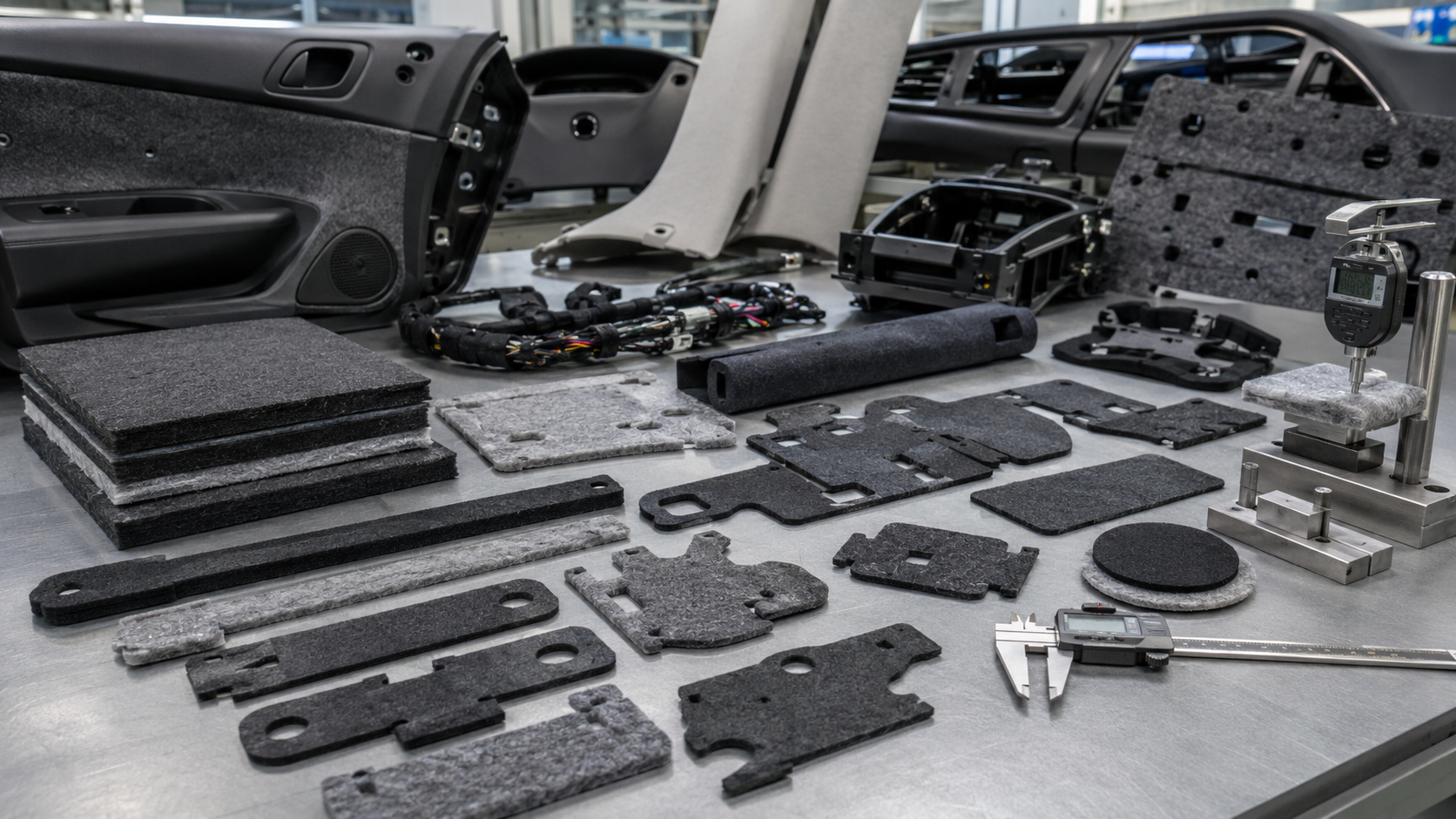
Why Die Cutting Quality Matters
Needle-punched felt is a fiber-based material, so cutting quality has a direct effect on final part performance.
Poor die cutting can cause rough edges, loose fibers, deformation, inaccurate holes, and inconsistent shapes.
For automotive sound absorption parts, this may lead to:
- Fiber contamination
- Poor installation fit
- Inconsistent acoustic performance
- Unstable adhesive edge
- Difficult waste removal
- Poor appearance during inspection
- Rejected parts during assembly
Complex felt parts with small holes, narrow strips, or thin bridges require careful tooling and process control.
Adhesive-backed felt parts may need controlled lamination, kiss cutting, waste removal, liner release inspection, and packaging support.
At Sanken, we review felt structure, adhesive backing, cutting pressure, blade condition, waste removal, edge cleanliness, dimensional tolerance, and packaging before mass production.
Customization Options for Automotive OEM Projects
Custom needle-punched nonwoven felt can be designed in many forms depending on the application.
Common customization options include:
- Custom thickness
- Custom density
- Adhesive-backed or non-adhesive structure
- Single-layer or laminated structure
- Die cut pads
- Long strips
- Complex profiles
- Holes and slots
- Kiss cut parts on release liner
- Roll format
- Sheet format
- Individual parts
- Assembly kits
For high-volume automotive projects, packaging format is also important.
A felt part may be technically correct but inefficient if it is difficult for operators to peel, locate, or install. Assembly-friendly delivery can reduce line time and improve production consistency.
How Sanken Helps Automotive Customers Reduce Risk
Sanken Manufacturing Co., Ltd. supports OEM customers with custom needle-punched nonwoven felt components for automotive sound absorption, NVH control, anti-rattle protection, cushioning, and interior assembly.
We help customers review:
- Felt thickness
- Felt density
- Fiber structure
- Compression behavior
- Adhesive backing
- Bonding surface
- Die cut shape
- Hole accuracy
- Edge cleanliness
- Fiber shedding risk
- Liner release
- Packaging method
- Assembly conditions
- Testing needs
For automotive interiors, we support door trim felt strips, dashboard felt pads, pillar trim parts, speaker acoustic felt, center console cushioning strips, seat friction pads, wire harness felt components, and electronic housing felt liners.
For automotive electronics and battery-related applications, we also support adhesive-backed foam parts, PET insulation films, rubber pads, protective films, sealing gaskets, and multilayer material components.
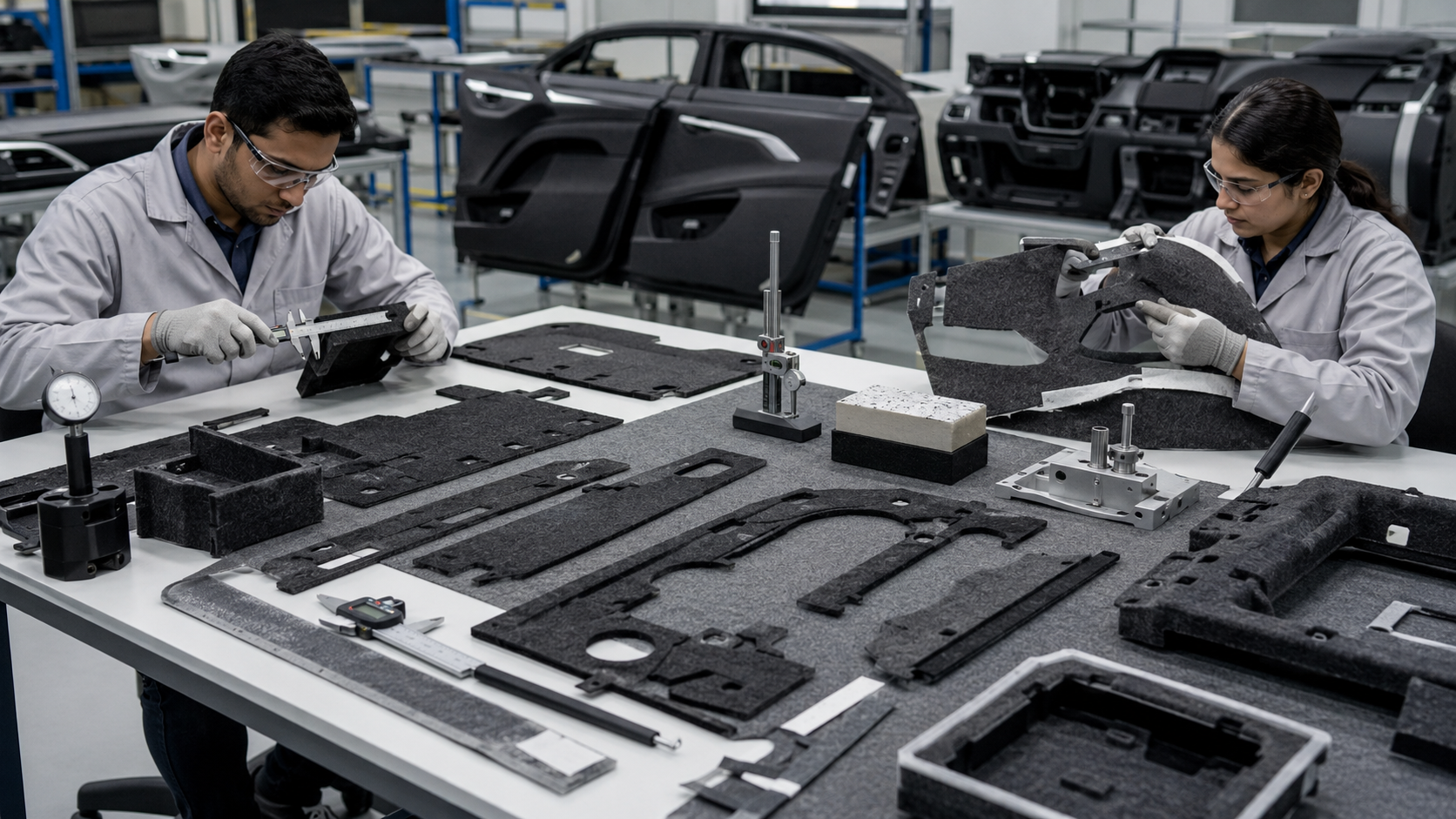
Our goal is to help customers reduce repeated samples, rattle noise, adhesive lifting, fiber shedding, poor fit, inconsistent thickness, and unstable mass production.
A good automotive sound absorption felt component should be quiet, stable, clean, easy to assemble, and reliable over time.
Conclusion
Custom needle-punched nonwoven felt for automotive sound absorption helps reduce cabin noise, rattle, squeak, vibration, friction, and unwanted resonance. But reliable performance depends on more than choosing a soft felt material. Engineers must review thickness, density, fiber structure, compression behavior, adhesive backing, die cutting quality, edge cleanliness, and assembly method.
At Sanken, we help automotive OEM customers turn needle-punched nonwoven felt into custom die cut sound absorption components that support cleaner assembly, better noise control, and more stable mass production.