
The best material for automotive electronic gaskets depends on the gasket’s function, location, compression requirement, sealing target, temperature exposure, electrical insulation need, and assembly method. There is no single material that is best for every automotive electronic gasket. A gasket used around an ECU housing may need water sealing and compression recovery. A gasket inside a battery module may need electrical insulation and heat resistance. A gasket around a sensor or display module may need cushioning, dust protection, adhesive positioning, or light blocking.
For OEM engineers and purchasing managers, the key is not only choosing foam, rubber, film, or adhesive tape. The real goal is to select a material structure that can stay stable during die cutting, bonding, assembly, vibration, aging, and long-term vehicle use.
At Sanken, we help automotive customers develop custom die cut gaskets, adhesive-backed foam parts, rubber pads, PET insulation films, non-woven felt parts, sealing components, and multilayer functional materials for automotive electronics and precision assembly applications.
Why Automotive Electronic Gaskets Need Careful Material Selection
Automotive electronics are exposed to more difficult conditions than many consumer products. They may face heat, humidity, dust, vibration, compression, pressure changes, road shock, chemical exposure, and long service life requirements.
Automotive electronic gaskets are commonly used in:
- ECU housings
- Battery modules
- Sensor assemblies
- ADAS components
- Camera modules
- Lighting systems
- Display modules
- Connectors
- Control panels
- Charging systems
- Automotive interior electronics
- Industrial vehicle electronics
A gasket may look like a simple soft part, but it can affect sealing, insulation, anti-rattle performance, dust protection, vibration control, and product reliability.
If the material is wrong, the final product may have water leakage, adhesive lifting, poor compression recovery, electrical risk, noise, assembly gaps, or unstable long-term performance.
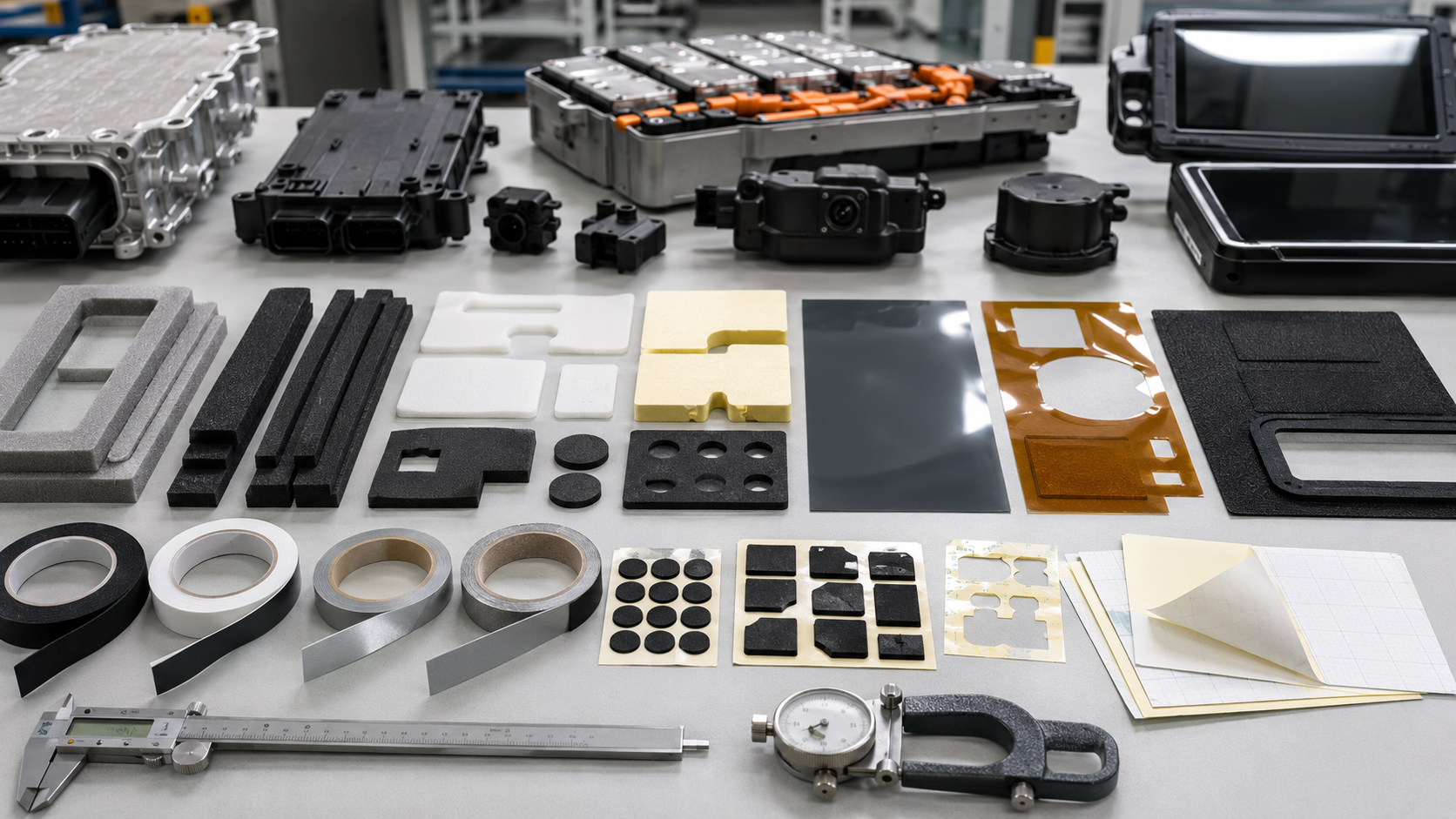
The Best Material Depends on the Function
Before choosing a material, engineers should define what the gasket must do.
| Gasket Function | Common Material Options | Key Requirement |
|---|---|---|
| Water and dust sealing | EPDM foam, silicone foam, rubber | Compression recovery and closed-cell structure |
| High-temperature sealing | Silicone foam, silicone rubber, PI film | Heat resistance and aging stability |
| Vibration cushioning | PU foam, PE foam, EPDM foam, silicone foam | Compression behavior and shock absorption |
| Electrical insulation | PET film, PI film, PC film, adhesive insulation film | Dielectric strength and dimensional stability |
| Anti-rattle protection | Non-woven felt, foam, rubber | Noise reduction and wear resistance |
| Adhesive positioning | Double-sided tape, transfer adhesive, foam tape | Bonding strength and liner release |
| Light blocking | Black foam, black PET, light-shielding tape | Opacity and clean edges |
| EMI shielding | Conductive fabric, conductive foam, metal foil tape | Conductivity and grounding contact |
This table shows why one material cannot be called the best for every automotive electronic gasket. The correct material must match the application.
Silicone Foam: Best for Heat and Compression Stability
Silicone foam is often one of the best choices for automotive electronic gaskets that require heat resistance, softness, compression recovery, and long-term sealing stability.
It is commonly used around electronic housings, battery-related components, lighting modules, sensors, and areas where temperature changes are important.
Silicone foam has several advantages:
- Good temperature resistance
- Good compression recovery
- Soft sealing performance
- Stable aging behavior
- Suitable for cushioning and gap filling
- Useful in sensitive electronic assemblies
However, silicone foam can be more expensive than common PE or PU foam. It also needs proper adhesive selection because bonding to silicone-based materials can be more challenging than bonding to PET, PE, or acrylic foam surfaces.
For high-reliability automotive electronics, silicone foam is often selected when cost is less important than long-term performance.
EPDM Foam: Best for Water Sealing and Weather Resistance
EPDM foam is widely used for automotive sealing because it offers good resistance to weather, moisture, and compression cycling.
For automotive electronic gaskets, EPDM foam can be suitable for enclosure seals, dust seals, cable area seals, and housing gaskets where water resistance is important.
EPDM foam is often selected for:
- Door-related electronics
- Exterior electronic housings
- Connector sealing pads
- Dust and water protection
- Automotive enclosure gaskets
- Anti-vibration sealing parts
Closed-cell EPDM foam is especially useful when the gasket must block water or dust.
The key is compression design. If the gasket is not compressed enough, sealing may fail. If it is compressed too much, the foam may deform or lose recovery over time.
PU Foam and PE Foam: Best for Cushioning and Cost Control
PU foam and PE foam are often used when cushioning, spacing, dust protection, and cost control are important.
PU foam is soft and flexible. It can absorb shock and reduce vibration, but open-cell PU foam may not be suitable for water sealing unless the structure is designed for that purpose.
PE foam is lightweight, clean, and available in different densities. Closed-cell PE foam can provide cushioning and basic sealing support.
These materials are often used in:
- Interior electronic modules
- Display assemblies
- Control panels
- Plastic housing pads
- Battery pack cushioning
- General electronic spacing parts
- Protective die cut foam pads
For automotive electronics, engineers should review foam density, thickness tolerance, compression force, adhesive backing, and aging performance before mass production.
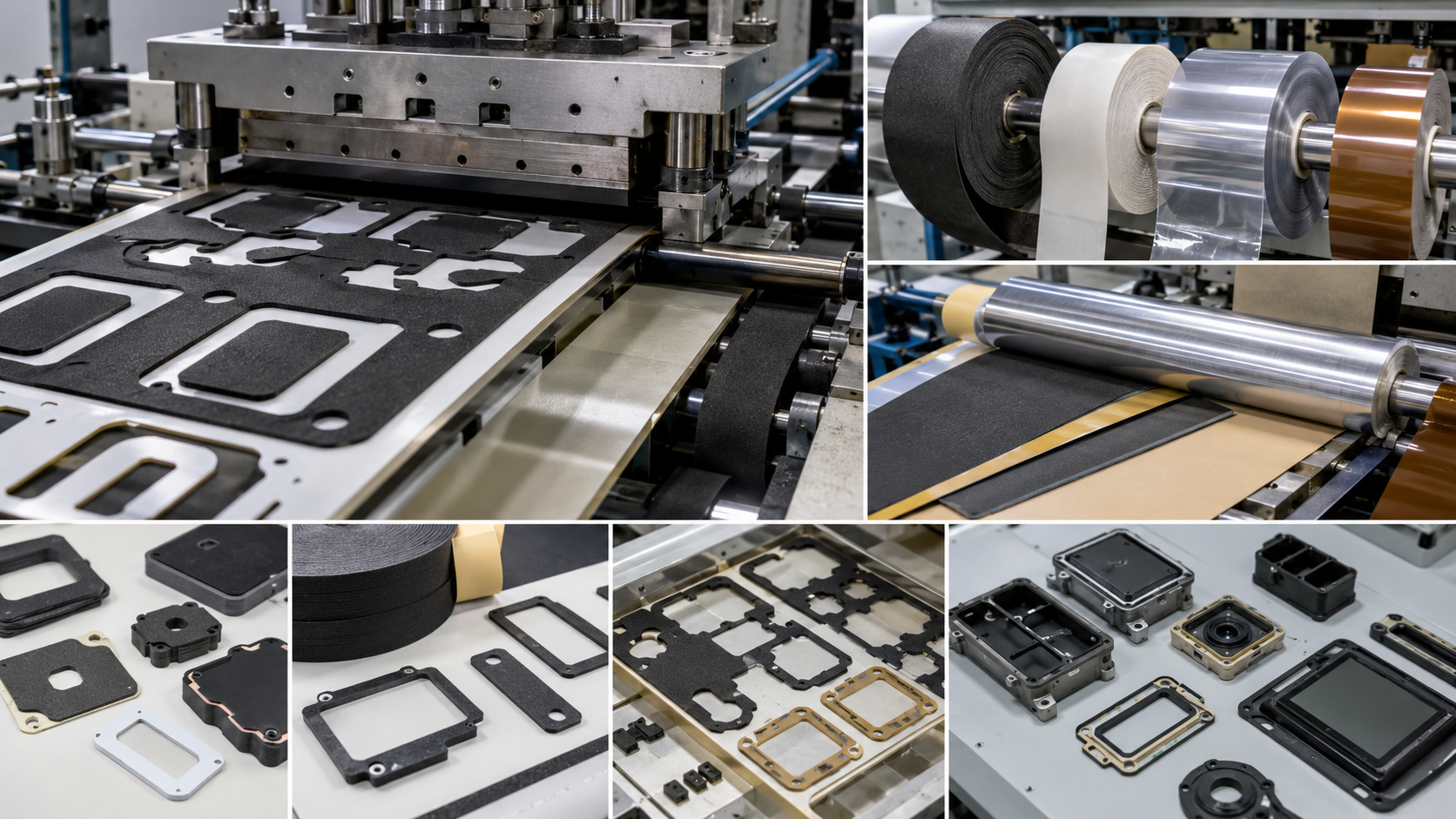
Solid Rubber: Best for Strong Sealing and Mechanical Durability
Solid rubber materials such as silicone rubber, EPDM rubber, neoprene rubber, and NBR rubber can be used when the gasket requires stronger mechanical sealing, durability, or oil resistance.
Silicone rubber is useful for heat resistance and flexible sealing.
EPDM rubber is commonly used for weather and water resistance.
Neoprene rubber can offer balanced sealing, cushioning, and resistance properties.
NBR rubber is useful where oil resistance is required, though it may not be the first choice for all automotive electronics.
Solid rubber may provide stronger sealing than foam, but it also requires higher compression force. This means engineers must check whether the plastic or metal housing can provide enough pressure without deformation.
For thin electronic housings, foam may be better. For stronger mechanical assemblies, solid rubber may be more suitable.
PET, PI, and PC Films: Best for Electrical Insulation
Not all automotive electronic gaskets are soft sealing parts. Some are thin insulation gaskets or spacing films.
PET film is widely used for electrical insulation, dimensional stability, and die cut film components.
PI film is selected for higher temperature resistance and electrical insulation in more demanding applications.
PC film may be used when impact resistance, shape stability, or appearance requirements are important.
These materials are commonly used for:
- Battery insulation films
- Electronic module insulation gaskets
- Sensor insulation pads
- Circuit protection films
- Die cut insulating spacers
- Connector insulation components
- Display and control module insulation layers
For insulation gaskets, edge quality, hole accuracy, burr control, adhesive position, and dielectric performance are more important than softness.
A PET insulation gasket may fail if the hole position shifts, the edge is contaminated, or the adhesive layer is unstable.
Adhesive Backing Is Also Part of the Material Choice
Many automotive electronic gaskets need adhesive backing to improve assembly efficiency.
The adhesive may be applied to foam, rubber, PET film, felt, or multilayer structures.
Adhesive selection depends on the bonding surface. Automotive electronic gaskets may bond to ABS, PC, PP, metal, painted surfaces, powder-coated surfaces, rubber, or composite materials.
Common adhesive-related risks include:
- Edge lifting
- Poor bonding to low surface energy plastics
- Adhesive overflow
- Difficult liner release
- Residue after removal
- Poor aging after heat or humidity
- Part deformation during peeling
A strong adhesive is not always the best adhesive. The adhesive must match the surface, pressure, temperature, liner, and assembly method.
For die cut gaskets, kiss cutting depth and liner release are also critical. If the liner is damaged or too difficult to peel, assembly speed and part quality may suffer.
How to Choose the Best Material
A practical way to choose the best material is to start from the failure risk.
| Application Need | Better Material Direction |
|---|---|
| High heat resistance | Silicone foam, silicone rubber, PI film |
| Water and dust sealing | Closed-cell EPDM foam, silicone foam, rubber |
| Low-cost cushioning | PE foam, PU foam |
| Long-term compression recovery | Silicone foam, EPDM foam |
| Electrical insulation | PET film, PI film, PC film |
| Anti-rattle and noise reduction | Non-woven felt, foam, rubber |
| Light blocking | Black foam, black PET, light-shielding tape |
| Strong bonding | Correct PSA adhesive matched to surface |
| EMI shielding | Conductive foam, conductive fabric, foil tape |
Engineers should also confirm:
- Temperature range
- Compression force
- Gasket thickness
- Housing gap
- Surface material
- Adhesive requirement
- Sealing grade
- Die cut tolerance
- Application environment
- Expected service life
- Testing method
The best material is the one that meets the real working condition, not the one that looks good in a sample box.
Why Die Cutting Quality Matters
Even the right material can fail if die cutting quality is poor.
Automotive electronic gaskets often have complex shapes, narrow walls, small holes, adhesive layers, tabs, slots, and tight tolerances.
Poor die cutting can cause:
- Rough edges
- Adhesive overflow
- Hole misalignment
- Material stretching
- Foam deformation
- Liner damage
- Burrs or particles
- Poor waste removal
- Inconsistent dimensions
For adhesive-backed foam gaskets, cutting pressure must be controlled to avoid adhesive squeeze-out and edge deformation.
For PET or PI insulation films, clean edges and hole accuracy are critical.
For rubber gaskets, material rebound and tool sharpness must be considered.
For non-woven felt parts, fiber shedding and edge cleanliness matter.
This is why material selection and converting process must be reviewed together.
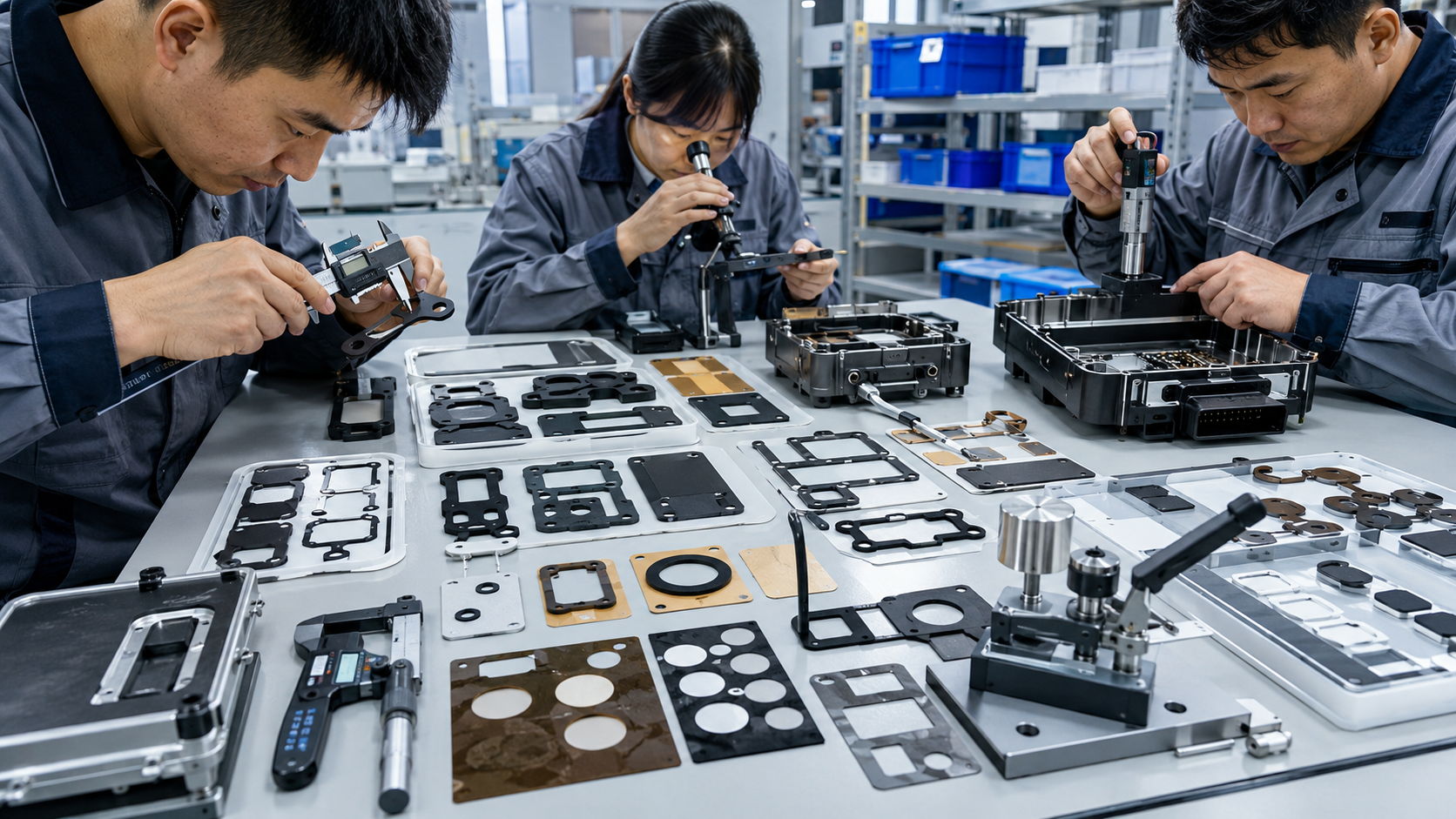
How Sanken Helps Automotive Customers Reduce Material Risk
Sanken Manufacturing Co., Ltd. helps OEM customers select and convert materials for automotive electronic gaskets based on real application requirements.
We support custom die cut foam gaskets, rubber sealing pads, PET insulation films, PI insulation layers, adhesive-backed components, non-woven felt pads, protective films, light-blocking gaskets, and multilayer material structures.
For each project, we review:
- Gasket function
- Material thickness
- Foam density or rubber hardness
- Compression requirement
- Adhesive structure
- Bonding surface
- Die cut tolerance
- Liner release
- Edge quality
- Packaging method
- Assembly condition
- Testing needs
Our goal is to help customers reduce repeated samples, adhesive lifting, sealing failure, poor fit, unstable dimensions, and mass production risk.
A good automotive electronic gasket should be easy to assemble, stable in position, clean at the edge, suitable for the environment, and reliable after long-term vehicle use.
Conclusion
The best material for automotive electronic gaskets depends on function. Silicone foam is strong for heat and compression stability. EPDM foam is strong for water and dust sealing. PU and PE foam are useful for cushioning and cost control. Rubber supports stronger mechanical sealing. PET, PI, and PC films are better for electrical insulation. Conductive materials may be needed for EMI shielding.
For OEM buyers, the safest choice is not simply selecting a material name. The material must match the sealing target, compression condition, adhesive surface, temperature exposure, electrical requirement, die cut tolerance, and assembly process.
At Sanken, we help automotive customers turn foam, rubber, films, tapes, felt, and multilayer materials into custom die cut gaskets that support reliable automotive electronic assembly and mass production.