
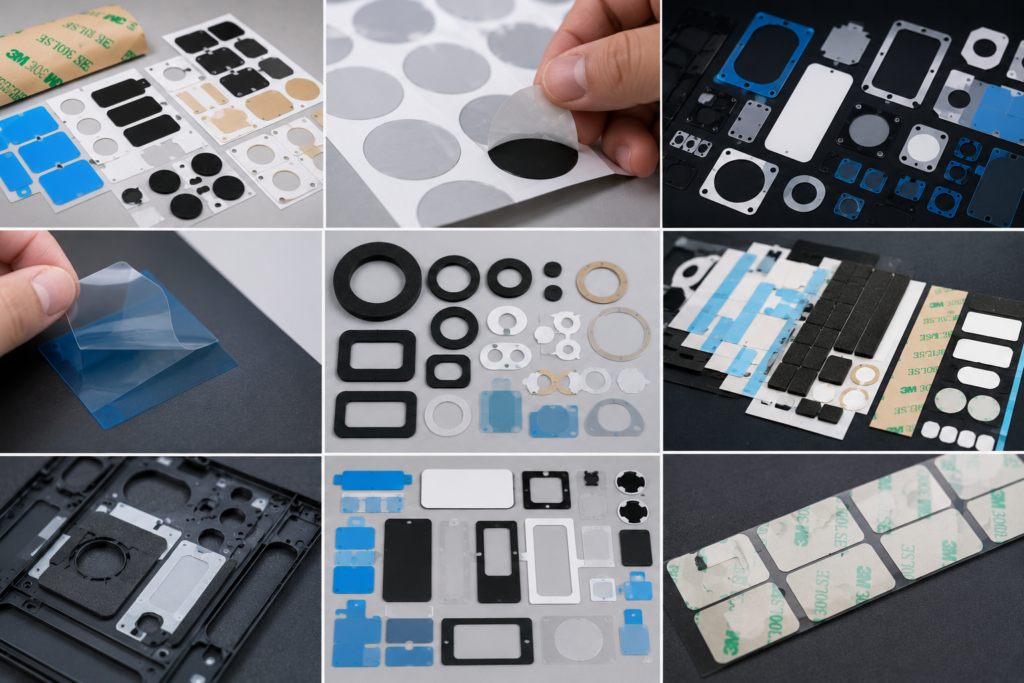
The best place to get die cut stickers made depends on what the sticker must do. If you need promotional logo stickers, packaging labels, or short-run marketing stickers, an online sticker printing company or local print shop may be enough. But if you need die cut stickers for OEM assembly, electronics, automotive parts, medical devices, industrial equipment, protective films, adhesive labels, insulation films, or functional adhesive components, you need a precision die cutting manufacturer that understands materials, adhesive behavior, tolerance, liner release, and mass production stability.
For engineers and purchasing managers, the question is not only “Who can print and cut stickers?” The better question is “Can this supplier make the sticker perform correctly in the final product?”
At Sanken, we support OEM customers with precision die cutting, adhesive lamination, foam and rubber components, PET insulation films, non-woven felt parts, sealing gaskets, adhesive-backed components, protective films, and custom industrial die cut parts.
Why This Topic Matters for OEM Manufacturing
Die cut stickers can mean different things in different industries.
For marketing teams, die cut stickers may be custom logo stickers, product labels, packaging stickers, warning decals, or brand tags.
For OEM engineers, die cut stickers may be much more functional. They may be adhesive-backed PET insulation films, protective films, double-sided tape parts, foam tape gaskets, battery labels, display protection layers, masking films, medical adhesive pads, or industrial bonding components.
The second group has higher risk.
A decorative sticker mainly needs good printing, clean cutting, and attractive appearance.
An OEM die cut sticker may need:
- Stable adhesive bonding
- Accurate hole alignment
- Clean edges
- Liner release control
- Thickness consistency
- Temperature resistance
- Surface compatibility
- Electrical insulation
- Dust and moisture protection
- Reliable mass production
If the wrong supplier is chosen, the sticker may peel, curl, shift, leave residue, block holes, contaminate parts, or fail during assembly.
That is why the best place to get die cut stickers made depends on the application, not only the price.
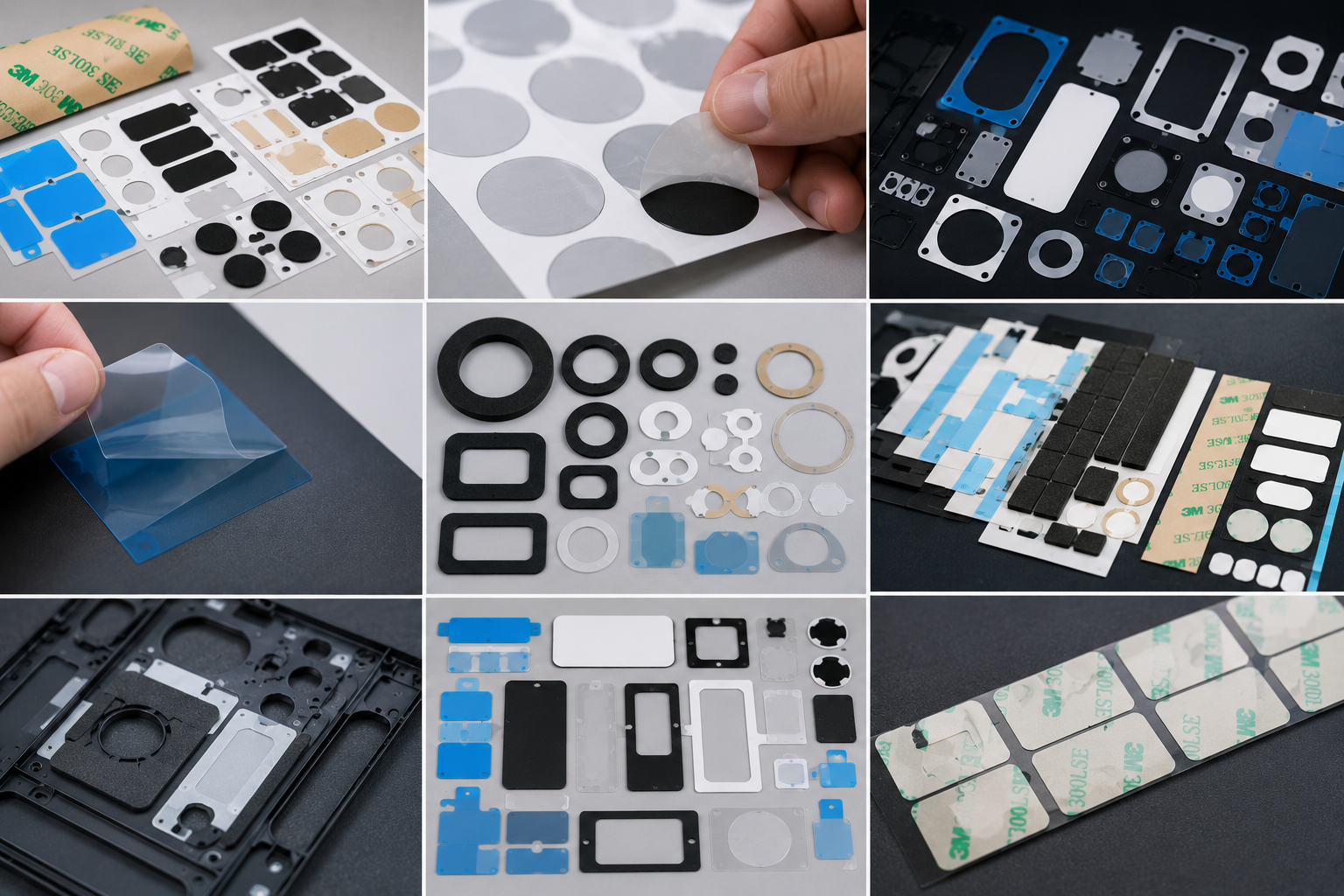
Common Supplier Options and Their Differences
Different suppliers are suitable for different die cut sticker needs.
| Supplier Type | Best For | Main Limitation |
|---|---|---|
| Online sticker printer | Logo stickers, packaging labels, small promotional orders | Limited engineering support |
| Local print shop | Simple labels, quick communication, small runs | May not handle technical materials |
| Label converter | Printed labels, barcode labels, warning labels | May focus more on printing than functional die cutting |
| Precision die cutting manufacturer | OEM adhesive parts, films, tapes, gaskets, insulation stickers | Requires more project details |
| Material converter | Multilayer adhesive, foam, film, and tape structures | Best for technical or production projects |
If the sticker is only for branding, packaging, or decoration, an online sticker printer may be the fastest and most cost-effective option.
If the sticker must become part of a product assembly, a precision die cutting manufacturer is usually a better choice.
For example, a printed vinyl sticker for packaging does not need the same process control as a PET insulation sticker inside an electronic product. A promotional sticker does not need the same adhesive testing as a foam tape gasket used in automotive electronics.
Common Problems and Production Risks
Die cut sticker problems often appear when buyers choose a supplier based only on appearance or unit price.
| Problem | Common Cause | OEM Risk |
|---|---|---|
| Edge lifting | Wrong adhesive or poor surface contact | Peeling after assembly |
| Poor liner release | Wrong liner or cutting depth | Slow production and damaged parts |
| Hole misalignment | Weak tolerance control | Assembly mismatch |
| Adhesive residue | Wrong adhesive for the surface | Contamination and rework |
| Curling | Thin film, tension, or poor packaging | Difficult handling |
| Ink or coating damage | Wrong material or process | Poor appearance or failed marking |
| Adhesive overflow | Soft adhesive or high cutting pressure | Contamination near components |
| Batch inconsistency | Weak process control | Unstable mass production |
A sticker may look good before application, but the real test happens when it is peeled, placed, pressed, exposed to heat, compressed, or used in the final product.
For OEM parts, visual approval is not enough.
Buyers should check whether the supplier can repeat the same quality across batches.
What Buyers or Engineers Should Check First
Before deciding where to get die cut stickers made, buyers should define the real purpose of the sticker.
| Checklist Item | What to Confirm | Why It Matters |
|---|---|---|
| Sticker function | Branding, warning, insulation, bonding, protection, sealing | Defines supplier type |
| Material | Vinyl, PET, PC, foam tape, adhesive film, protective film | Affects performance |
| Adhesive type | Permanent, removable, acrylic, rubber-based, silicone | Controls bonding |
| Bonding surface | Plastic, metal, glass, painted surface, rubber, coating | Prevents peeling |
| Thickness | Film, adhesive, foam, or multilayer thickness | Affects fit and assembly |
| Die cut shape | Holes, slots, tabs, windows, narrow strips | Affects manufacturability |
| Printing requirement | Logo, warning mark, barcode, blank technical part | Defines printing needs |
| Liner release | Easy peel, tight release, roll-fed, sheet format | Affects assembly speed |
| Environment | Heat, humidity, vibration, chemicals, outdoor use | Confirms durability |
| Production volume | Sample, small batch, mass production | Determines best process |
This checklist helps avoid choosing the wrong supplier.
A print shop may be right for simple printed labels.
A precision converter may be right for technical adhesive parts.
An OEM buyer should not use a consumer sticker supplier for a critical functional part unless the supplier can prove material control, tolerance, adhesive performance, and repeatability.
When an Online Sticker Printer Is the Best Choice
An online sticker printer is a good option when the sticker is mainly decorative or promotional.
This includes:
- Logo stickers
- Brand stickers
- Packaging stickers
- Laptop stickers
- Event stickers
- Simple product labels
- Short-run marketing stickers
The advantages are speed, easy online ordering, many shape options, and low minimum order quantities.
However, most online sticker printers are not designed for technical OEM projects. They may not support special adhesive testing, custom material lamination, tight tolerance holes, functional films, cleanroom handling, or automotive and electronics assembly requirements.
If the sticker must perform as an engineering component, the buyer should ask more questions before ordering.
When a Precision Die Cutting Manufacturer Is the Best Choice
A precision die cutting manufacturer is the better choice when the sticker has a functional role inside a product.
This includes:
- PET insulation stickers
- Battery insulation labels
- Protective film stickers
- Adhesive-backed foam parts
- Foam tape gaskets
- Double-sided tape components
- Medical adhesive pads
- Masking films
- Industrial bonding stickers
- Automotive electronics adhesive components
These parts may need special materials, adhesive lamination, kiss cutting, liner control, and strict inspection.
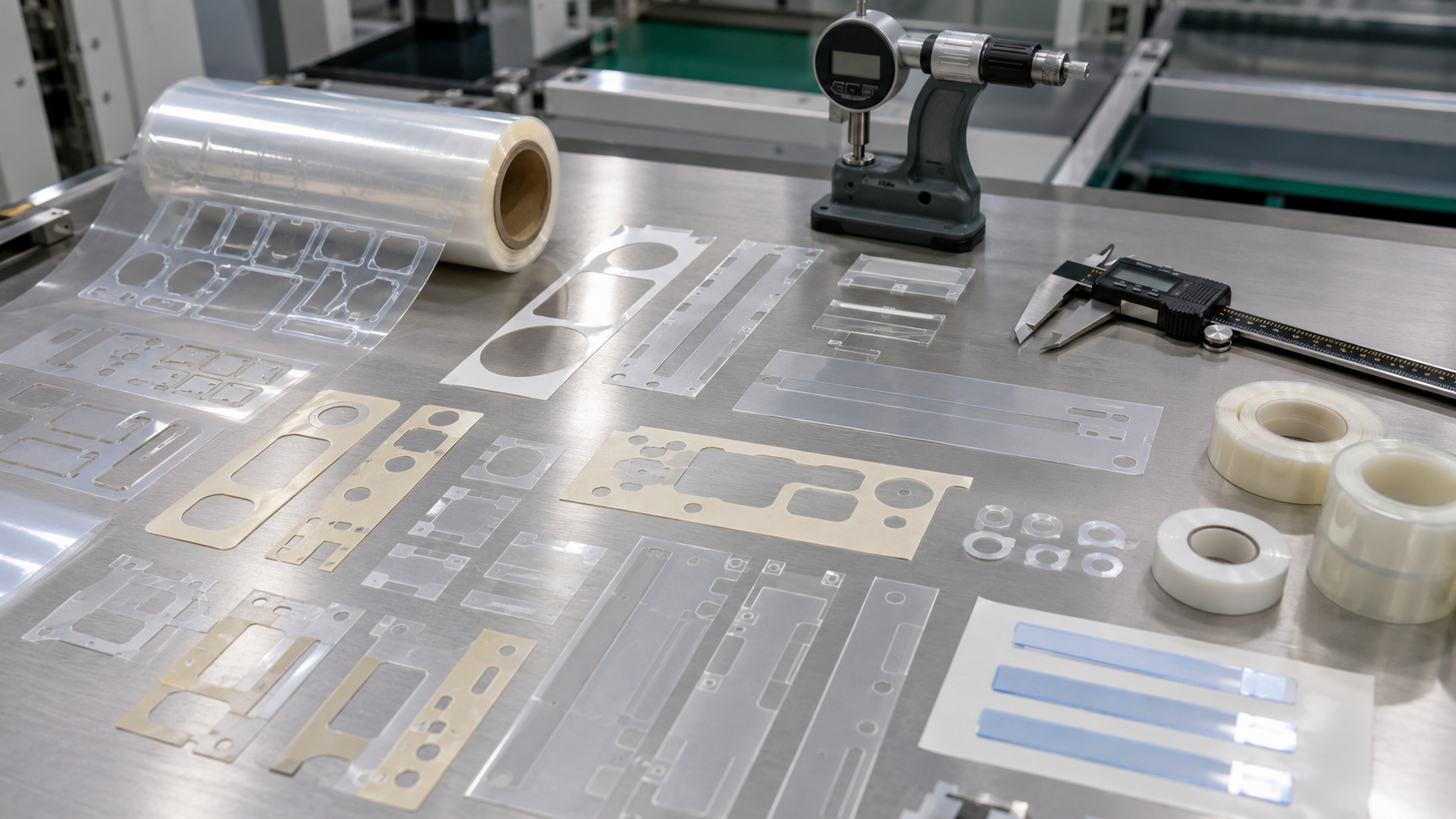
For example, an adhesive-backed PET insulation sticker used in electronics must have clean edges, accurate holes, stable adhesive, and controlled liner release.
A foam tape sticker used for sealing must compress properly and stay bonded after assembly.
A protective film sticker must peel cleanly without leaving residue.
These requirements go beyond normal sticker printing.
Material and Process Considerations
The best supplier should understand how different materials behave during die cutting and assembly.
Vinyl is common for printed stickers and labels. It is flexible and suitable for decorative use.
PET film is often used for insulation, protection, electronics, and industrial applications. It provides better dimensional stability than many soft films.
PC film may be used where impact resistance or specific appearance is needed.
Foam tape is useful for sealing, cushioning, gap filling, and vibration reduction.
Double-sided tape and transfer adhesive are used for bonding and mounting.
Protective films are used to protect surfaces during manufacturing, shipping, or assembly.
The process also matters.
Kiss cutting is often used for adhesive-backed stickers, where the top material is cut while the release liner remains uncut.
Through cutting may be used for individual sticker pieces.
Printing, lamination, die cutting, waste removal, inspection, and packaging must be matched to the final application.
If the material is soft, narrow, or adhesive-heavy, waste removal can become difficult. If the liner is wrong, operators may damage the part during peeling. If the adhesive does not match the surface, the sticker may lift after assembly.
How Sanken Helps OEM Buyers Reduce Risk
Sanken Manufacturing Co., Ltd. helps OEM buyers and engineers develop custom die cut adhesive components for automotive electronics, consumer electronics, medical-related products, appliances, battery modules, and industrial equipment.
For sticker-like adhesive components, we review material, adhesive type, bonding surface, die cut shape, tolerance, liner release, cutting depth, waste removal, and packaging format.
For PET insulation stickers, we focus on clean edges, hole accuracy, adhesive stability, and dimensional control.
For foam tape stickers and gaskets, we review compression, foam density, adhesive bonding, sealing wall width, and liner release.
For protective film stickers, we review peel behavior, surface protection, residue risk, and packaging.
For double-sided tape components, we control kiss cutting depth, adhesive overflow, part spacing, and assembly-friendly delivery.
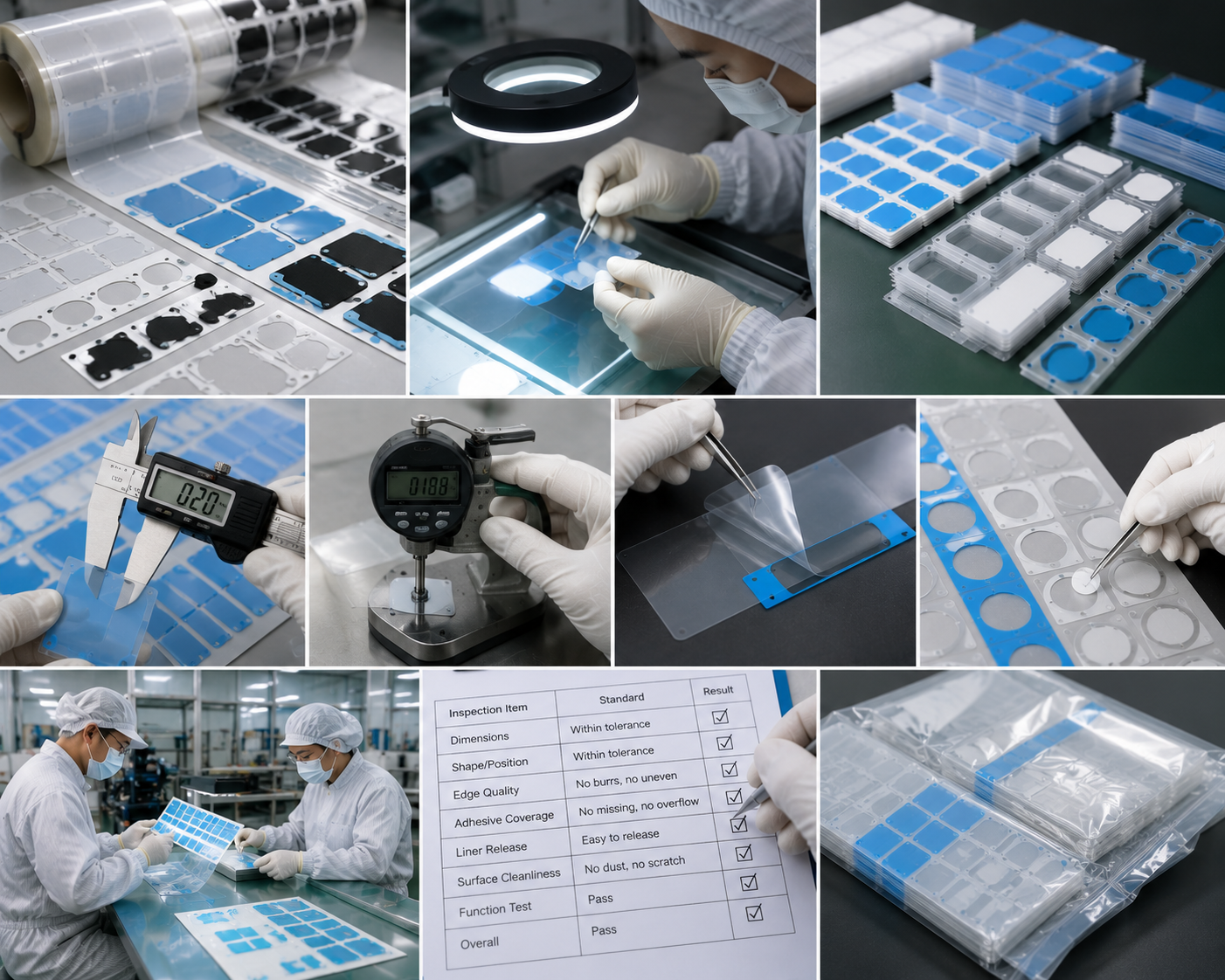
Our goal is to help customers avoid repeated samples, peeling problems, adhesive residue, tolerance issues, poor liner release, and unstable batch production.
If the part is only a simple promotional sticker, a sticker printer may be enough. If the part must work inside a real OEM product, a precision die cutting manufacturer is usually the safer choice.
FAQ
Where is the best place to get die cut stickers made?
The best place depends on the application. For promotional stickers, an online sticker printer or local print shop may be suitable. For OEM adhesive components, insulation stickers, protective films, foam tape gaskets, or technical die cut parts, a precision die cutting manufacturer is usually a better choice.
Are die cut stickers the same as die cut adhesive components?
Not always. Decorative die cut stickers are mainly used for branding or packaging. Die cut adhesive components are functional parts used for bonding, sealing, insulation, protection, cushioning, or assembly.
What materials can be used for die cut stickers?
Common materials include vinyl, PET film, PC film, protective film, double-sided tape, foam tape, transfer adhesive, paper label material, and specialty adhesive films.
What should buyers check before ordering die cut stickers?
Buyers should check the application, material, adhesive type, bonding surface, die cut shape, tolerance, liner release, printing requirement, environment, and production volume.
Can die cut stickers be used in electronics?
Yes. Die cut PET insulation stickers, protective films, adhesive tapes, and masking films are commonly used in electronics. These parts require better dimensional control and material selection than ordinary decorative stickers.
Why do die cut stickers peel or lift?
They may peel because of wrong adhesive selection, dirty surface, low surface energy plastic, insufficient pressure, sharp corners, poor liner release, or unsuitable material.
Can Sanken make custom die cut sticker-like adhesive parts?
Yes. Sanken supports custom die cut adhesive components, PET insulation films, protective films, foam tape gaskets, double-sided tape parts, and OEM adhesive-backed materials based on drawings, samples, and application requirements.
Conclusion
The best place to get die cut stickers made depends on whether the sticker is decorative or functional. For simple logo stickers and packaging labels, online sticker printers or local print shops may be enough. For OEM adhesive parts, insulation stickers, protective films, foam tape gaskets, and custom industrial adhesive components, buyers should work with a precision die cutting manufacturer.
At Sanken, we help OEM customers turn adhesive films, tapes, foams, PET materials, and protective films into reliable custom die cut components that support real production and assembly requirements.