
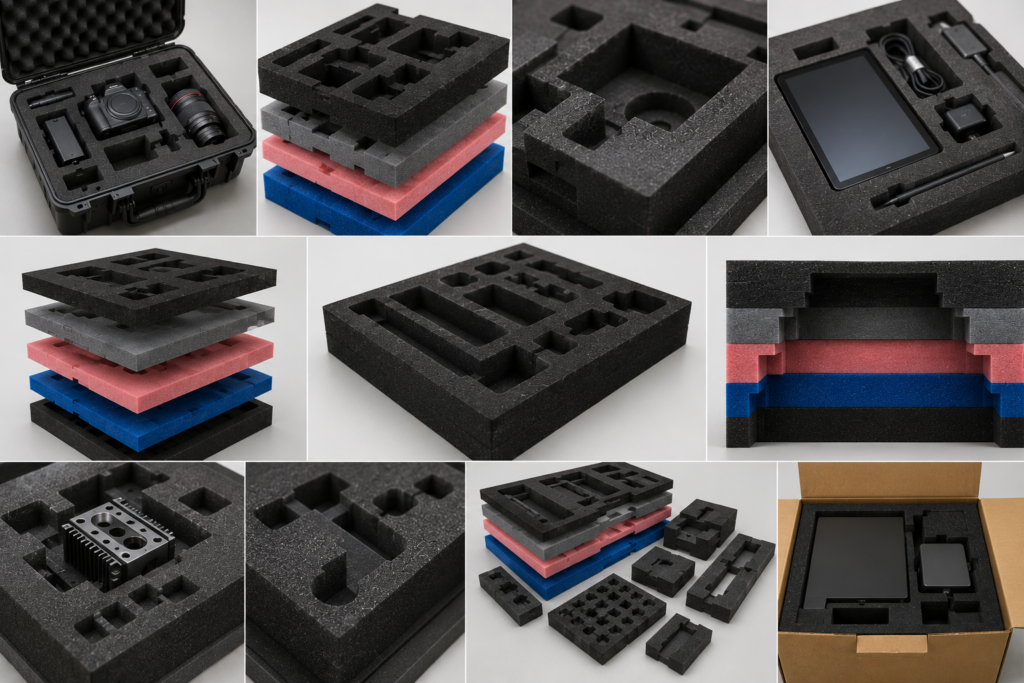
Flexible custom die-cut foam inserts are used to protect, separate, cushion, seal, position, and organize parts during transportation, assembly, storage, and final product use. They may look simple, but for OEM buyers and engineers, the correct foam insert can reduce product damage, improve assembly efficiency, protect sensitive surfaces, and create a more reliable packaging or product structure.
The best foam insert is not only soft. It must match the product weight, surface sensitivity, compression requirement, thickness tolerance, adhesive need, packaging method, and production volume.
At Sanken, we help OEM customers develop custom die-cut foam inserts, foam pads, adhesive-backed foam parts, protective films, rubber components, PET insulation films, non-woven felt parts, and precision material converting solutions for automotive, electronics, medical, appliance, battery, and industrial applications.
Why Flexible Foam Inserts Matter
Flexible foam inserts are commonly used when a product needs protection or controlled positioning. In many OEM projects, the insert is not only packaging material. It may also become part of the assembly process, kitting system, product protection plan, or internal cushioning structure.
Flexible die-cut foam inserts are often used for:
- Product packaging protection
- Shock absorption
- Vibration reduction
- Surface protection
- Component separation
- Assembly positioning
- Anti-scratch protection
- Tool and part organization
- Electronics protection
- Automotive component protection
- Medical device packaging
- Industrial equipment packaging
A poor foam insert can cause movement inside the package, edge damage, surface scratches, compression marks, part deformation, poor appearance, or customer complaints.
A well-designed foam insert keeps the product stable, protected, clean, and easy to handle.
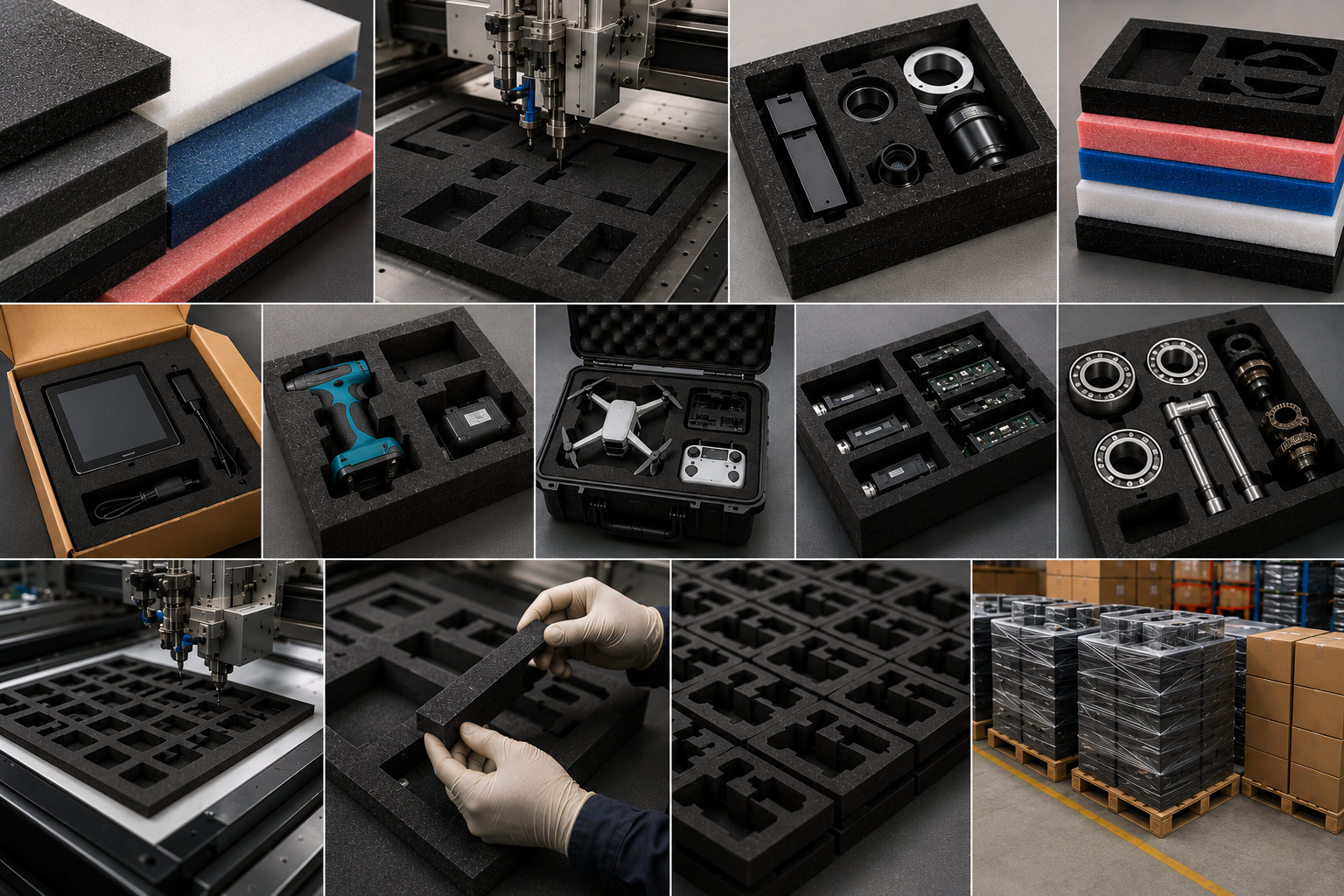
Common Foam Materials for Custom Inserts
Different foam materials behave differently during cutting, compression, and use. The best material depends on the product and application.
| Foam Material | Common Features | Typical Use |
|---|---|---|
| EVA foam | Durable, flexible, good cushioning | Tool inserts, electronics packaging, industrial kits |
| PE foam | Lightweight, clean, closed-cell structure | Protective packaging, transport inserts |
| PU foam | Soft, compressible, good cushioning | Delicate product protection, soft pads |
| EPDM foam | Weather-resistant, good sealing support | Automotive and outdoor applications |
| Silicone foam | Heat-resistant, stable compression | Electronics, battery, high-temperature areas |
| CR foam | Balanced cushioning and sealing | Industrial and automotive pads |
| EPE foam | Lightweight and cost-effective | General packaging protection |
EVA and PE foam are common choices for packaging inserts because they offer good shape stability and cushioning. PU foam is softer and can protect delicate products. EPDM or silicone foam may be selected when the insert also needs sealing, heat resistance, or automotive durability.
The material should be selected according to the real function, not only price.
Common Problems and Production Risks
Many foam insert problems happen because the design looks acceptable in a drawing but fails during handling, shipping, or assembly.
| Problem | Common Cause | Risk |
|---|---|---|
| Product moves inside insert | Cavity too loose or foam too soft | Scratches, impact damage |
| Foam tears easily | Thin walls or wrong foam density | Poor durability |
| Compression marks | Foam too hard or wrong thickness | Product surface damage |
| Poor fit | Tolerance not controlled | Assembly or packaging delay |
| Rough edges | Poor cutting process | Low-quality appearance |
| Foam dust or particles | Wrong foam or poor cutting | Cleanliness concern |
| Insert deformation | Weak material or poor packaging | Unstable protection |
| High cost | Over-designed foam or wrong process | Unnecessary packaging expense |
For OEM projects, a foam insert should be tested with the real product, real packaging, and real transportation or assembly conditions.
A sample that looks good on the table may not perform well after vibration, stacking, shipping, or repeated handling.
What Buyers Should Check First
Before ordering flexible custom die-cut foam inserts, buyers should confirm the application details clearly.
| Checklist Item | What to Confirm | Why It Matters |
|---|---|---|
| Product weight | Light, medium, heavy | Determines foam density and thickness |
| Product surface | Painted, polished, coated, plastic, metal, glass | Prevents scratches or marks |
| Protection target | Shock, vibration, scratch, dust, positioning | Defines foam structure |
| Foam type | EVA, PE, PU, EPDM, silicone, CR | Controls performance and cost |
| Thickness | Total insert thickness and cavity depth | Affects fit and cushioning |
| Cavity design | Tight fit, loose fit, finger notch, layered structure | Improves usability |
| Compression requirement | Soft support or firm holding | Prevents movement or damage |
| Die cut tolerance | Hole position, cavity size, edge width | Controls product fit |
| Packaging format | Box insert, tray insert, kit insert, sheet insert | Determines final structure |
| Quantity | Prototype, small batch, mass production | Affects tooling and cost |
This checklist helps avoid wrong material selection and repeated sample changes.
How to Choose the Right Foam Density
Foam density is one of the most important factors.
Low-density foam is softer and lighter. It can cushion delicate products, but it may not hold heavy components firmly.
High-density foam is stronger and more durable. It can hold parts more securely, but it may be too hard for sensitive surfaces.
For example, a lightweight electronic accessory may only need soft PU or PE foam. A heavy machined metal component may need higher-density EVA or PE foam. A delicate optical part may need soft foam plus protective film or surface-safe lining.
The foam should compress enough to absorb impact, but not so much that the product becomes loose.
The safest approach is to test the actual product with the foam sample before mass production.
Cavity Design Matters
A custom die-cut foam insert usually includes cavities, slots, holes, grooves, or layered cut-outs that match the product shape.
Good cavity design should make the product easy to place, easy to remove, and stable during movement.
Important cavity design features include:
- Correct product clearance
- Rounded internal corners
- Finger notches for easy removal
- Enough wall thickness between cavities
- Proper cavity depth
- Layered foam if the product shape is complex
- Support under fragile areas
- No excessive pressure on sensitive surfaces
Very tight cavities can make removal difficult and may damage the product surface.
Very loose cavities allow movement and reduce protection.
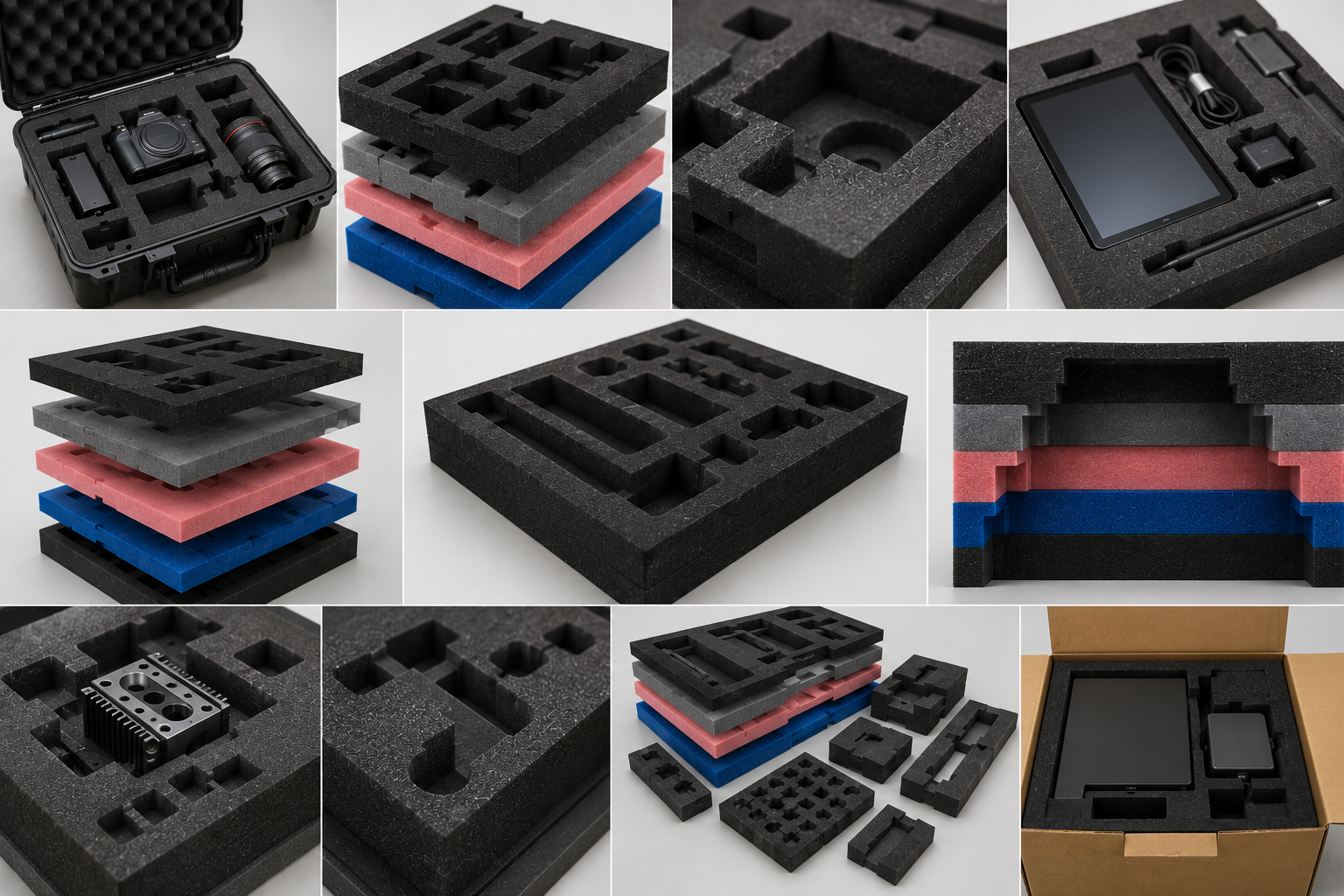
For products with irregular shapes, layered foam inserts may be better than a single thick foam layer. Multiple layers can create stepped cavities, deeper pockets, and more accurate support.
When Adhesive Backing Is Needed
Some foam inserts require adhesive backing. Adhesive-backed foam inserts can be fixed inside a box, housing, panel, tray, or product assembly.
Adhesive backing may be useful for:
- Box inserts
- Protective pads
- Anti-slip foam pads
- Cushioning inside housings
- Assembly fixtures
- Automotive interior components
- Electronics packaging
- Industrial equipment protection
However, adhesive selection must be reviewed carefully.
The adhesive must match the bonding surface, such as paperboard, plastic, metal, painted surface, or coated material. It should also be easy to peel from the liner and stable after application.
Common adhesive risks include edge lifting, liner release problems, adhesive overflow, poor bonding, and residue.
For die-cut adhesive-backed foam inserts, kiss cutting depth, liner control, and waste removal are also important.
Die Cutting Quality and Edge Cleanliness
Flexible foam inserts can be made by die cutting, CNC cutting, waterjet cutting, laser cutting, or other converting methods. For repeatable foam shapes and mass production, die cutting is often efficient and cost-effective.
Die cutting quality affects the final appearance and fit.
Poor cutting can cause rough edges, crushed foam, uneven cavities, poor hole alignment, and loose particles.
For OEM packaging and assembly use, clean edges are important because they improve appearance and reduce contamination risk.
The die cutting process should be selected according to foam thickness, density, cavity complexity, tolerance, and production volume.
At Sanken, we review foam structure, thickness, density, cutting method, adhesive backing, edge quality, packaging, and inspection before production.
How to Reduce Cost Without Losing Protection
Foam insert cost is affected by material type, thickness, density, cutting complexity, waste rate, tooling, adhesive backing, layering, and quantity.
To reduce cost, engineers can review:
- Whether the foam thickness is excessive
- Whether all cavities are necessary
- Whether one material can replace a more expensive material
- Whether wall widths can be optimized
- Whether layered foam is needed
- Whether adhesive backing is required
- Whether the layout can improve material utilization
- Whether tolerance is tighter than necessary
Cost reduction should not remove the protection function.
A cheaper foam insert that allows product damage will cost more in the long term.
The goal is to balance protection, usability, appearance, and production cost.
How Sanken Helps OEM Customers Choose Foam Inserts
Sanken Manufacturing Co., Ltd. supports OEM customers with flexible custom die-cut foam inserts and related material converting solutions.
We help review product size, weight, surface sensitivity, foam material, density, thickness, cavity design, adhesive backing, tolerance, edge quality, and delivery format.
For electronics customers, we support foam inserts, protective pads, PET protective films, adhesive tapes, and cushioning components.
For automotive customers, we support foam pads, anti-rattle parts, sealing strips, non-woven felt parts, and adhesive-backed components.
For medical, appliance, and industrial customers, we support clean cutting, stable dimensions, protective packaging, assembly-friendly formats, and custom kitting solutions.
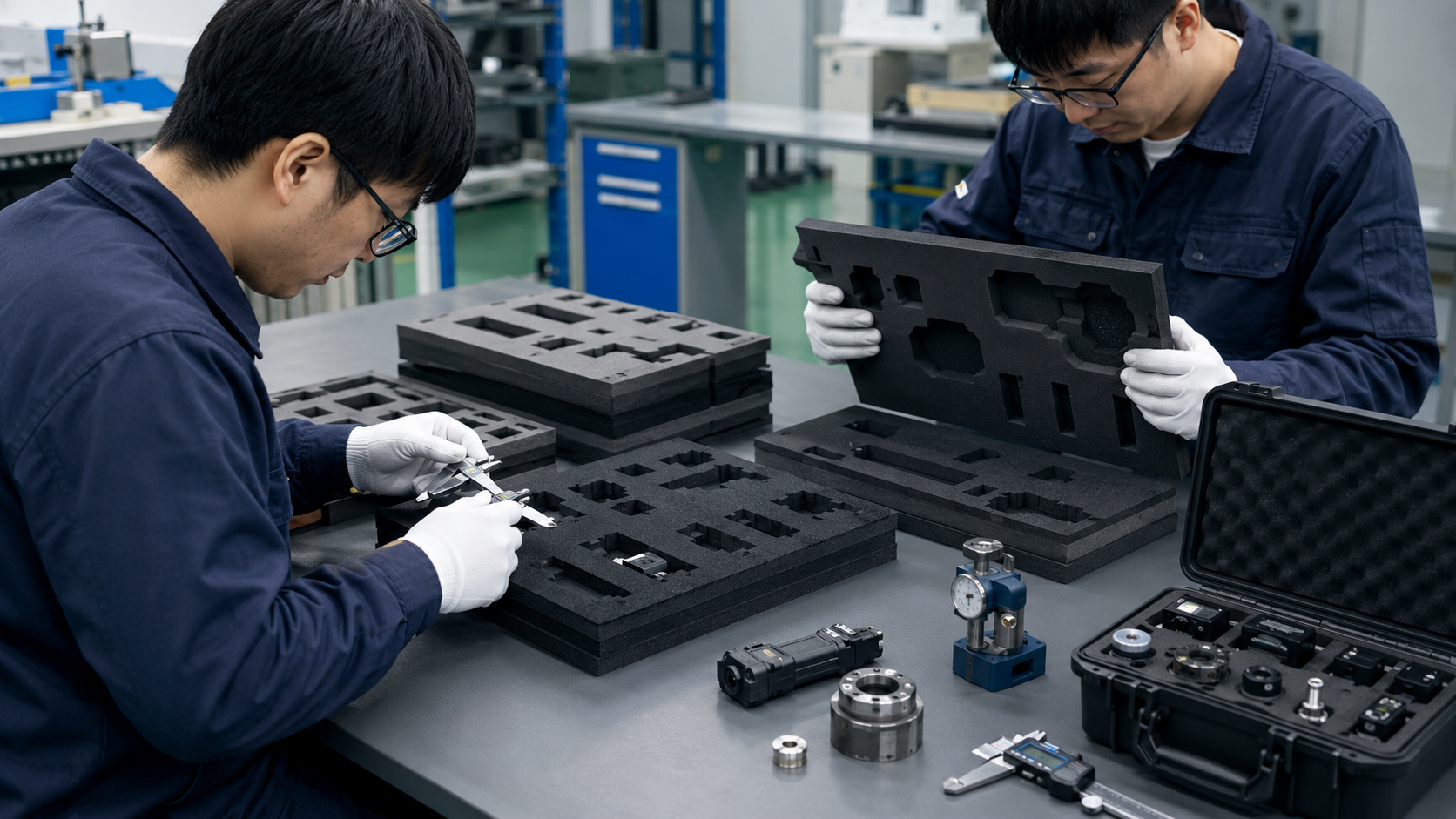
Our goal is to help customers reduce product damage, repeated samples, unstable fit, poor cushioning, rough edges, and packaging-related complaints.
A good foam insert should protect the product, fit correctly, look clean, and support efficient handling.
FAQ
What are custom die-cut foam inserts used for?
Custom die-cut foam inserts are used for product protection, cushioning, shock absorption, vibration reduction, surface protection, component separation, packaging organization, and assembly positioning.
What is the best foam for custom inserts?
There is no single best foam. EVA foam is durable and stable. PE foam is lightweight and clean. PU foam is soft and compressible. EPDM and silicone foam are useful for special sealing, automotive, or high-temperature applications.
How do I choose foam density?
Choose foam density based on product weight, surface sensitivity, protection requirement, and compression behavior. Heavy products usually need stronger foam, while delicate products may need softer cushioning.
Can foam inserts be adhesive-backed?
Yes. Foam inserts can be laminated with pressure-sensitive adhesive and supplied on release liner for easy placement inside boxes, housings, trays, or assemblies.
Are die-cut foam inserts suitable for electronics packaging?
Yes. Die-cut foam inserts are widely used for electronics packaging, protective cushioning, display parts, sensors, accessories, and precision components.
Why do foam inserts tear?
Foam inserts may tear because the foam density is too low, the wall width is too narrow, the cavity design is weak, or the cutting process is not suitable.
What should buyers provide before ordering custom foam inserts?
Buyers should provide product dimensions, weight, photos or drawings, surface sensitivity, packaging size, protection requirement, foam preference, thickness, quantity, and any adhesive or cleanliness requirements.
Conclusion
Flexible custom die-cut foam inserts help protect products, improve packaging, support assembly, and reduce damage during handling and transportation. The right insert depends on foam material, density, thickness, cavity design, adhesive backing, edge quality, tolerance, and real application conditions.
For OEM buyers, the best choice is not simply the softest or cheapest foam. The best foam insert is the one that protects the product, fits correctly, stays stable, and supports efficient production.
At Sanken, we help customers design and produce custom die-cut foam inserts and related precision components for electronics, automotive, medical, appliance, battery, and industrial applications.