
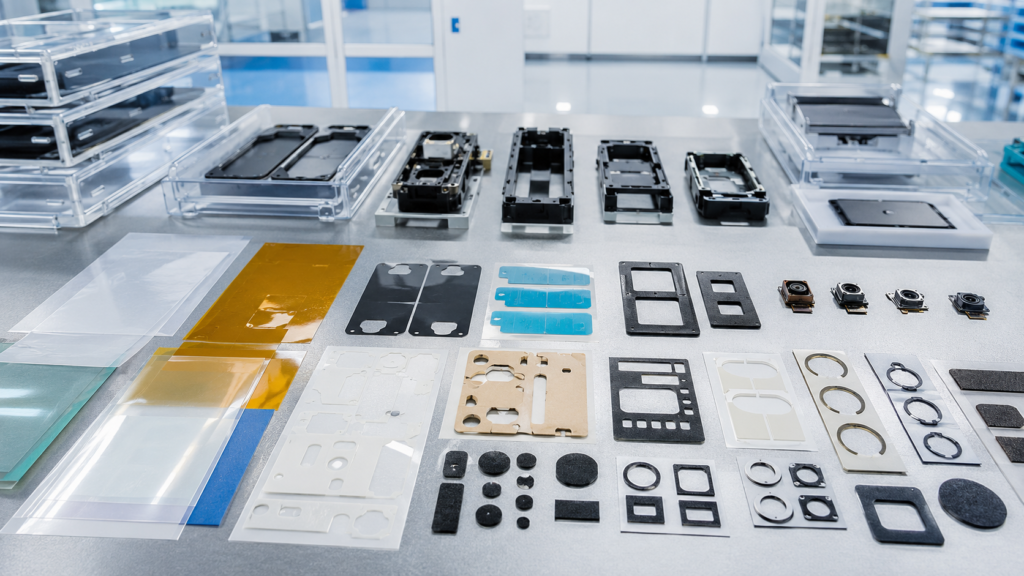
Cleanroom die cutting for electronics is used to produce clean, accurate, and assembly-ready components from PET film, PI film, protective film, double-sided tape, foam, rubber, and multilayer materials. In electronic products, even a small particle, fiber, adhesive string, or surface scratch can affect appearance, bonding, insulation, optical performance, or final assembly yield.
For OEM engineers and purchasing teams, contamination control is not only a cleanroom issue. It is connected to material selection, lamination, die cutting process, static control, waste removal, tool condition, operator handling, inspection, and packaging.
At Sanken, we support electronics, optical, display, battery, automotive electronics, appliance, medical device, and industrial customers with precision die cutting and material converting for PET insulation films, PI films, protective films, adhesive tape parts, foam gaskets, rubber pads, light-blocking materials, and multilayer auxiliary components.
Why Cleanroom Die Cutting Matters for Electronics
Electronic components are becoming thinner, smaller, and more sensitive. Many die cut parts are installed near displays, sensors, lenses, circuit boards, battery modules, connectors, speakers, cameras, touch panels, and housings.
A die cut part may be used for:
- Electrical insulation
- Surface protection
- Display bonding
- Light blocking
- Cushioning
- Gap filling
- Dust sealing
- Vibration reduction
- Adhesive mounting
- Assembly positioning
If the part carries dust, loose fibers, adhesive residue, or particles, it can create defects during final assembly. For example, a particle under a protective film may create a visible bubble. A fiber on an adhesive tape may reduce bonding strength. A rough PET film edge may create debris near an electronic module. A dirty foam gasket may contaminate the housing during installation.
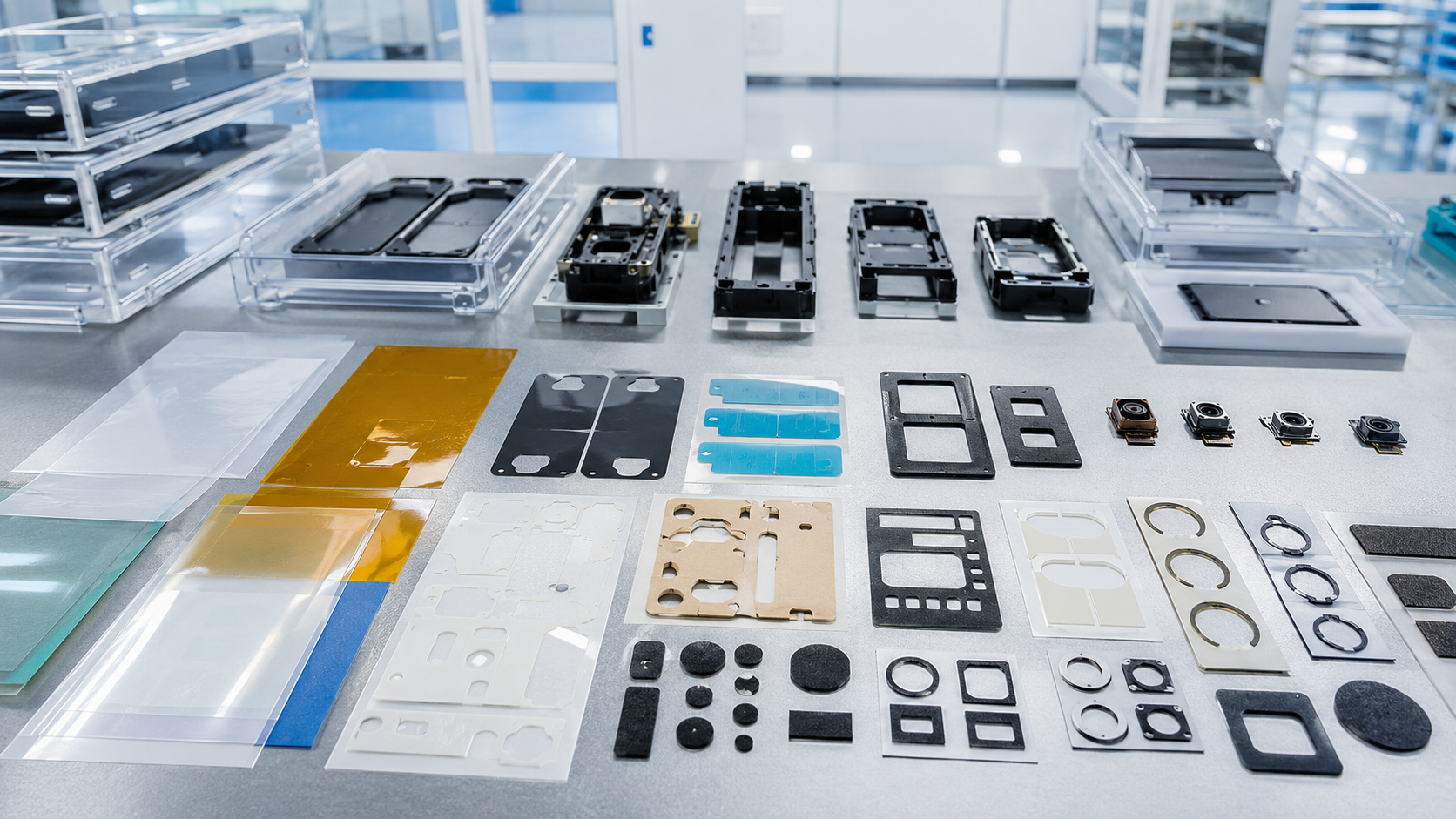
Cleanroom die cutting helps reduce these risks by controlling the material, environment, process, handling, and packaging before the part reaches the customer’s assembly line.
Common Contamination Problems in Die Cut Electronic Parts
Contamination can come from many sources. It may come from the raw material, adhesive, liner, blade, machine, operator, packaging, or waste removal process.
| Contamination Type | Common Source | Possible Risk |
|---|---|---|
| Dust particles | Material handling, air, cutting process | Appearance defects, bonding failure |
| Fibers | Non-woven materials, paper liner, gloves, cloth | Optical defects, surface contamination |
| Adhesive strings | Soft adhesive, dull blade, poor waste removal | Sticking, poor appearance, assembly issues |
| Film debris | Rough cutting, burrs, static attraction | Insulation or assembly risk |
| Foam dust | Poor foam cutting or material shedding | Housing contamination |
| Rubber particles | Burrs, friction, poor edge control | Surface contamination and poor fit |
| Scratches | Handling, stacking, packaging | Display or protective surface defects |
| Static dust | Film materials and dry environments | Dust attraction and poor cleanliness |
In electronics, the problem is often not one large defect. It is many small issues that reduce yield and increase inspection work.
Choose Low-Shedding Materials First
Cleanroom die cutting starts before cutting. It starts with material selection.
Some materials naturally generate more particles or fibers than others. For precision electronics, buyers should consider how the material behaves during cutting, peeling, lamination, and packaging.
Common clean die cut materials include:
- PET insulation film
- PI high-temperature insulation film
- PC film
- Protective film
- Optical protection film
- Double-sided adhesive tape
- Transfer adhesive
- PET carrier tape
- PE foam
- Silicone foam
- Rubber sheets
- Light-blocking film
- Multilayer adhesive film structures
For applications close to displays, sensors, batteries, circuits, or optical modules, clean edge quality and stable surface condition are very important.
Non-woven felt and fiber-based materials can also be die cut for electronics or automotive electronic applications, but fiber shedding must be carefully reviewed. If the part is used near sensitive electronics, edge treatment, material density, adhesive lamination, and packaging should be checked early.
Control Lamination Before Die Cutting
Many electronic die cut components are multilayer parts. A PET film may be laminated with adhesive. A protective film may include a pull tab. A foam gasket may be laminated with double-sided tape. A light-blocking film may require adhesive backing and release liner.
Lamination can create contamination if it is not controlled.
Common lamination risks include:
- Dust trapped between layers
- Air bubbles
- Adhesive overflow
- Liner wrinkles
- Film scratches
- Misaligned layers
- Static dust attraction
- Uneven tension
For clean electronics components, lamination should be controlled before die cutting. The material should remain flat, clean, and stable. The adhesive should not flow beyond the edge. The liner should release smoothly without tearing or leaving particles.
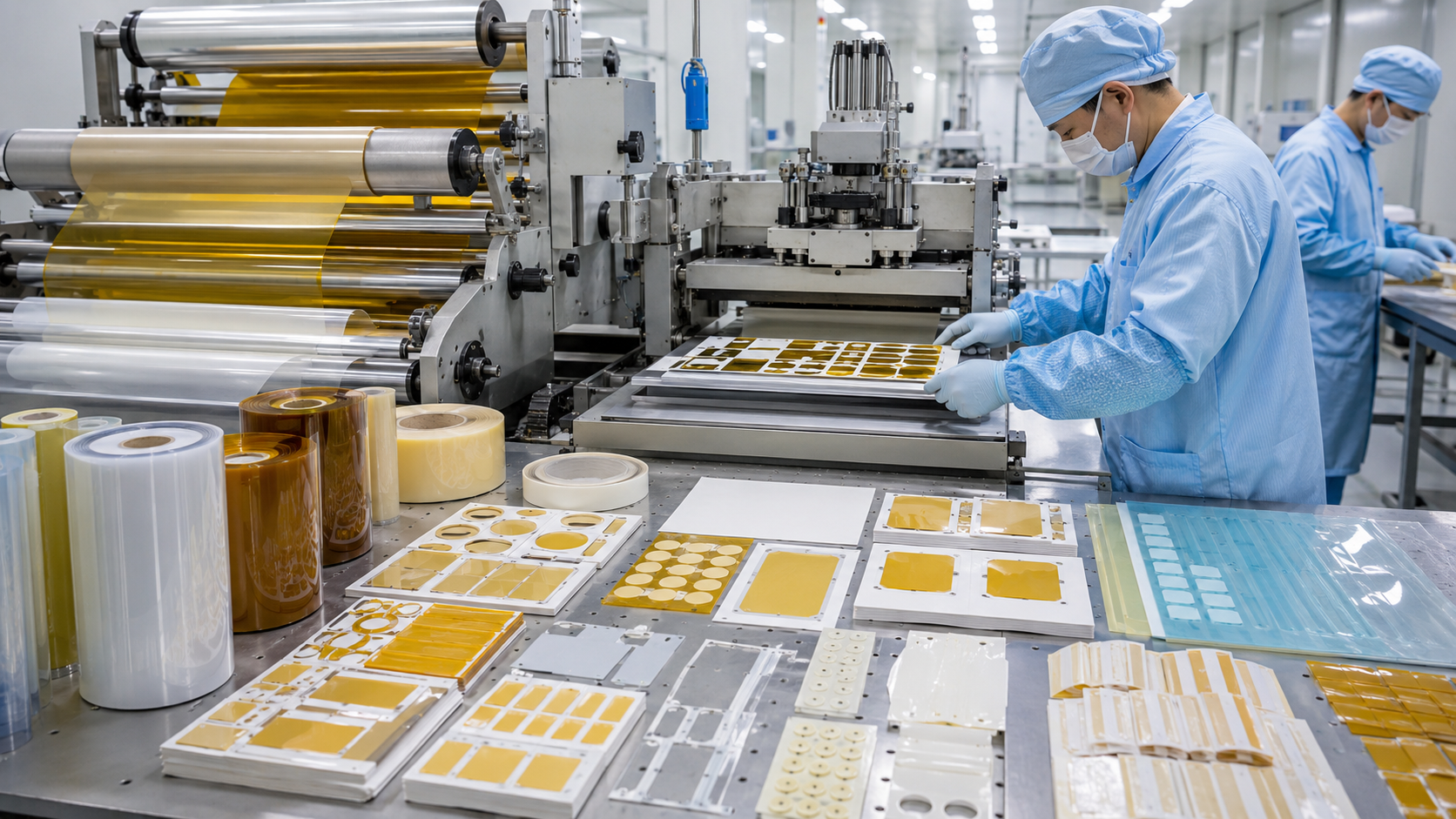
At Sanken, material converting and die cutting review are handled together. This helps reduce problems that appear when lamination, adhesive behavior, and cutting depth are treated as separate processes.
Prevent Dust During Die Cutting
Die cutting itself can create particles if the blade, pressure, material, or waste removal method is not suitable.
Key process factors include:
- Blade sharpness
- Cutting pressure
- Tool condition
- Kiss cutting depth
- Web tension
- Machine cleanliness
- Waste matrix removal
- Material flatness
- Static control
- Operator handling
For PET and PI film parts, a clean blade and controlled cutting pressure help reduce burrs and edge debris.
For adhesive tape parts, kiss cutting depth must be controlled so the liner is not damaged. If the liner is cut too deeply, it may tear and create particles during peeling.
For foam parts, excessive pressure may crush the foam and generate dust at the edge.
For rubber parts, poor tooling can create burrs or loose edge particles.
For protective films, scratches and dust must be prevented during cutting, stacking, and packing.
Manage Static Electricity
Static electricity is a major reason dust sticks to film and adhesive materials.
PET film, protective film, release liner, and adhesive tape can attract dust during unwinding, lamination, cutting, waste removal, and packaging. Static can also cause thin films to shift, curl, or stick together.
To reduce static-related contamination, manufacturers should control:
- Material unwinding tension
- Humidity conditions
- Film handling method
- Anti-static process support
- Clean work surfaces
- Packaging environment
- Operator handling procedures
Static control is especially important for protective films, display-related films, PET insulation films, and thin adhesive components.
Use Clean Waste Removal Methods
Waste removal is often where contamination problems appear.
During die cutting, unwanted material must be removed from holes, windows, inner cavities, and outer edges. If waste removal is unstable, small pieces may remain on the liner or cling to the part.
Common waste removal problems include:
- Small holes not removed
- Adhesive waste sticking to parts
- Film chips remaining on liner
- Foam fragments trapped in cavities
- Liner damage
- Adhesive strings
- Part movement during stripping
For electronics, waste removal must be stable because small leftover particles can affect final assembly.
Part design also matters. Very small holes, narrow slots, sharp corners, and thin strips increase waste removal difficulty. Rounded corners, proper spacing, and manufacturable hole sizes can improve cleanliness and yield.
Inspect Critical Surfaces and Edges
Cleanroom die cutting should include inspection for both dimensions and cleanliness.
Important inspection items include:
| Inspection Item | Why It Matters |
|---|---|
| Edge cleanliness | Reduces particles and burrs |
| Surface dust | Prevents appearance and bonding defects |
| Film scratches | Protects optical and display quality |
| Adhesive overflow | Prevents sticking and contamination |
| Liner condition | Supports clean peeling and application |
| Hole clearance | Prevents blocked openings |
| Flatness | Improves assembly placement |
| Thickness | Supports fit and compression |
| Packaging condition | Protects cleanliness before use |
For electronic die cut parts, visual appearance alone is not enough. The supplier should also check how the part peels, applies, bonds, and fits in the customer’s assembly process.
Packaging Is Part of Contamination Control
A clean part can become contaminated if packaging is poor.
Packaging should protect the part from dust, scratches, compression, curling, and handling damage. It should also support the customer’s assembly workflow.
Common packaging formats include:
- Liner-backed sheets
- Roll format
- Protective bags
- Tray packaging
- Clean stacked sheets
- Kitted component sets
- Assembly-ready layouts
Thin protective films should be kept flat. Adhesive-backed parts should remain stable on the liner. Foam parts should not be compressed too tightly. Small electronic components may need organized sheets or trays to reduce handling.
Good packaging helps reduce customer-side inspection, rework, and assembly delay.
Material Selection Guide for Clean Electronic Die Cut Parts
| Application | Recommended Material Direction | Key Cleanliness Focus |
|---|---|---|
| Electrical insulation | PET film, PI film, PC film | Clean edges, hole accuracy, no burrs |
| Display protection | Protective film, PET film | No dust, scratches, bubbles, residue |
| Sensor or optical area | Black film, light-blocking tape, protective film | No particles, clean surface, accurate windows |
| Adhesive bonding | Double-sided tape, transfer adhesive, PET carrier tape | Liner release, no adhesive strings |
| Cushioning | PE foam, silicone foam, PU foam | Low dust, controlled compression |
| Sealing | Foam gasket, rubber pad, adhesive-backed foam | Clean edge, stable thickness |
| Battery electronics | PET film, PI film, foam pad, adhesive insulation film | Insulation, clean holes, stable adhesive |
The best material should be chosen based on both function and cleanliness requirement.
How Sanken Helps Prevent Dust, Fibers, and Contamination
Sanken Manufacturing Co., Ltd. supports OEM customers with precision die cutting, adhesive lamination, material converting, clean handling, inspection, and assembly-ready packaging for electronic auxiliary materials.
For PET and PI insulation films, we focus on edge cleanliness, hole alignment, flatness, and dimensional stability.
For protective films, we focus on surface quality, dust prevention, easy peeling, and residue control.
For adhesive tape components, we focus on liner release, kiss cutting depth, adhesive position, waste removal, and clean application.
For foam gaskets and cushioning pads, we review density, compression, edge quality, adhesive backing, and packaging pressure.
For rubber and felt components, we review edge control, material shedding risk, adhesive lamination, and final assembly use.
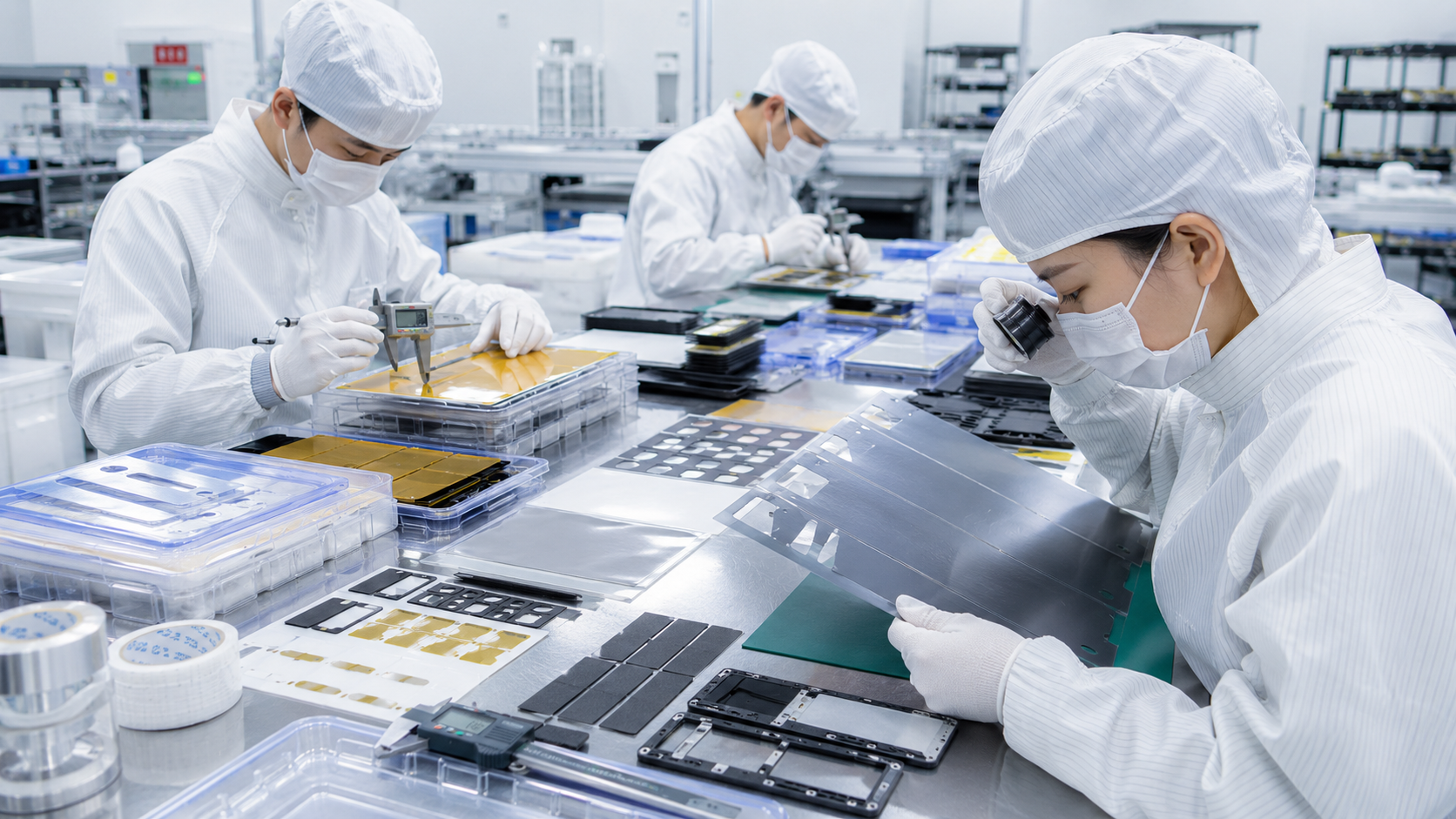
Our goal is to help customers reduce dust, fibers, adhesive residue, scratches, particle defects, poor bonding, inspection rejection, and assembly rework.
A good cleanroom die cut part should be clean, accurate, easy to peel, easy to apply, and stable from sample to mass production.
Common Mistakes to Avoid
| Mistake | Possible Result |
|---|---|
| Choosing material only by price | Higher contamination and failure risk |
| Ignoring static control | Dust attraction on film and adhesive |
| Using poor liner | Fiber or particle contamination |
| Cutting with dull tooling | Burrs, dust, adhesive strings |
| Ignoring waste removal | Loose particles and blocked holes |
| Poor packaging | Dust, scratches, curling, compression |
| No real assembly test | Clean sample fails during production |
| Treating cleanroom as the only solution | Material and process risks remain |
Cleanroom production is important, but it cannot solve every problem alone. Material, tooling, lamination, cutting, inspection, and packaging must all work together.
FAQ
What is cleanroom die cutting for electronics?
Cleanroom die cutting is the controlled cutting and converting of films, tapes, foams, rubber, and multilayer materials into clean custom components for electronics, display, optical, battery, and precision assembly applications.
Why do electronics die cut parts need contamination control?
Dust, fibers, adhesive residue, scratches, and particles can affect bonding, insulation, optical appearance, display quality, and assembly yield.
What materials are commonly used for cleanroom die cutting?
Common materials include PET film, PI film, PC film, protective film, double-sided tape, transfer adhesive, foam, rubber, light-blocking film, and multilayer adhesive materials.
How can dust be prevented during die cutting?
Dust can be reduced by choosing low-shedding materials, controlling static, keeping tools sharp, managing waste removal, using clean handling procedures, and protecting parts with proper packaging.
Why is liner selection important for clean adhesive parts?
A poor liner can create fibers, tear during peeling, release particles, or make adhesive parts difficult to handle. The liner must match the adhesive and assembly method.
Can foam be used in clean electronic applications?
Yes, foam can be used for cushioning, sealing, and gap filling, but density, edge dust, compression, adhesive backing, and packaging must be controlled carefully.
Can Sanken support cleanroom die cut parts for electronics?
Yes. Sanken supports precision die cutting and material converting for PET insulation films, PI films, protective films, adhesive tape parts, foam gaskets, rubber pads, and multilayer electronic components with cleanliness-focused process review.
Conclusion
Cleanroom die cutting for electronics is about more than producing parts in a clean environment. It requires careful control of material selection, lamination, static, cutting pressure, kiss cutting depth, waste removal, edge quality, inspection, and packaging.
For electronics, display, optical, battery, and precision assembly applications, dust, fibers, adhesive strings, scratches, and particles can create serious quality problems. The best way to prevent contamination is to review the full process before mass production.
At Sanken, we help OEM customers convert PET film, PI film, protective film, adhesive tape, foam, rubber, and multilayer materials into clean, accurate, and assembly-ready die cut components for demanding electronic applications.