
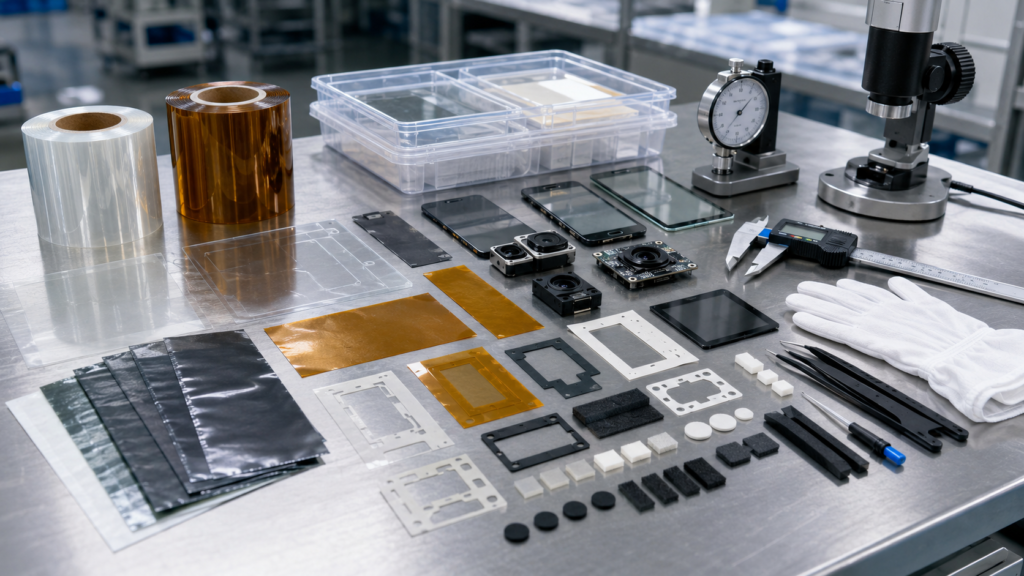
Die cut optical films are used in electronics and display modules to protect surfaces, control light, support bonding, provide insulation, improve assembly accuracy, and reduce contamination during manufacturing. These films may look thin and simple, but in display assemblies, camera modules, sensors, touch panels, wearable devices, and automotive electronics, small film components can directly affect appearance, reliability, optical performance, and production yield.
For OEM engineers and purchasing teams, die cut optical films are not only about cutting transparent plastic film into a shape. The real challenge is controlling material thickness, dust, scratches, adhesive position, liner release, hole alignment, edge cleanliness, static, and packaging. If these details are not controlled, the final display module may face bubbles, light leakage, poor bonding, misalignment, surface scratches, or inspection failure.
At Sanken, we support OEM customers with precision die cutting, clean material converting, adhesive lamination, PET and PI insulation films, protective films, light-blocking components, foam spacers, rubber pads, adhesive tape parts, and multilayer converted components for electronics, display modules, automotive electronics, sensors, battery-related assemblies, and industrial devices.
What Are Die Cut Optical Films?
Die cut optical films are thin film materials converted into custom shapes for use in electronic and display assemblies. They are usually supplied as sheets, rolls, liner-backed parts, kiss-cut parts, or assembly-ready components.
Common film materials include:
- PET film
- PC film
- PI film
- Protective film
- Release liner film
- Light-blocking film
- Diffusion-related film
- Reflective or shielding film
- Double-sided adhesive film
- OCA or optically clear adhesive-related structures
- Black shading film
- Insulation film
- Multilayer laminated film structures
Not every project uses the same film. A protective film used during assembly is different from an insulation film used inside an electronic module. A black light-blocking film is different from a transparent bonding film. The right material depends on optical function, electrical requirement, adhesive behavior, assembly method, and final product environment.
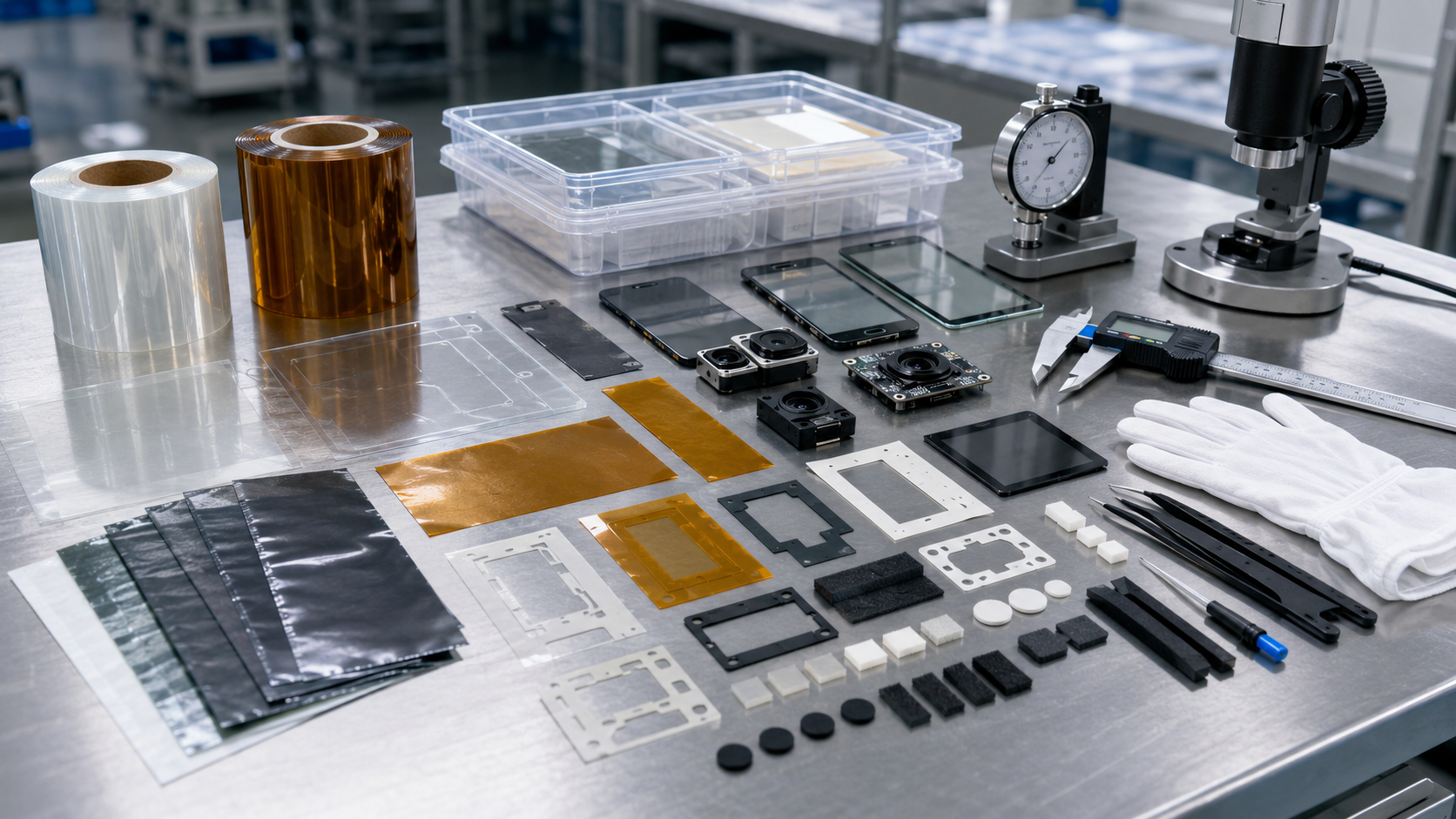
Why Optical Films Need Precision Die Cutting
Display and electronics assemblies usually have tight space and strict appearance requirements. A small misalignment can affect product performance or cause inspection failure.
Precision die cutting helps control:
| Control Point | Why It Matters |
|---|---|
| Outer shape | Ensures the film fits the module design |
| Hole position | Aligns with cameras, sensors, screws, and connectors |
| Edge quality | Reduces particles, burrs, and film lifting |
| Adhesive position | Prevents overflow, bubbles, and bonding failure |
| Liner release | Improves assembly efficiency |
| Thickness | Supports stable spacing and optical consistency |
| Cleanliness | Reduces dust, fibers, and contamination |
| Packaging | Prevents scratches, curling, and deformation |
For display modules, cutting accuracy is not enough. Clean handling, surface protection, and stable packaging are also important.
Common Uses in Electronics and Display Modules
Die cut optical films are used in many areas of electronics manufacturing.
| Application Area | Die Cut Film Function |
|---|---|
| Display module | Protection, bonding, light control, spacing |
| Touch panel | Adhesive bonding, insulation, surface protection |
| Camera module | Light blocking, dust protection, spacing |
| Sensor module | Optical shielding, sealing, positioning |
| Wearable device | Protective film, adhesive gasket, insulation |
| Automotive display | Anti-rattle, bonding, shading, protection |
| Battery electronics | Insulation and surface protection |
| Consumer electronics | Screen protection, assembly support, bonding |
In many cases, one device may use several different die cut film parts. For example, a display module may need a protective film, black shading film, adhesive frame, PET insulation film, foam spacer, and rubber cushion pad.
Protective Films for Surface Protection
Protective films are used to prevent scratches, dust, fingerprints, and handling damage during production, transport, and assembly. They are often applied to display glass, plastic panels, lens covers, touch panels, and housing surfaces.
Key requirements include:
- Clean surface
- Stable adhesion
- Easy removal
- No adhesive residue
- No bubbles
- No scratches
- Accurate shape
- Good liner release
A protective film that is too weak may fall off during handling. A film that is too strong may leave residue or become difficult to remove. The adhesive level must match the surface and the assembly process.
For OEM projects, Sanken can die cut protective films into custom shapes with tabs, holes, windows, or liner-backed formats to support easier application and removal.
Light-Blocking Films for Displays, Cameras, and Sensors
Light leakage is a common problem in display and optical modules. Black die cut films, shading films, and light-blocking tapes are used to control unwanted light transmission.
They are commonly used around:
- Camera openings
- Sensor windows
- Display borders
- LED areas
- Backlight structures
- Optical modules
- Wearable sensor areas
- Automotive display frames
A light-blocking film must be accurately positioned. If the film is too small, light leakage may occur. If it is too large, it may block the active optical area. Edge quality is also important because rough edges can create particles or interfere with assembly.
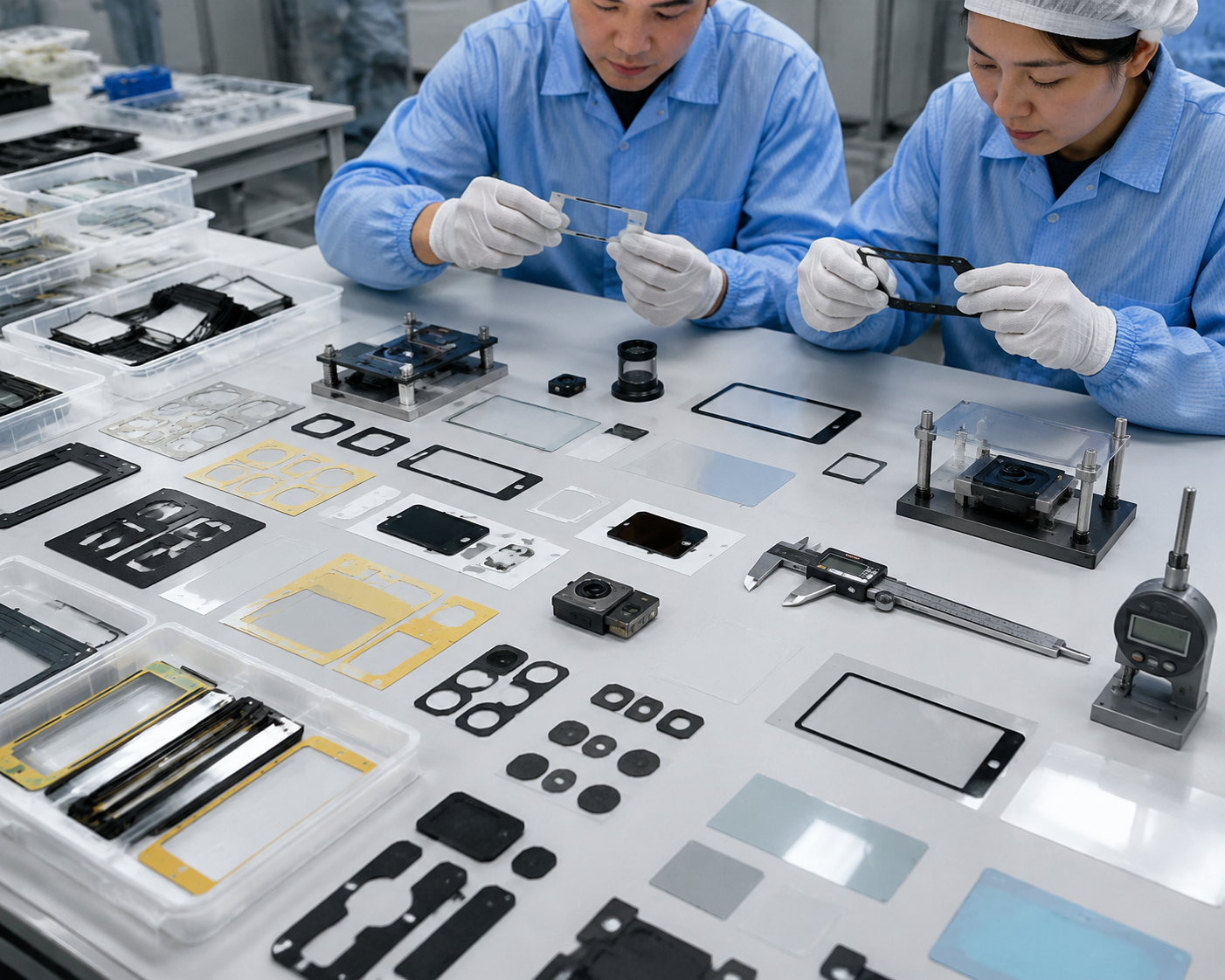
Adhesive Films and Bonding Components
Adhesive-backed optical films and double-sided film components are used for bonding, positioning, sealing, and assembly support.
Common requirements include:
- Stable adhesive thickness
- Clean die cut edge
- No adhesive overflow
- Smooth liner release
- Accurate hole and window alignment
- Good bonding to glass, plastic, metal, or coated surfaces
- Controlled peel strength
- No contamination on visible areas
In display and electronics assembly, adhesive behavior is critical. If the adhesive is too aggressive, the part may be hard to reposition. If it is too weak, lifting may occur. If the liner release is poor, operators may stretch or damage the film during application.
Sanken supports adhesive lamination and die cutting for custom film structures based on the customer’s drawing, bonding surface, and assembly method.
PET and PI Insulation Films
Not all optical or display-related films are used for light control. Some films are used for electrical insulation and protection inside electronic devices.
PET and PI films are commonly used in electronics because they can provide thin, lightweight insulation in compact spaces.
Typical uses include:
- Battery electronics insulation
- Display module insulation
- Connector area protection
- PCB surface protection
- Sensor module insulation
- Automotive electronic components
- Wearable electronics assemblies
Die cut PET and PI films must have accurate holes, clean edges, stable thickness, and good flatness. Poor cutting may create burrs, particles, or misalignment. In compact electronics, even a small position error can create assembly problems.
Foam, Rubber, and Film Work Together
Display and electronics modules often need more than film. Foam, rubber, adhesive tape, and film components are often used together.
Examples include:
| Component | Function |
|---|---|
| PET film | Insulation and spacing |
| PI film | Heat-resistant insulation |
| Protective film | Surface protection |
| Light-blocking film | Optical shielding |
| Foam spacer | Cushioning and gap filling |
| Rubber pad | Damping and support |
| Double-sided tape | Bonding and positioning |
| Non-woven felt | Anti-rattle or soft contact protection |
For example, a display frame may use black shading film to prevent light leakage, foam tape to fill gaps, PET film for insulation, and protective film to prevent surface damage. If these parts are designed separately, assembly problems may appear later.
A one-stop converting supplier can review the complete structure before mass production.
Cleanliness and Contamination Control
Cleanliness is one of the most important quality factors for die cut optical films. Dust, fibers, particles, adhesive strings, or surface scratches can cause visible defects or functional problems.
Common contamination risks include:
- Film dust
- Adhesive strings
- Static attraction
- Fingerprints
- Scratches
- Fiber shedding
- Poor liner handling
- Dirty packaging
- Edge particles
For display modules, even small particles can cause inspection rejection. For camera and sensor modules, dust may affect optical performance. For adhesive films, contamination may create bubbles or poor bonding.
To reduce these risks, suppliers should control material handling, cutting tools, lamination, waste removal, inspection, and packaging.
Important Quality Control Items
Quality inspection for die cut optical films should cover both dimensions and surface condition.
| Inspection Item | Purpose |
|---|---|
| Outer dimensions | Confirms correct fit |
| Hole and window position | Ensures alignment with displays, cameras, or sensors |
| Edge cleanliness | Reduces particles and burrs |
| Surface scratches | Prevents appearance defects |
| Adhesive overflow | Prevents contamination and bonding issues |
| Liner release | Improves assembly handling |
| Film flatness | Prevents bubbles and lifting |
| Dust and particles | Supports display and optical quality |
| Packaging condition | Protects parts before assembly |
For OEM projects, critical-to-quality points should be defined before production. These may include visible areas, optical windows, bonding borders, sensor openings, and connector clearances.
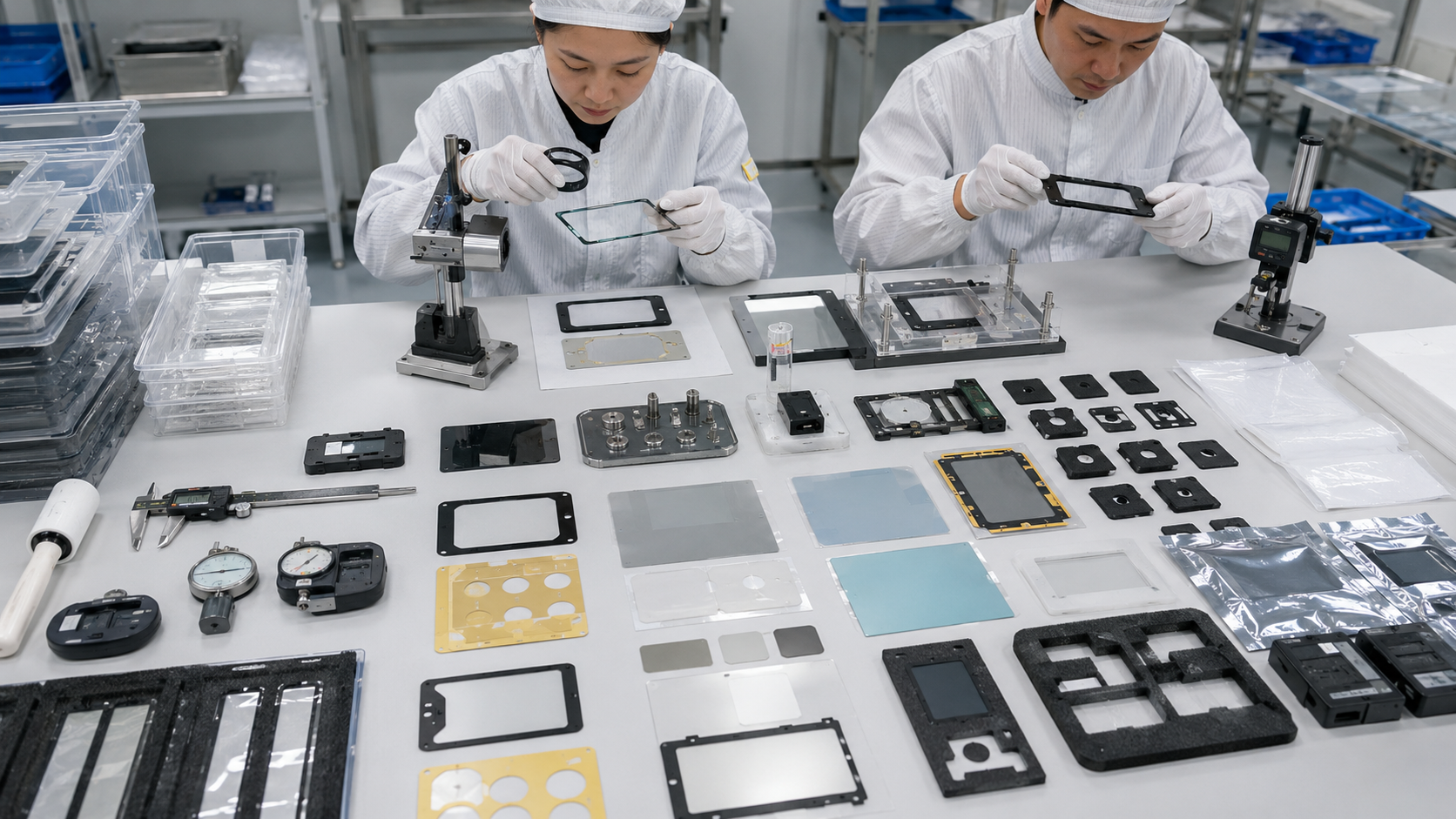
Common Problems and How to Prevent Them
| Problem | Possible Cause | Prevention |
|---|---|---|
| Light leakage | Poor film size or misalignment | Review optical border and tolerance |
| Bubbles | Dust, poor flatness, wrong adhesive | Improve cleanliness and adhesive selection |
| Scratches | Poor handling or packaging | Use protective packaging and clean handling |
| Adhesive overflow | Wrong cutting depth or adhesive structure | Control lamination and die cutting process |
| Hard peeling | Poor liner selection or kiss cutting | Review liner release and tab design |
| Film curling | Material stress or poor packaging | Control storage and packing format |
| Particle contamination | Rough edges or poor waste removal | Use sharp tooling and clean inspection |
| Assembly mismatch | Poor hole alignment | Define critical dimensions early |
Many problems can be prevented by reviewing the film material, adhesive structure, die cut tolerance, liner, packaging, and final assembly method before mass production.
How Sanken Supports Die Cut Optical Film Projects
Sanken Manufacturing Co., Ltd. supports OEM customers with precision die cut optical films and related electronic assembly components.
Our support includes:
- PET insulation films
- PI insulation films
- Protective films
- Light-blocking films
- Adhesive film components
- Double-sided tape parts
- Foam spacers and gaskets
- Rubber pads
- Multilayer laminated structures
- Liner-backed die cut parts
- Clean material handling
- Sample development
- Quality inspection
- Assembly-ready packaging
For each project, we review film material, thickness, adhesive structure, liner release, hole alignment, optical window position, edge cleanliness, dust risk, packaging method, and assembly process.
Our goal is to help customers reduce light leakage, scratches, adhesive lifting, bubbles, dust contamination, poor liner release, film misalignment, and unstable mass production.
What Buyers Should Provide Before Starting a Project
To develop reliable die cut optical films, OEM buyers should provide:
- 2D drawing
- 3D assembly information if available
- Film material requirement
- Thickness requirement
- Adhesive requirement
- Optical window position
- Critical dimensions
- Bonding surface
- Cleanliness requirement
- Liner preference
- Packaging method
- Application method
- Expected quantity
- Sample or reference part if available
The more clearly the supplier understands the final module, the easier it is to recommend the right material and die cutting method.
FAQ
What are die cut optical films used for?
Die cut optical films are used for surface protection, light blocking, bonding, insulation, spacing, dust protection, and assembly support in electronics, displays, sensors, cameras, and optical modules.
What materials are used for die cut optical films?
Common materials include PET film, PI film, PC film, protective film, black light-blocking film, adhesive film, release liner film, and multilayer laminated film structures.
Why is cleanliness important for die cut optical films?
Dust, fibers, scratches, and particles can cause display defects, bonding problems, bubbles, light leakage, or optical performance issues.
Can optical films be adhesive-backed?
Yes. Many optical film components use adhesive backing for bonding, positioning, sealing, or assembly support. Adhesive type and liner release must be selected carefully.
Why do die cut optical films fail during assembly?
They may fail because of poor hole alignment, dust contamination, scratches, adhesive overflow, hard liner release, curling, poor packaging, or incorrect material selection.
Yes. Sanken supports die cut PET films, PI films, protective films, light-blocking films, adhesive tape parts, foam spacers, rubber pads, and multilayer converted components for electronics and display modules.
Conclusion
Die cut optical films play an important role in electronics and display modules. They help protect surfaces, control light, support bonding, provide insulation, improve assembly accuracy, and reduce contamination risk. Although these parts are thin and lightweight, they require careful control of material, thickness, adhesive, liner release, edge quality, cleanliness, packaging, and assembly fit.
For OEM projects, optical films should also be reviewed together with foam, rubber, adhesive tape, PET, PI, protective film, and other converted components used in the same module.
At Sanken, we help customers develop precision die cut optical films and related electronic assembly components that are clean, accurate, assembly-ready, and stable from prototype to mass production.