
How Die Cut Nonwoven Parts Are Used in Filtration and Cushioning?
Nonwoven materials are widely used in modern products because they are lightweight, cost-effective, versatile, and easy to convert into custom shapes. While many people associate nonwoven fabrics with hygiene products or packaging, they are also critical components in filtration systems, automotive interiors, consumer electronics, medical devices, and industrial equipment.
Die cut nonwoven parts are used in filtration and cushioning applications because they can capture particles, control airflow, absorb vibration, reduce noise, prevent abrasion, and provide lightweight protection. By converting nonwoven materials into precise custom shapes, manufacturers can improve product performance while simplifying assembly and reducing material waste.
Today, precision die-cut nonwoven components are found in everything from automotive cabin filters to electronic cushioning pads and medical filtration devices.
What Are Nonwoven Materials?
Unlike woven fabrics, nonwoven materials are made by bonding fibers together without traditional weaving or knitting processes.
Common nonwoven materials include:
- Polyester nonwoven fabric
- Polypropylene nonwoven fabric
- Needle-punched felt
- Meltblown materials
- Spunbond fabrics
- Composite nonwoven structures
These materials offer unique combinations of:
- Air permeability
- Filtration performance
- Flexibility
- Lightweight construction
- Sound absorption
Because of these properties, nonwovens are ideal for both filtration and cushioning applications.
Theme: Precision Die Cut Nonwoven Components
Why Nonwoven Materials Are Ideal for Filtration
Filtration requires a material that allows air or liquid to pass through while trapping unwanted particles.
Nonwoven materials provide:
- High surface area
- Controlled pore size
- Excellent particle capture
- Low weight
- Good airflow characteristics
The fiber network creates multiple pathways that help filter contaminants efficiently.
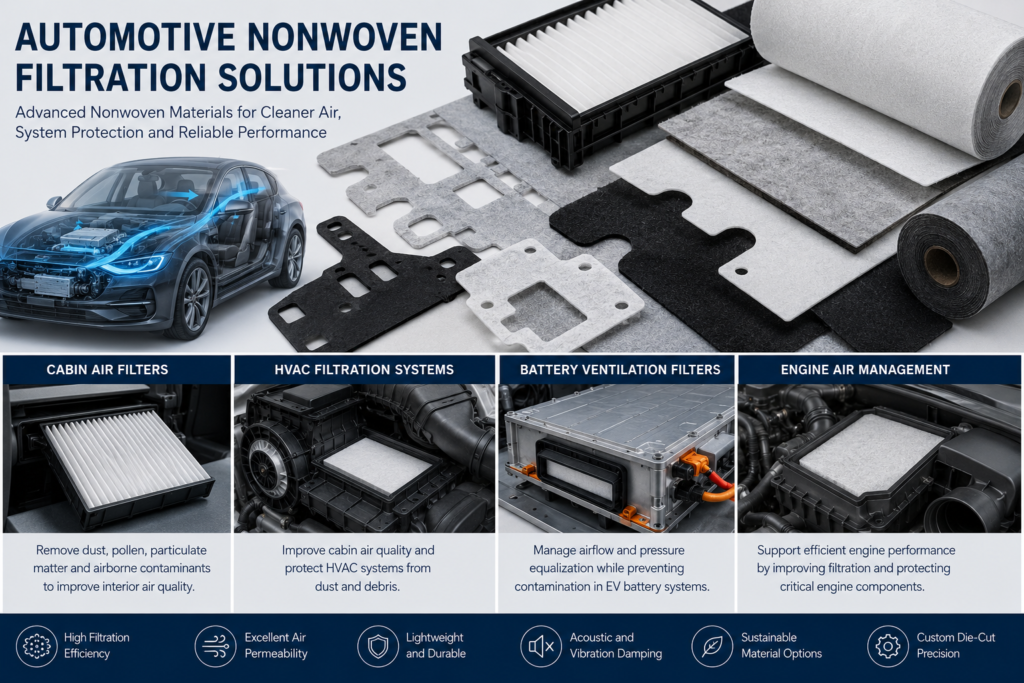
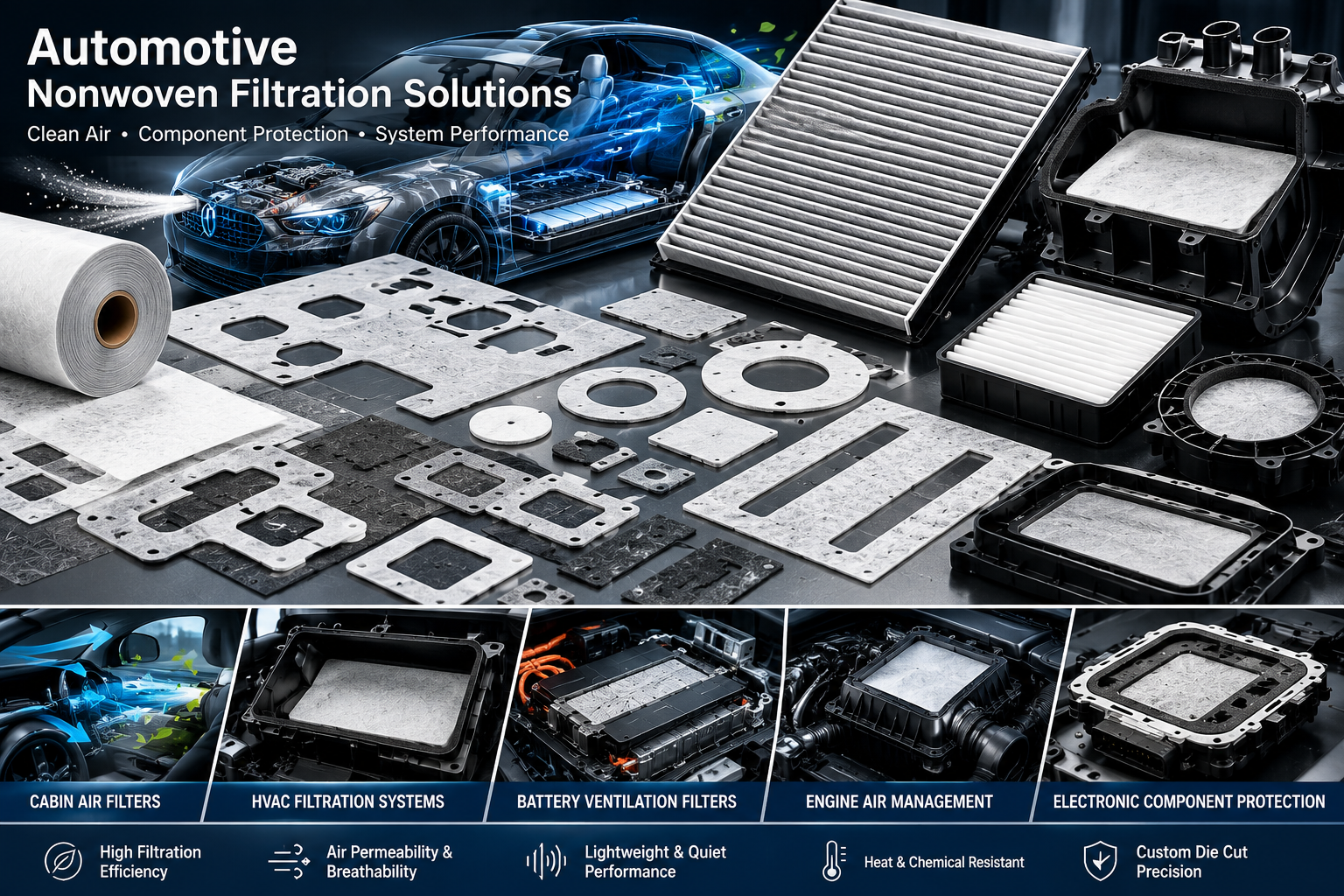
Automotive Filtration Applications
Automotive manufacturers use die-cut nonwoven materials extensively in filtration systems.
Common applications include:
Cabin Air Filters
Help remove:
- Dust
- Pollen
- Particulate matter
- Airborne contaminants
HVAC Filtration Systems
Improve interior air quality and protect vehicle systems.
Battery Ventilation Filters
Used in electric vehicles to manage airflow while preventing contamination.
Engine Air Management Systems
Certain nonwoven materials help improve filtration efficiency and component protection.
Theme: Automotive Nonwoven Filtration Solutions
Industrial Filtration Applications
Industrial equipment often requires customized filtration solutions.
Die-cut nonwoven parts are used for:
- Air filtration
- Dust collection
- Ventilation systems
- Equipment protection
- Fluid filtration
Advantages include:
- Custom geometry
- Easy installation
- Consistent performance
- Cost-effective production
Precision die cutting allows manufacturers to create filters that fit complex equipment designs.
Medical and Healthcare Filtration
Medical devices frequently rely on nonwoven filtration materials.
Applications include:
- Respiratory filters
- Device vents
- Protective barriers
- Airflow management systems
These applications require:
- Consistent material quality
- Clean manufacturing
- Reliable filtration performance
Precision converting helps ensure repeatable results.
How Nonwoven Materials Provide Cushioning
In addition to filtration, nonwoven materials are widely used for cushioning and protection.
The fiber structure helps absorb energy and distribute pressure.
Benefits include:
- Vibration damping
- Noise reduction
- Surface protection
- Wear resistance
- Impact absorption
This makes nonwoven materials valuable in automotive and electronics applications.
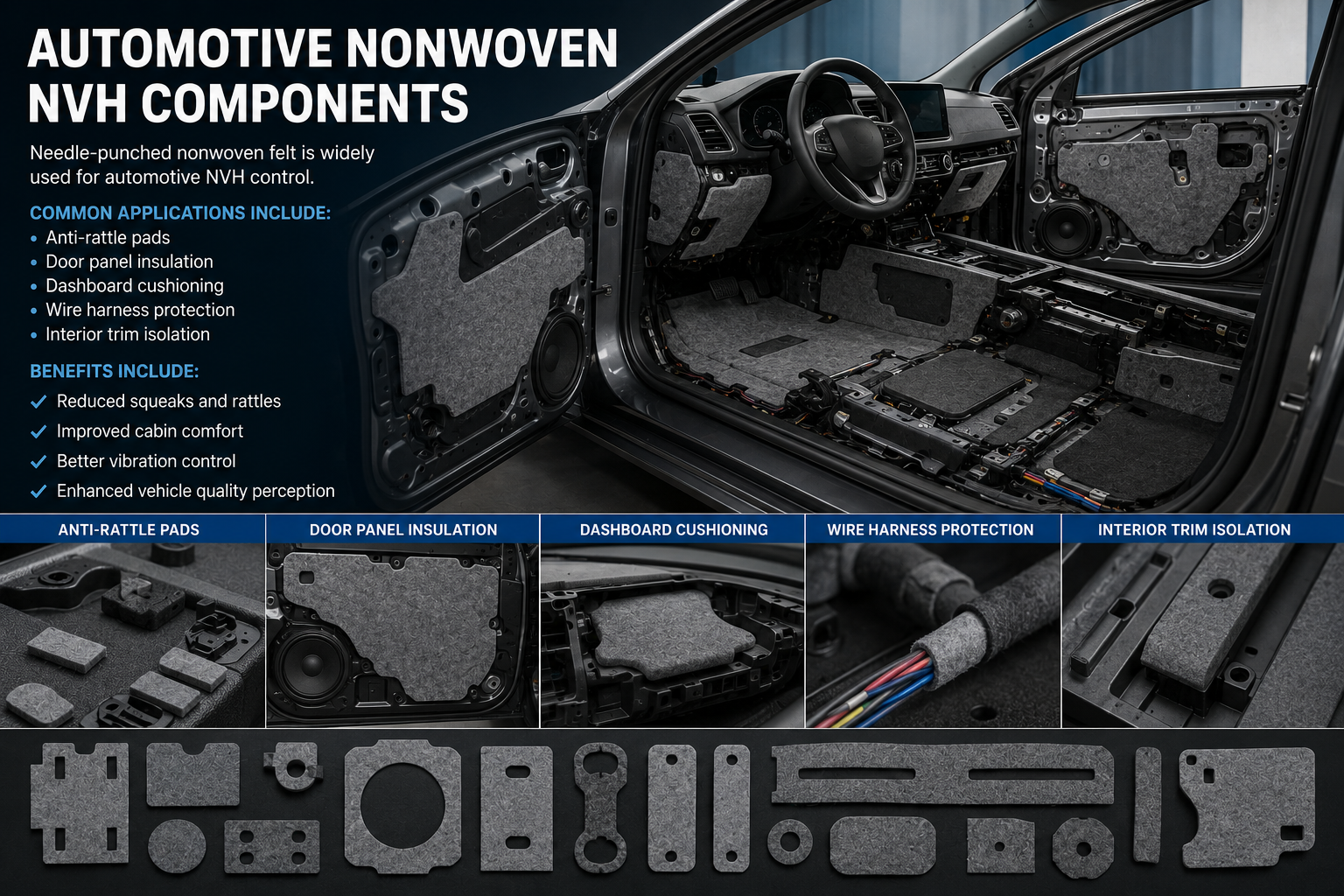
Automotive NVH and Cushioning Applications
Needle-punched nonwoven felt is widely used for automotive NVH control.
Common applications include:
- Anti-rattle pads
- Door panel insulation
- Dashboard cushioning
- Wire harness protection
- Interior trim isolation
Benefits include:
- Reduced squeaks and rattles
- Improved cabin comfort
- Better vibration control
- Enhanced vehicle quality perception
Theme: Automotive Nonwoven NVH Components
Consumer Electronics Cushioning Applications
Die-cut nonwoven components are commonly used in:
- Smartphones
- Tablets
- Laptops
- Wearable devices
Applications include:
- Display cushioning
- Component isolation
- Surface protection
- Vibration reduction
Compared with heavier materials, nonwovens provide protection without increasing product weight.
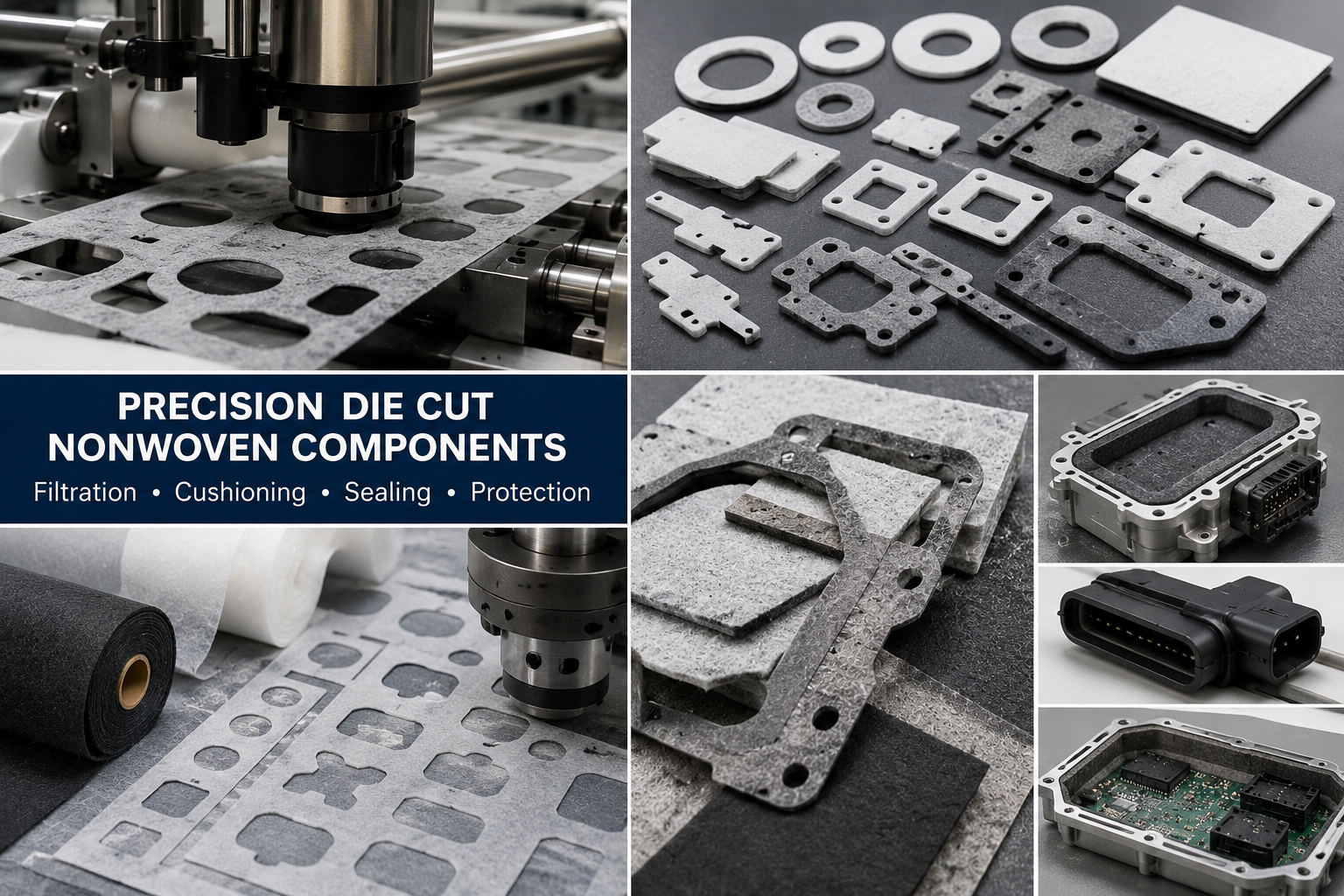
Why Precision Die Cutting Is Important
Nonwoven materials often require custom geometries to fit modern products.
Precision die cutting enables:
- Complex shapes
- Tight tolerances
- Consistent dimensions
- Fast assembly
Features may include:
- Holes
- Slots
- Adhesive backing
- Multi-layer laminations
Accurate converting helps ensure consistent filtration and cushioning performance.
Multi-Layer Nonwoven Constructions
Many advanced products combine nonwoven materials with:
- Foam
- PET films
- Adhesive tapes
- Rubber materials
These multi-layer structures can provide:
- Filtration
- Sealing
- Noise reduction
- Vibration isolation
in a single integrated component.
This helps simplify assembly and reduce part count.
Common Nonwoven Materials Used in Die Cutting
| Material | Main Function |
|---|---|
| Polyester Nonwoven | Filtration and cushioning |
| Polypropylene Nonwoven | Lightweight filtration |
| Needle-Punched Felt | NVH and cushioning |
| Meltblown Fabric | Fine particle filtration |
| Composite Nonwoven | Multi-functional applications |
Material selection depends on airflow, durability, compression, and environmental requirements.
How Sanken Manufacturing Supports Nonwoven Applications
Dongguan Sanken Electronics Manufacturing Co., Ltd. specializes in precision die-cut nonwoven materials and custom converting solutions.
Our capabilities include:
- Precision die cutting
- Needle-punched felt converting
- Nonwoven material processing
- Adhesive laminating
- Foam and felt composite manufacturing
- Multi-layer material assembly
- Cleanroom precision production
Key Advantages
- OEM and ODM customization
- ISO 9001 certified quality management
- RoHS and REACH compliant materials
- Domestic and overseas production bases
- Cleanroom manufacturing capabilities
- Tool development from drawings or samples
We support automotive NVH systems, filtration products, consumer electronics, wearable devices, industrial equipment, and medical applications.
Featured Snippet Summary
Die-cut nonwoven parts are used in filtration and cushioning applications because they provide particle capture, airflow management, vibration damping, noise reduction, and surface protection. Common applications include automotive cabin filters, industrial filtration systems, automotive NVH components, electronic cushioning pads, and medical filtration devices.
Conclusion
Nonwoven materials offer a unique combination of filtration efficiency, lightweight construction, cushioning performance, and manufacturing flexibility. Through precision die cutting, these materials can be converted into custom components that improve product performance while simplifying assembly.
Whether used for air filtration, vibration isolation, noise reduction, or component protection, die-cut nonwoven parts continue to play an essential role in modern automotive, electronics, industrial, and medical applications.