
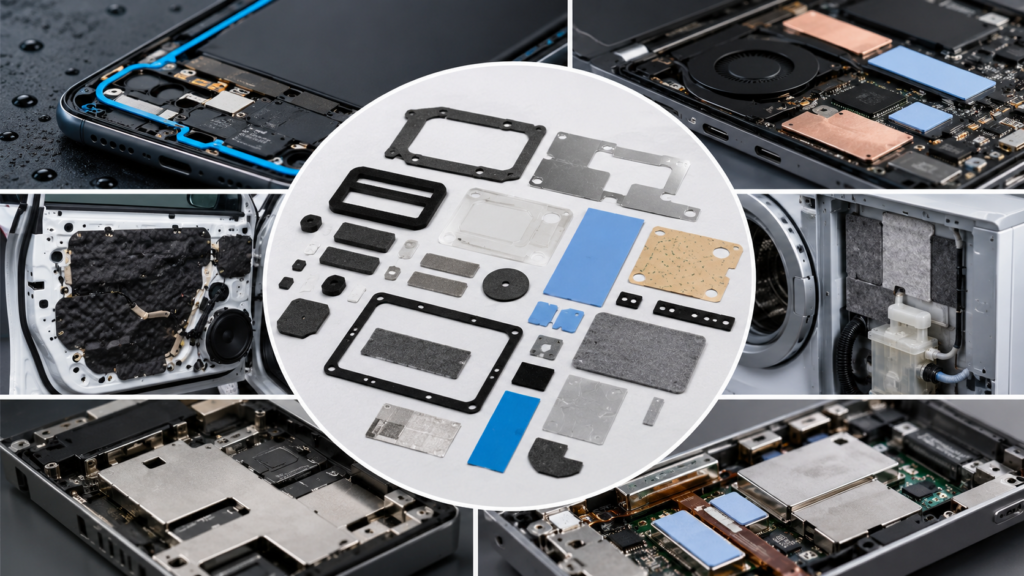
Custom die cut foam gaskets for automotive electronics are used to protect sensitive electronic modules from dust, moisture, vibration, air gaps, rattling and assembly instability. These parts may look simple, but foam thickness, compression range, adhesive backing, hole position and tolerance control can directly affect long-term reliability.
For OEM engineers and buyers, the key is not only whether the gasket fits the drawing. The gasket must also match the real housing gap, screw position, bonding surface, compression requirement and mass production assembly method.
At Sanken, precision die cutting services help convert foam, adhesive tape, rubber, PET film and non-woven materials into stable production-ready components for automotive electronics and other OEM applications.
Why This Topic Matters for OEM Manufacturing
Automotive electronics are exposed to much tougher conditions than ordinary consumer products.
A gasket inside an electronic control unit, sensor housing, lighting module, display assembly, connector cover, or battery management component may face heat, vibration, compression, humidity, dust, and long service life requirements.
If the foam gasket fails, the problem may appear as:
- Dust entering the housing
- Moisture affecting electronic components
- Rattling noise during vehicle operation
- Poor compression around screw areas
- Gasket shifting during assembly
- Adhesive lifting from the housing
- Uneven sealing pressure
- Higher rejection rate during production
This is why automotive foam gaskets must be reviewed as functional sealing components, not just simple die cut shapes.
A good foam gasket should match the housing gap, compression requirement, material environment, adhesive surface, hole position, and assembly method.
Common Problems and Production Risks
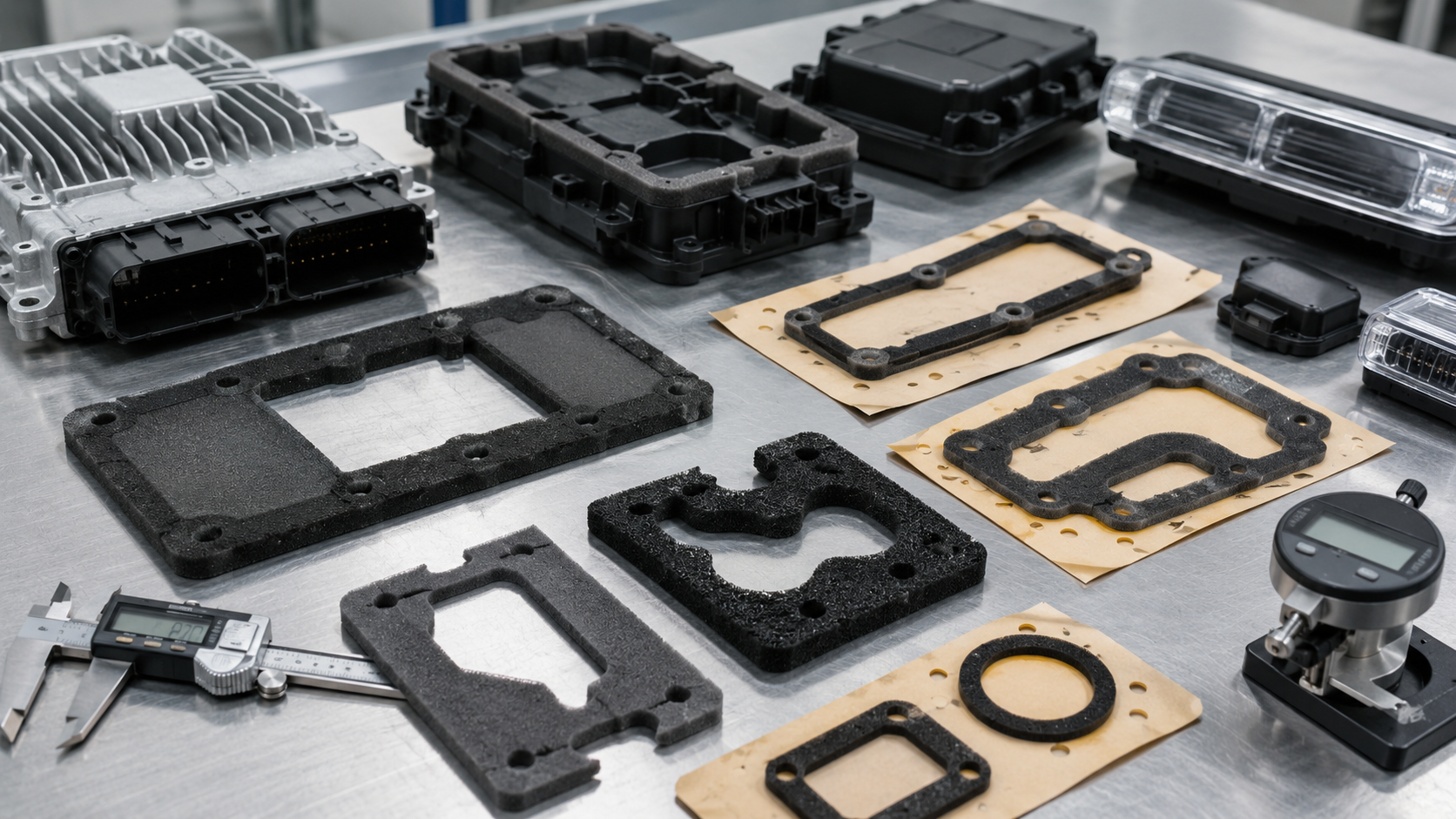
Many foam gasket problems are not visible when the part is lying flat on a table. They appear after compression, screw tightening, heat aging, vibration, or assembly handling.
| Problem | Common Cause | Automotive Electronics Risk |
|---|---|---|
| Poor sealing | Wrong foam thickness or density | Dust, water, or air leakage |
| Gasket tearing | Narrow wall or weak foam structure | Assembly scrap and sealing failure |
| Hole misalignment | Poor tolerance control | Screw assembly difficulty |
| Adhesive lifting | Wrong adhesive or poor surface match | Gasket shifting inside housing |
| Over-compression | Foam too thick or too soft | Loss of rebound and sealing force |
| Edge deformation | Excessive cutting pressure | Poor fit and unstable contact |
| Adhesive overflow | Soft adhesive or poor kiss cutting | Contamination near electronics |
| Batch inconsistency | Weak process control | Unstable mass production quality |
For automotive electronics, one of the biggest risks is uneven compression.
If one area of the gasket is compressed too much while another area is not compressed enough, the housing may look closed, but the sealing path may still have weak points.
This can lead to long-term reliability problems.
What Buyers or Engineers Should Check First
Before ordering custom die cut foam gaskets, engineers should confirm the real sealing and assembly conditions. This helps avoid repeated sampling and unnecessary tooling changes.
| Checklist Item | What to Confirm | Why It Matters |
|---|---|---|
| Housing gap | Actual space between mating surfaces | Determines gasket thickness |
| Compression range | Target compression after assembly | Controls sealing pressure |
| Foam material | PU, PE, EPDM, CR, EVA, silicone foam | Affects rebound and durability |
| Foam density | Soft, medium, or high-density foam | Controls strength and compression |
| Critical dimensions | Holes, edges, sealing walls, inner openings | Protects assembly accuracy |
| Hole-to-edge distance | Space around screw holes and cutouts | Prevents tearing and weak areas |
| Adhesive backing | Adhesive type and liner structure | Supports positioning and bonding |
| Surface material | Plastic, metal, coating, painted surface | Affects adhesive selection |
| Application environment | Heat, vibration, humidity, dust | Confirms long-term suitability |
| Delivery format | Sheet, roll, individual piece, liner-backed | Supports assembly efficiency |
The most important point is to separate critical dimensions from non-critical dimensions.
A screw hole, sealing wall, adhesive area, or sensor opening may need tighter control. A non-functional outer edge may not require the same strict tolerance.
This approach helps protect performance while avoiding unnecessary cost.
Material and Process Considerations
Different foam materials behave differently in automotive electronics applications.
PU foam is often used for cushioning, dust sealing, and soft contact areas. It is easy to compress, but narrow gasket walls may tear if the design is too thin.
PE foam offers better structure and moisture resistance in many applications. It can be useful where shape stability and clean cutting are important.
EPDM foam is commonly selected for automotive sealing because it offers good weather resistance, compression performance, and durability.
CR foam can be used for industrial and automotive sealing where oil resistance, cushioning, or vibration control may be required.
EVA foam is often used for general cushioning, spacing, and protection.
Silicone foam may be used where heat resistance, elasticity, and long-term recovery are important.
The material should not be selected only by price or thickness. Engineers should also consider compression set, rebound, density, surface condition, adhesive compatibility, and service temperature.
For adhesive-backed foam gaskets, the process becomes more complex.
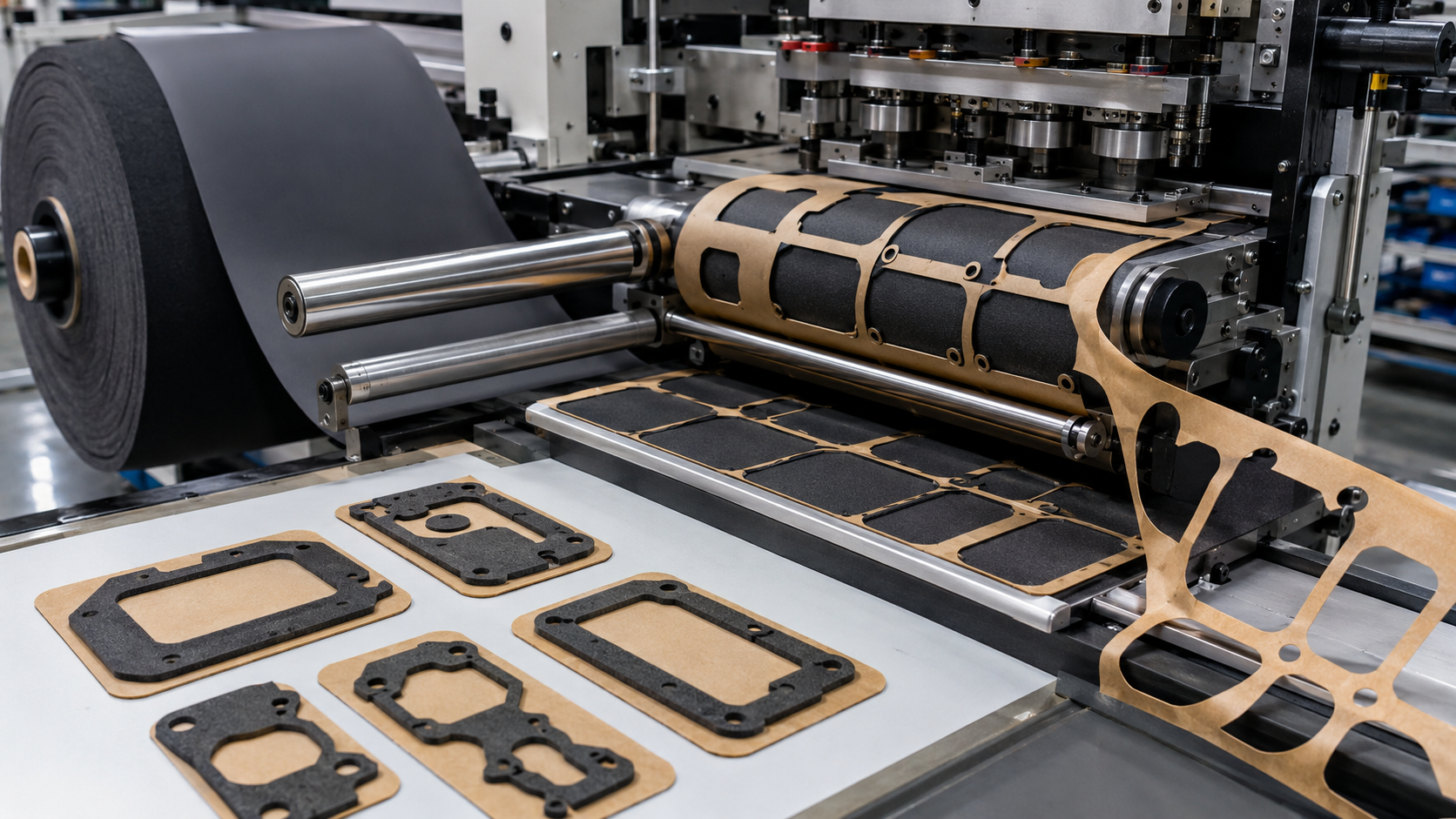
The supplier must control adhesive lamination, liner selection, kiss cutting depth, cutting pressure, waste removal, and packaging. If these steps are not stable, the gasket may stretch, lift, tear, or leave adhesive residue.
Why Tolerance Is Critical for Automotive Foam Gaskets
Foam is flexible, but that does not mean tolerance is unimportant.
In fact, tolerance is often more important because foam can deform during cutting, handling, and assembly.
Key tolerance areas include:
- Outer profile
- Inner window
- Screw holes
- Locating holes
- Sealing wall width
- Adhesive position
- Foam thickness
- Hole-to-edge distance
If hole position shifts, the gasket may not align with the housing.
If sealing wall width becomes too narrow, sealing pressure may become weak.
If thickness varies too much, compression may become uneven.
If adhesive position is unstable, the gasket may shift during assembly.
At Sanken, we review tolerance together with material behavior. A tolerance that works for PET film may not be realistic for soft foam. A narrow foam gasket may need design adjustment before tooling to avoid tearing or unstable production.
Why Samples Pass but Mass Production Fails
A foam gasket sample may look clean during approval, but mass production can still fail.
This happens because sample production is usually slower and more carefully adjusted. Mass production introduces more variables.
Common mass production variables include:
- Foam batch variation
- Tool wear
- Cutting pressure change
- Roll tension change
- Adhesive lamination variation
- Waste removal force
- Operator handling
- Packaging compression
- Temperature and humidity changes
For automotive electronics OEMs, this is a serious concern because assembly lines require consistent parts.
A supplier should not only prove that one sample can be made. The supplier should prove that the process can produce stable parts repeatedly.
That is why inspection, tooling control, packaging method, and production repeatability should be reviewed before mass production.
How Sanken Helps Reduce Risk Before Mass Production
Sanken Manufacturing Co., Ltd. helps OEM customers develop custom die cut foam gaskets for automotive electronics by reviewing the part as a complete sealing system.
We focus on material selection, foam density, thickness, compression range, adhesive structure, sealing wall width, hole position, tolerance, cutting process, waste removal, and packaging.
For automotive electronic housings, we pay special attention to dustproof sealing, waterproof protection, anti-rattle performance, vibration resistance, and assembly fit.
For adhesive-backed foam gaskets, we review bonding surface, adhesive type, liner release, kiss cutting depth, and adhesive overflow risk.
For complex gasket shapes, we check minimum wall width, hole-to-edge distance, narrow bridges, sharp corners, and stripping stability before tooling.
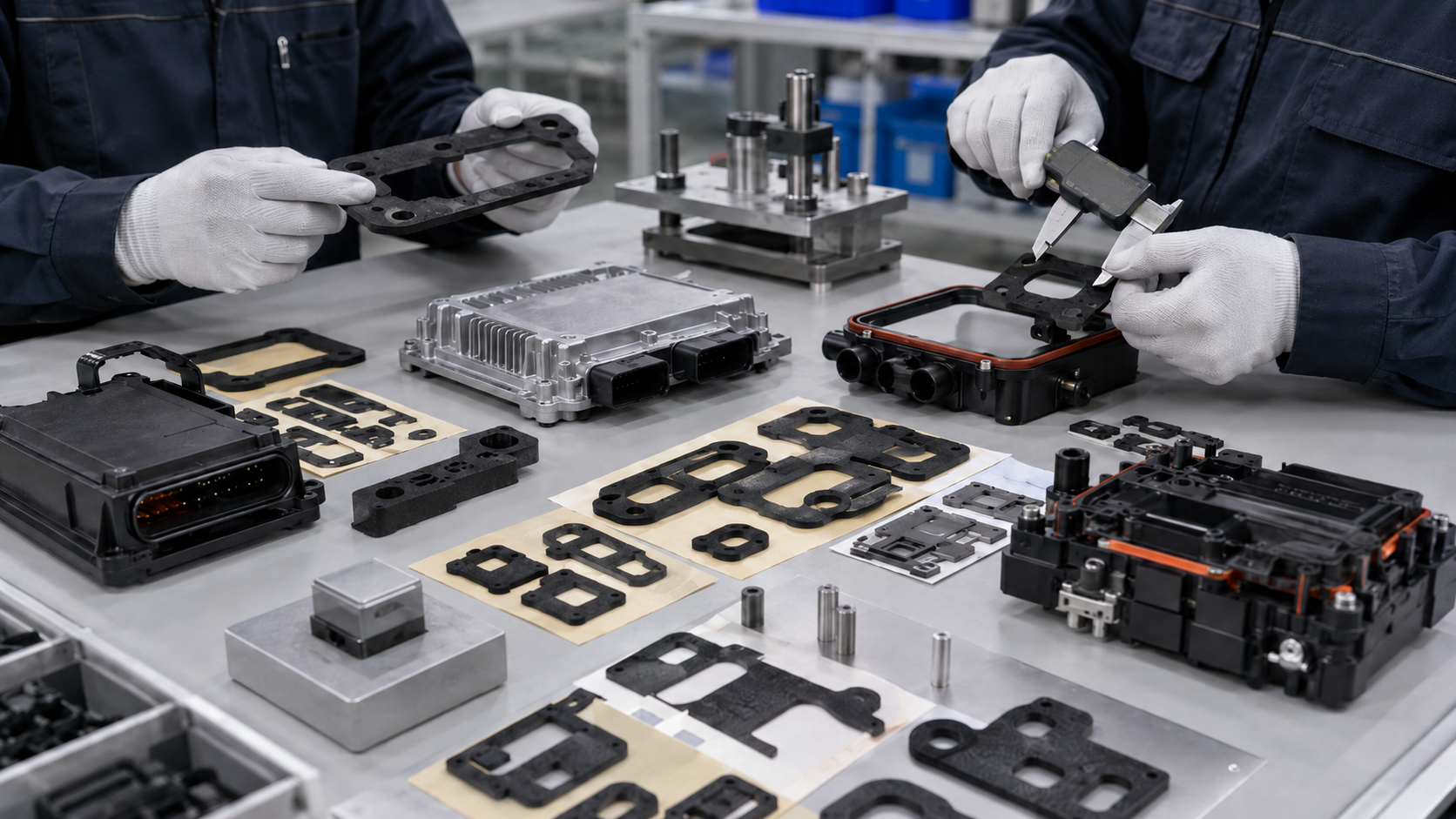
Our goal is to help customers reduce repeated trials, avoid gasket tearing, improve assembly efficiency, and reach stable mass production faster.
A custom foam gasket should not only fit the drawing. It should work inside the real automotive electronic assembly.
Conclusion
Custom die cut foam gaskets for automotive electronics must be designed and produced with sealing performance, compression behavior, tolerance, adhesive stability, material durability, and mass production repeatability in mind. A small gasket can affect the reliability of an entire electronic module.
At Sanken, we help OEM buyers and engineers develop foam gaskets that fit real automotive applications, reduce sampling risks, and support stable mass production from material selection to final delivery.