
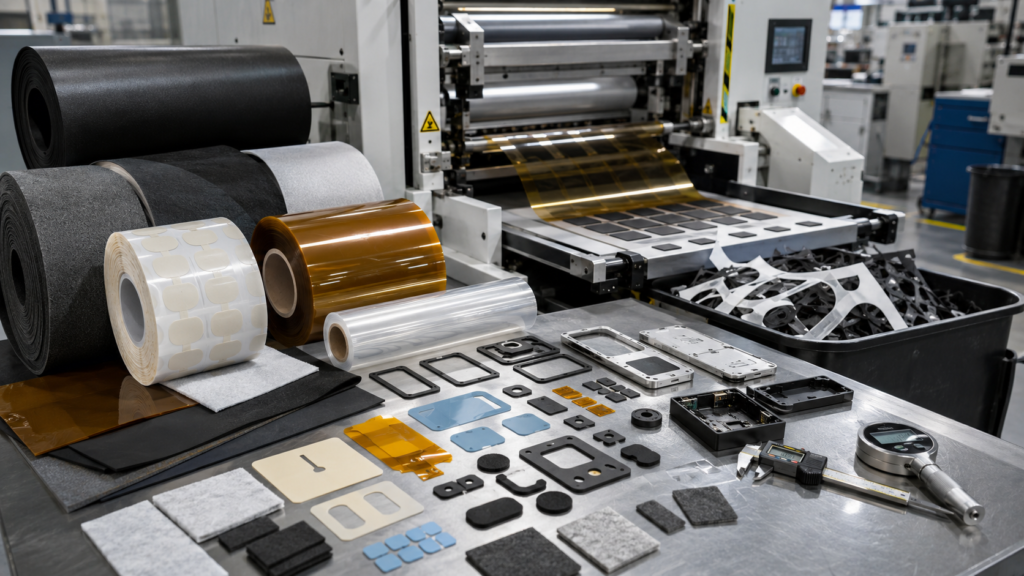
The hidden manufacturing process inside cars, phones and medical devices is often precision die cutting and material converting. These processes turn foam, rubber, PET film, adhesive tape, protective film and non-woven materials into small functional parts used for sealing, bonding, insulation, cushioning, dust control and surface protection.
Although these components are usually hidden inside the final product, they can directly affect reliability. A foam gasket may help prevent leakage in an automotive electronics housing, a PET insulation film may support electrical protection in an electronics assembly, and an adhesive-backed component may improve positioning during OEM assembly.
At Sanken, we treat these small parts as functional components, not simple cut shapes.
Why This Topic Matters for OEM Manufacturing
Cars, phones and medical devices all rely on compact, precise and reliable internal components.
A vehicle may contain die cut foam gaskets for sensors, battery modules, lighting systems and electronic control units.
A phone may use PET films, adhesive tapes, foam pads and insulation layers around the battery, display, camera and speaker.
A medical device may need clean adhesive parts, protective films, foam cushioning, sealing layers and non-woven components.
These parts are usually thin, lightweight and custom-shaped. They are often placed between larger components to solve problems that the main structure cannot solve alone.
They help control:
- Dust and moisture
- Vibration and noise
- Electrical insulation
- Surface protection
- Shock absorption
- Bonding and positioning
- Assembly efficiency
- Long-term product reliability
This is why precision die cutting and material converting are important hidden processes in modern OEM manufacturing.
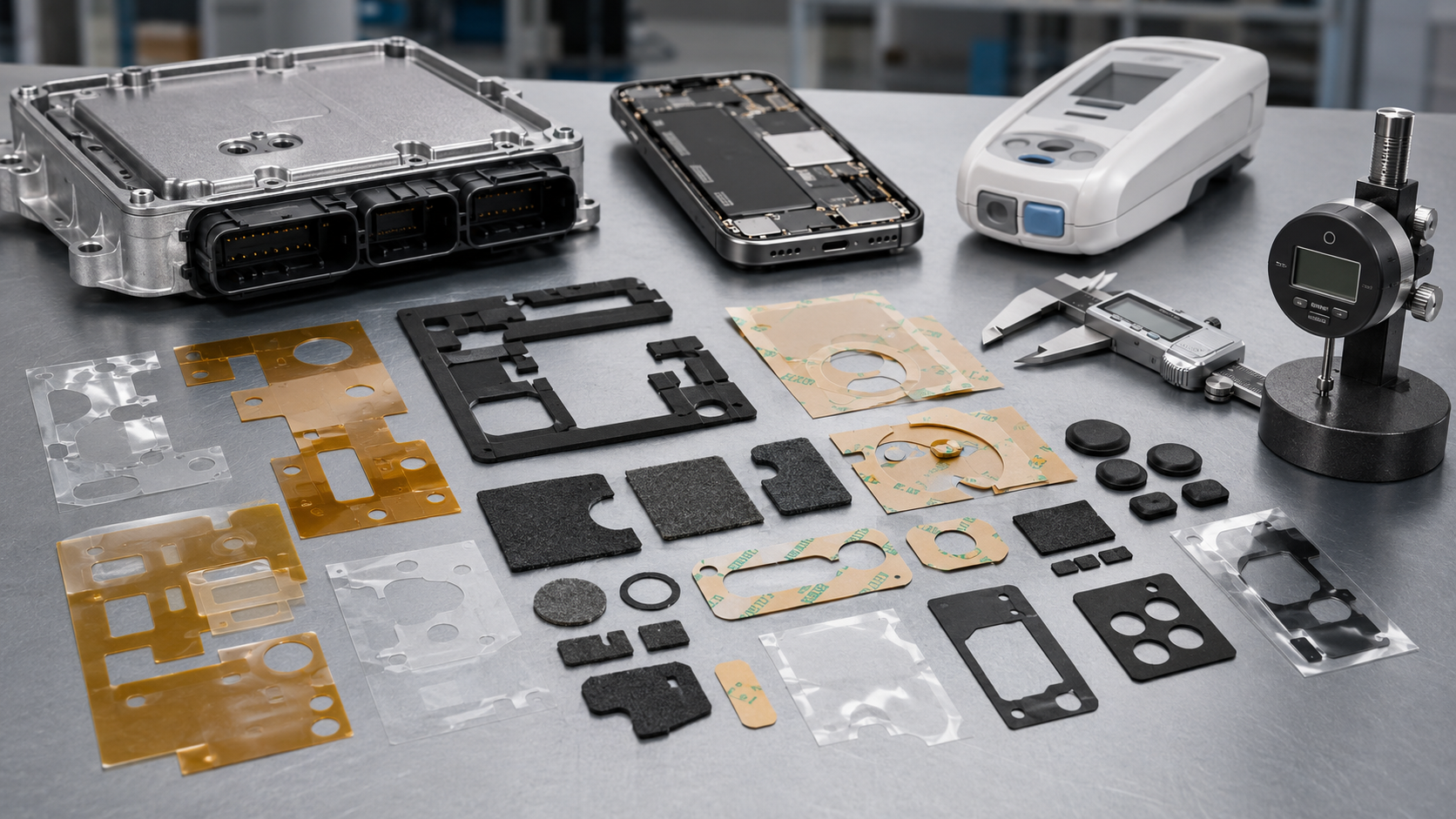
For sealing applications, foam gaskets and sealing components are often used to control dust, moisture, vibration and compression.
Common Hidden Components and Production Risks
Small flexible components can create large production risks if material, tolerance or process control is weak.
| Hidden Component | Typical Application | Common Risk |
|---|---|---|
| Foam gasket | Automotive electronics housing | Poor sealing or compression loss |
| PET insulation film | Electronics battery or PCB area | Hole misalignment or insulation failure |
| Adhesive tape part | Display, sensor or medical-related device assembly | Peeling, shifting or adhesive overflow |
| Rubber pad | Vibration control and sealing | Poor rebound or edge deformation |
| Non-woven felt part | Automotive NVH and anti-rattle areas | Fiber shedding or unstable thickness |
| Protective film | Electronics and device surfaces | Curling or poor release |
| Multilayer laminate | Bonding, insulation or cushioning | Delamination or difficult waste removal |
Many of these problems do not appear when the part is lying flat on a table.
They appear during assembly, compression, peeling, aging, vibration, heat exposure or repeated use.
For example, a foam gasket may look clean after die cutting, but if the compression range is wrong, it may leak after installation. A PET insulation film may look accurate, but if the hole position shifts slightly, it may interfere with screws, contacts or connectors. An adhesive-backed medical part may pass visual inspection, but if liner release is unstable, assembly speed and product consistency can suffer.
The hidden process must be controlled because the hidden part often protects the visible product.
What Buyers or Engineers Should Check First
Before sourcing custom die cut components, buyers and engineers should clarify how the part will function inside the final product. The drawing alone is not enough.
| Checklist Item | What to Confirm | Why It Matters |
|---|---|---|
| Final application | Car, electronics, medical-related device or industrial product | Defines reliability requirements |
| Part function | Sealing, bonding, insulation, cushioning or protection | Guides material selection |
| Material type | Foam, PET, rubber, adhesive tape, felt or film | Affects cutting and performance |
| Thickness | Nominal thickness and tolerance | Controls fit, compression and assembly |
| Critical dimensions | Holes, windows, edges and sealing walls | Prevents functional failure |
| Adhesive requirement | Adhesive type, liner and bonding surface | Prevents peeling or shifting |
| Environment | Heat, humidity, vibration, chemicals or handling condition | Confirms long-term suitability |
| Assembly method | Manual, fixture, automated or compression assembly | Affects delivery format |
| Inspection needs | Dimension, edge, adhesive, cleanliness and release | Protects batch quality |
| Packaging format | Roll, sheet, tray, kit or liner-backed part | Supports efficient production |
A professional supplier should ask these questions before quoting.
If the supplier only asks for size, material and quantity, important risks may be missed.
For OEM projects, the goal is not just to receive parts. The goal is to receive parts that work inside the product and remain stable during mass production.
How Die Cutting Turns Flexible Materials Into Functional Parts
Die cutting begins with raw materials such as foam rolls, rubber sheets, PET films, adhesive tapes, non-woven felt or laminated materials.
The material is reviewed first. Thickness, density, surface condition, adhesive structure and tolerance requirements are checked before production.
If adhesive is needed, lamination may be added. This step must control adhesive alignment, liner selection, bubbles, wrinkles and edge stability.
Then tooling is prepared. Depending on material and volume, the supplier may use flatbed die cutting, rotary die cutting, kiss cutting or precision tooling.
After cutting, waste removal becomes important. Small holes, narrow walls, soft foam and adhesive-backed parts can tear or deform if stripping is not controlled.
Finally, the parts are inspected and packaged. Packaging may look simple, but it can affect whether parts arrive flat, clean and easy to assemble.
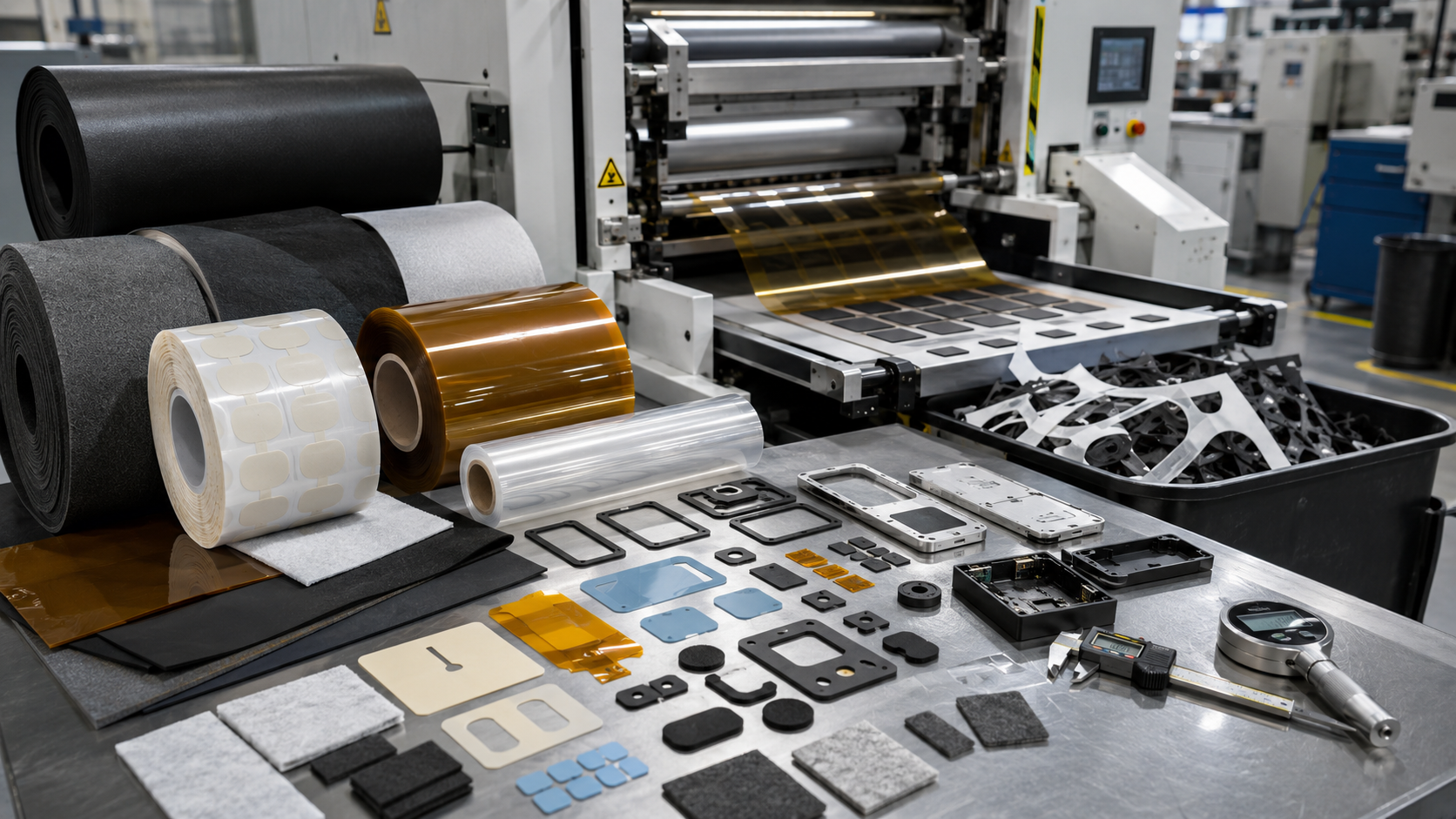
This complete process is what transforms flexible material into a functional OEM component.
For cars, phones and medical devices, this process must be stable enough for repeat production, not only sample approval.
Material and Process Considerations
Different industries require different material choices.
In automotive applications, foam, rubber, PET film, adhesive tape and non-woven felt may be used for sealing, insulation, NVH reduction, dust protection and vibration control. These parts must often handle heat, vibration, humidity and long service life.
In phones and consumer electronics, components are usually smaller and thinner. PET insulation films, adhesive tapes, protective films, foam spacers and cushioning pads must fit tight spaces while maintaining clean edges and accurate positioning.
In medical devices, adhesive parts, protective films, foam pads and non-woven materials may need clean handling, stable adhesive release and consistent material behavior.
The same manufacturing method may be used across industries, but the engineering priority changes.
For automotive electronics, compression and sealing performance may be critical.
For phones, dimensional accuracy and clean assembly may be the main concern.
For medical devices, consistency, cleanliness and controlled adhesive behavior may matter more.
This is why material converting and die cutting require application knowledge. A supplier must understand not only how to cut the material, but also how the finished part will be used.
Why Hidden Parts Fail During Mass Production
Many hidden component failures happen after a good sample has already been approved.
This is because sample production is often slower, more manual and more carefully adjusted. Mass production introduces more variables.
Common production variables include:
- Material batch variation
- Tool wear
- Cutting pressure changes
- Roll tension changes
- Adhesive lamination variation
- Waste removal force
- Liner release behavior
- Packaging pressure
- Operator handling
- Temperature and humidity changes
A first sample may look correct, but the real test is whether the supplier can repeat the same result across production batches.
This is especially important for small parts used in cars, phones and medical devices. A slight shift in hole position, edge quality, adhesive placement or thickness can affect assembly and performance.
For buyers, the best way to reduce risk is to involve the supplier early, before tooling and sampling.
How Sanken Helps Reduce Risk Before Mass Production
Sanken Manufacturing Co., Ltd. supports OEM customers with precision die cutting, material converting, adhesive lamination, foam and rubber components, PET insulation films, non-woven felt parts, automotive electronics components, sealing gaskets and custom industrial parts.
For hidden components inside cars, phones and medical devices, we focus on the details that affect real product performance.
For foam gaskets, we review compression range, thickness, density, sealing wall width, hole position and rebound.
For PET insulation films, we review dimensional stability, edge cleanliness, hole alignment, adhesive structure and packaging.
For adhesive-backed parts, we review bonding surface, adhesive type, liner release, kiss cutting depth and overflow risk.
For non-woven felt and acoustic parts, we review thickness, fiber condition, cutting edge and assembly environment.
For rubber pads and sealing parts, we review rebound, thickness, cutting edge and application load.
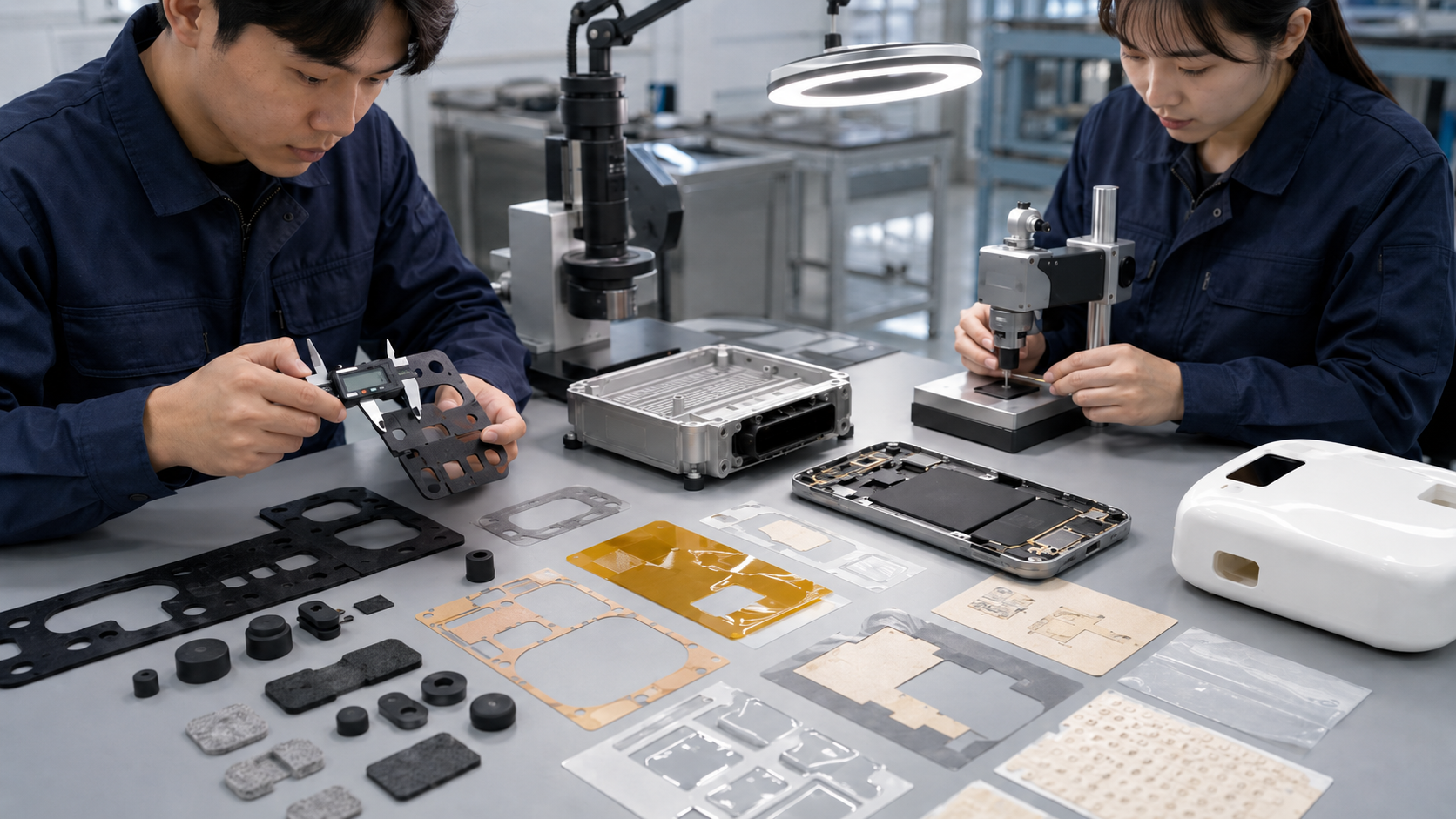
Our goal is to help customers reduce repeated sampling, tooling changes, assembly delays, part deformation, adhesive problems and unstable batch quality.
A hidden part should not become a hidden risk.
Need hidden die cut components for an OEM project?
Send us your drawing, sample, material requirement, thickness, adhesive structure, tolerance, application environment, annual volume and packaging preference. Sanken can help review material selection, lamination, die cutting method, inspection points and delivery format before mass production.
Conclusion
The hidden manufacturing process inside cars, phones and medical devices is often precision die cutting and material converting. These processes transform foam, rubber, PET film, adhesive tape and non-woven felt into small functional components that protect product reliability.
At Sanken, we help OEM buyers and engineers control material behavior, tolerance, adhesive structure, cutting quality, inspection and packaging before mass production, so hidden components can support stable product performance instead of creating hidden risks.