
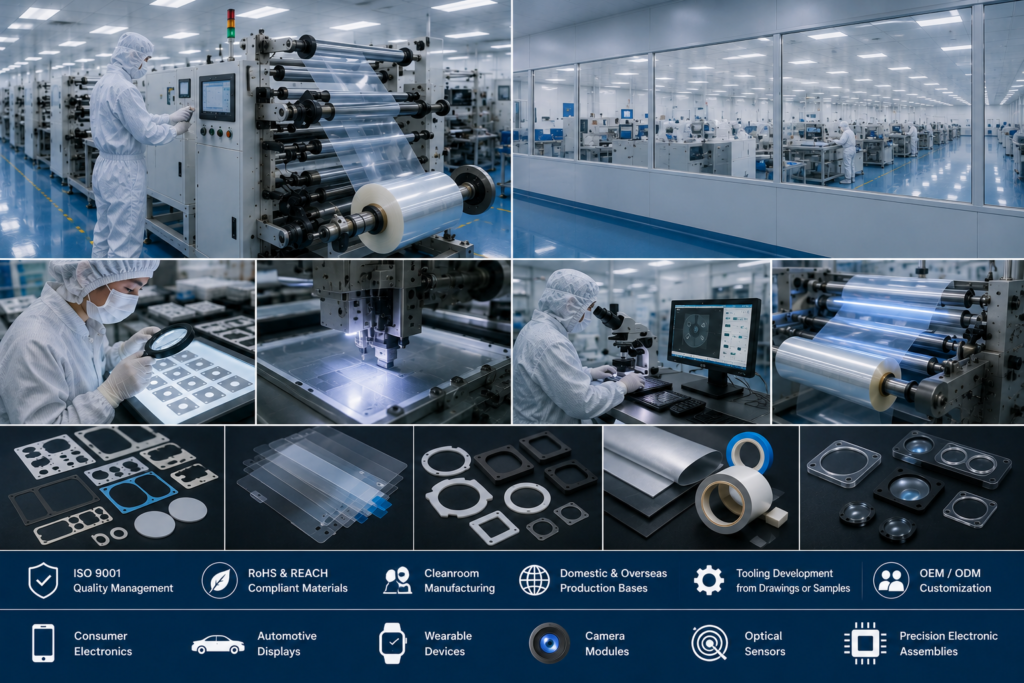
Bubbles are one of the most common defects in optical film die cutting. A small bubble trapped between a PET film, protective film, optical adhesive, or release liner can cause display defects, poor bonding, optical distortion, and customer rejection. For consumer electronics, automotive displays, camera modules, and wearable devices, bubble control is essential.
To avoid bubbles in optical film die cutting, manufacturers must control material cleanliness, lamination pressure, web tension, adhesive selection, release liner quality, static electricity, and cleanroom conditions. Proper process control helps ensure smooth bonding, stable optical performance, and consistent high-volume production.
Why Bubbles Occur in Optical Film Die Cutting
Bubbles usually appear when air, dust, moisture, or uneven pressure becomes trapped between material layers.
Common causes include:
- Poor lamination pressure
- Dust or particles on the film surface
- Uneven adhesive coating
- Static attraction
- Incorrect web tension
- Moisture contamination
- Poor release liner quality
- Fast lamination speed
Because optical films are transparent or semi-transparent, even tiny bubbles can become visible after final assembly.
Theme: Optical Film Die Cutting Process
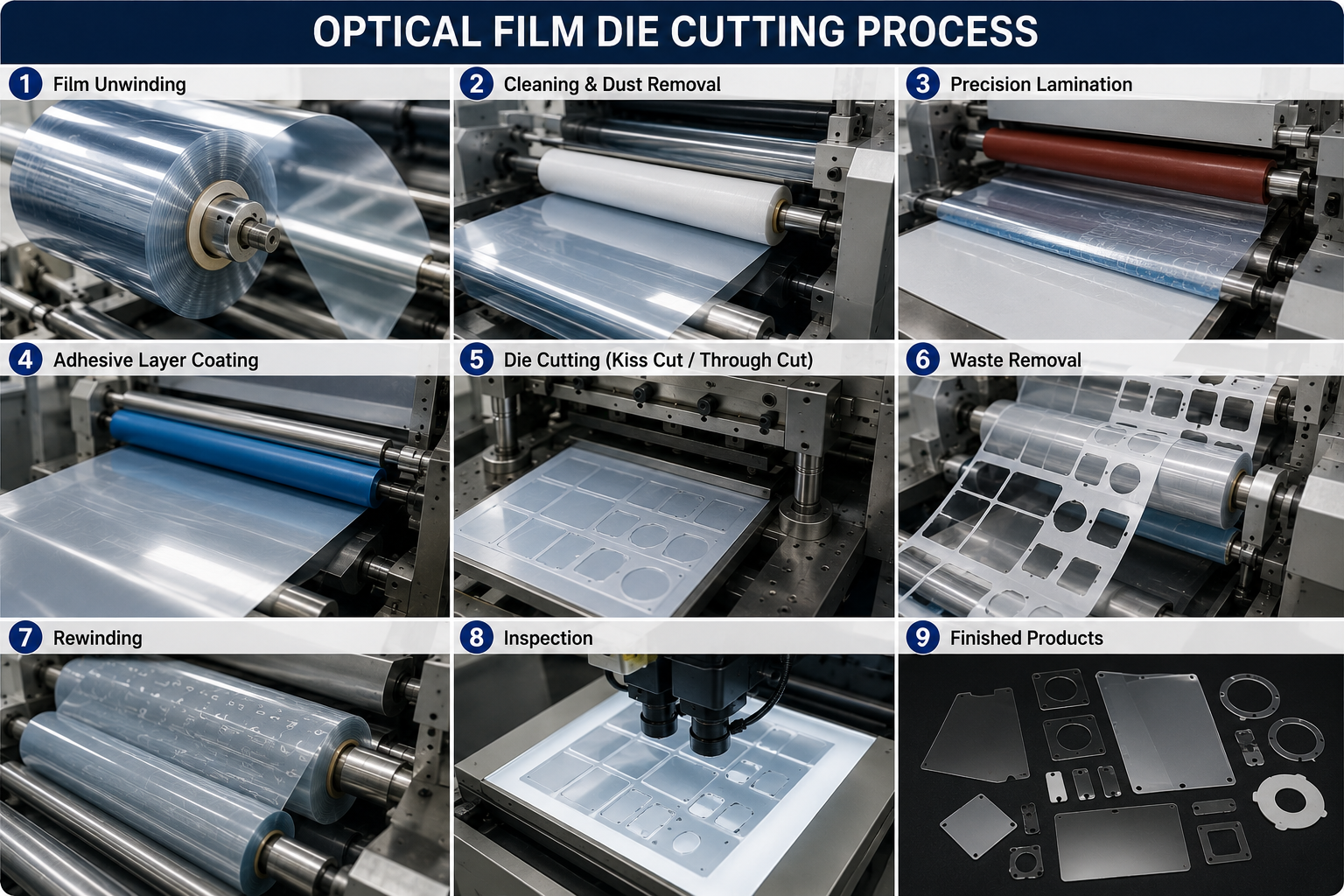
Use Clean Materials Before Lamination
Cleanliness is the first step in bubble prevention.
Optical films, PET films, TPU films, OCA adhesives, and protective films must be handled carefully before die cutting.
Dust, fibers, and small particles can create raised points under the film. During lamination, air may remain around these particles and form visible bubbles.
Best practices include:
- Clean material storage
- Protective packaging
- Dust-free handling
- Surface inspection before lamination
- Cleanroom converting when required
For display and optical sensor applications, clean manufacturing is often necessary.
Control Lamination Pressure
Lamination pressure directly affects bubble formation.
If pressure is too low, air may not be fully pushed out.
If pressure is too high, soft adhesive layers may deform or create flow marks.
The goal is stable, even pressure across the full material width.
Proper lamination helps:
- Remove trapped air
- Improve adhesive wet-out
- Maintain flatness
- Reduce optical defects
Pressure should be validated based on film thickness, adhesive type, and final application.
Optimize Web Tension
Optical films are sensitive to tension variation.
Excessive tension may stretch the film.
Low tension may cause wrinkles or unstable feeding.
Both can create uneven lamination and increase bubble risk.
Good tension control helps maintain:
- Flat material surfaces
- Accurate registration
- Smooth lamination
- Stable die cutting
For roll-to-roll optical film converting, tension control is one of the most important process factors.
Theme: Cleanroom Optical Film Converting
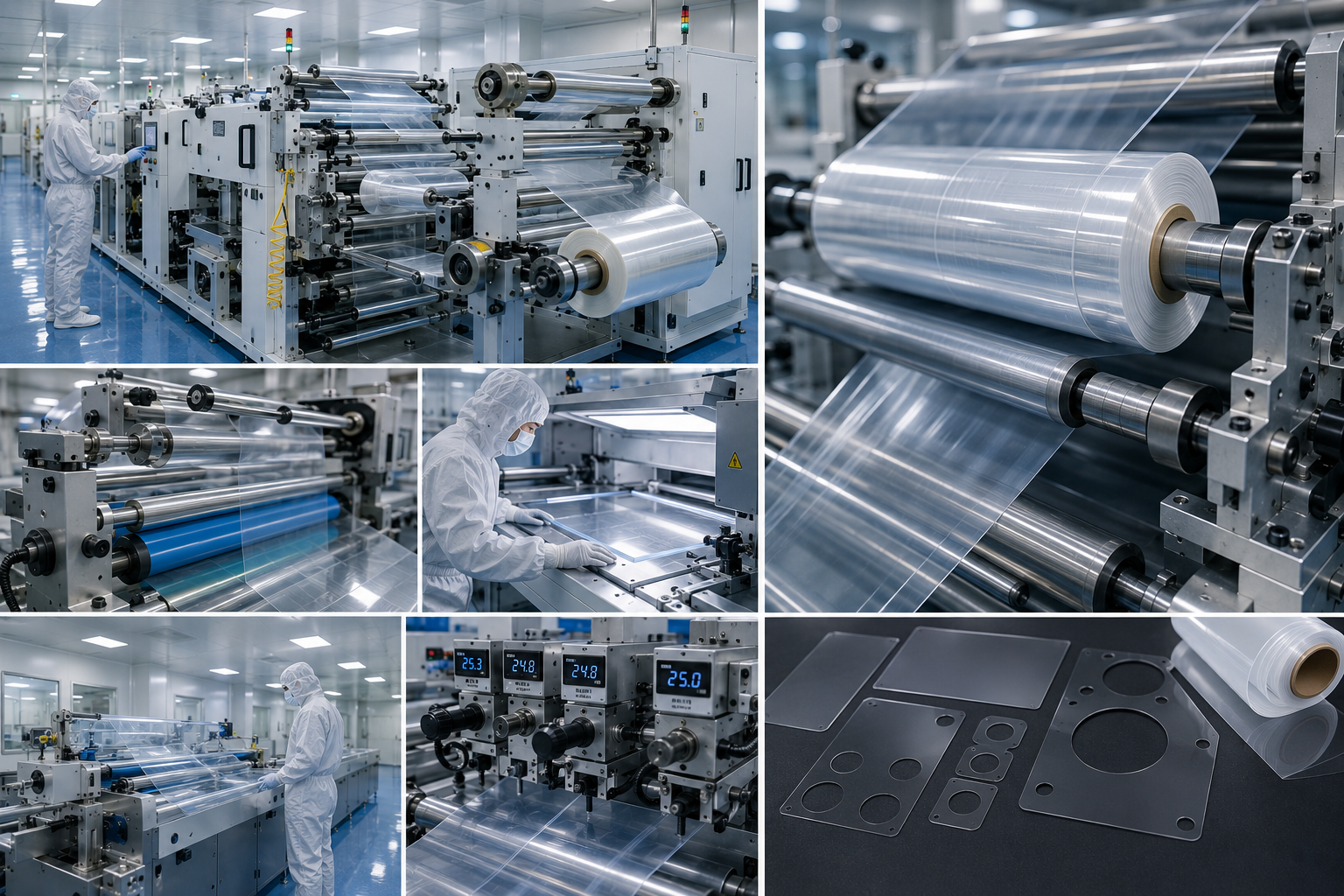
Choose the Right Adhesive
Adhesive selection strongly affects bubble performance.
Some adhesives wet out quickly and release air easily. Others require longer dwell time or higher pressure.
Key adhesive factors include:
- Tack level
- Viscosity
- Thickness
- Flow behavior
- Aging stability
- Surface compatibility
For optical applications, adhesive clarity and bubble resistance are especially important.
Poor adhesive selection may lead to delayed bubbles after storage or environmental testing.
Control Static Electricity
Optical films often generate static during unwinding, laminating, and die cutting.
Static attracts:
- Dust
- Fibers
- Film particles
- Process debris
These contaminants can create bubbles during bonding.
Static control methods include:
- Ionizing bars
- Grounded rollers
- ESD-safe workstations
- Controlled humidity
- Antistatic handling procedures
Static control is especially important for PET, TPU, protective films, and release liners.
Inspect Release Liners Carefully
Release liners play a critical role in optical film die cutting.
A poor liner may cause:
- Uneven release
- Surface marks
- Wrinkles
- Trapped air
- Adhesive disturbance
The liner should have stable release force, clean surface quality, and good dimensional stability.
For high-precision optical parts, PET liners are often preferred because they provide better flatness than paper liners.
Avoid Wrinkles During Die Cutting
Wrinkles can trap air and create bubble-like defects.
Wrinkles may occur because of:
- Poor web alignment
- Tension imbalance
- Roller contamination
- Improper rewind pressure
- Uneven material thickness
Regular equipment maintenance and process monitoring are required to prevent these defects.
Theme: Precision Optical Film Components
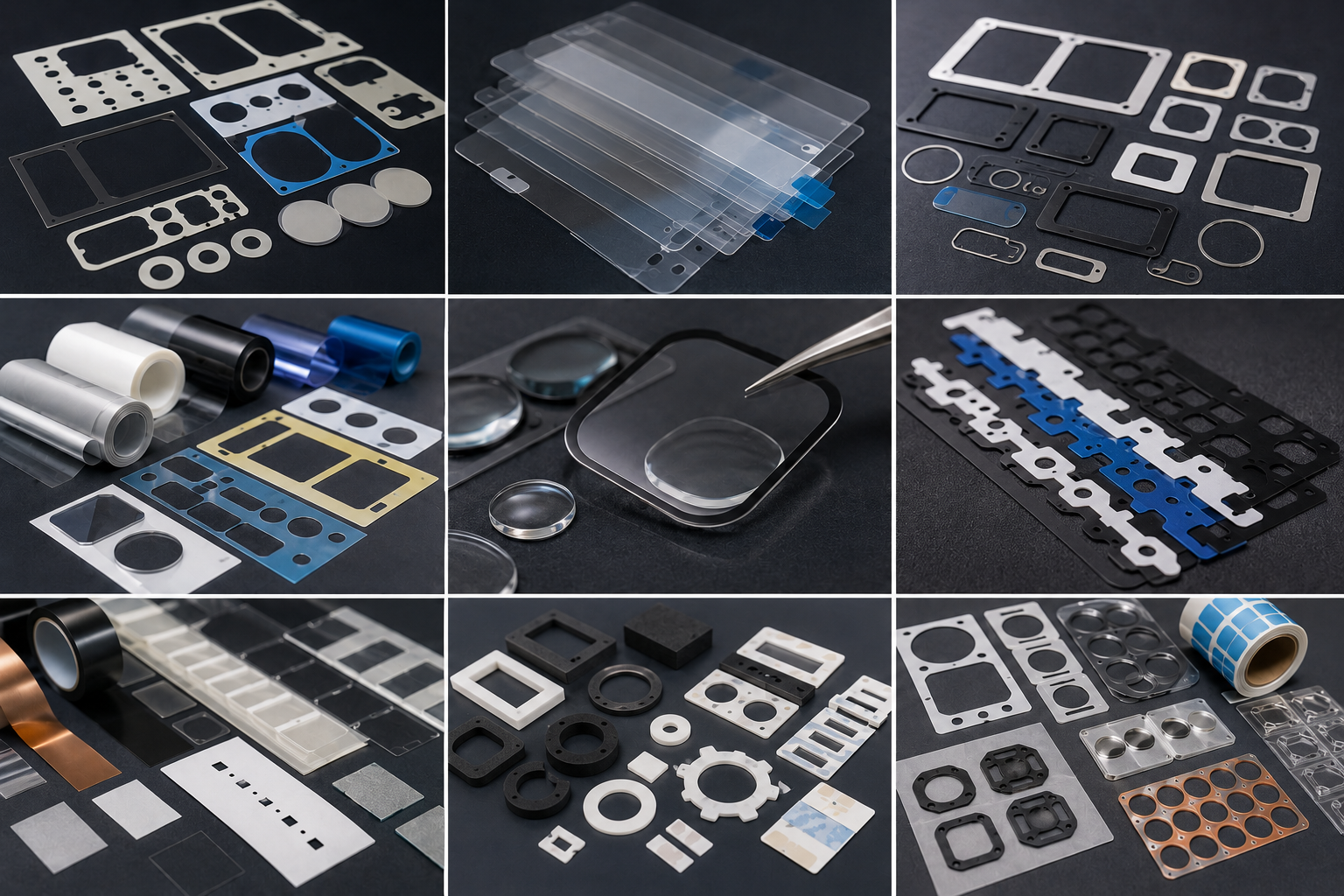
Use Cleanroom Die Cutting for Sensitive Applications
Cleanroom die cutting helps reduce bubbles caused by contamination.
Cleanroom production controls:
- Airborne particles
- Fibers
- Static electricity
- Temperature
- Humidity
- Operator handling
This is especially valuable for:
- Display films
- Camera module films
- Optical sensors
- Wearable device films
- Automotive display components
Cleanroom converting improves yield and reduces rejection in optical assemblies.
Validate Parts After Aging
Some bubbles do not appear immediately after production.
Delayed bubbles may develop after:
- Heat exposure
- Humidity exposure
- Storage
- Transportation
- Adhesive aging
Testing should include:
- 24-hour inspection
- 72-hour inspection
- Thermal aging
- Humidity testing
- Final assembly simulation
This helps identify long-term bubble risks before mass production.
How Sanken Manufacturing Helps Prevent Optical Film Bubbles
Dongguan Sanken Electronics Manufacturing Co., Ltd. provides precision optical film die cutting and cleanroom converting solutions for OEM and ODM customers.
Our capabilities include:
- Precision die cutting
- Optical film converting
- PET and TPU film processing
- Protective film die cutting
- Adhesive laminating
- Cleanroom precision production
- Multi-layer material assembly
Key advantages include:
- ISO 9001 quality management
- RoHS and REACH compliant materials
- Cleanroom manufacturing environment
- Domestic and overseas production bases
- Tool development from drawings or samples
- OEM/ODM customization
We support consumer electronics, automotive displays, wearable devices, optical sensors, camera modules, and precision electronic assemblies.
Featured Snippet Summary
Bubbles in optical film die cutting can be avoided by controlling material cleanliness, lamination pressure, web tension, adhesive selection, static electricity, release liner quality, and cleanroom conditions. Proper validation after aging also helps prevent delayed bubble formation.
Conclusion
Avoiding bubbles in optical film die cutting requires more than careful cutting. The full process must be controlled, from material storage and lamination to static management, liner selection, cleanroom handling, and final inspection.
By using the right materials, stable process controls, and cleanroom converting methods, manufacturers can improve optical clarity, reduce defects, and achieve more reliable high-volume production.