
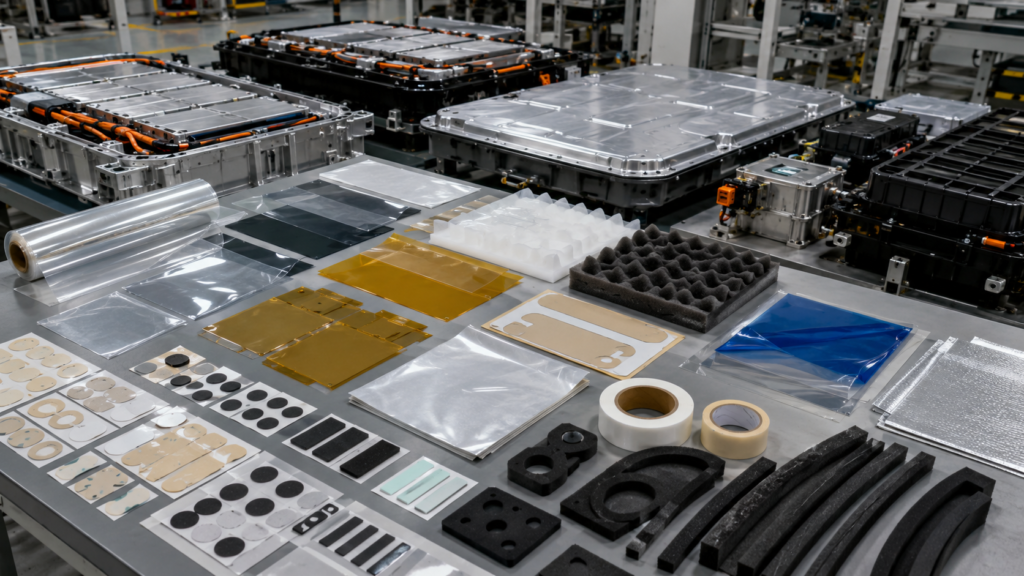
Choosing die cut materials for EV battery packs is not the same as choosing ordinary foam, tape, film, or rubber parts. Battery pack components must support electrical insulation, cushioning, bonding, sealing, vibration control, heat exposure, assembly protection, and long-term reliability. A small die cut film or foam pad may look simple, but the wrong material can lead to insulation risk, adhesive failure, poor compression, assembly interference, or unstable mass production.
For OEM engineers and purchasing teams, material selection should start from the real function of the part inside the battery pack. Is the part used for insulation, spacing, cushioning, surface protection, sealing, bonding, anti-rattle control, or assembly positioning? Each function needs a different material structure.
At Sanken, we focus on custom die cut auxiliary materials for OEM battery pack and electronics assembly, including PET insulation films, PI films, PC films, protective films, adhesive-backed foam pads, double-sided tape components, rubber pads, cushioning parts, sealing gaskets, and multilayer converted components. We do not manufacture battery cells or battery modules. Our role is to help customers convert flexible materials into clean, accurate, assembly-ready die cut parts.
Why Material Selection Matters in EV Battery Packs
EV battery packs are exposed to vibration, compression, temperature changes, electrical risk, and tight assembly spaces. Many components inside or around the pack need thin, flexible, and accurately shaped materials.
Custom die cut parts may be used between cells, around busbars, near battery covers, under electronic control units, inside module housings, around cable areas, or on protective surfaces.
Common battery pack die cut part functions include:
- Electrical insulation
- Surface protection
- Cushioning and compression support
- Gap filling
- Anti-vibration support
- Sealing and dust protection
- Adhesive bonding
- Temporary protection during assembly
- Spacing and positioning
- Noise and rattle reduction
If the material does not match the application, the part may fail even if the shape is correct. For example, a PET film with poor hole alignment may interfere with screws or terminals. A foam pad that is too soft may lose compression. A tape part with the wrong adhesive may lift after heat exposure. A rubber pad that is too hard may create assembly stress.
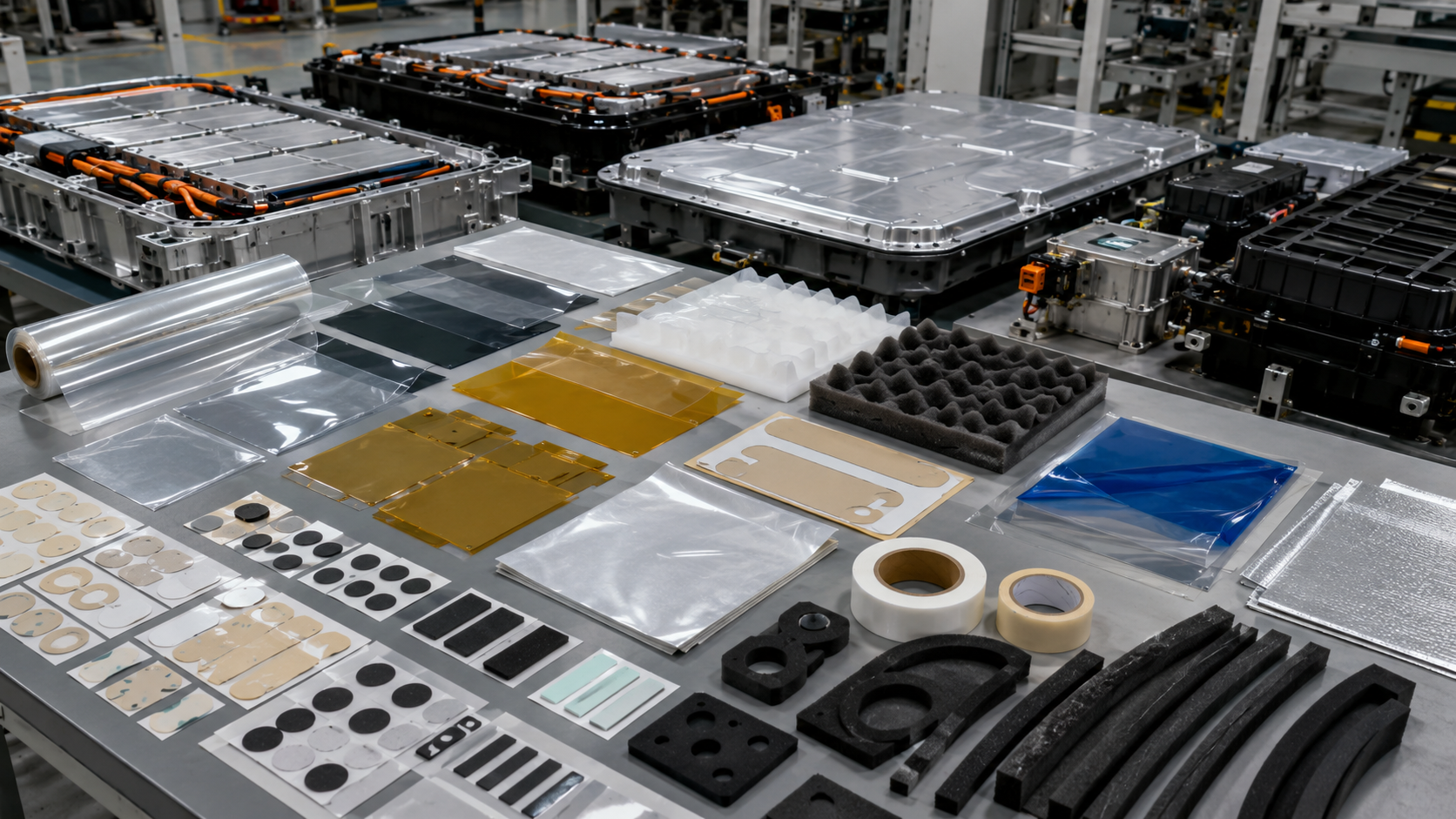
Main Die Cut Materials Used in EV Battery Pack Applications
Different materials solve different battery pack problems.
| Material Type | Main Function | Common Battery Pack Use |
|---|---|---|
| PET film | Electrical insulation, spacing, protection | Cell insulation, module insulation, cover protection |
| PI film | High-temperature insulation | Heat-sensitive electronic and battery areas |
| PC film | Tough insulation and protection | Structural insulation and protective covers |
| Protective film | Temporary surface protection | Panels, covers, modules, assembly protection |
| Foam | Cushioning, gap filling, vibration control | Pads, spacers, sealing strips, compression support |
| Rubber | Damping, sealing, anti-slip support | Pads, washers, vibration damping parts |
| Double-sided tape | Bonding and positioning | Film bonding, foam attachment, component fixing |
| Multilayer materials | Combined function | Insulation plus adhesive, foam plus tape, film plus liner |
The right choice depends on voltage risk, temperature exposure, compression force, bonding surface, tolerance, thickness, cleanliness, and assembly method.
PET Film for Electrical Insulation
PET film is one of the most common materials for die cut battery insulation parts. It offers good dimensional stability, clean cutting performance, and reliable insulation support for many battery and electronic applications.
PET die cut parts may be used for:
- Battery module insulation
- Cell spacing and protection
- Cover insulation
- Electrical isolation barriers
- Connector and busbar area protection
- Adhesive-backed insulation pads
- Custom-shaped protective films
When choosing PET film, engineers should review thickness, insulation requirement, surface cleanliness, hole accuracy, edge quality, and whether adhesive backing is needed.
For battery pack use, edge cleanliness is especially important. Rough edges, burrs, dust, or film particles may create assembly and quality risks. Hole alignment is also critical because PET films often need to fit around screws, posts, cables, terminals, or module structures.
PI Film for High-Temperature Areas
PI film is often selected when higher heat resistance is required. Compared with standard PET, PI film can better support applications exposed to elevated temperature or localized heat sources.
PI die cut parts are commonly used in:
- Battery electronics areas
- High-temperature insulation zones
- Flexible circuit protection
- Thermal-sensitive assembly areas
- Electrical insulation near heat exposure
PI material is usually more expensive than PET, so it should be selected where its performance is truly needed. Not every insulation part requires PI. For many standard insulation or protection applications, PET may be more cost-effective.
A good supplier should help buyers compare the real application environment instead of automatically choosing the most expensive material.
Foam Materials for Cushioning and Gap Filling
Foam materials are used when the battery pack needs cushioning, gap filling, compression support, sealing, or vibration reduction.
Common foam options include PE foam, PU foam, EVA foam, EPDM foam, silicone foam, and CR foam.
| Foam Type | General Feature | Battery Pack Application Focus |
|---|---|---|
| PE foam | Lightweight and clean | Cushioning, spacing, general protection |
| PU foam | Soft and compressible | Soft contact and light cushioning |
| EVA foam | Durable and stable | Pads, spacers, support parts |
| EPDM foam | Good sealing support | Dust sealing and environmental sealing |
| Silicone foam | Heat-resistant compression support | High-temperature or electronics areas |
| CR foam | Balanced cushioning and sealing | General battery and industrial pads |
Foam selection should not be based only on thickness. Density, compression force, rebound, cell structure, aging behavior, and adhesive compatibility must also be reviewed.
If the foam is too soft, it may collapse after long-term compression. If it is too hard, it may create stress on battery pack parts. If the foam thickness is wrong, it may fail to fill the gap or make assembly difficult.
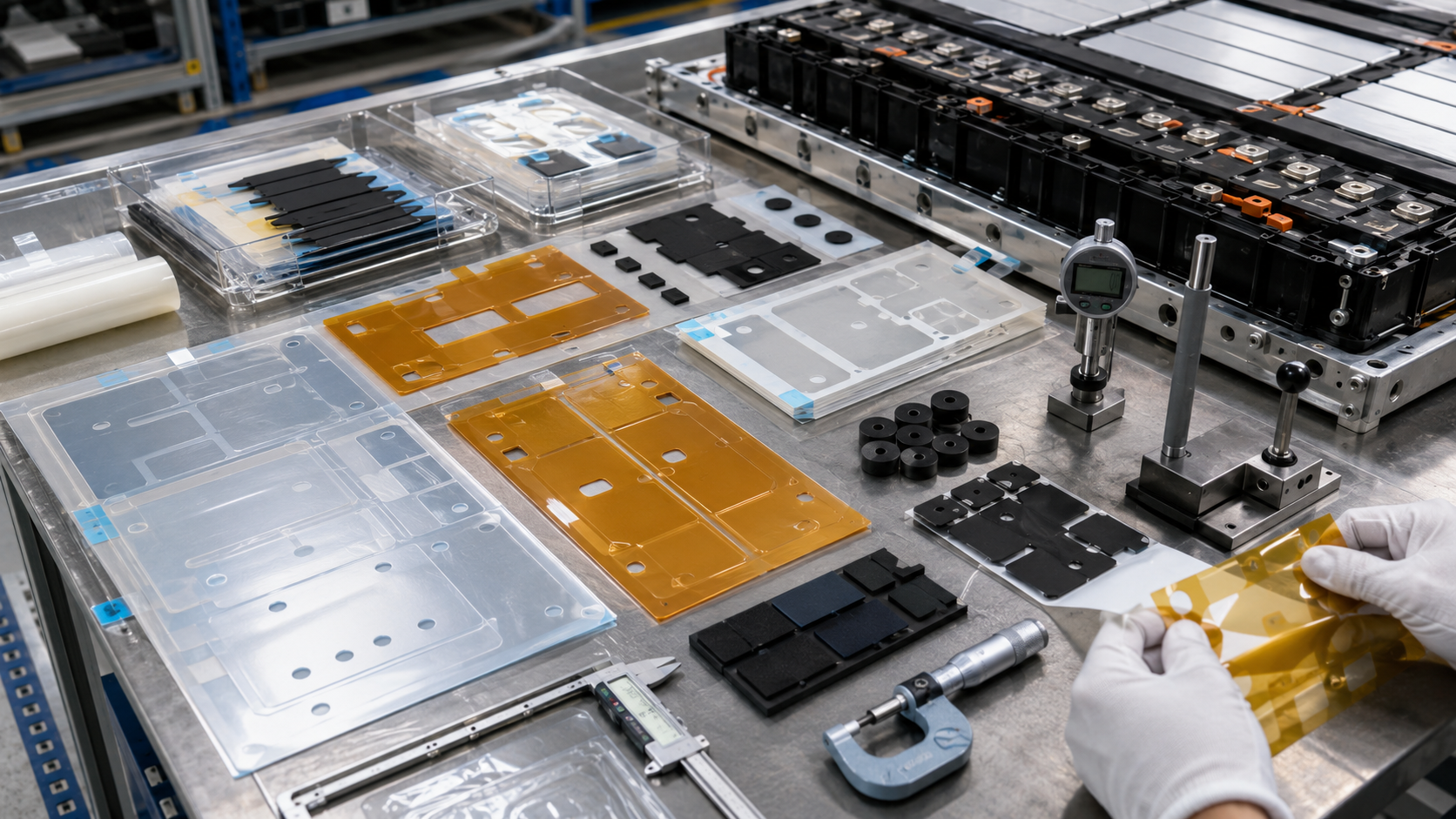
Rubber Pads for Damping and Mechanical Support
Rubber die cut parts are useful when the battery pack requires stronger damping, mechanical support, anti-slip function, or impact resistance.
Rubber parts may be used as:
- Damping pads
- Anti-vibration pads
- Sealing washers
- Cushioning spacers
- Support pads
- Protective contact pads
Compared with foam, rubber usually has better mechanical durability, but it may require higher compression force. Engineers should review hardness, thickness, rebound, heat resistance, oil resistance, and bonding method before choosing rubber.
For die cut rubber parts, edge quality and dimensional stability are also important. Rubber can rebound after cutting, so tolerance should be reviewed realistically.
Adhesive Tape for Bonding and Positioning
Many EV battery pack die cut parts need adhesive backing. Adhesive tape can help attach insulation films, foam pads, protective films, rubber pads, and multilayer components to the correct position during assembly.
Common adhesive structures include:
- Double-sided tape
- Transfer adhesive
- PET carrier adhesive tape
- Foam tape
- Heat-resistant adhesive film
- Removable protective film adhesive
- Easy-release liner structures
Adhesive selection must match the bonding surface. Battery pack parts may include aluminum, stainless steel, coated metal, plastic, PET film, foam, rubber, painted surfaces, or powder-coated surfaces.
Important adhesive factors include:
- Initial tack
- Peel strength
- Shear resistance
- Temperature resistance
- Aging stability
- Surface compatibility
- Liner release
- Residue control
- Die cutting behavior
A strong adhesive is not always the best choice. If the adhesive is too aggressive, the part may become difficult to peel from the liner. If the adhesive is too soft, it may overflow during cutting or compression. If the adhesive does not match the surface, the part may lift after assembly.
Protective Films for Assembly Protection
Protective films are used to prevent scratches, contamination, and surface damage during battery pack handling and assembly.
Custom die cut protective films may include:
- Pull tabs
- Easy-peel areas
- Custom windows
- Hole openings
- Edge clearance
- Temporary adhesive
- Liner-backed supply format
For battery pack and electronics applications, protective films should be easy to apply and remove without residue. The film should also stay flat and clean during storage and assembly.
Poor protective film selection can cause residue, scratches, curling, trapped dust, or removal difficulty.
Multilayer Die Cut Materials
Many EV battery pack components require more than one material layer.
Examples include:
- PET film plus adhesive backing
- PI film plus release liner
- Foam plus double-sided tape
- Rubber pad plus adhesive layer
- Protective film plus pull tab
- Insulation film plus foam spacer
- Foam gasket plus PET carrier layer
Multilayer die cut parts can reduce customer assembly steps because the part arrives ready to use. However, they require accurate lamination, layer registration, kiss cutting depth, adhesive control, liner release, and waste removal.
For battery pack applications, multilayer structures should be reviewed carefully because each layer affects thickness, compression, bonding, and tolerance.
Key Factors for Choosing Battery Pack Die Cut Materials
Before selecting a material, engineers and buyers should confirm the actual application conditions.
| Selection Factor | What to Confirm | Why It Matters |
|---|---|---|
| Function | Insulation, cushioning, bonding, sealing, protection | Defines material direction |
| Location | Cell area, module, cover, electronics, cable area | Determines temperature and stress |
| Thickness | Material and total stack thickness | Affects fit and compression |
| Insulation need | Voltage risk and isolation area | Supports safety and reliability |
| Temperature exposure | Normal, high heat, localized heat | Determines PET, PI, foam, or adhesive choice |
| Compression | Gap size and assembly pressure | Prevents collapse or stress |
| Bonding surface | Metal, plastic, coating, film, rubber | Determines adhesive selection |
| Tolerance | Holes, slots, outer profile, thickness | Prevents assembly interference |
| Cleanliness | Dust, particles, burrs, scratches | Important for electronics and battery assembly |
| Delivery format | Roll, sheet, tray, liner-backed, kit | Improves assembly efficiency |
This checklist helps prevent material mismatch before tooling and mass production.
Common Material Selection Mistakes
| Mistake | Possible Result |
|---|---|
| Choosing film only by thickness | Poor insulation fit or assembly risk |
| Using standard foam without checking compression | Collapse or poor support |
| Choosing adhesive without testing surface | Lifting or bonding failure |
| Ignoring heat exposure | Material aging or adhesive failure |
| Tight tolerance on soft material | High rejection rate |
| Ignoring edge cleanliness | Particles or quality risk |
| Poor liner selection | Difficult peeling and slow assembly |
| Weak packaging | Curling, compression marks, or contamination |
Battery pack components should be tested under real assembly conditions whenever possible. A material that looks good as a flat sample may behave differently after cutting, lamination, peeling, compression, heat exposure, or packaging.
How Sanken Supports EV Battery Pack Die Cut Materials
Sanken Manufacturing Co., Ltd. supports OEM customers with precision die cutting, adhesive lamination, material converting, foam and rubber components, PET and PI insulation films, protective films, sealing gaskets, and custom adhesive-backed components.
For EV battery pack auxiliary die cut parts, we review:
- Part function
- Material type
- Insulation requirement
- Thickness and tolerance
- Foam compression
- Rubber hardness
- Film stability
- Adhesive structure
- Bonding surface
- Liner release
- Kiss cutting depth
- Edge cleanliness
- Hole alignment
- Packaging format
- Assembly method
- Testing requirement
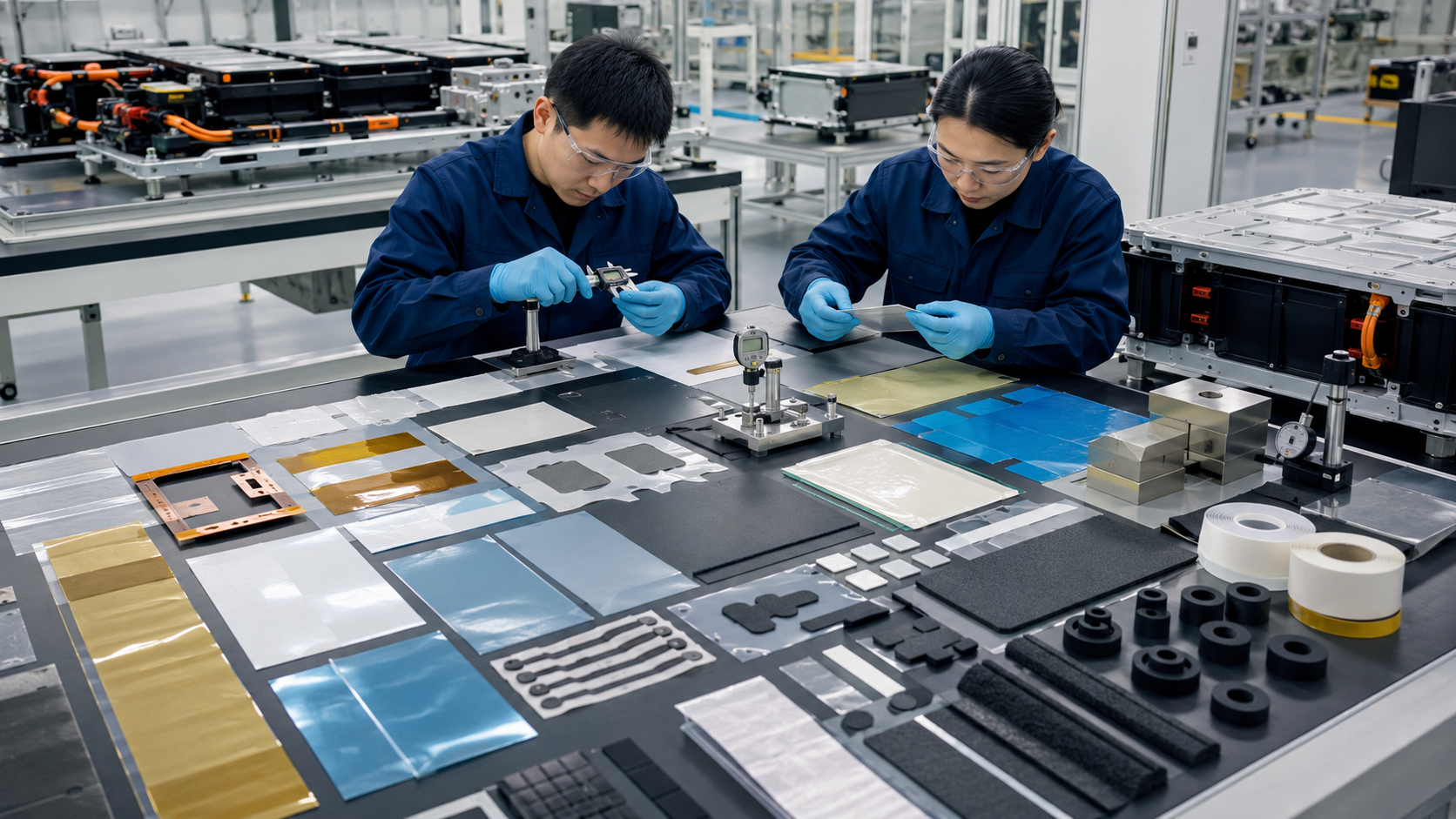
We help customers develop battery pack insulation films, adhesive-backed PET parts, PI insulation parts, foam cushioning pads, rubber damping pads, protective films, sealing components, and multilayer converted parts.
Our goal is to help customers reduce repeated samples, poor fit, adhesive lifting, liner release issues, rough edges, material waste, and unstable mass production.
FAQ
What die cut materials are used in EV battery packs?
Common die cut materials include PET film, PI film, PC film, protective film, PE foam, PU foam, EVA foam, EPDM foam, silicone foam, rubber, double-sided tape, and multilayer adhesive materials.
Why is PET film used in battery packs?
PET film is commonly used for electrical insulation, spacing, and protection because it offers good dimensional stability, clean die cutting performance, and reliable insulation support for many battery applications.
When should PI film be used instead of PET film?
PI film is usually selected when the part needs higher temperature resistance or insulation performance in heat-sensitive battery or electronic areas.
What foam is suitable for EV battery pack die cut parts?
The right foam depends on compression, gap size, temperature, sealing, and cushioning requirements. PE, PU, EVA, EPDM, silicone, and CR foam may be selected for different battery pack support functions.
Why is adhesive selection important for battery pack parts?
Adhesive selection affects bonding strength, liner release, heat aging, residue, and assembly reliability. The adhesive must match the bonding surface and working environment.
Can battery pack die cut parts be supplied with adhesive backing?
Yes. PET films, PI films, foam pads, rubber pads, protective films, and multilayer components can be supplied with adhesive backing and release liners for easier OEM assembly.
Can Sanken make custom die cut parts for EV battery pack projects?
Yes. Sanken supports custom die cut PET insulation films, PI films, protective films, foam pads, rubber pads, adhesive tape parts, sealing gaskets, and multilayer converted components for OEM battery pack and electronics applications.
Conclusion
Choosing die cut materials for EV battery packs requires more than selecting foam, film, rubber, or tape by name. Engineers must review insulation needs, temperature exposure, compression behavior, adhesive compatibility, tolerance, edge cleanliness, packaging, and final assembly conditions.
PET and PI films support insulation and protection. Foam materials support cushioning, gap filling, and vibration control. Rubber provides damping and mechanical durability. Adhesive tapes support bonding, positioning, and multilayer assembly. Protective films reduce surface damage during handling and production.
At Sanken, we help OEM customers convert these materials into custom die cut battery pack components that are clean, accurate, easy to assemble, and stable in mass production.