
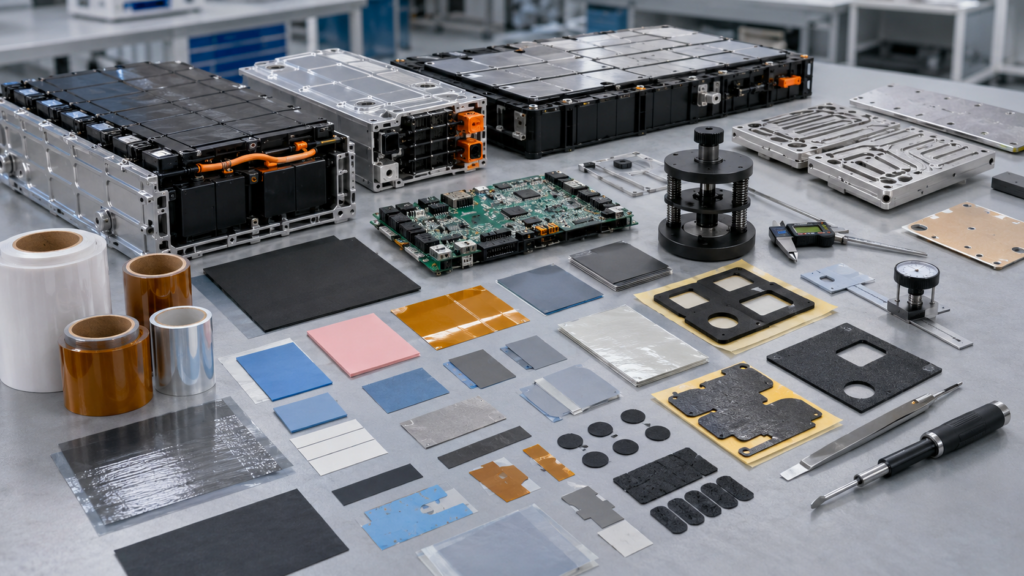
Choosing die cut thermal management materials for EV battery packs requires balancing heat transfer, heat insulation, electrical safety, compression performance, dimensional accuracy, adhesive structure, and long-term reliability. In electric vehicle battery systems, thermal materials help control battery temperature, protect sensitive components, improve charging performance, and reduce the risk of overheating.
For OEM engineers and purchasing teams, the right thermal material is not simply the material with the highest thermal conductivity. The material must fit the battery structure, maintain stable thickness, work with cooling plates and modules, support insulation requirements, resist aging, and remain easy to assemble in mass production.
At Sanken, we manufacture precision die cut thermal pads, thermal insulation films, graphite sheets, PET and PI insulation films, foam gaskets, rubber pads, adhesive tape components, protective films, and multilayer laminated parts for EV battery packs, battery modules, BMS assemblies, automotive electronics, and charging systems.
Why Thermal Management Materials Matter in EV Battery Packs
EV battery packs generate heat during charging, discharging, fast charging, and long-term operation. If heat is not controlled properly, the battery system may face performance loss, uneven cell temperature, reduced lifespan, safety risk, and unstable charging efficiency.
Thermal management materials help:
- Transfer heat from cells to cooling plates
- Fill air gaps between components
- Improve temperature balance
- Protect heat-sensitive electronics
- Provide thermal insulation where needed
- Reduce hot spots
- Support battery safety
- Improve long-term reliability
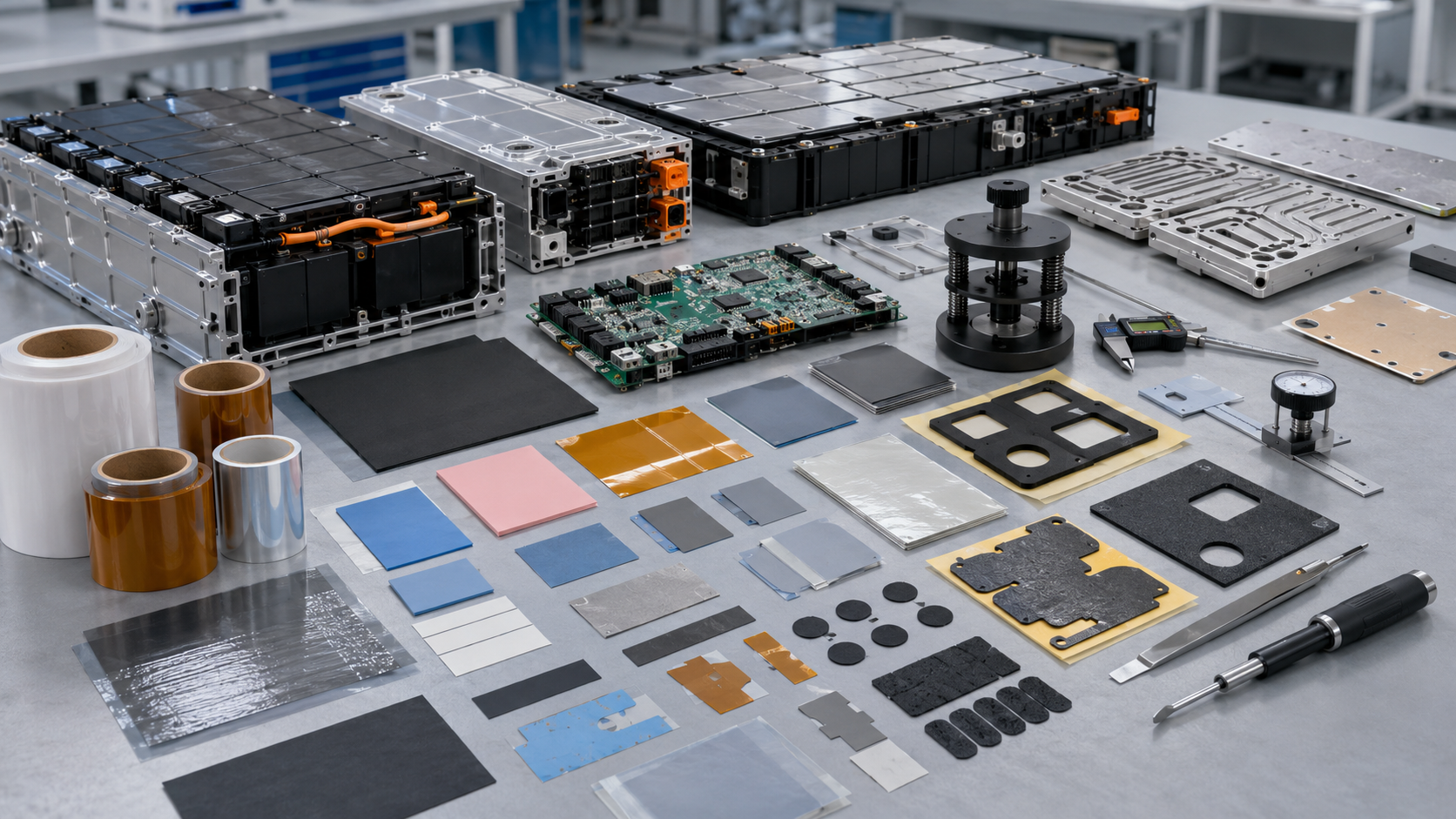
Main Types of Die Cut Thermal Management Materials
Different battery areas require different thermal functions.
| Material Type | Main Function |
|---|---|
| Thermal gap pads | Heat transfer and gap filling |
| Thermal insulation films | Heat isolation and protection |
| Graphite sheets | Heat spreading |
| Silicone thermal pads | Heat transfer with compression |
| PET films | Electrical insulation and support |
| PI films | High-temperature insulation |
| Foam gaskets | Sealing and vibration cushioning |
| Adhesive tapes | Positioning and bonding |
| Multilayer laminates | Combined thermal, insulation, and adhesive functions |
The correct material depends on whether the battery design needs heat transfer, heat spreading, heat blocking, insulation, cushioning, or assembly support.
Choose Thermal Gap Pads for Heat Transfer
Thermal gap pads are commonly used between battery cells, modules, cooling plates, power electronics, and heat sinks. They help transfer heat across small gaps while compensating for surface unevenness.
Thermal gap pads are suitable when the application needs:
- Heat transfer
- Gap filling
- Compression contact
- Vibration tolerance
- Soft interface support
- Stable thickness
- Easy installation
Important selection factors include:
- Thermal conductivity
- Thickness
- Compression force
- Hardness
- Electrical insulation
- Surface tack
- Aging resistance
- Assembly pressure
A thermal pad that is too soft may deform too much. A pad that is too hard may create assembly stress. A pad that is too thick may affect module fit, while a pad that is too thin may not fill the gap completely.
Choose Graphite Sheets for Heat Spreading
Graphite sheets are often used when heat must be spread across a wider area instead of transferred only in one direction.
They may be used near:
- Battery modules
- BMS electronics
- Power control areas
- Charging electronics
- Automotive electronic modules
Graphite materials can help reduce hot spots and improve temperature distribution. However, graphite sheets may require insulation protection, lamination, or edge control depending on the application.
For die cut graphite parts, edge cleanliness, film lamination, adhesive backing, and packaging flatness are important.
Choose Thermal Insulation Films for Heat Isolation
Not every thermal material is designed to transfer heat. Some battery areas need thermal insulation to protect nearby components from heat exposure.
Thermal insulation films may be used to:
- Separate heat-sensitive parts
- Protect electronics
- Reduce heat transfer to nearby structures
- Support fire barrier design
- Improve battery module safety
- Protect cables and connectors
Thermal insulation materials should be selected based on temperature resistance, thickness, flexibility, flame resistance, electrical insulation, and assembly location.
PET and PI Films for Electrical and Thermal Protection
EV battery packs require both thermal and electrical protection. PET and PI films are often used together with thermal materials.
PET films are commonly used for:
- General electrical insulation
- Battery module protection
- Connector insulation
- Surface protection
- Adhesive-backed insulation parts
PI films are selected when higher temperature resistance is required, such as:
- Busbar insulation
- Flexible circuit protection
- Power electronics protection
- High-temperature module areas
- BMS insulation
Adhesive-Backed Thermal Materials Improve Assembly
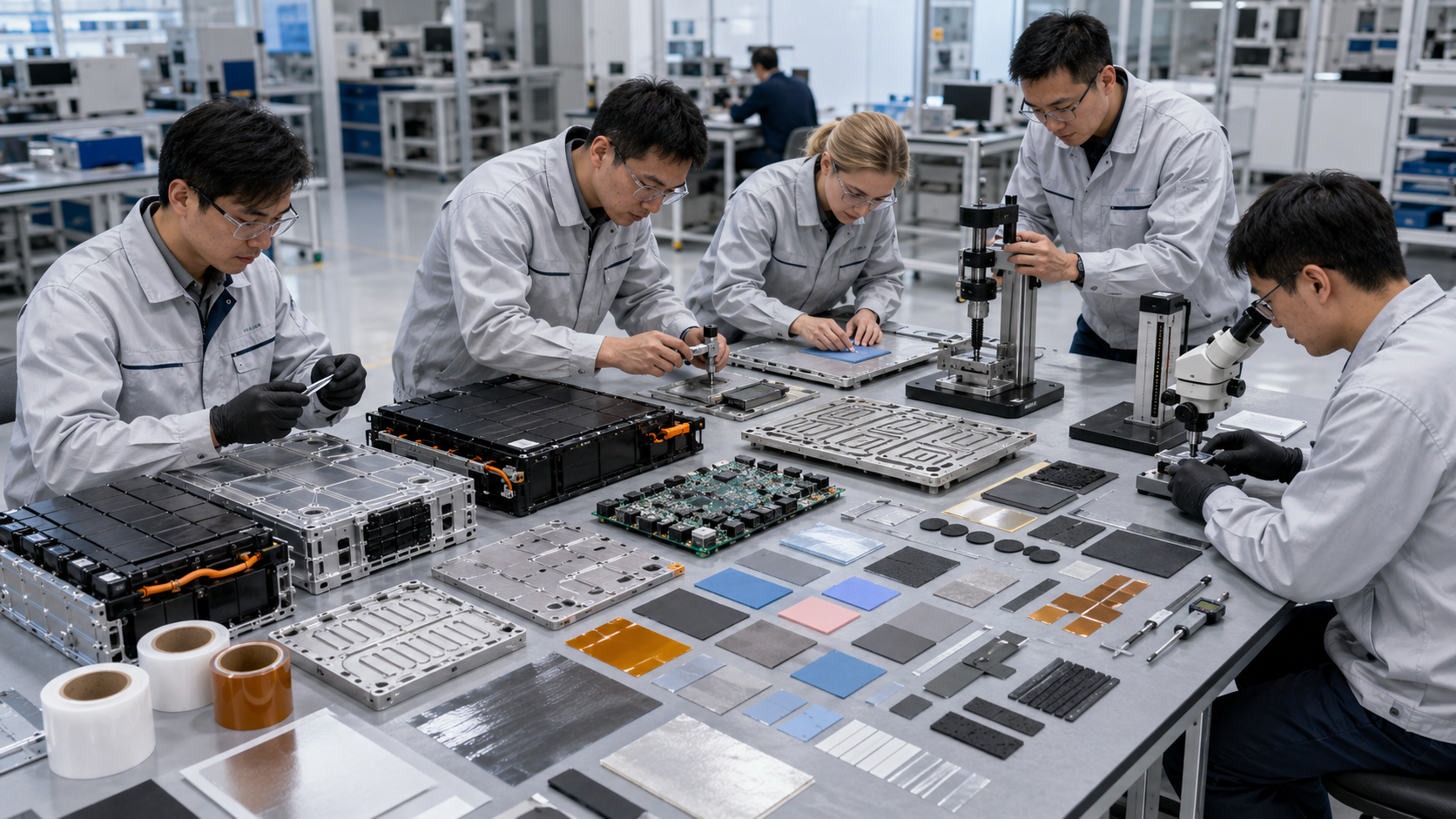
Many thermal materials are supplied with adhesive backing to improve positioning during battery assembly.
Adhesive-backed thermal parts can help:
- Prevent material shifting
- Improve assembly speed
- Support automated placement
- Reduce manual alignment errors
- Hold thermal pads or films before final compression
- Improve repeatability
Common adhesive structures include:
- Single-sided adhesive
- Double-sided adhesive
- PET carrier adhesive
- High-temperature adhesive
- Release liner structures
The adhesive should match the bonding surface and operating temperature. In many cases, the thermal function comes from compression contact, while the adhesive mainly supports positioning.
Compression and Thickness Control Are Critical
Thermal management materials often work under compression. The thickness and compression behavior directly affect heat transfer and assembly fit.
Important factors include:
| Factor | Why It Matters |
|---|---|
| Material thickness | Controls gap filling and final stack height |
| Compression force | Affects thermal contact and assembly stress |
| Hardness | Determines how the material conforms to surfaces |
| Compression set | Affects long-term stability |
| Surface flatness | Improves contact with cooling plates |
| Tolerance | Prevents uneven pressure |
| Packaging condition | Prevents deformation before use |
For EV battery packs, thermal materials should be reviewed together with the module gap, cooling plate flatness, enclosure design, and fastening method.
Consider Electrical Insulation Requirements
Thermal materials used in battery packs often sit near high-voltage components. Electrical insulation must be reviewed carefully.
Buyers should confirm:
- Dielectric strength
- Insulation thickness
- Surface resistance
- Edge safety
- Contact with busbars or cells
- Compatibility with PET or PI insulation films
- Material cleanliness
- No conductive particle risk
Some thermal materials conduct heat but may require additional insulation layers. In these cases, multilayer laminated structures can combine thermal, insulation, adhesive, and liner materials into one die cut component.
Consider Flame Resistance and Safety
EV battery packs have strict safety expectations. Thermal management materials may need to support flame resistance, heat shielding, or fire barrier functions depending on the battery design.
Selection factors may include:
- Flame resistance
- Temperature rating
- Aging resistance
- Chemical resistance
- Smoke and odor requirements
- Long-term reliability
- Compatibility with battery safety design
The required safety level should be confirmed by the customer’s engineering standard and battery pack design.
Die Cut Tolerance and Edge Quality
Precision die cutting ensures thermal materials fit the battery design accurately.
Important quality points include:
- Outer dimensions
- Hole alignment
- Slot position
- Edge cleanliness
- Stable thickness
- Adhesive alignment
- Liner release
- Film flatness
- No tearing
- No particles
- Packaging protection
Poor die cut quality may cause misalignment, uneven compression, poor thermal contact, electrical insulation risk, or assembly delay.
For thin thermal films and graphite sheets, edge quality and packaging flatness are especially important.
Multilayer Thermal Management Structures
Many battery thermal parts are not single-layer materials. They may combine thermal pads, PET films, PI films, adhesives, liners, protective films, or insulation layers.
Examples include:
| Structure | Function |
|---|---|
| Thermal pad + adhesive + liner | Heat transfer and positioning |
| Graphite sheet + PET film | Heat spreading and insulation support |
| PI film + adhesive | High-temperature insulation |
| Thermal insulation film + adhesive | Heat isolation and assembly positioning |
| PET film + adhesive + liner | Electrical insulation and bonding |
| Foam + adhesive | Sealing and cushioning near thermal zones |
Multilayer converting can reduce assembly steps and improve consistency, but it requires accurate lamination, layer alignment, die cut depth control, and clean packaging.
Quality Control Checklist for EV Battery Thermal Materials
Before approving die cut thermal management materials, OEM buyers should check:
| Inspection Item | Purpose |
|---|---|
| Material confirmation | Ensures approved material is used |
| Thickness | Controls thermal contact and stack height |
| Outer dimensions | Confirms assembly fit |
| Hole alignment | Matches battery module design |
| Thermal material surface | Prevents contact defects |
| Adhesive position | Improves assembly accuracy |
| Liner release | Supports smooth placement |
| Edge cleanliness | Reduces contamination |
| Film flatness | Prevents uneven contact |
| Compression behavior | Confirms long-term stability |
| Packaging condition | Prevents deformation before assembly |
Common Selection Mistakes
| Mistake | Possible Result |
|---|---|
| Choosing only by thermal conductivity | Poor fit, high cost, or assembly stress |
| Ignoring compression force | Uneven contact or module deformation |
| Using wrong thickness | Poor heat transfer or stack-up interference |
| Ignoring electrical insulation | High-voltage safety risk |
| Poor adhesive selection | Material shifting or lifting |
| Ignoring edge quality | Particles or insulation concerns |
| Poor packaging | Material deformation before assembly |
| No real assembly test | Sample passes inspection but fails in module |
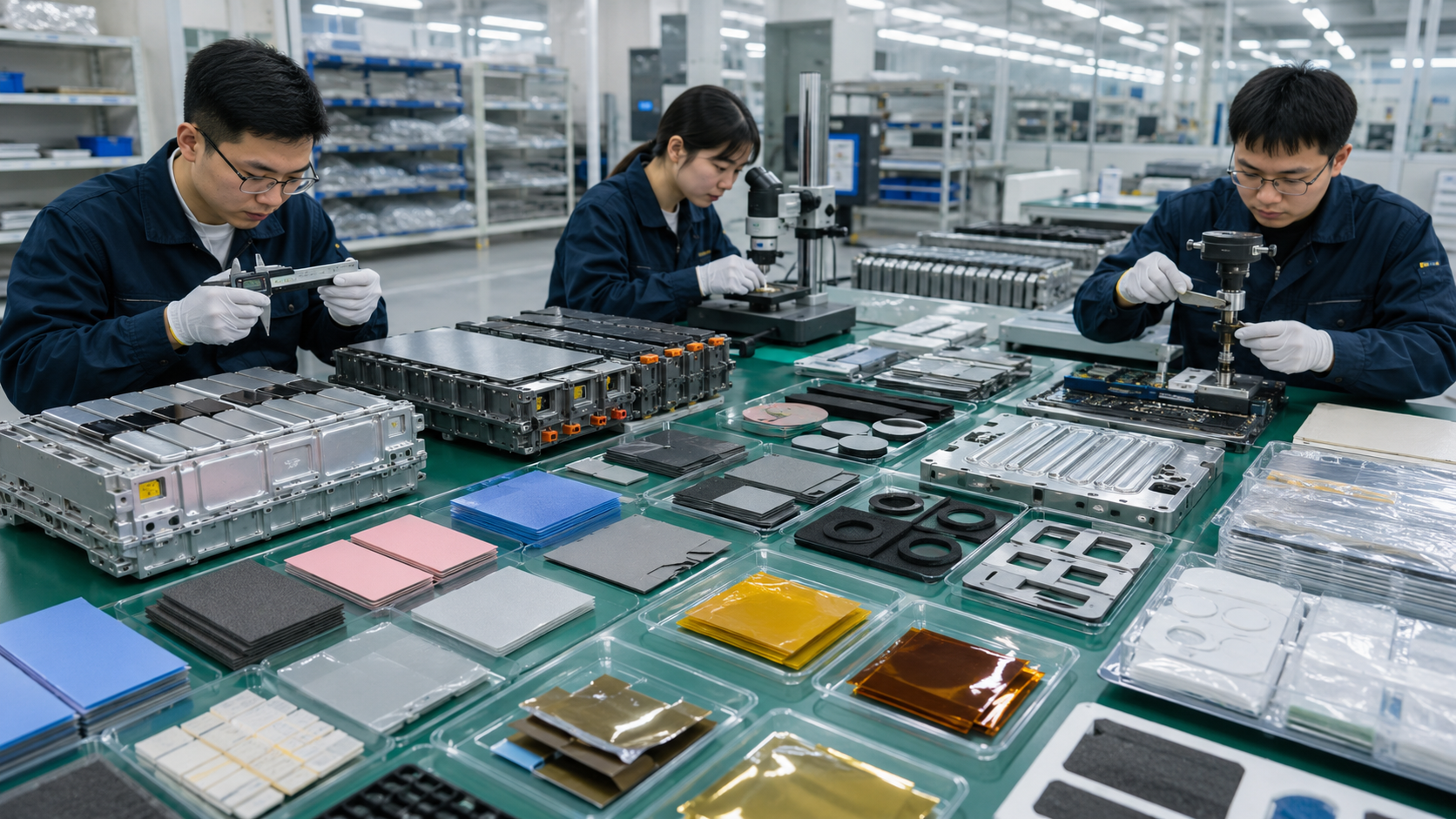
Thermal material selection should always be based on real battery structure and working conditions.
How Sanken Supports EV Battery Thermal Management Projects
Sanken Manufacturing Co., Ltd. supports EV battery OEMs and Tier suppliers with precision die cut thermal management and insulation materials.
Our support includes:
- Thermal gap pads
- Thermal insulation films
- Graphite sheets
- Silicone thermal pads
- PET insulation films
- PI insulation films
- Adhesive-backed thermal parts
- Protective films
- Foam gaskets
- Rubber pads
- Multilayer laminated structures
- Sample development
- Quality inspection
- Assembly-ready packaging
For each project, we review thermal function, material type, thickness, compression behavior, insulation requirement, adhesive structure, bonding surface, die cut tolerance, edge quality, packaging method, and final assembly process.
Our goal is to help customers reduce thermal hot spots, poor contact, material shifting, insulation risk, deformation, repeated sampling, and unstable mass production.
Buyer Checklist Before Requesting Samples
To choose the right die cut thermal management materials, buyers should provide:
- 2D drawing
- 3D structure if available
- Battery pack application
- Thermal function: heat transfer, heat spreading, or heat insulation
- Material preference
- Thickness requirement
- Compression requirement
- Electrical insulation requirement
- Flame resistance requirement
- Adhesive requirement
- Bonding surface
- Temperature range
- Packaging format
- Expected quantity
- Existing sample if available
Clear information helps the supplier recommend a practical material and die cutting method.
FAQ
What thermal management materials are used in EV battery packs?
Common materials include thermal gap pads, thermal insulation films, graphite sheets, silicone thermal pads, PET films, PI films, adhesive tapes, foam gaskets, and multilayer laminated structures.
Is higher thermal conductivity always better?
No. Higher thermal conductivity is useful for heat transfer, but the material must also match thickness, compression, insulation, assembly pressure, and cost requirements.
Why is compression important for battery thermal pads?
Compression helps the thermal pad contact both surfaces properly. Poor compression can reduce heat transfer or create uneven pressure.
Can thermal materials be die cut into custom shapes?
Yes. Thermal pads, graphite sheets, insulation films, adhesive-backed thermal parts, and multilayer structures can be die cut into custom shapes for battery modules.
Do thermal materials also need electrical insulation?
Often yes. EV battery components operate near high-voltage areas, so electrical insulation and dielectric strength should be reviewed carefully.
Can Sanken support custom EV battery thermal management materials?
Yes. Sanken manufactures custom die cut thermal pads, thermal insulation films, graphite sheets, PET and PI films, adhesive-backed thermal parts, foam gaskets, rubber pads, and multilayer thermal management components.
Conclusion
Choosing die cut thermal management materials for EV battery packs requires a complete review of thermal function, thickness, compression behavior, electrical insulation, flame resistance, adhesive structure, die cut tolerance, packaging, and final assembly conditions.
Thermal gap pads help transfer heat, graphite sheets help spread heat, thermal insulation films help isolate heat, and PET or PI films provide electrical protection. In many battery packs, these materials must work together with foam gaskets, rubber pads, adhesive tapes, and multilayer converted structures.
At Sanken, we help EV battery manufacturers develop precision die cut thermal management materials that support battery safety, stable assembly, and long-term reliability.