
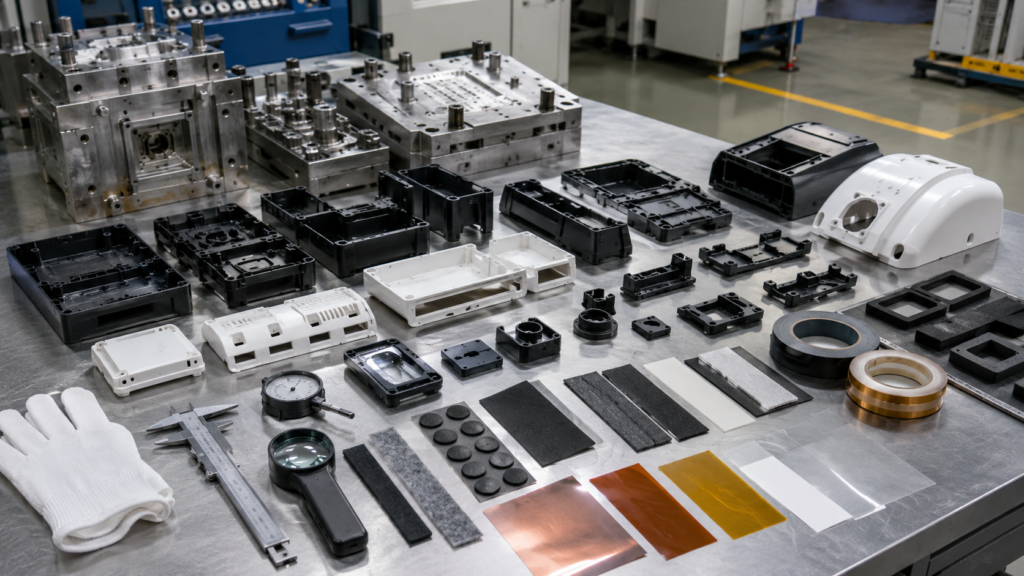
Choosing the right injection molding process for OEM plastic parts depends on the part function, material, production volume, tolerance, surface requirement, assembly method, and total project cost. A simple plastic housing may only need conventional injection molding, while a plastic part with metal inserts, soft sealing areas, or tight dimensional requirements may need insert molding, overmolding, two-shot molding, or precision injection molding.
For OEM engineers and purchasing teams, the goal is not only to make a plastic part. The molded component must fit the final assembly, remain stable during mass production, and work with related materials such as foam gaskets, adhesive tape components, PET insulation films, rubber pads, protective films, non-woven felt strips, and other custom die cut parts.
At Sanken, we support OEM customers with custom injection molded plastic parts, precision die cut foam gaskets, adhesive tape parts, PET and PI insulation films, rubber pads, protective films, non-woven felt components, sealing parts, and multilayer material converting for automotive, electronics, battery, appliance, medical device, and industrial applications.
Why the Injection Molding Process Matters
Different injection molding processes solve different manufacturing problems. Choosing the wrong process can increase tooling cost, create assembly problems, delay sample approval, or make mass production unstable.
Common risks include:
- Poor part fit
- Warpage or shrinkage
- Weak clips or screw posts
- Surface defects
- Poor sealing performance
- Adhesive tape lifting
- PET film misalignment
- Rubber pad interference
- High tooling cost
- Long sampling cycle
- Difficult mass production control
A good supplier should review the product function before recommending a molding process. The best process is usually the simplest process that can reliably meet the required performance.
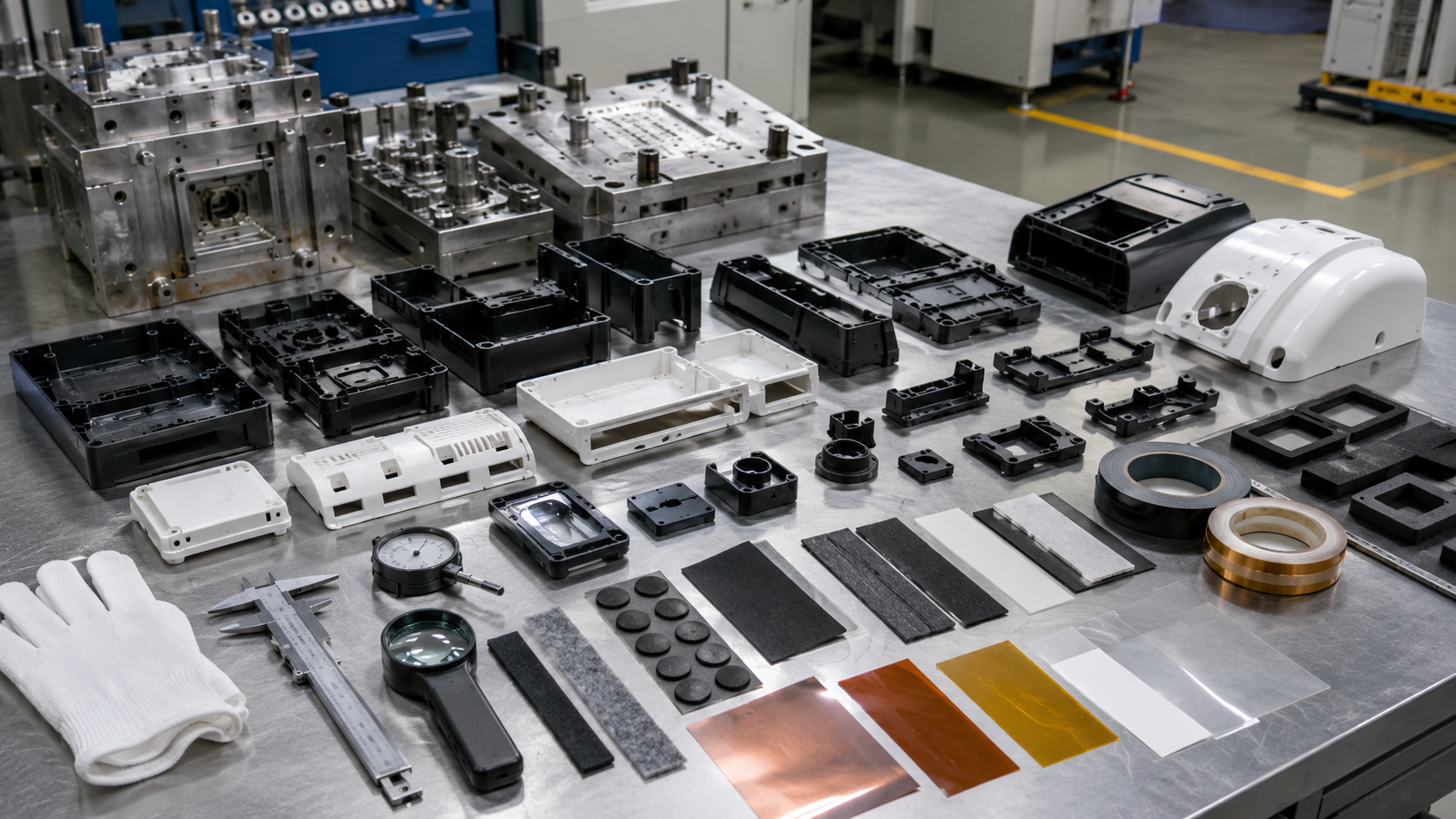
Start With the Part Function
Before choosing the molding process, first define what the plastic part needs to do.
Ask these questions:
| Question | Why It Matters |
|---|---|
| Is the part structural or cosmetic? | Affects material, surface, and strength requirements |
| Does it need metal inserts? | May require insert molding |
| Does it need a soft-touch or sealing area? | May require overmolding or a die cut gasket |
| Does it need two materials or two colors? | May require two-shot molding |
| Does it have tight tolerance? | May require precision molding |
| Will it bond with adhesive tape? | Surface compatibility must be checked |
| Will it assemble with foam, film, or rubber parts? | Related die cut components should be reviewed early |
| What is the expected volume? | Affects tooling and process selection |
For example, a standard electronics housing may use conventional injection molding. A connector housing with metal terminals may use insert molding. A handheld device with a soft grip may use overmolding. A sensor housing that must align with PET films and foam spacers may need precision molding and assembly fit review.
Conventional Injection Molding
Conventional thermoplastic injection molding is the most common process for OEM plastic parts. Plastic resin is melted, injected into a mold cavity, cooled, and ejected as a finished part.
This process is suitable for:
- Plastic housings
- Covers
- Brackets
- Clips
- Enclosures
- Frames
- Appliance panels
- Automotive electronic shells
- Industrial plastic components
- Medical device plastic shells
For many OEM projects, conventional injection molding is the best choice because it offers stable production, wide material options, good repeatability, and practical tooling cost.
It is suitable when the part does not require metal inserts, soft overmolded areas, or two-material structures.
Insert Molding
Insert molding is used when a metal or other component is placed inside the mold before plastic is injected around it. This creates a combined plastic-metal part.
Insert molding is often used for:
- Metal threaded inserts
- Electrical terminals
- Bushings
- Reinforced screw areas
- Connector components
- Sensor parts
- Automotive electronic parts
- Plastic-metal structural parts
The advantage is stronger integration and reduced secondary assembly. However, insert molding requires careful control of insert position, mold design, plastic flow, shrinkage, and bonding stability.
If the insert shifts during molding, the part may fail inspection or assembly. For this reason, insert molding is best used when the insert function is necessary and the project volume supports the added process control.
Overmolding
Overmolding is used when one material is molded over another part or substrate. It is commonly used to add a soft, protective, sealing, or grip layer to a harder plastic or metal part.
Overmolding is suitable for:
- Soft-touch grips
- Protective edges
- Sealing surfaces
- Shock-absorbing areas
- Handheld device parts
- Flexible contact surfaces
- Comfort or anti-slip areas
Overmolding can improve product feel, protection, and sealing. However, it can also increase tooling complexity and cost.
In some cases, a die cut foam gasket, rubber pad, adhesive tape, or protective film may provide a simpler solution. For example, a molded plastic housing may not need overmolded sealing if a precision die cut foam gasket can provide the required compression and dust protection.
Two-Shot Injection Molding
Two-shot injection molding uses two materials or two colors in one molding process. The first material is molded, then the second material is molded onto or into the first part.
This process is useful when a part needs:
- Two materials
- Two colors
- Hard and soft areas
- Integrated sealing features
- Improved appearance
- Reduced secondary assembly
- Strong bonding between materials
Two-shot molding can produce clean and integrated parts, but it usually requires more complex tooling and higher project volume. It is often suitable for stable, high-volume OEM projects where the design is already confirmed.
For lower-volume projects or projects that may change, conventional molding with die cut foam, rubber, tape, or film components may be more flexible.
Precision Injection Molding
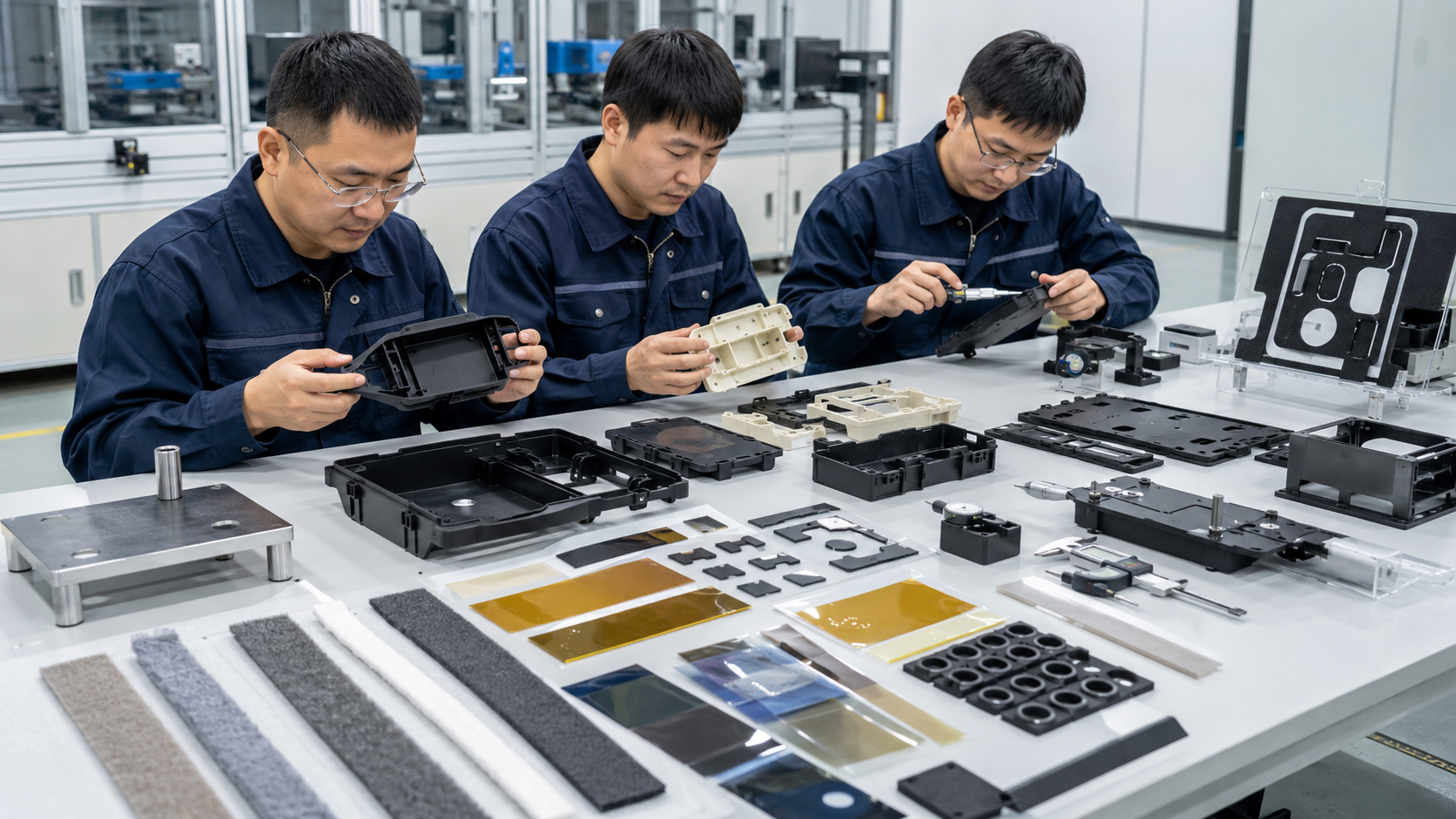
Precision injection molding is used when plastic parts require tight tolerance, small features, high repeatability, and stable dimensional control.
It is suitable for:
- Small plastic components
- Connectors
- Sensor housings
- Electronic parts
- Medical device components
- Display-related parts
- Plastic parts with accurate holes
- Components that must align with films, tapes, or gaskets
Precision molding requires strong control of mold accuracy, material shrinkage, machine settings, cooling, inspection, and packaging.
This process is important when molded plastic parts must assemble with precision die cut PET insulation films, PI films, adhesive tape parts, foam spacers, rubber pads, or light-blocking films.
Compare the Main Injection Molding Processes
| Process | Best For | Key Advantage | Main Consideration |
|---|---|---|---|
| Conventional injection molding | Standard plastic housings, covers, clips, brackets | Practical cost and stable mass production | Not ideal for integrated metal or soft-material structures |
| Insert molding | Plastic parts with metal inserts or terminals | Strong plastic-metal integration | Insert position must be controlled |
| Overmolding | Soft-touch, sealing, grip, or protection areas | Adds soft or protective function | Higher tooling and material complexity |
| Two-shot molding | Two-material or two-color parts | Integrated structure and appearance | Best for higher-volume stable designs |
| Precision injection molding | Tight-tolerance parts | High dimensional accuracy | Requires stronger process and inspection control |
The best choice depends on function, not only part shape.
Consider Related Die Cut Components Early
Many OEM plastic parts require flexible functional components after molding.
Examples include:
| Molded Plastic Part | Related Die Cut Component | Function |
|---|---|---|
| Automotive electronic housing | Foam gasket | Dust sealing and vibration reduction |
| Battery-related plastic cover | PET or PI insulation film | Electrical insulation |
| Display frame | Double-sided adhesive tape | Bonding and positioning |
| Sensor housing | Light-blocking film | Optical shielding |
| Appliance panel | Rubber pad | Cushioning and damping |
| Medical device shell | Protective film | Surface protection |
| Interior plastic trim | Non-woven felt strip | Anti-rattle control |
If these components are not considered during molding process selection, the final assembly may fail even if the plastic part itself is acceptable.
For example, a foam gasket may not seal if the molded groove is too shallow. An adhesive tape part may lift if the plastic surface is not suitable for bonding. A PET insulation film may not align if posts or holes shift during molding. A rubber pad may create too much pressure if the plastic clearance is not reviewed.
A one-stop review helps reduce these problems before tooling and mass production.
Balance Tooling Cost and Total Project Cost
OEM buyers often compare quotations by tooling cost and unit price. However, the lowest quotation is not always the lowest total cost.
A poor process choice may cause:
- Mold modification
- Repeated samples
- Assembly failure
- Higher inspection cost
- Slow production
- Material waste
- Customer complaints
- Delayed delivery
The right injection molding process should reduce total risk, not only reduce the first quotation.
For example, two-shot molding may be more expensive than conventional molding, but it may reduce secondary assembly for high-volume parts. On the other hand, a simple molded part plus a die cut foam gasket may be more flexible and cost-effective than complex overmolding.
How Sanken Helps Choose the Right Process
Sanken Manufacturing Co., Ltd. helps OEM customers review injection molded plastic parts together with related die cut components.
Our support includes:
- Custom plastic housings
- Molded covers, clips, brackets, and enclosures
- Injection molded OEM parts
- Foam gasket die cutting
- Adhesive tape components
- PET and PI insulation films
- Rubber pads and sealing parts
- Protective films
- Non-woven felt parts
- Multilayer material converting
- Sample development
- Quality inspection
- Assembly-ready packaging
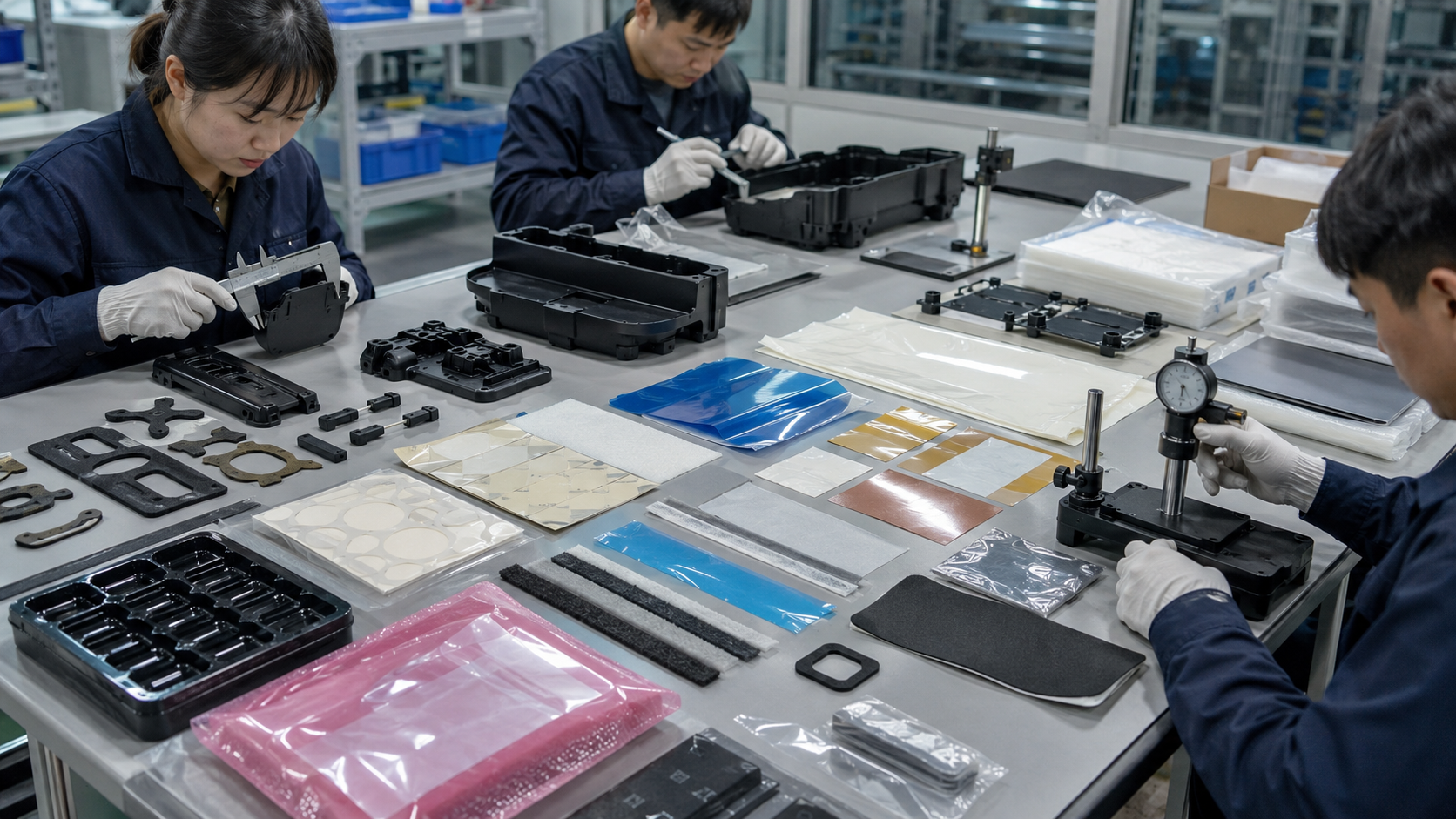
For each project, we review part function, material selection, mold feasibility, tolerance, surface quality, foam gasket fit, adhesive bonding surface, PET film alignment, rubber compression, protective film coverage, packaging, and final assembly method.
Our goal is to help customers choose a practical injection molding and die cutting solution that reduces tooling changes, repeated samples, poor fit, adhesive lifting, gasket mismatch, inspection failure, and unstable mass production.
Practical Selection Checklist
Before choosing an injection molding process, OEM buyers should confirm:
- Part function
- Material requirement
- Surface appearance requirement
- Expected production volume
- Critical dimensions
- Assembly method
- Insert requirement
- Soft-touch or sealing requirement
- Adhesive bonding surface
- Foam gasket position
- PET or PI film alignment
- Rubber pad contact area
- Packaging requirement
- Testing and inspection standards
The clearer the project information, the easier it is to choose the right process and avoid unnecessary cost.
FAQ
What is the most common injection molding process for OEM plastic parts?
Conventional thermoplastic injection molding is the most common process because it supports stable mass production, wide material selection, and practical tooling cost for standard plastic housings, covers, brackets, clips, and enclosures.
When should I choose insert molding?
Choose insert molding when the plastic part needs metal inserts, terminals, threaded parts, bushings, or reinforced plastic-metal structures.
When is overmolding better?
Overmolding is better when the part needs a soft-touch surface, grip, sealing edge, cushioning, shock absorption, or protective layer.
Is two-shot molding always better than conventional molding?
No. Two-shot molding is useful for two-material or two-color parts, but it requires more complex tooling. Conventional molding with die cut components may be more practical for many OEM projects.
Why is precision injection molding important?
Precision injection molding is important when the plastic part has tight tolerance, small features, or must align with films, tapes, gaskets, rubber pads, or other assembly components.
Can die cut parts reduce molding complexity?
Yes. Foam gaskets, adhesive tapes, PET films, rubber pads, protective films, and felt strips can provide sealing, bonding, insulation, cushioning, protection, and anti-rattle functions without making the mold overly complex.
Can Sanken support injection molding and die cutting together?
Yes. Sanken supports custom injection molded plastic parts together with precision die cut foam gaskets, adhesive tape parts, PET and PI films, rubber pads, protective films, non-woven felt parts, and multilayer OEM components.
Conclusion
Choosing the right injection molding process for OEM plastic parts requires more than selecting a production method. Buyers must consider part function, material, tolerance, appearance, volume, assembly method, tooling cost, and related die cut components.
Conventional injection molding is suitable for many OEM plastic parts. Insert molding, overmolding, two-shot molding, and precision injection molding are better for special requirements such as metal inserts, soft-touch surfaces, two-material structures, or tight tolerance.
At Sanken, we help OEM customers review molded plastic parts together with foam, rubber, film, tape, felt, and protective components so the final solution is practical, assembly-ready, and stable from prototype to mass production.