
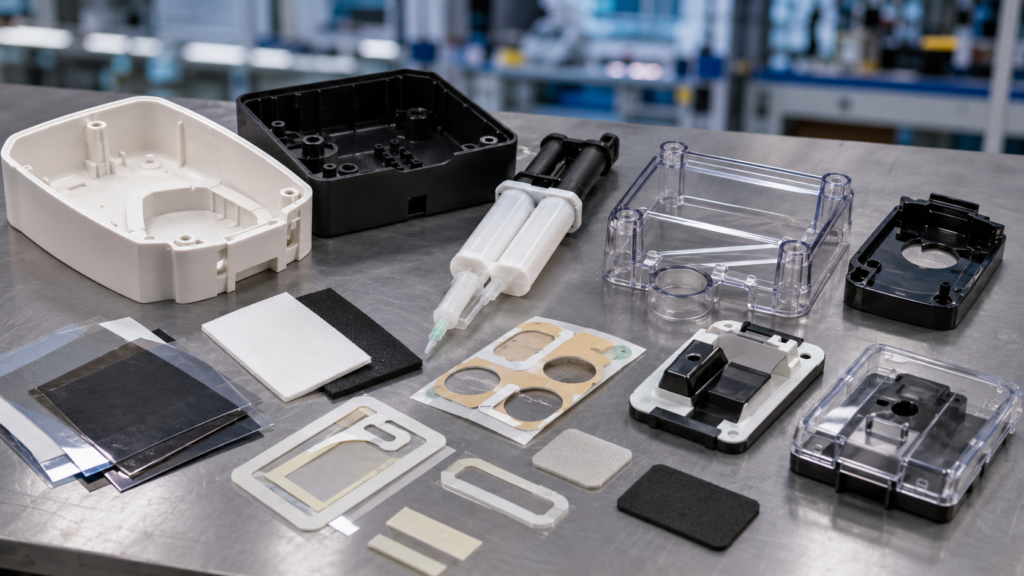
Yes, there are stronger bonding options for plastic than superglue, but the best choice depends on the plastic type, surface condition, load, temperature, and whether the bond must be permanent, flexible, removable, or impact-resistant.
Superglue, also called cyanoacrylate adhesive, is useful for quick repairs and small rigid parts. It bonds fast and works well on many hard surfaces. But it is not always the strongest choice for plastic, especially when the part faces vibration, bending, heat, moisture, impact, or long-term stress.
For OEM buyers and product engineers, the better question is not only “What glue is stronger than superglue?” The real question is:
“Which bonding method will stay reliable on my plastic part during assembly, aging, shipping, and real product use?”
In many industrial projects, the answer may be epoxy, structural acrylic adhesive, plastic welding adhesive, polyurethane adhesive, silicone adhesive, solvent cement, or custom die-cut adhesive tape.
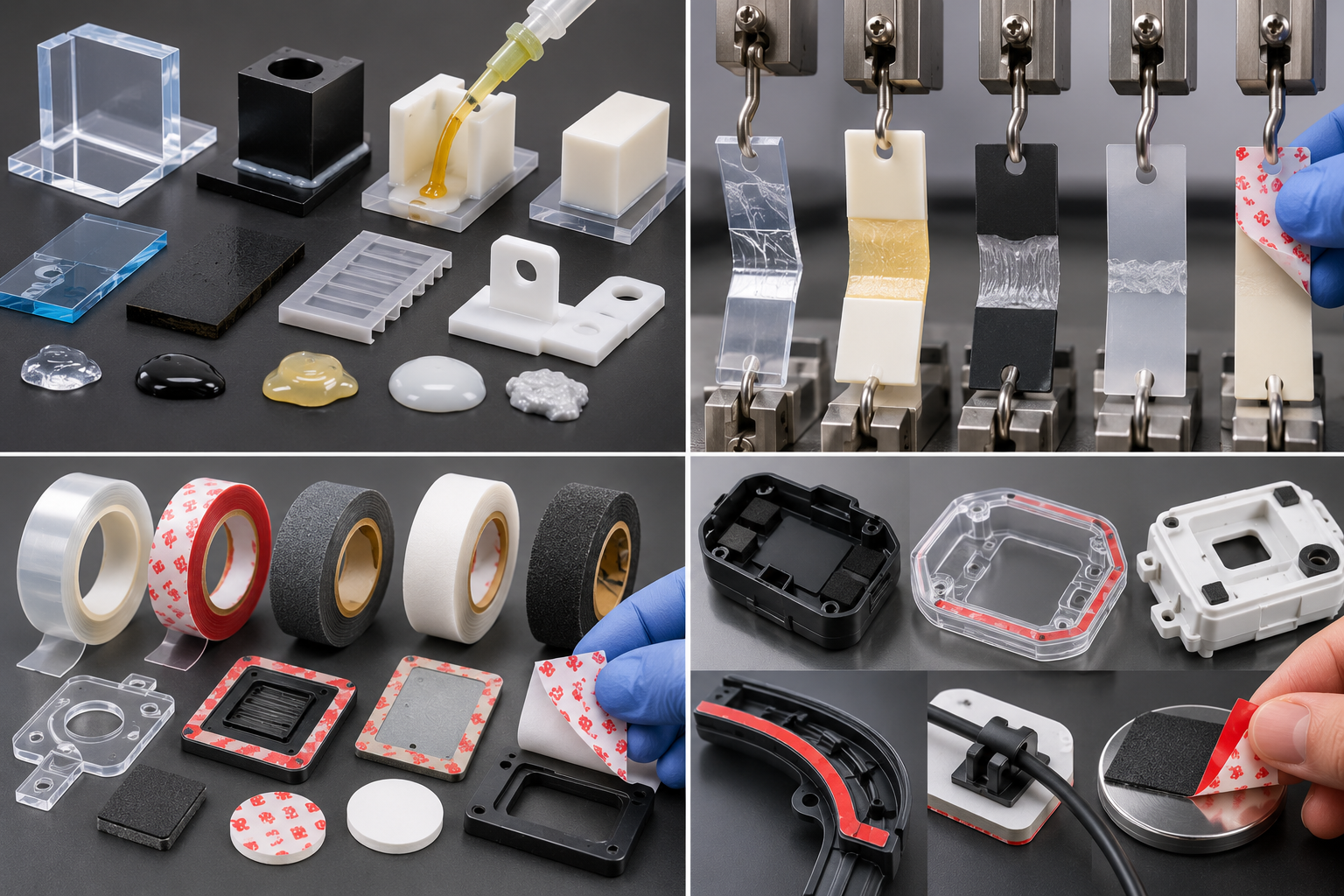
Why Superglue Is Not Always the Best for Plastic
Superglue is popular because it is fast and easy to use. It can bond many small plastic parts within seconds.
However, it has several limits.
Superglue can be brittle after curing. This means it may crack when the plastic bends, vibrates, or receives impact. It may also perform poorly on some low-surface-energy plastics, such as polyethylene and polypropylene, unless special surface treatment or primer is used.
Common problems include:
- Brittle bond line
- Poor impact resistance
- Weak bonding on PE or PP plastic
- White blooming or residue
- Poor gap filling
- Lower performance under vibration
- Limited flexibility
- Weak long-term durability in some environments
For a small broken toy, superglue may be enough. For an automotive part, electronic housing, medical device component, sensor module, or industrial assembly, it may not be the safest choice.
Stronger Options Than Superglue for Plastic
Different adhesives solve different problems. A “stronger” glue is not always the same for every plastic.
| Bonding Option | Best For | Key Advantage |
|---|---|---|
| Epoxy adhesive | Rigid plastic bonding, gap filling | Strong and durable |
| Structural acrylic adhesive | Industrial plastic bonding | High strength and fast curing |
| Polyurethane adhesive | Flexible plastic assemblies | Good flexibility and impact resistance |
| Silicone adhesive | Sealing, heat, flexibility | Soft, flexible, durable |
| Solvent cement | Certain plastics like PVC, acrylic, ABS | Chemically fuses plastic surfaces |
| 3M or industrial adhesive tape | Clean assembly, large surface bonding | Fast, uniform, die-cut friendly |
| Plastic welding | Same or compatible plastics | Strong material-level joining |
The strongest choice depends on the plastic and the working condition.
Epoxy Adhesive: Strong but Rigid
Epoxy is often stronger than superglue for plastic, especially when the bond area is large and the joint needs gap filling.
Epoxy usually comes in two parts: resin and hardener. When mixed, it cures into a strong bond.
Epoxy is useful for:
- Rigid plastic parts
- Industrial repairs
- Housings
- Mounting parts
- Structural support
- Gap filling
- Metal-to-plastic bonding
However, epoxy can be rigid. If the plastic bends or vibrates, a very stiff epoxy bond may crack or separate from the surface.
Epoxy also needs curing time. It is not as instant as superglue.
For production, this matters. Long curing time may slow assembly unless the process is designed for it.
Structural Acrylic Adhesive: Strong for Industrial Plastic Bonding
Structural acrylic adhesives are often used when stronger industrial bonding is needed.
They can bond many plastics, metals, and composites. Some grades are designed for difficult plastics and can provide strong impact resistance.
They are useful for:
- Automotive plastic parts
- Electronic housings
- Appliance components
- Industrial assemblies
- Plastic-to-metal bonding
- Large surface bonding
- Semi-structural joints
Compared with superglue, structural acrylic adhesive usually provides better toughness and durability.
The challenge is that it must be matched to the plastic surface. Some plastics still need cleaning, surface treatment, or primer.
Solvent Cement: Strong for Specific Plastics
For certain plastics, solvent cement may create a stronger bond than ordinary glue.
Solvent cement works by softening the plastic surface and fusing the two parts together as the solvent evaporates.
It is commonly used for:
- PVC
- Acrylic
- ABS
- Polystyrene
- Some plastic pipes
- Plastic sheets
- Fabricated plastic parts
This can create a very strong joint because the plastic surfaces become chemically joined.
However, solvent cement is not suitable for every plastic. It also requires good fitting surfaces and careful handling.
It is not a universal plastic glue.
Polyurethane Adhesive: Better When Flexibility Matters
Polyurethane adhesive can be better than superglue when the plastic assembly needs flexibility and impact resistance.
It is often used where the bond must absorb movement.
Useful applications include:
- Flexible plastic parts
- Vibration-prone assemblies
- Outdoor components
- Plastic-to-rubber bonding
- Some automotive and industrial parts
- Products exposed to movement or shock
Polyurethane adhesive is not always the highest-strength option in a rigid pull test, but it may perform better in real products because it does not crack as easily as brittle adhesives.
This is important for plastic parts that expand, bend, or vibrate.
Silicone Adhesive: Not Always Strongest, but Very Useful
Silicone adhesive is usually not the strongest glue for plastic if the only goal is high pull strength.
But it is very useful when the bond also needs sealing, flexibility, heat resistance, or vibration absorption.
Silicone adhesive is used for:
- Sealing plastic housings
- Sensor protection
- Automotive electronics
- Gaskets
- Waterproofing support
- Flexible assemblies
- Heat-exposed areas
The benefit of silicone is durability and flexibility. The limitation is that bonding strength depends strongly on the plastic surface and adhesive grade.
For low-surface-energy plastics, special silicone or surface treatment may be needed.
Adhesive Tape Can Be Stronger in Real Assembly
Many people think glue is always stronger than tape. In industrial production, this is not always true.
High-performance double-sided tape, acrylic foam tape, PET-backed adhesive tape, and foam tape can create strong, uniform bonding over a large surface area.
Adhesive tape can be better when the project needs:
- Clean assembly
- No curing time
- Consistent thickness
- Gap filling
- Vibration damping
- Easy positioning
- No liquid overflow
- Die-cut custom shapes
- Large-area bonding
- Fast production
For example, a die-cut double-sided tape frame may bond a plastic housing more consistently than liquid glue because the adhesive thickness is controlled and the shape is already prepared.
Tape also avoids problems like excess glue, uneven spreading, and long curing time.
However, tape must be selected carefully. The adhesive must match the plastic surface, temperature, pressure, and aging requirement.
Why Some Plastics Are Hard to Bond
Not all plastics bond the same way.
Some plastics have low surface energy, which makes it difficult for adhesive to wet the surface.
Hard-to-bond plastics include:
- Polyethylene
- Polypropylene
- PTFE
- Some silicone-based materials
- Some oily or waxy plastic surfaces
Easier plastics may include:
- ABS
- PVC
- Acrylic
- Polycarbonate
- Some PET and polyester materials
- Some treated nylon parts
For difficult plastics, buyers may need:
- Surface cleaning
- Corona treatment
- Plasma treatment
- Flame treatment
- Primer
- Special adhesive
- Mechanical design support
- Larger bonding area
If the plastic is not identified correctly, even a strong adhesive can fail.
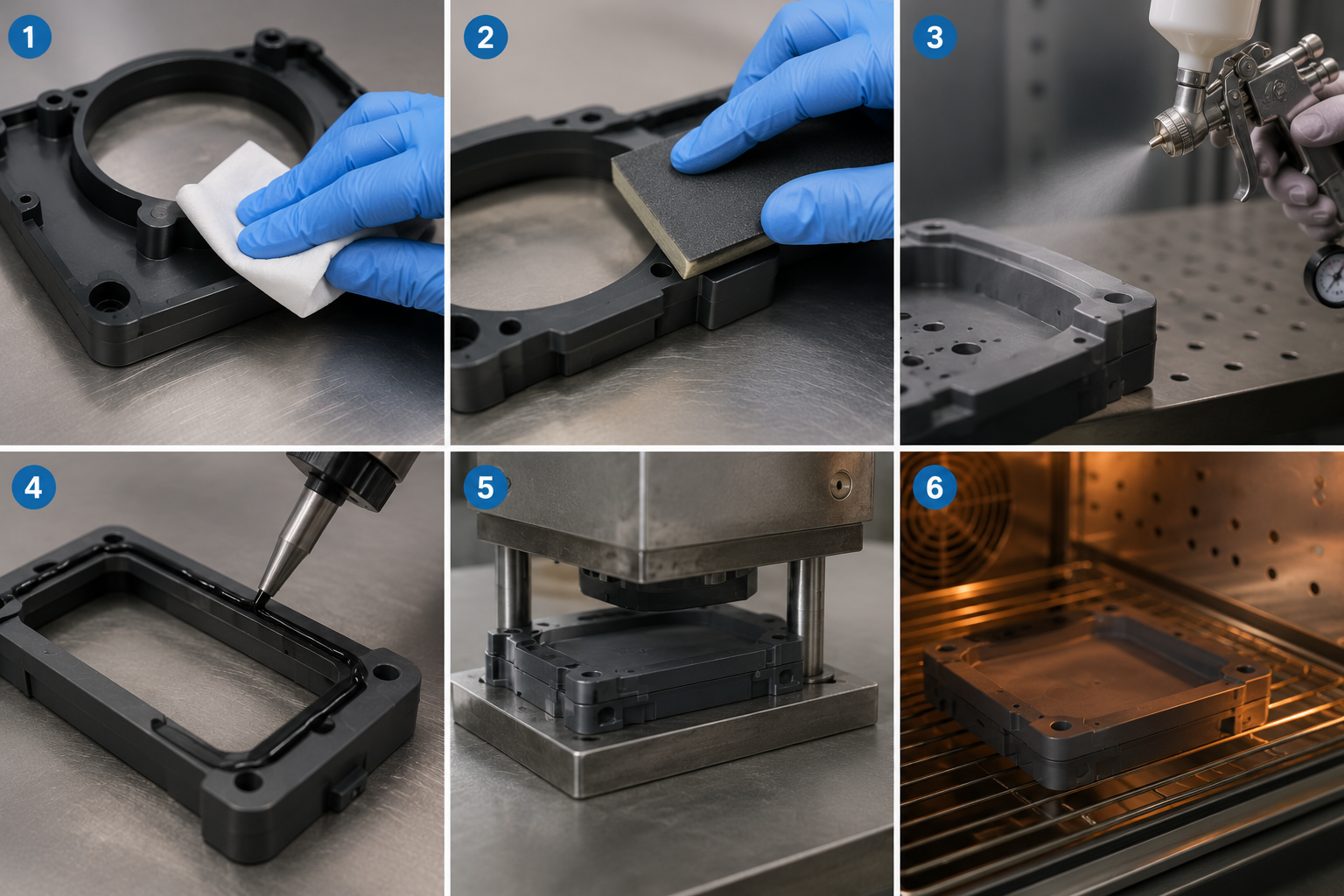
Surface Preparation Often Matters More Than Glue Strength
Many plastic bonding failures are caused by poor surface preparation.
Before bonding, the surface should usually be:
- Clean
- Dry
- Free from oil
- Free from mold release agent
- Free from dust
- Free from loose coating
- Lightly roughened if suitable
Plastic parts from injection molding may contain mold release residue. This can reduce adhesive performance.
A buyer may choose an expensive adhesive but still get poor bonding if the surface is contaminated.
This is why bonding tests should be done on real production parts, not only clean laboratory samples.
How to Choose the Right Plastic Adhesive
Before selecting a glue or tape, ask these questions:
- What type of plastic is being bonded?
- Is the bond permanent or removable?
- Will the part face heat, humidity, vibration, or impact?
- Does the bond need to be rigid or flexible?
- Is the surface smooth, textured, painted, or coated?
- Is gap filling required?
- Is fast assembly important?
- Does the adhesive need to avoid overflow?
- Will the part be used indoors or outdoors?
- Can the surface be cleaned or treated before bonding?
- Is the bonding area large enough?
- Does the final part need custom die-cut adhesive tape?
These questions help avoid choosing glue only by advertised strength.
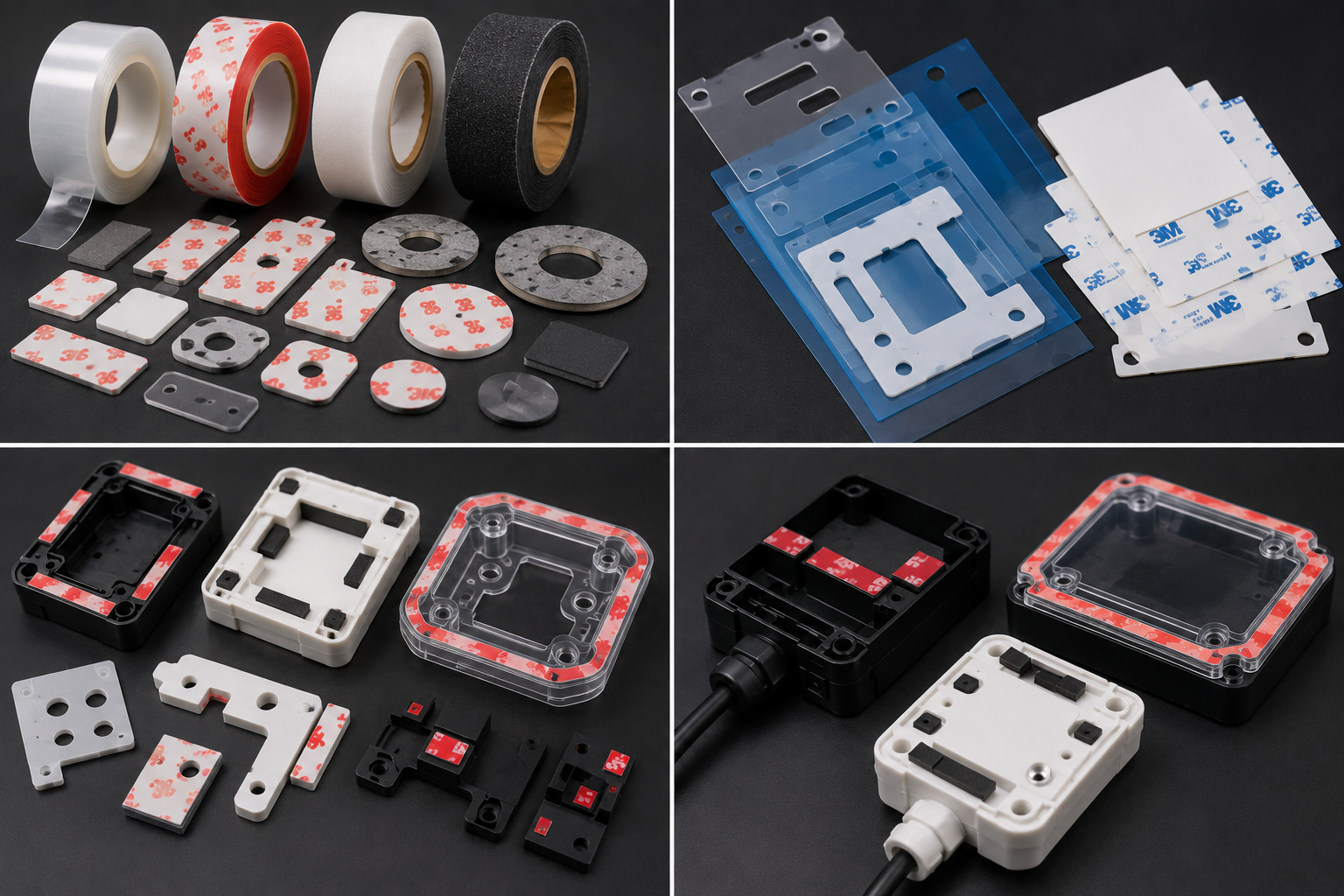
Where Sanken Supports Plastic Bonding Projects
For OEM projects, the bonding problem is often not solved by simply buying a stronger glue.
The real issue may be surface energy, adhesive thickness, temperature aging, vibration, part stress, liner release, die-cut shape, or assembly method.
Sanken Manufacturing supports customers with custom adhesive converting, double-sided tape die cutting, foam tape converting, PET-backed adhesive film processing, protective film converting, and laminated material solutions.
For plastic bonding projects, we help customers review:
- What plastic is being bonded
- Whether the adhesive should be permanent or removable
- Whether foam tape or film tape is better
- Whether the part needs cushioning or sealing
- Whether the adhesive shape should be die cut
- Whether the liner should support fast assembly
- Whether the adhesive must resist heat, vibration, or humidity
The goal is to help customers avoid weak bonding, residue, edge lifting, difficult assembly, and late-stage product failure.
Conclusion
Yes, there are stronger options for plastic than superglue. Epoxy, structural acrylic adhesive, polyurethane adhesive, silicone adhesive, solvent cement, plastic welding and high-performance adhesive tapes can all be better depending on the plastic type and application.
Superglue is fast and useful for small repairs, but it can be brittle and may not bond well to all plastics. For OEM buyers, the best plastic bonding solution is not simply the strongest glue on paper. It is the adhesive system that matches the plastic surface, assembly method, temperature, vibration, aging requirement and product life.
Sanken supports custom adhesive tape parts, foam tape pads, PET-backed adhesive films, protective films, liner-backed bonding components and precision die-cut adhesive solutions for automotive, electronics, medical, appliance and industrial OEM applications.