

Noise Reduction Materials for Automotive Interior? Why “Quiet Cabin Engineering” Is No Longer Optional
Automotive interiors are getting quieter, but customer expectations are getting louder.
That is the paradox every NVH engineer faces today.
A car can look perfect on paper. But one tiny buzz from the dashboard, one faint vibration in the door panel, and the entire “premium feel” collapses instantly.
At Sanken, I see this every day. OEMs don’t complain about materials. They complain about feelings. And feelings, unfortunately, are extremely sensitive to sound, friction, and vibration.
Noise reduction inside a vehicle is no longer about adding “soft materials.” It is about building a controlled acoustic environment where every component behaves like a tuned system.
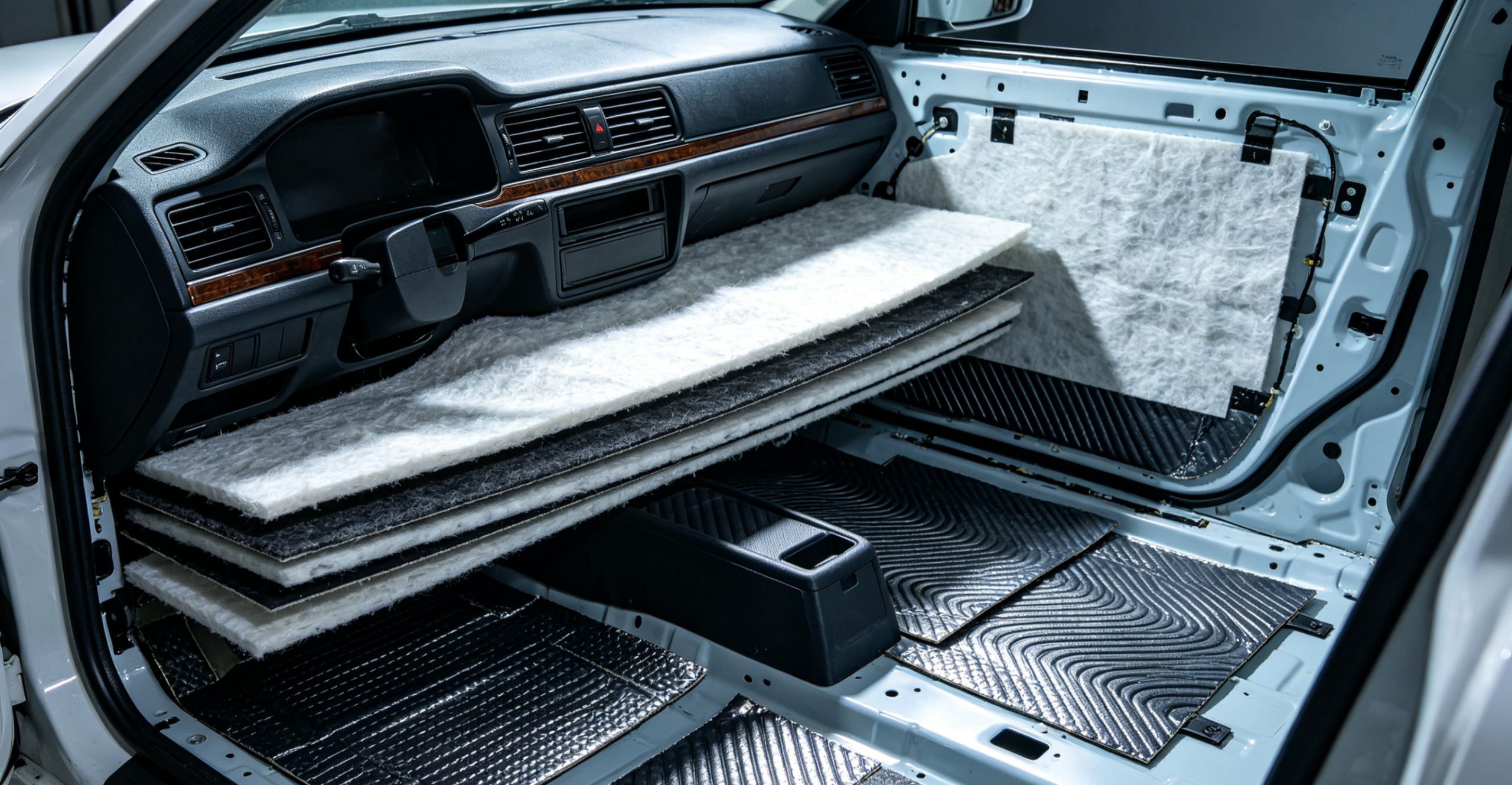
We often describe automotive noise control as a “silent battlefield.”
On one side, you have engine vibration, road resonance, wind turbulence, and structural friction.
On the other side, you have foam, felt, foam tapes, rubber pads, adhesive films, and composite laminates fighting to stabilize the cabin experience.
The challenge is not choosing a material.
The challenge is making multiple materials work together without failure under heat, pressure, and time.
This is where most supply chains break down.
And this is where Sanken positions itself differently.
We don’t just supply materials. We build noise control architectures using precision converting, multi-layer lamination, and engineered die-cut structures.
What really causes noise inside automotive interiors?
Most engineers already know the obvious answer: vibration and friction.
But in reality, the root causes are more complex:
- Micro-gap movement between assembled parts
- Adhesive aging and partial detachment
- Thermal expansion mismatch between materials
- Uneven compression recovery after assembly
- Structural resonance amplification in enclosed cavities
Each of these problems is small.
But combined, they become audible frustration.
At Sanken, we treat these as system instability issues, not material defects.
That shift in thinking changes everything.
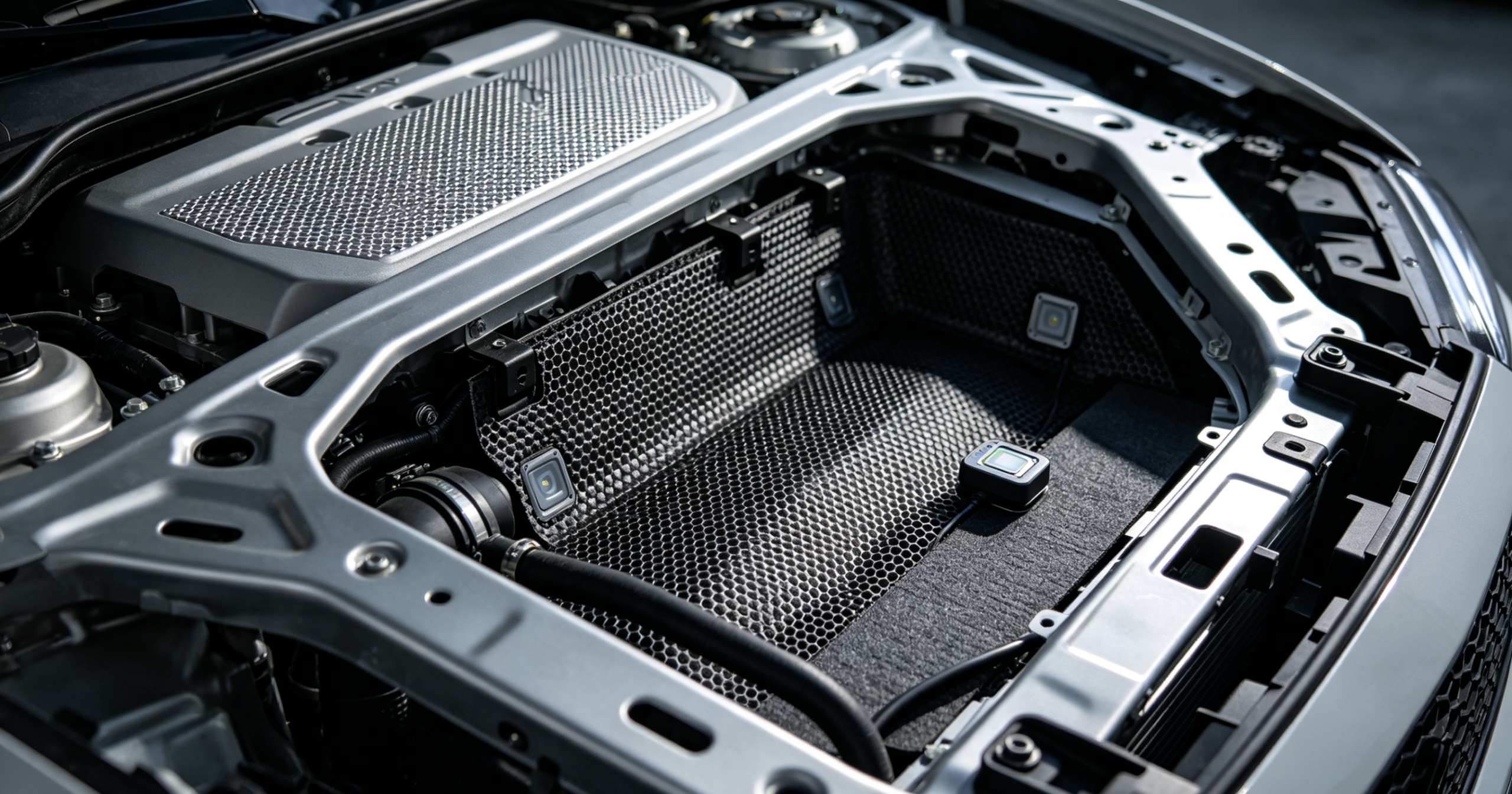
Why do traditional noise reduction materials often fail in real vehicles?
Because lab performance and road performance are two different worlds.
A material may show excellent absorption in controlled testing.
But once installed inside a vehicle:
- temperature cycles begin
- humidity fluctuates
- vibration becomes unpredictable
- assembly stress accumulates
Then failure appears slowly:
First a slight gap.
Then a faint click.
Then a persistent rattle that warranty teams cannot ignore.
We solve this not by “stronger materials,” but by engineering stability into the material system itself.
That includes:
- controlling compression behavior under load
- optimizing surface friction pairing
- stabilizing adhesive flow characteristics
- designing cut geometry for stress dispersion
This is where our precision die-cutting and multi-process integration become critical advantages.
How does Sanken design a quieter automotive interior system?
We start from the noise source, not the material catalog.
Every vehicle area has different acoustic demands:
- Door panels → vibration + impact noise
- Dashboard → resonance + structure-borne noise
- Floor systems → road noise + low-frequency vibration
- Trunk area → echo + cavity amplification
Instead of using one material everywhere, we build layered functional stacks.
Typical structures may include:
- acoustic felt for absorption
- foam layer for damping
- adhesive layer for bonding stability
- film barrier for sound blocking
- die-cut geometry for perfect fit
Each layer has a job.
No layer is decorative.
At Sanken, we integrate these through:
- precision lamination systems
- high-tonnage forming equipment (150T–315T class)
- controlled converting lines
- multi-stage inspection and batch traceability
This ensures every component behaves identically when installed in mass production.
Because in automotive manufacturing, variation is more dangerous than weakness.
Why material selection alone is no longer enough
Many buyers still think the solution is “better foam” or “better felt.”
But modern vehicles are not simple structures anymore.
They are multi-material assemblies with:
- lightweight design constraints
- tight packaging space
- strict NVH targets
- complex supplier coordination
So the real question is not:
“What material should I use?”
It is:
“How do I make different materials behave as one stable system?”
That is exactly where Sanken operates.
We combine:
- non-woven felt systems
- rubber and elastomer pads
- foam-based damping layers
- adhesive and bonding films
- molded structural components
Into a unified, manufacturable solution.
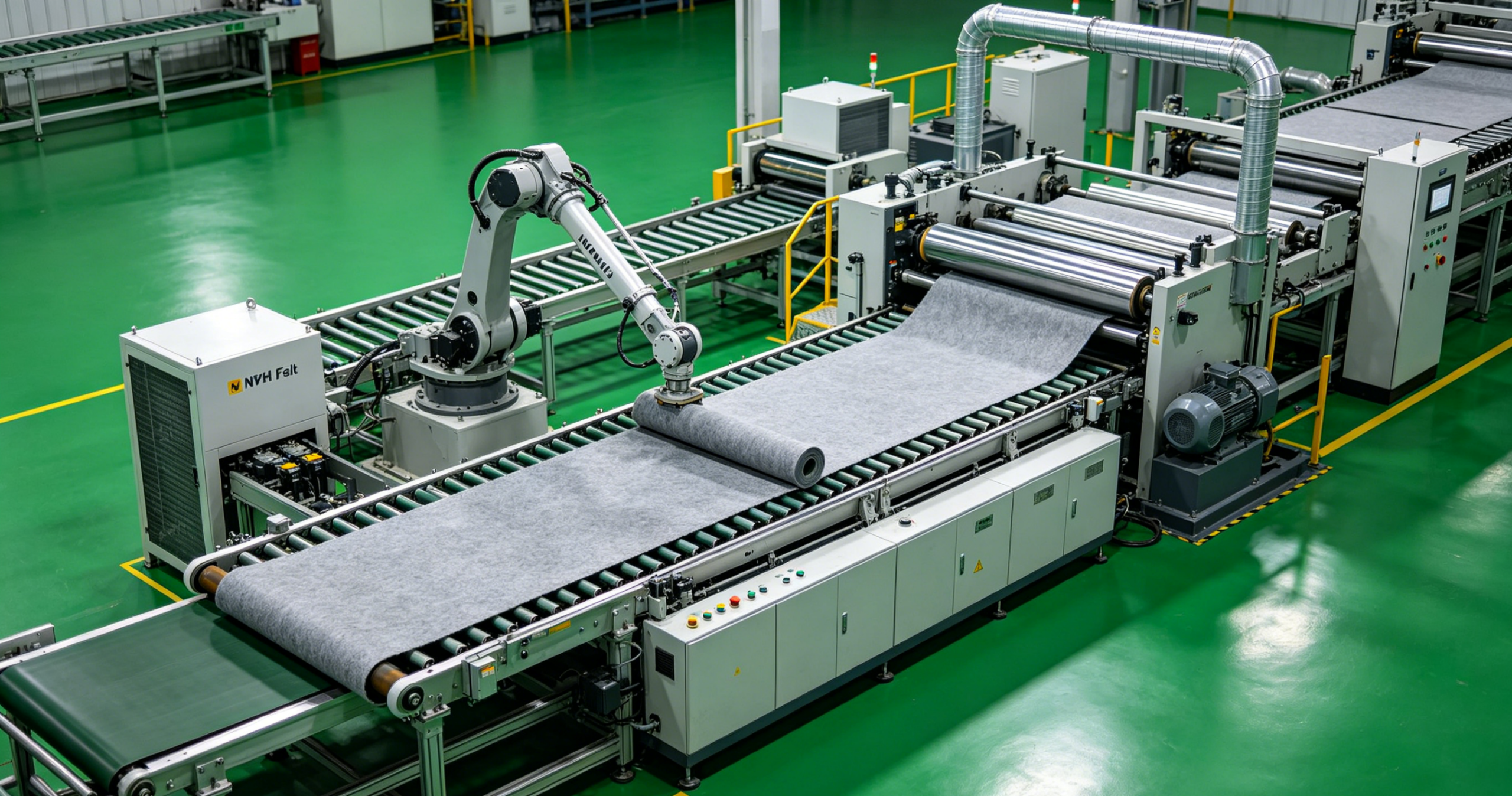
How do we prevent noise issues from appearing after mass production starts?
This is where most projects fail silently.
Prototype success does not guarantee production stability.
We solve this through engineering discipline:
- material incoming inspection (batch consistency control)
- process parameter locking (no uncontrolled variation)
- dimensional die-cut precision systems
- controlled compression forming
- full traceability from roll to finished part
We also simulate assembly behavior before mass production.
Because in NVH engineering, installation behavior matters as much as material performance.
A perfect material installed incorrectly still creates noise.
What automotive engineers actually want (but rarely say directly)
They don’t just want noise reduction.
They want:
- fewer warranty claims
- fewer supplier coordination problems
- stable long-term performance
- predictable assembly behavior
- simplified sourcing structure
In short:
They want risk reduction disguised as materials.
That is why Sanken positions itself not as a material supplier, but as a noise reduction engineering partner.
We don’t sell parts.
We stabilize systems.
Why global OEMs are shifting toward integrated suppliers
The automotive supply chain is becoming more compressed.
OEMs no longer want fragmented sourcing for:
- foam
- felt
- adhesive
- stamping
- die-cutting
- assembly prep
They want one partner who can control the full chain.
That shift is exactly aligned with our structure at Sanken:
- material development capability
- multi-process manufacturing lines
- precision converting expertise
- automotive-grade quality systems
- one-stop solution delivery model
This reduces coordination loss.
And more importantly, it reduces NVH uncertainty.
What is the most critical factor in automotive interior noise reduction?
System integration. Material alone cannot solve NVH without proper structural design and assembly control.
Can multiple noise reduction materials be combined in one part?
Yes. Hybrid structures are increasingly common, especially in door, dashboard, and floor applications.
How does material thickness affect NVH performance?
Thickness impacts both absorption frequency range and compression stability under installation load.
Why do rattles appear after months of driving?
Material relaxation, adhesive aging, and micro-movement between assemblies gradually create audible gaps.
Conclusion
Noise reduction in automotive interiors is no longer a material choice problem.
It is a system engineering problem.
At Sanken, we design noise control solutions that survive real-world driving conditions, not just lab tests.
Because silence inside a car is not accidental.
It is engineered.