
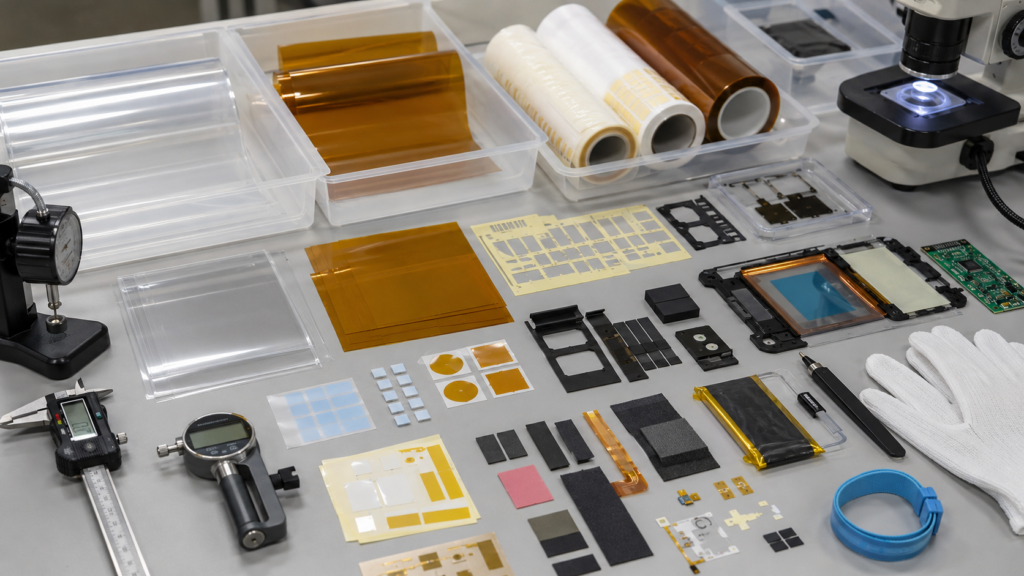
PET and PI insulation films are both widely used in electronic components, but they are not used for the same purpose. PET film is often chosen for cost-effective electrical insulation, spacing, surface protection, and general electronic assembly. PI film is usually selected when the component requires higher temperature resistance, stronger dimensional stability under heat, or more demanding insulation performance.
For OEM engineers and purchasing teams, the best choice depends on the application environment, working temperature, insulation requirement, thickness, flexibility, adhesive structure, die cut tolerance, assembly method, and cost target.
At Sanken, we support OEM customers with precision die cut PET films, PI insulation films, adhesive-backed insulation parts, protective films, double-sided tape components, foam spacers, rubber pads, light-blocking films, and multilayer converted materials for electronics, display modules, automotive electronics, EV battery-related components, sensors, and industrial devices.
Why PET and PI Films Are Used in Electronic Components
Electronic components are becoming smaller, thinner, and more integrated. Inside compact assemblies, insulation films help prevent unwanted electrical contact, protect surfaces, separate layers, support assembly positioning, and improve product reliability.
PET and PI films are commonly used in:
- PCB protection
- Connector insulation
- Battery-related electronics
- Display module insulation
- Sensor module protection
- Flexible circuit protection
- Automotive electronic housings
- Consumer electronics assemblies
- Industrial control modules
- Medical device electronics
These films are usually die cut into custom shapes with holes, windows, slots, tabs, or adhesive backing. Even a small insulation film must fit accurately, stay clean, and remain stable during assembly.
What Is PET Insulation Film?
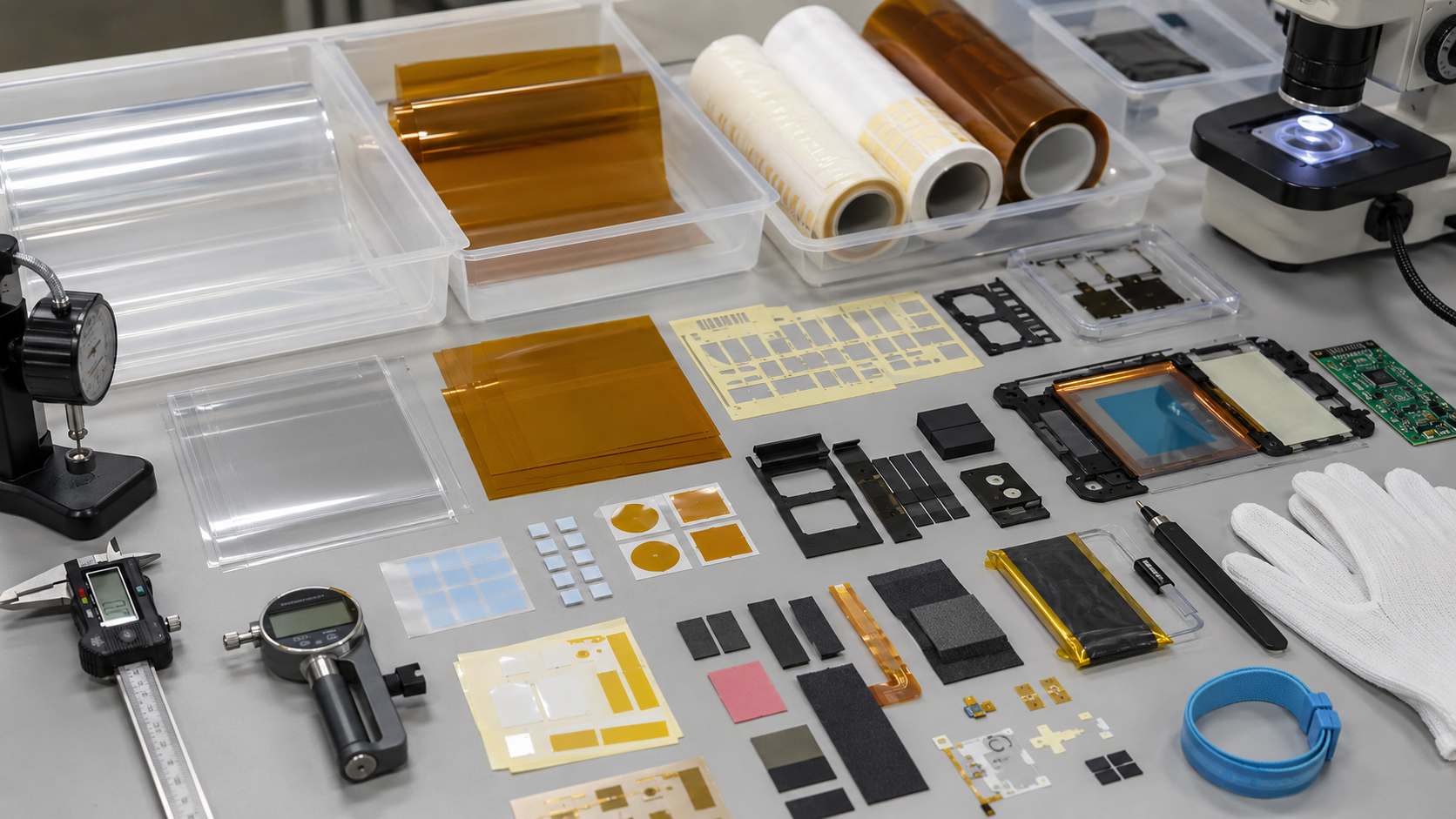
PET film, also known as polyester film, is a thin plastic film commonly used for electrical insulation, spacing, protection, and support in electronic assemblies.
PET film is often selected because it offers a practical balance of performance and cost. It is lightweight, stable, easy to convert, and suitable for many general electronic insulation applications.
Common PET film uses include:
- Die cut insulation sheets
- Battery pack insulation pieces
- PCB protection films
- Connector area insulation
- Display module support films
- Surface protection layers
- Adhesive-backed insulation parts
- Spacing and separation films
PET film is usually a good choice when the application does not require extreme heat resistance but still needs clean, thin, and reliable insulation.
What Is PI Insulation Film?
PI film, also known as polyimide film, is a high-performance insulation film used in applications where higher temperature resistance and stronger insulation performance are required.
PI film is often used in more demanding electronic environments, such as areas near heat sources, flexible circuits, high-temperature bonding processes, or automotive electronics.
Common PI film uses include:
- High-temperature insulation
- Flexible circuit protection
- Connector insulation
- Battery-related insulation parts
- Sensor module insulation
- Automotive electronic components
- Heat-resistant adhesive-backed films
- Thin die cut insulation parts for compact assemblies
PI film is usually more expensive than PET film, but it can be necessary when the component faces higher thermal stress or stricter reliability requirements.
PET vs PI: Key Differences
| Factor | PET Insulation Film | PI Insulation Film |
|---|---|---|
| Cost | Usually more cost-effective | Usually higher cost |
| Temperature resistance | Suitable for general electronics | Better for high-temperature areas |
| Electrical insulation | Good for many standard applications | Stronger for demanding applications |
| Flexibility | Good for many die cut parts | Excellent for thin and flexible structures |
| Dimensional stability under heat | Moderate to good | Better under high heat |
| Common use | General insulation, spacing, protection | High-temperature insulation, flexible circuits |
| Die cutting | Easy to convert | Requires careful handling and clean cutting |
| Best for | Cost-sensitive electronic components | Heat-resistant and high-reliability components |
The choice is not simply “PET is cheaper” or “PI is better.” The correct film depends on the real working condition.
When PET Film Is the Better Choice
PET film is often the better choice when the project needs reliable insulation at a practical cost.
Choose PET film when:
- The working temperature is moderate
- The application needs general electrical insulation
- Cost control is important
- The part needs clean die cut edges
- The film is used for spacing or surface protection
- The part does not face high heat
- The project requires large-volume production
- Adhesive-backed insulation parts are needed
For example, many display module insulation parts, connector protection films, battery pack auxiliary films, and electronic assembly spacers can use PET film when the temperature and performance requirements are suitable.
PET film is also useful when parts need to be supplied as liner-backed sheets, kiss-cut parts, or adhesive-backed die cut components.
When PI Film Is the Better Choice
PI film is better when the electronic component faces higher temperature, stricter insulation needs, or more demanding reliability requirements.
Choose PI film when:
- The part is near a heat source
- The assembly involves high-temperature processing
- The component requires stronger thermal stability
- The film must protect flexible circuits
- The product is used in automotive electronics
- The part must stay stable in compact high-reliability assemblies
- Standard PET film may not meet the requirement
PI film is often used in electronic areas where failure would create higher risk. It is especially useful for flexible circuits, battery-related insulation, sensor modules, and electronic assemblies that require heat-resistant protection.
Adhesive-Backed PET and PI Films
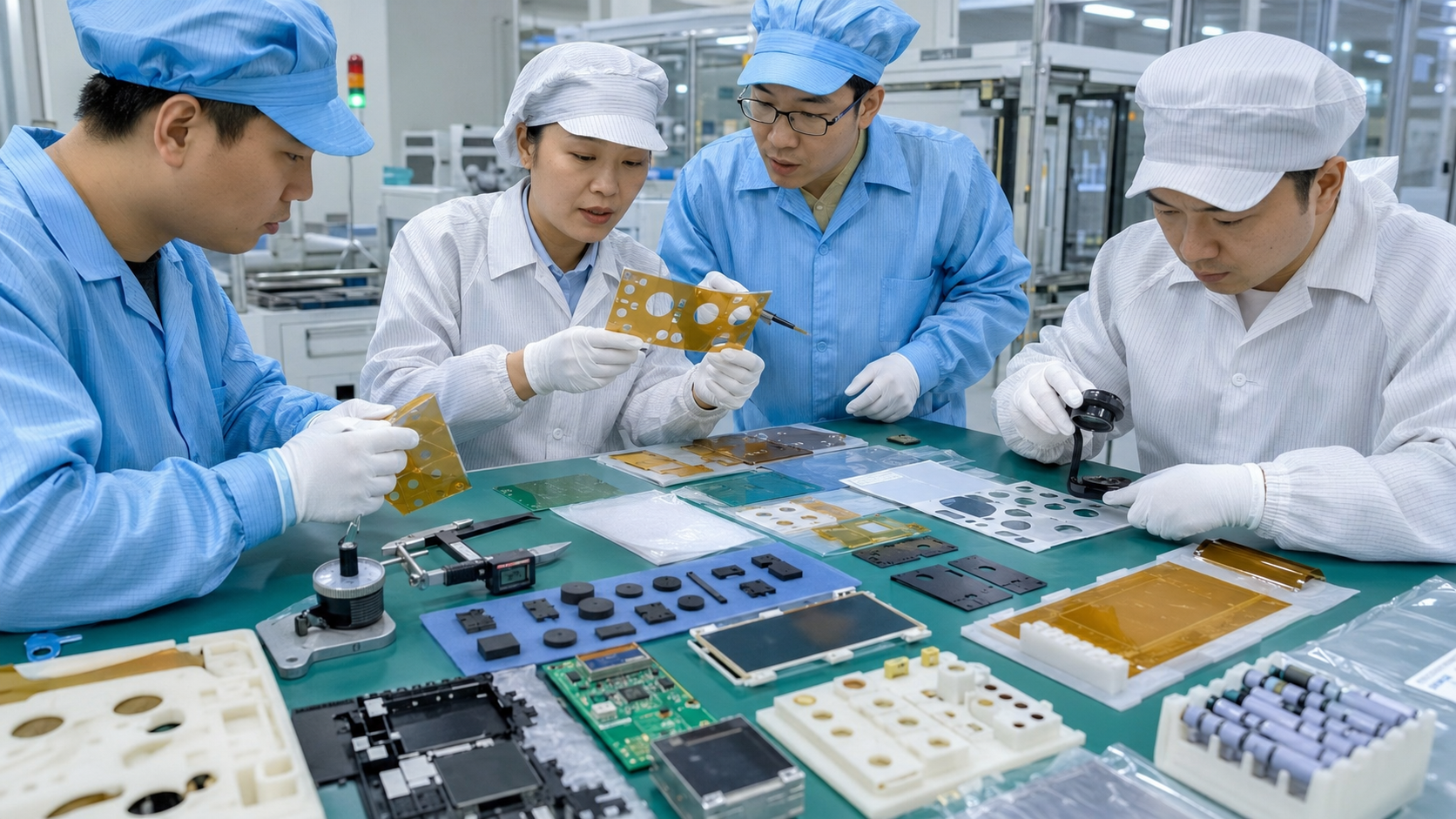
Many PET and PI insulation films are supplied with adhesive backing. Adhesive-backed films help operators position the part during assembly and keep the insulation layer stable.
Important adhesive selection factors include:
| Control Point | Why It Matters |
|---|---|
| Adhesive thickness | Affects total part thickness and fit |
| Bonding surface | Must match plastic, metal, PCB, film, or coated surface |
| Temperature resistance | Adhesive must match the working environment |
| Liner release | Affects operator handling |
| Die cut accuracy | Controls hole and window alignment |
| Adhesive overflow | Prevents contamination |
| Peel strength | Prevents lifting during use |
| Packaging flatness | Reduces curling and application issues |
An adhesive-backed PET film may be suitable for general insulation. An adhesive-backed PI film may be better when higher heat resistance is needed.
The adhesive should be selected together with the film, not after the film material is chosen.
Die Cutting Requirements for PET and PI Films
PET and PI films often require precision die cutting because they are used in compact electronic spaces.
Important die cutting requirements include:
- Accurate outer dimensions
- Clean hole alignment
- Burr-free edges
- Stable film thickness
- Clean adhesive edges
- Good liner release
- No film curling
- No surface scratches
- No dust or particles
- Proper packaging
Thin films can shift, curl, or stretch during converting if the process is not controlled. Adhesive-backed films also require accurate kiss cutting, liner protection, and clean waste removal.
For electronic components, small particles or rough edges can create inspection problems. This is why die cut PET and PI films should be produced with clean handling and clear quality control standards.
PET and PI Films in Display Modules
In display modules, PET and PI films are often used with protective films, adhesive tapes, light-blocking films, foam spacers, and rubber pads.
Common uses include:
- Display module insulation
- Flexible circuit protection
- Connector area protection
- Touch panel insulation
- Backlight structure support
- Sensor window protection
- Automotive display electronics
- Adhesive-backed insulation parts
PET film is often used for general insulation and support. PI film may be used when higher heat resistance is required near electronic circuits or flexible printed structures.
In display modules, the film must not interfere with optical windows, active display areas, sensors, or bonding frames.
PET and PI Films in Automotive Electronics
Automotive electronics often require higher reliability than standard consumer products. Components may face heat, vibration, long service life, and strict assembly requirements.
PET and PI films may be used in:
- Automotive control modules
- Sensor housings
- Battery-related electronics
- Display systems
- Wire harness protection
- Camera module areas
- Connector protection
- Interior electronic assemblies
PET film can be suitable for many general automotive insulation parts. PI film may be selected for higher-temperature locations or more demanding electronic protection.
In automotive projects, material choice should be confirmed with the customer’s temperature, aging, insulation, and assembly requirements.
Cost Considerations
Cost is often one of the main reasons buyers compare PET and PI films.
PET film is usually more cost-effective, making it suitable for large-volume insulation parts where standard performance is enough. PI film is usually more expensive, but it may reduce risk when higher temperature resistance or stronger reliability is needed.
Cost is affected by:
- Film material
- Thickness
- Adhesive backing
- Liner type
- Die cut complexity
- Hole accuracy
- Production volume
- Inspection requirements
- Packaging format
- Cleanliness requirements
The best solution is not always the cheapest material. If PET film cannot meet the environment requirement, failure may cost more than using PI film from the beginning. If PI film is not necessary, using it may increase cost without adding real value.
How to Choose Between PET and PI Films
Use this practical decision guide:
| Requirement | Better Choice |
|---|---|
| General electronic insulation | PET film |
| Cost-sensitive high-volume production | PET film |
| Surface protection or spacing | PET film |
| Higher temperature resistance | PI film |
| Flexible circuit protection | PI film |
| Automotive high-reliability electronics | PET or PI, depending on heat requirement |
| Thin adhesive-backed insulation | PET or PI, depending on application |
| Heat-resistant adhesive-backed film | PI film |
| Standard display module insulation | PET film |
| High-temperature display electronics | PI film |
Before final selection, buyers should confirm temperature exposure, voltage requirement, assembly method, adhesive needs, tolerance, and packaging format.
Quality Control Checklist
Before approving PET or PI die cut insulation films, OEM buyers should check:
- Film material confirmation
- Thickness
- Adhesive structure
- Outer dimensions
- Hole alignment
- Edge cleanliness
- Burrs or particles
- Film flatness
- Surface scratches
- Liner release
- Adhesive overflow
- Packaging condition
- Assembly fit
- Temperature or insulation requirement if needed
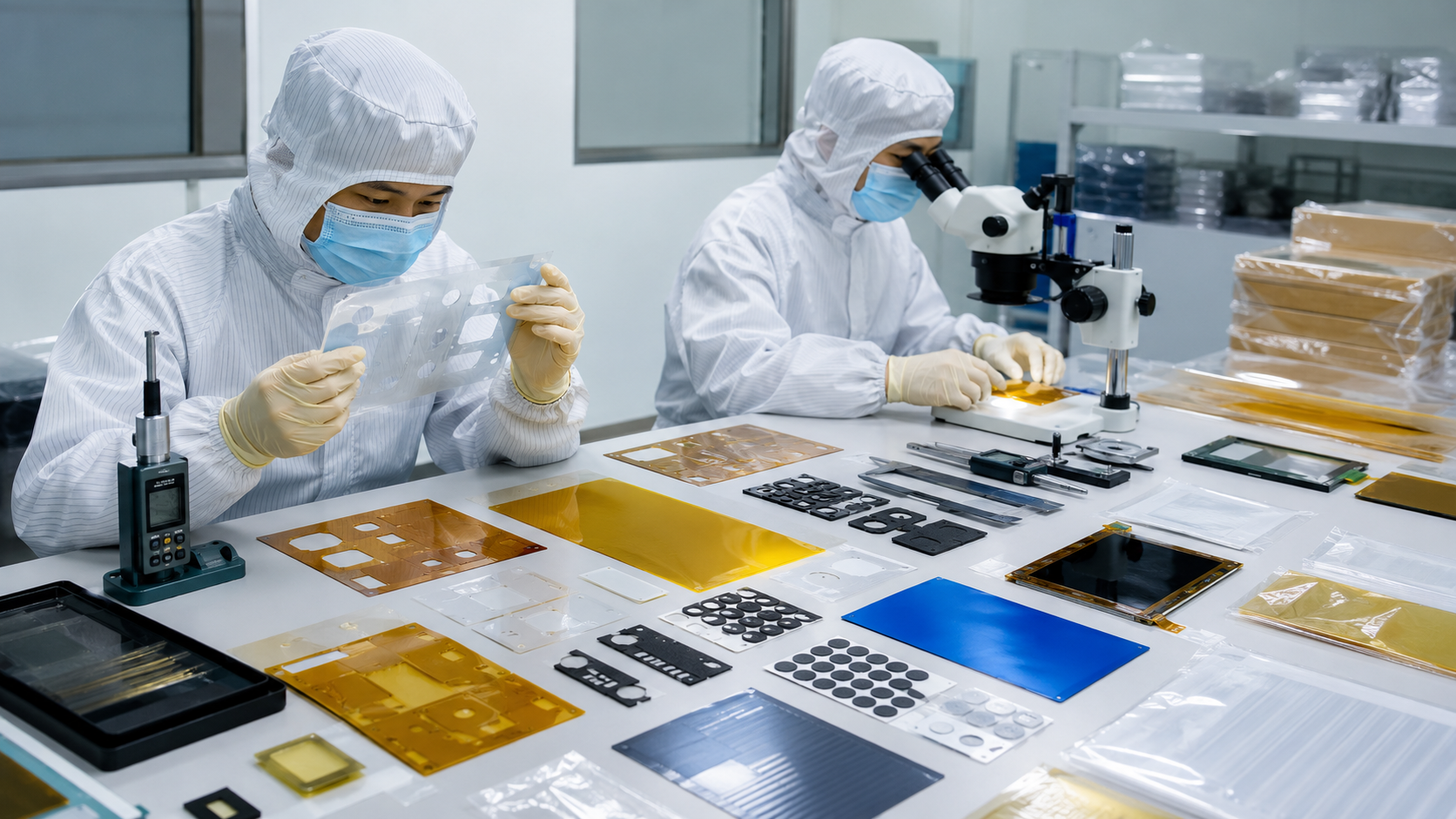
For compact electronic components, critical dimensions should be marked clearly on the drawing. These may include screw holes, connector openings, positioning holes, optical windows, or bonding areas.
How Sanken Supports PET and PI Insulation Film Projects
Sanken Manufacturing Co., Ltd. supports OEM customers with precision die cut PET and PI insulation films for electronic components.
Our support includes:
- PET insulation films
- PI insulation films
- Adhesive-backed PET films
- Adhesive-backed PI films
- Protective films
- Light-blocking films
- Double-sided adhesive tape parts
- Foam spacers
- Rubber pads
- Release liner structures
- Multilayer laminated components
- Sample development
- Quality inspection
- Assembly-ready packaging
For each project, we review film material, thickness, adhesive structure, bonding surface, hole alignment, edge cleanliness, liner release, packaging method, and final assembly process.
Our goal is to help customers reduce misalignment, curling, adhesive lifting, rough edges, particles, poor liner release, repeated sampling, and unstable mass production.
What Buyers Should Provide Before Starting a Project
To choose the right PET or PI insulation film, buyers should provide:
- 2D drawing
- Application area
- Film material preference
- Thickness requirement
- Adhesive requirement
- Temperature requirement
- Insulation requirement
- Critical dimensions
- Bonding surface
- Liner preference
- Packaging method
- Assembly process
- Expected quantity
- Sample or reference part if available
Clear information helps the supplier recommend the right film and converting method.
FAQ
Is PET film good for electronic insulation?
Yes. PET film is widely used for general electronic insulation, spacing, protection, and adhesive-backed die cut components when the application does not require extreme heat resistance.
Is PI film better than PET film?
PI film is better for higher temperature resistance and more demanding insulation applications. PET film is better when cost, general insulation, and high-volume production are the main priorities.
When should I choose PI film instead of PET film?
Choose PI film when the electronic component faces higher heat, flexible circuit protection, stricter reliability requirements, or when PET film may not meet the working environment.
Can PET and PI films be adhesive-backed?
Yes. Both PET and PI films can be laminated with adhesive and die cut into custom insulation parts with release liners.
Why do PET and PI die cut films need clean edges?
Clean edges reduce particles, burrs, and contamination risks in compact electronic assemblies, display modules, sensors, and battery-related components.
Can Sanken support custom PET and PI insulation films?
Yes. Sanken supports custom die cut PET and PI insulation films, adhesive-backed insulation parts, protective films, light-blocking films, foam spacers, rubber pads, and multilayer converted materials for electronic components.
Conclusion
PET and PI insulation films are both useful in electronic components, but they serve different needs. PET film is often the better choice for cost-effective general insulation, spacing, and protection. PI film is the better choice when higher temperature resistance, flexible circuit protection, or stronger reliability is required.
For OEM projects, the best choice depends on temperature, insulation requirement, thickness, adhesive structure, tolerance, assembly method, cleanliness, packaging, and cost target.
At Sanken, we help customers develop precision die cut PET and PI insulation films that are clean, accurate, assembly-ready, and stable from prototype to mass production.