
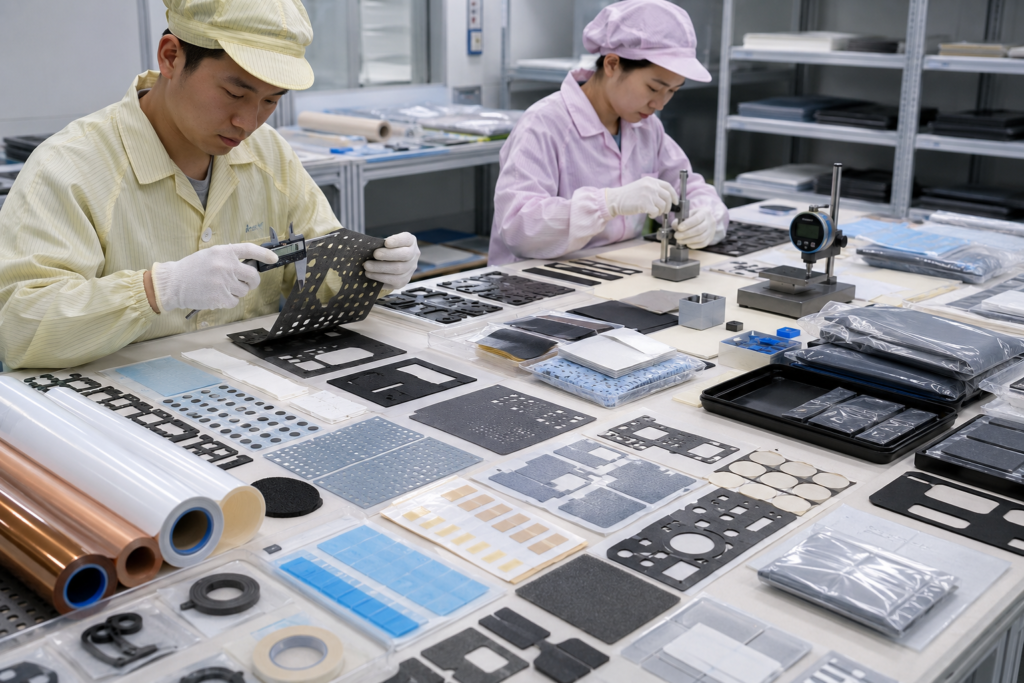
Perforation and die cutting are both converting processes used for flexible materials, but they serve different purposes. Perforation creates a line or pattern of small cuts, holes, or weakened points so the material can bend, tear, vent, fold, or separate more easily. Die cutting cuts flexible materials into a specific shape, profile, hole pattern, gasket, pad, film, tape, or component for final assembly.
For OEM engineers and purchasing teams, the difference matters because flexible materials such as foam, rubber, PET film, PI film, protective film, adhesive tape, non-woven felt, and multilayer laminated materials behave differently during cutting. Choosing the wrong process may cause poor tearing, rough edges, adhesive lifting, dust, burrs, misalignment, difficult liner release, or assembly failure.
At Sanken, we support OEM customers with precision die cutting, perforation, kiss cutting, through cutting, adhesive lamination, foam gaskets, rubber pads, PET and PI insulation films, protective films, non-woven felt parts, double-sided tape components, and multilayer converted materials for automotive, electronics, display modules, battery-related assemblies, medical devices, appliances, and industrial applications.
What Is Perforation?
Perforation is a process that creates a series of small holes, slots, cuts, or weakened points in a material. The goal is usually not to fully remove the part into a final shape. Instead, perforation makes the material easier to tear, fold, separate, vent, or bend.
Perforation is commonly used when the part needs:
- Easy manual tearing
- Controlled separation
- Fold lines
- Venting or air release
- Flexible bending
- Reduced stiffness
- Peel-off sections
- Roll or sheet separation
- Packaging convenience
- Assembly handling support
For example, adhesive liner sheets may be perforated so operators can remove sections more easily. Protective films may use perforation for controlled removal. Foam or felt materials may be perforated to improve flexibility, reduce stiffness, or support air release.
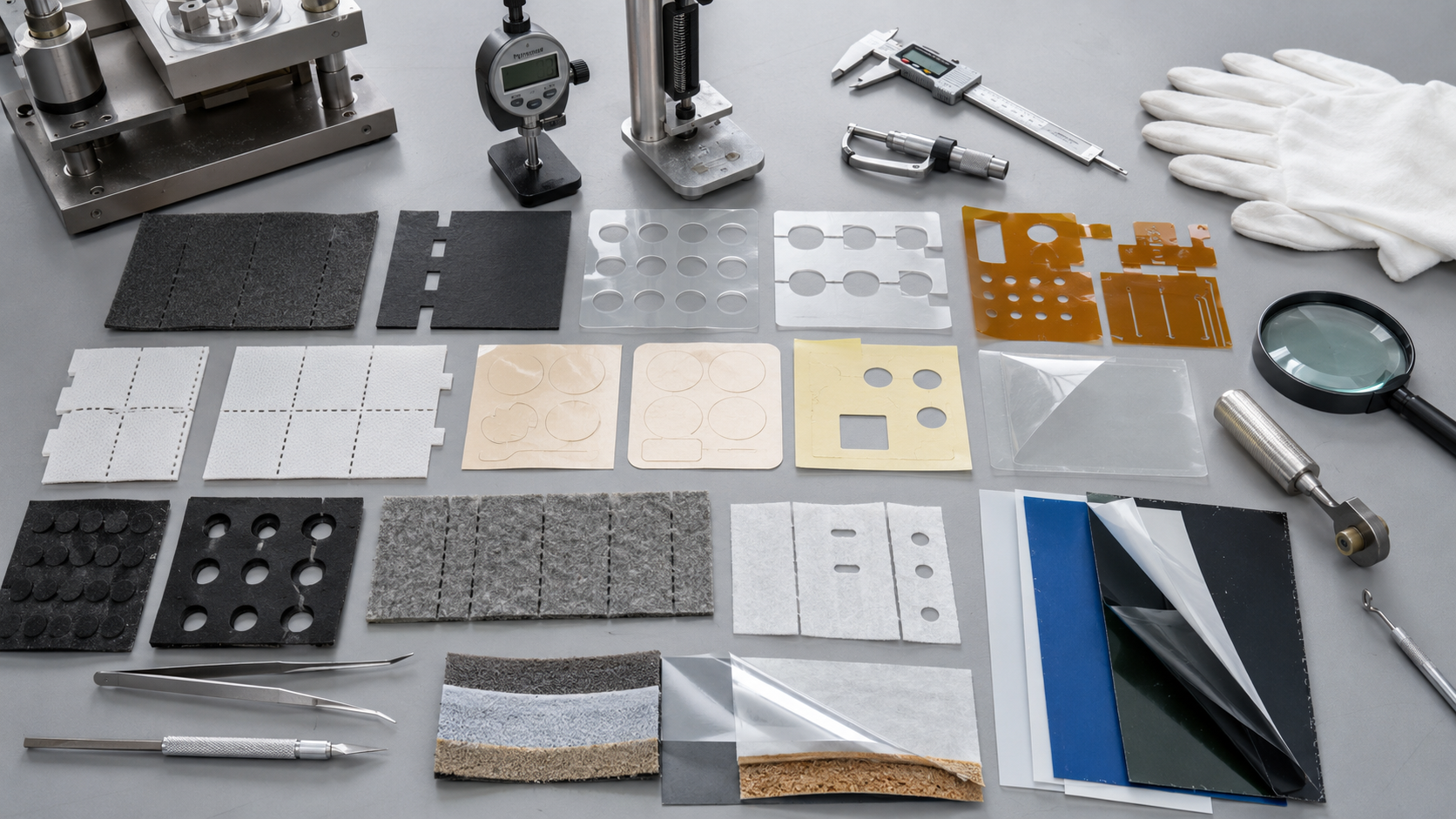
What Is Die Cutting?
Die cutting is a process that cuts flexible material into a custom shape. It may create outer profiles, inner holes, slots, windows, frames, pads, gaskets, strips, or multilayer adhesive-backed components.
Die cutting is commonly used to produce:
- Foam gaskets
- Rubber pads
- PET insulation films
- PI film parts
- Protective films
- Adhesive tape components
- Non-woven felt NVH strips
- Light-blocking films
- Display module film frames
- Battery insulation films
- Medical adhesive pads
- Appliance sealing parts
- Automotive damping pads
Die cutting can be used for simple shapes or complex precision components. It can also include kiss cutting, through cutting, laminating, waste removal, liner control, and assembly-ready packaging.
The Main Difference Between Perforation and Die Cutting
The simplest difference is this:
Perforation weakens or opens selected areas of a material. Die cutting creates a finished part shape.
| Item | Perforation | Die Cutting |
|---|---|---|
| Main purpose | Tear, fold, vent, bend, or separate | Create a finished custom part |
| Cut style | Dotted, slotted, partial, or patterned cuts | Full profile, holes, windows, or shapes |
| Final result | Material remains connected or partially weakened | Part is shaped for assembly |
| Common use | Tear lines, vent holes, fold lines, liner separation | Gaskets, films, tapes, pads, insulation parts |
| Material handling | Supports removal or flexibility | Supports final fit and assembly |
| Quality focus | Tear strength, hole pattern, spacing | Dimension, edge quality, tolerance, fit |
In real OEM manufacturing, perforation and die cutting may also be combined in one part.
For example, a protective film may be die cut into a custom shape and perforated to create an easy-tear section. An adhesive liner may be kiss cut for the part shape and perforated for easier peeling. A foam pad may be die cut into shape and perforated for venting or compression control.
When Should You Use Perforation?
Perforation is useful when the material must remain connected but still needs controlled separation, flexibility, or airflow.
Common use cases include:
| Application | Why Perforation Helps |
|---|---|
| Release liners | Makes peeling or section removal easier |
| Protective films | Supports controlled removal |
| Adhesive sheets | Allows operators to separate sections |
| Foam pads | Helps vent air or improve flexibility |
| Non-woven felt | Reduces stiffness or improves handling |
| Packaging materials | Creates tear lines |
| Filter or vent materials | Allows airflow or drainage |
| Foldable materials | Creates controlled bending areas |
Perforation design should consider hole size, spacing, pattern, cut depth, material thickness, adhesive layer, liner strength, and final handling method.
If perforations are too weak, the material may tear during production or transport. If they are too strong, operators may find it difficult to tear or remove.
When Should You Use Die Cutting?
Die cutting is the better choice when the material needs to become a functional custom component.
Use die cutting when the part requires:
- Accurate outer shape
- Inner holes or windows
- Assembly alignment
- Sealing function
- Cushioning function
- Insulation protection
- Adhesive bonding
- Light blocking
- Surface protection
- Gap filling
- Anti-rattle or damping performance
- Assembly-ready delivery format
For example, an automotive foam gasket must fit a housing groove. A PET insulation film must align with screw posts or battery module areas. A display light-blocking film must match the optical window. A double-sided adhesive tape frame must bond accurately without adhesive overflow.
These applications need die cutting because the part must match the product design.
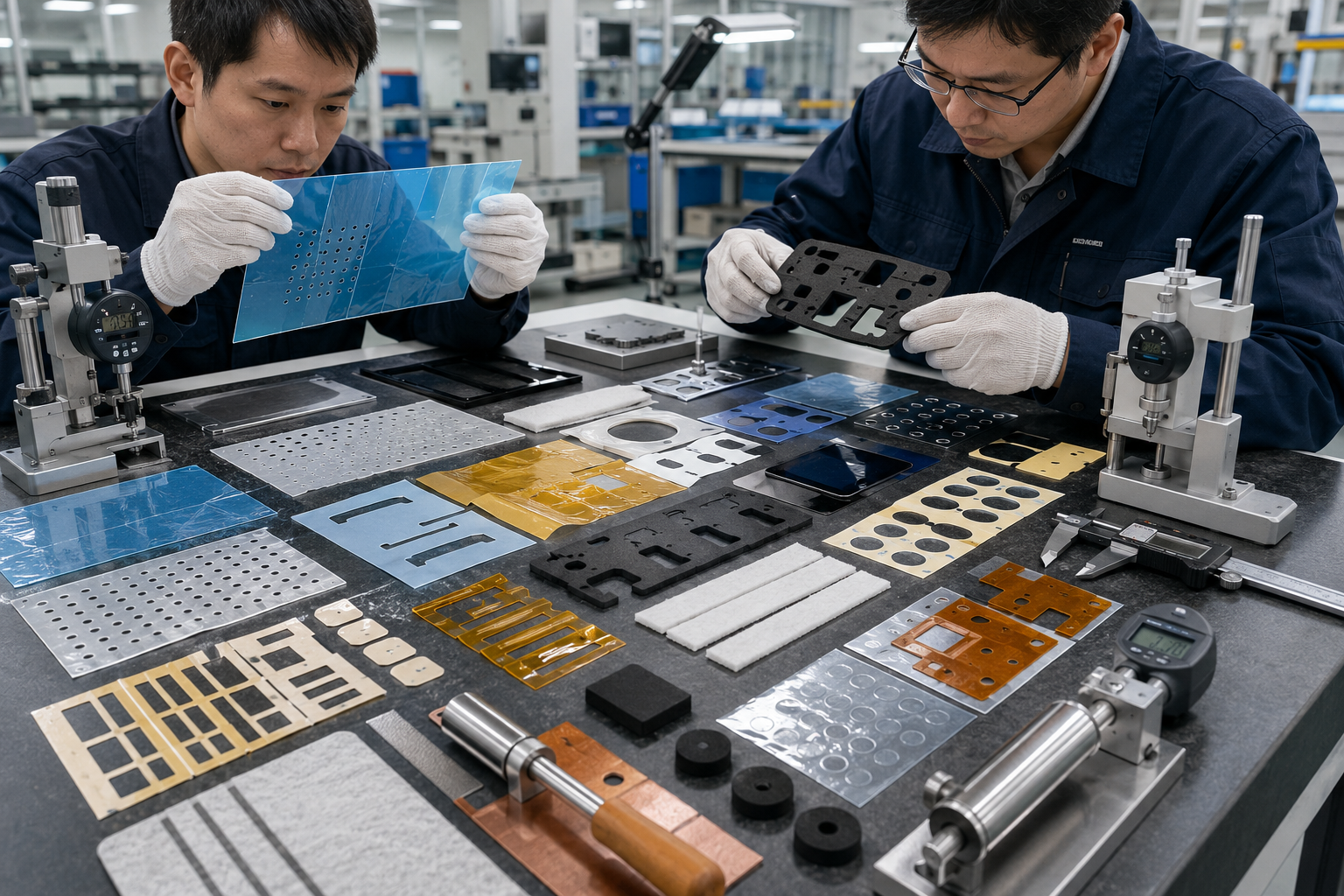
Flexible Materials Behave Differently During Cutting
Flexible materials are not all converted the same way. Their thickness, density, hardness, stretch, adhesive structure, and liner support affect the cutting process.
Common flexible materials include:
| Material | Cutting Consideration |
|---|---|
| Foam | Compression, thickness, recovery, dust |
| Rubber | Hardness, burrs, rebound, clean edge |
| PET film | Hole accuracy, burr control, flatness |
| PI film | Heat resistance, clean edges, dimensional stability |
| Protective film | Scratch control, liner release, no residue |
| Double-sided tape | Adhesive overflow, liner control, kiss cutting |
| Non-woven felt | Fiber shedding and edge cleanliness |
| Multilayer materials | Layer registration and cutting depth |
Soft foam may compress during cutting. Rubber may rebound after cutting. Adhesive tape may stretch or leave adhesive strings. Thin film may curl or shift. Felt may shed fibers. Multilayer materials may need different cutting depths for different layers.
This is why OEM flexible material converting requires process review before mass production.
Kiss Cutting, Through Cutting, and Perforation
Many flexible material projects require more than one cutting method.
| Process | Meaning | Common Use |
|---|---|---|
| Kiss cutting | Cuts the top material but not the liner | Adhesive-backed parts |
| Through cutting | Cuts completely through all layers | Finished pieces or full profiles |
| Perforation | Creates dotted or partial cut patterns | Tear lines, vents, flexible sections |
| Slitting | Cuts material into narrower rolls | Roll preparation |
| Laminating | Combines materials before cutting | Multilayer die cut parts |
For adhesive-backed parts, kiss cutting is very common. The part is cut through the material and adhesive, while the liner remains intact. This allows operators to peel the part from the liner during assembly.
Perforation may be added to the liner or part area to improve handling. Through cutting may be used when the finished part needs to be fully separated.
Quality Control Differences
Perforation and die cutting require different inspection priorities.
For perforation, quality control may check:
- Hole size
- Hole spacing
- Perforation depth
- Tear strength
- Fold behavior
- Airflow or venting effect
- Material tearing risk
- Liner damage
For die cutting, quality control may check:
- Outer dimension
- Hole alignment
- Edge cleanliness
- Material thickness
- Adhesive position
- Liner release
- Foam compression
- Rubber hardness
- Film flatness
- Burrs or particles
- Packaging condition
- Assembly fit
For OEM parts, inspection should match the final function. A perforated liner must tear correctly. A die cut gasket must fit correctly. A PET film must align correctly. A foam spacer must compress correctly.
Common Problems in Perforation and Die Cutting
| Problem | Possible Cause | Prevention |
|---|---|---|
| Material tears too easily | Perforation too deep or spacing too close | Adjust pattern and cut depth |
| Material hard to tear | Perforation too weak | Increase cut length or reduce spacing |
| Rough edges | Tooling not suitable or blade wear | Improve tooling and maintenance |
| Adhesive overflow | Wrong cutting pressure or adhesive structure | Control kiss cutting and lamination |
| Film curling | Material stress or poor packaging | Review storage and packaging |
| Foam deformation | Excessive pressure or poor packaging | Adjust tooling and packing |
| Felt fibers | Rough cutting or material issue | Improve cutting method and inspection |
| Poor liner release | Wrong liner or cutting depth | Review liner and kiss cut depth |
| Hole misalignment | Tooling or registration issue | Define critical dimensions and inspect |
Most problems can be reduced through material review, tooling selection, cutting depth control, sample testing, and packaging design.
How to Choose Between Perforation and Die Cutting
Choose the process based on the function of the material.
| Project Need | Recommended Process |
|---|---|
| Tear-off section | Perforation |
| Finished gasket shape | Die cutting |
| Easy liner removal | Perforation or kiss cutting |
| Adhesive-backed custom part | Kiss cutting and die cutting |
| Vent holes or airflow | Perforation or hole die cutting |
| Fold line | Perforation |
| PET insulation part | Precision die cutting |
| Foam sealing gasket | Die cutting |
| Protective film with removal tab | Die cutting and possible perforation |
| Multilayer adhesive part | Lamination and die cutting |
In many OEM projects, the best solution combines both processes.
How Sanken Supports Flexible Material Converting
Sanken Manufacturing Co., Ltd. supports OEM customers with flexible material converting for automotive, electronics, display modules, battery-related assemblies, medical devices, appliances, and industrial products.
Our support includes:
- Precision die cutting
- Perforation
- Kiss cutting
- Through cutting
- Adhesive lamination
- Foam gasket converting
- Rubber pad cutting
- PET and PI film die cutting
- Protective film converting
- Non-woven felt NVH parts
- Double-sided tape components
- Multilayer material structures
- Sample development
- Quality inspection
- Assembly-ready packaging
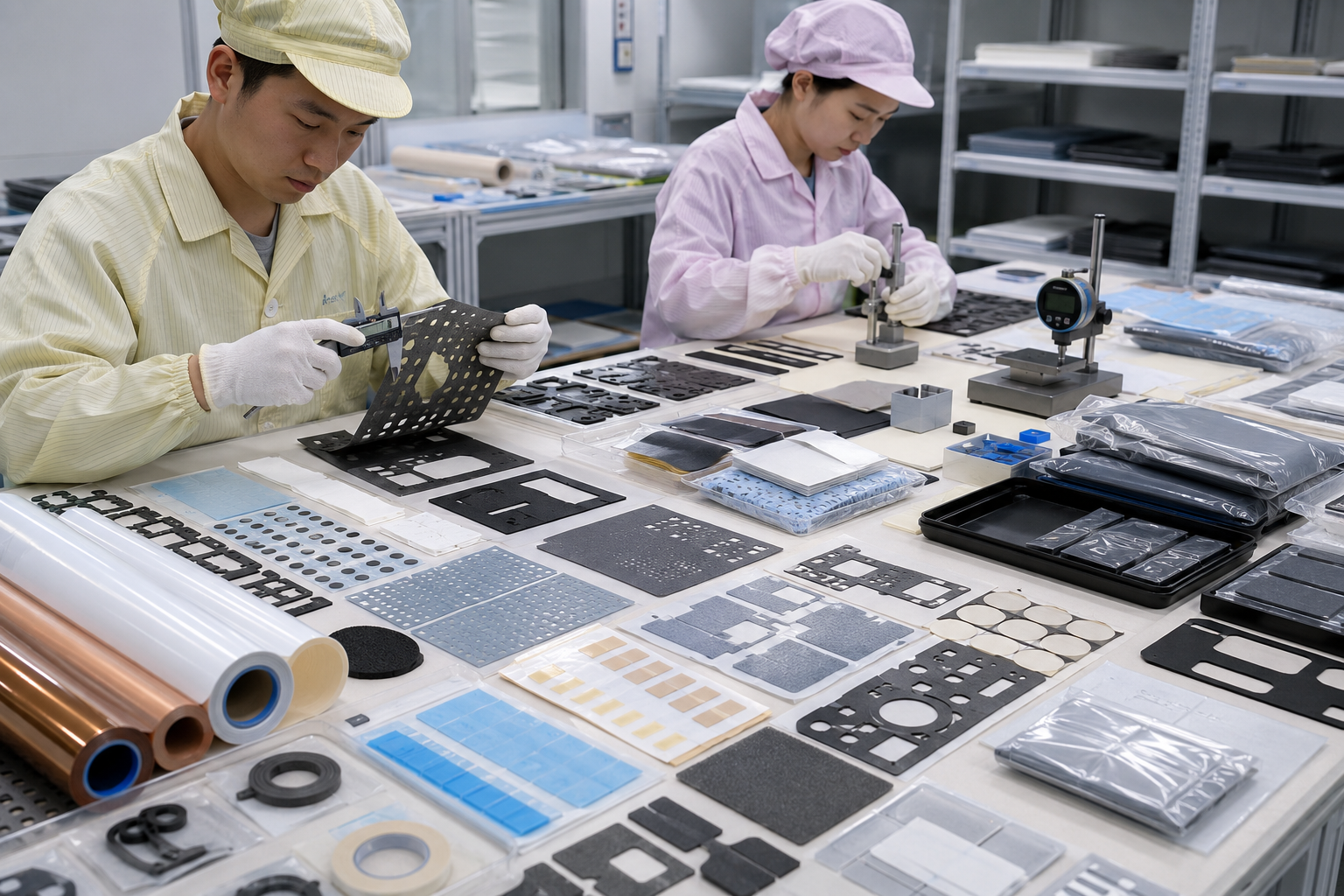
For each project, we review material type, thickness, adhesive structure, liner release, perforation pattern, cutting depth, tolerance, edge quality, packaging, and final assembly method.
Our goal is to help customers choose the right converting process, reduce handling problems, improve assembly efficiency, and maintain stable quality from prototype to mass production.
What Buyers Should Provide Before Starting a Project
To choose the right process, buyers should provide:
- 2D drawing
- Material requirement
- Thickness requirement
- Adhesive structure
- Liner requirement
- Perforation pattern if needed
- Tear strength requirement if needed
- Critical dimensions
- Assembly method
- Bonding surface
- Packaging preference
- Expected quantity
- Sample or reference part if available
Clear information helps the supplier recommend whether perforation, die cutting, kiss cutting, through cutting, or a combined process is most suitable.
Conclusion
Perforation and die cutting are both important processes for flexible materials, but they are used for different purposes. Perforation creates controlled tear lines, venting patterns, fold lines, or separation points. Die cutting creates finished custom parts with specific shapes, holes, windows, and assembly features.
For OEM projects, the best process depends on material function, thickness, adhesive structure, liner design, tolerance, assembly method, and packaging requirement. In many cases, perforation and die cutting work together to improve handling, application, and final part performance.
At Sanken, we help OEM customers convert foam, rubber, PET, PI, protective film, adhesive tape, non-woven felt, and multilayer flexible materials into clean, accurate, assembly-ready parts for stable production.