
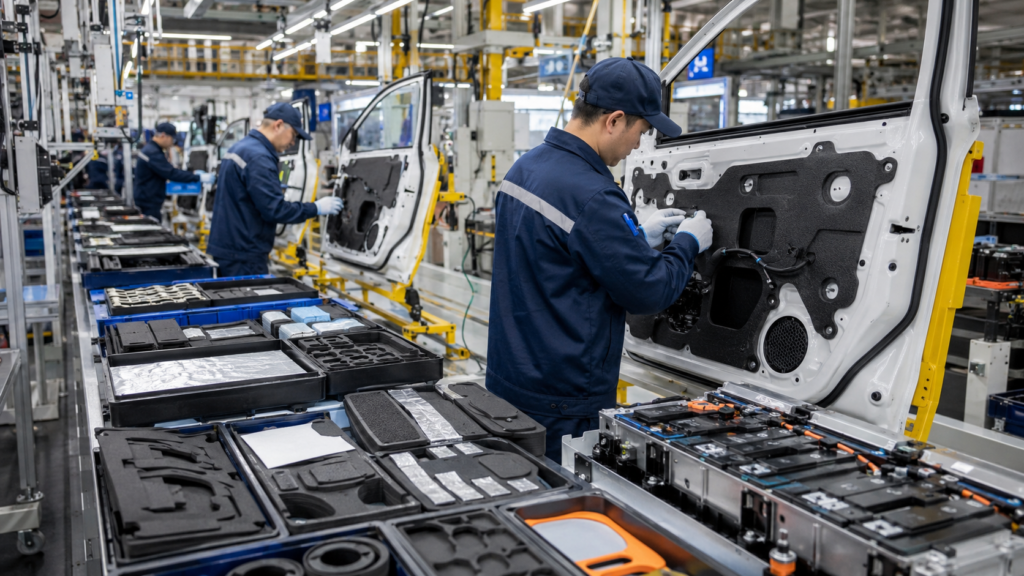
Automotive die cutting solutions are used to manufacture precision foam, rubber, felt, adhesive tape and insulation film components for vehicle assembly. These parts support sealing, bonding, vibration damping, sound absorption, electrical insulation, thermal protection and anti-rattle performance in automotive interiors, electronics, battery modules, sensors and structural assemblies.
For OEM buyers and automotive engineers, the challenge is not only cutting a material into a shape. The real challenge is keeping thickness, tolerance, compression, adhesive performance and batch consistency stable from sample development to mass production.
At Sanken Manufacturing Co., Ltd., we often remind our team of a simple truth: if a die-cut component is doing its job perfectly, nobody will ever think about it. But if it is even slightly off, the vehicle may show problems through squeaks, vibration, misalignment, adhesive lifting, sealing failure or insulation issues.
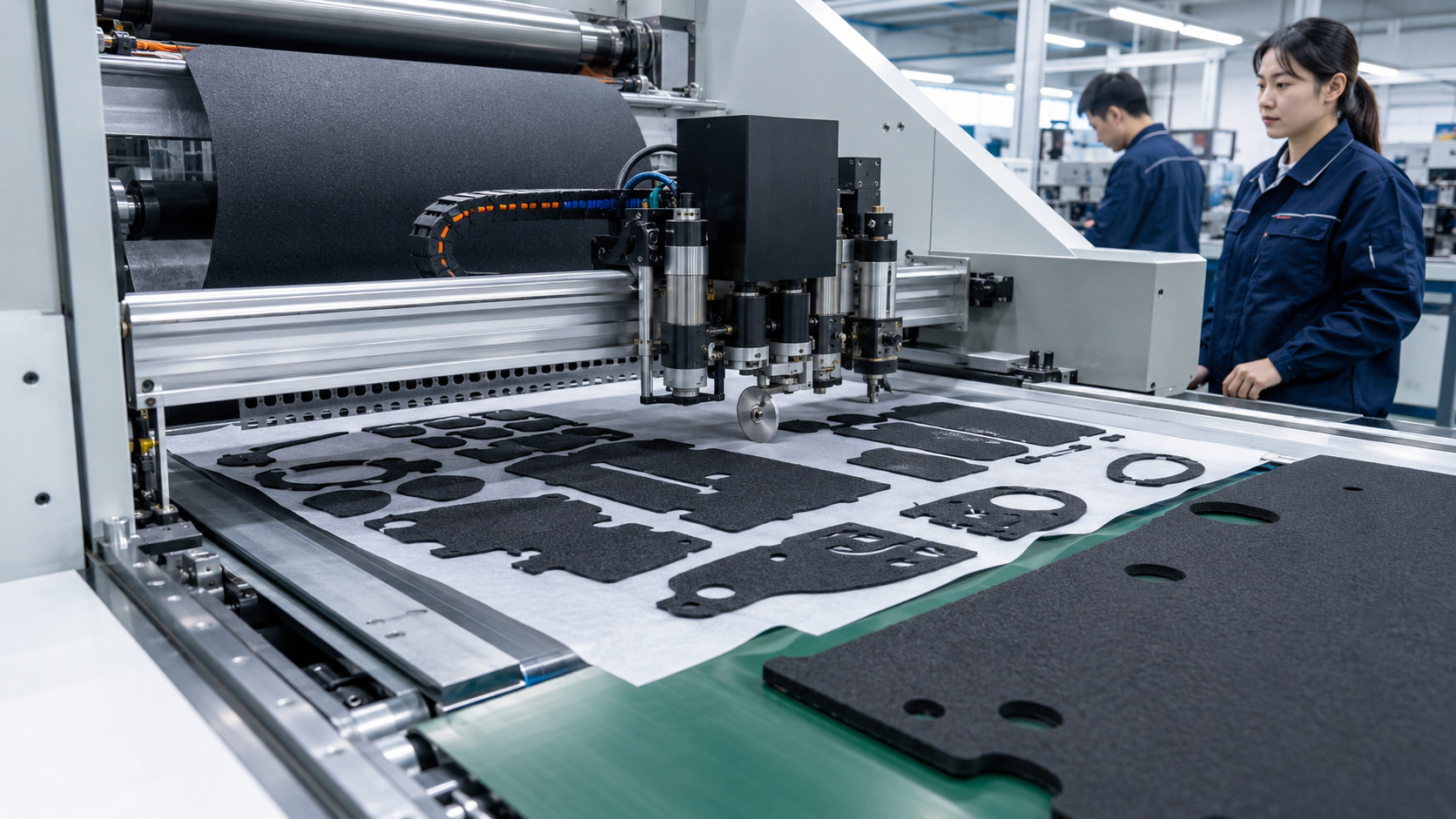
In today’s automotive industry, engineering complexity is rising faster than assembly simplicity.
OEMs are designing:
- thinner dashboards
- lighter doors
- tighter battery enclosures
- more integrated electronics
- multi-functional interior modules
Every millimeter is now negotiated.
Every material layer must justify its existence.
This is where precision die-cutting becomes a critical enabler rather than a secondary process.
Because when space disappears, only precision remains.
Why does precision die-cutting define modern automotive performance?
Because vehicles are no longer “mechanical products.”
They are layered systems of interacting materials.
Inside one door module alone, you may find:
- vibration damping pads
- sealing gaskets
- acoustic insulation layers
- wiring protection films
- anti-scratch spacers
- adhesive positioning components
Each one must align perfectly.
Not “almost.”
Perfectly.
Even a 0.3 mm deviation can create:
- assembly stress
- uneven compression
- adhesive failure points
- rattling under vibration
At Sanken, we treat precision not as a specification.
We treat it as a survival condition for the system.
What makes automotive precision die-cutting so challenging?
Unlike general industrial cutting, automotive applications face a brutal combination of constraints:
1. Multi-material complexity
Foam, rubber, felt, adhesive tape, film — all behave differently under pressure and temperature.
2. Tight tolerance stacking
Multiple layers accumulate error. Small deviations become large failures.
3. Dynamic operating conditions
Heat, vibration, humidity, and long-term compression constantly change material behavior.
4. High-speed production requirements
Millions of units must maintain identical performance.
This is where many suppliers struggle.
Because cutting shape is easy.
But controlling long-term behavior is not.
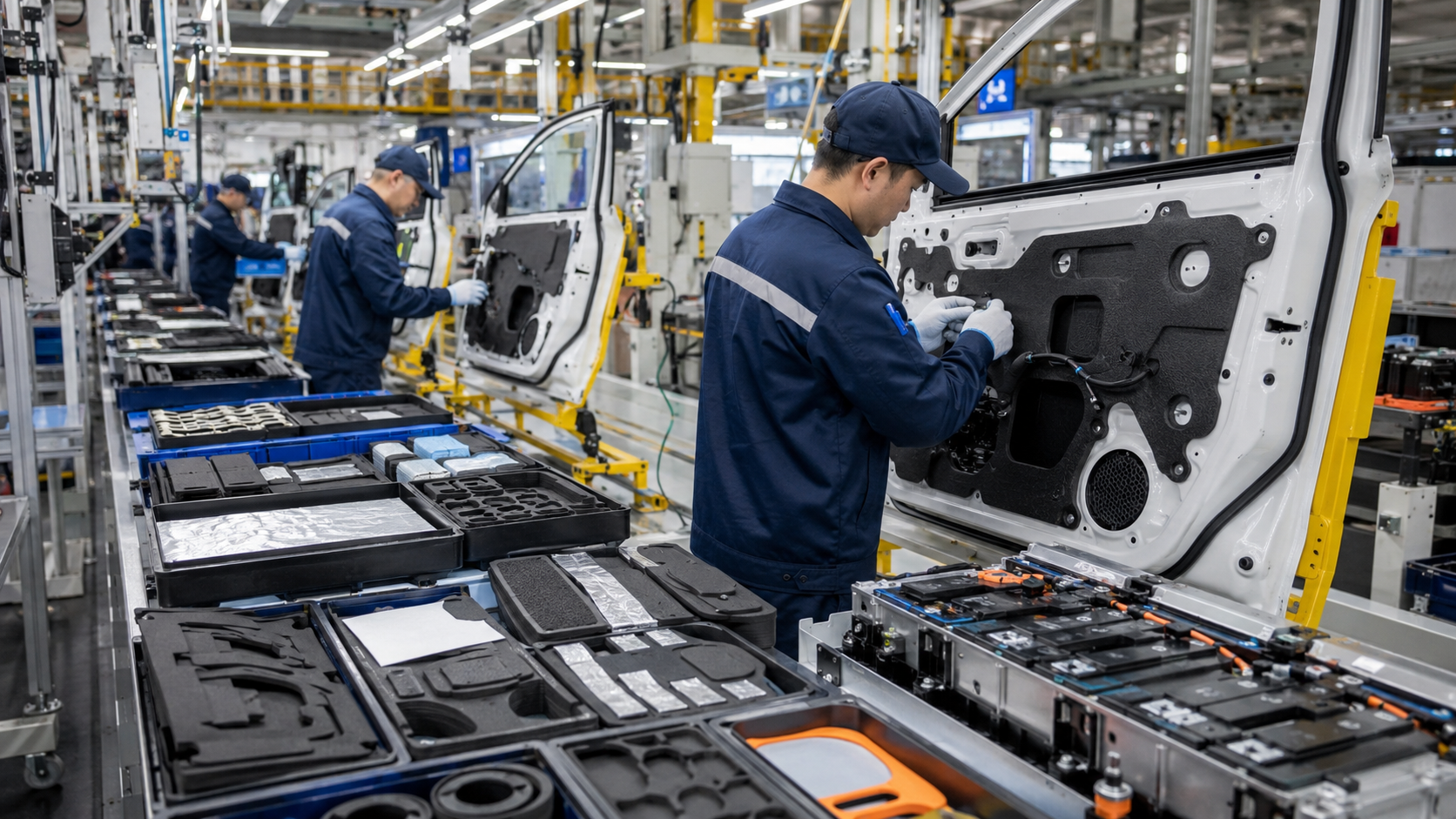
How does Sanken approach precision die-cutting differently?
We don’t start with the cutting process.
We start with the final installed behavior inside the vehicle.
That changes everything.
Instead of asking:
“What shape should we cut?”
We ask:
“What mechanical behavior must this part maintain after 3 years of vibration, heat cycles, and compression stress?”
From there, we design:
- material selection strategy
- layer structure optimization
- adhesive behavior control
- cutting geometry compensation
- tolerance compensation logic
Precision is not just geometry.
It is prediction.
Most people underestimate tooling.
But in automotive production, tooling defines reality.
A perfect material with poor tooling still produces:
- burr edges
- dimensional drift
- inconsistent compression response
- assembly misfit
At Sanken, tooling is treated as a living system:
- continuous calibration cycles
- wear compensation tracking
- multi-stage verification
- geometry stability control
Because once a tool drifts, every part drifts with it.
And automotive production never forgives drift.
What materials are most sensitive in precision die-cutting?
Some materials look simple but behave aggressively under processing:
- soft foam collapses under pressure variation
- rubber rebounds differently depending on temperature
- adhesive tapes shift under cutting heat
- non-woven structures fray at unstable edges
- composite laminates delaminate if pressure is uneven
That is why we carefully tune:
- blade sharpness curves
- cutting pressure distribution
- release liner stability
- lamination stress balance
Precision is not force.
It is control of force.
How precision die-cutting impacts vehicle comfort and safety
Most drivers will never hear the word “die-cutting.”
But they will feel its result.
If precision is achieved:
- doors close silently
- dashboards remain vibration-free
- batteries stay thermally stable
- interior panels remain aligned
- seals maintain airtight performance
If precision fails:
- noise appears
- efficiency drops
- long-term durability suffers
This is why automotive OEMs increasingly treat die-cut components as functional engineering parts, not consumables.
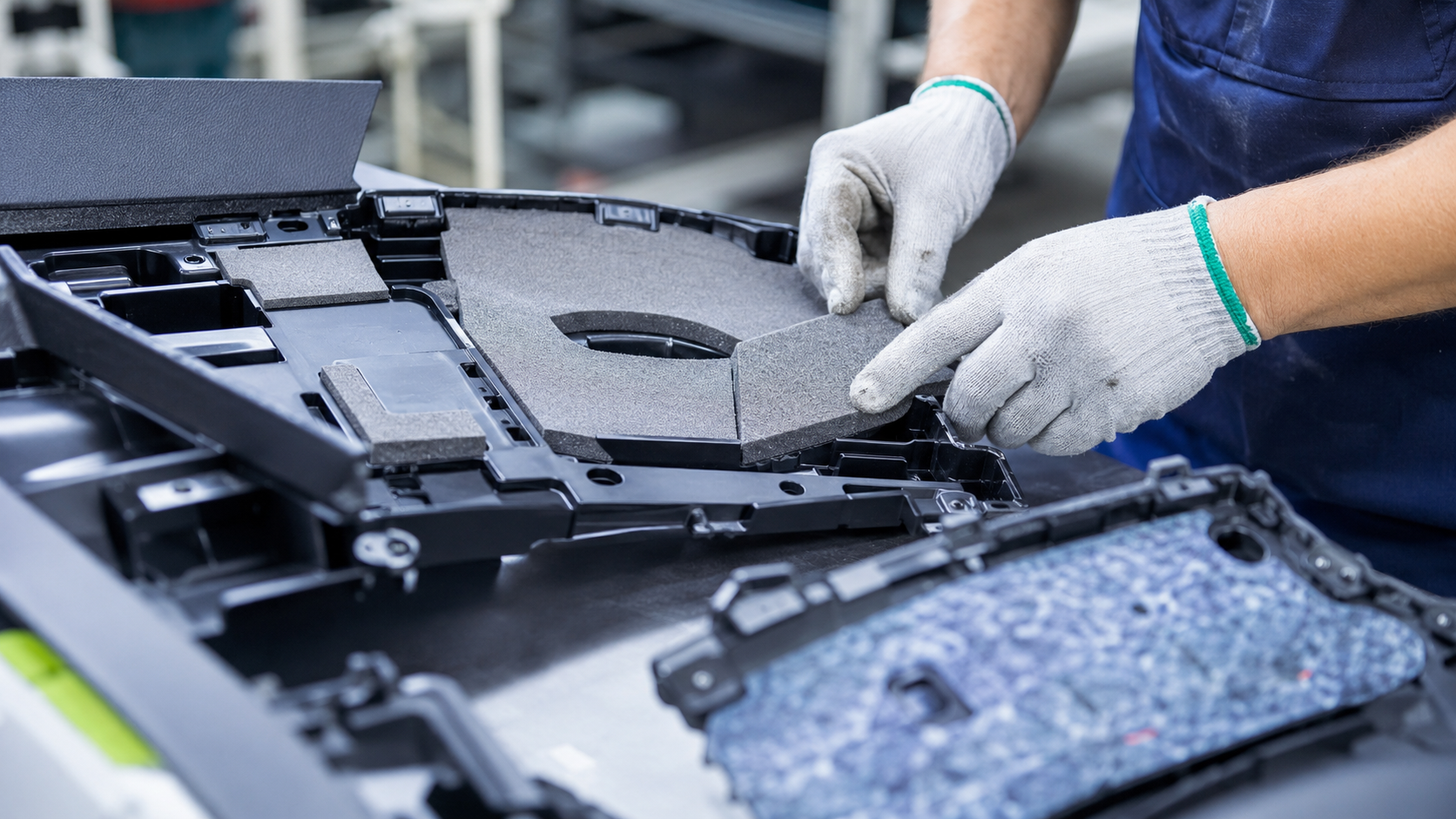
How does Sanken ensure repeatable precision in mass production?
In automotive manufacturing, one perfect sample means nothing.
Only batch consistency matters.
We achieve this through:
- controlled raw material intake systems
- standardized process parameters
- high-stability cutting platforms
- multi-layer inspection checkpoints
- dimensional feedback loops
- traceability across production batches
We also simulate installation conditions before mass release.
Because real performance only appears when parts are installed under stress, not in storage.
Why OEMs prefer integrated die-cutting partners
The automotive supply chain is becoming too fragmented.
One supplier for foam.
One for adhesive.
One for cutting.
One for assembly prep.
This structure creates hidden risks:
- communication delays
- tolerance mismatch
- responsibility gaps
- inconsistent quality control
That is why OEMs are shifting toward integrated partners like Sanken, who can handle:
- material processing
- multi-layer lamination
- precision die-cutting
- forming and shaping
- assembly-ready delivery
This reduces friction in the system.
And increases reliability in production.
What do automotive engineers actually want from precision die-cutting suppliers?
They rarely ask for “cutting services.”
What they really want is:
- predictable performance
- stable installation behavior
- fewer assembly issues
- reduced warranty risk
- simplified sourcing structure
- engineering collaboration support
In short:
They want parts that disappear into the system without causing problems.
That is exactly what precision should achieve.
Conclusion
Precision die-cutting is no longer a simple manufacturing step.
It is a critical engineering discipline that determines whether modern vehicles feel refined or problematic.
At Sanken, we build die-cut solutions that integrate materials, geometry, and production stability — ensuring every component performs exactly as intended, every time.