
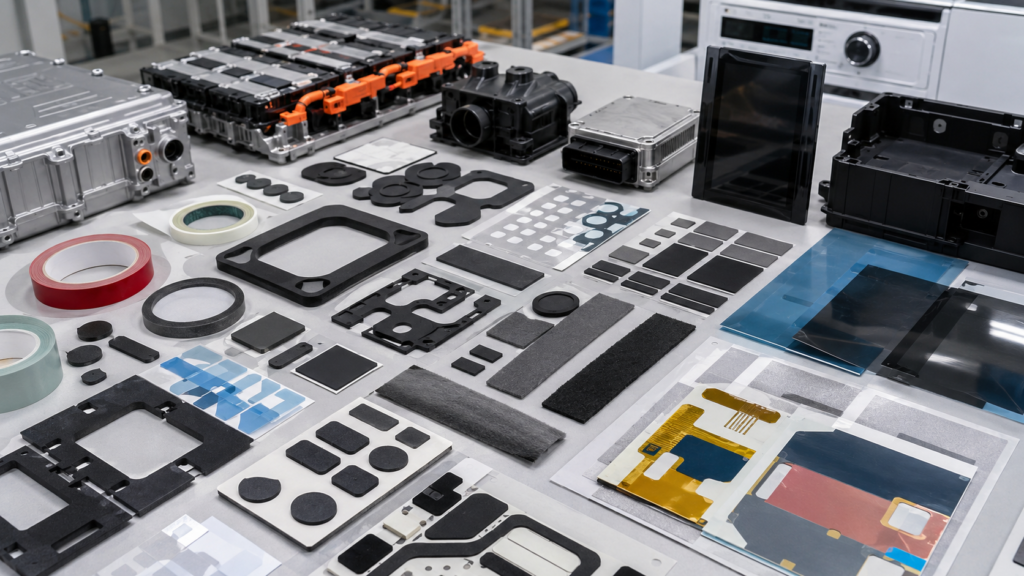
Custom die cut parts are used in automotive and electronics manufacturing to seal, bond, insulate, cushion, protect, reduce vibration, block light, control noise, and support efficient assembly. These parts are often small and hidden inside the final product, but they can directly affect product reliability, assembly speed, appearance, comfort, and long-term performance.
For OEM engineers and purchasing teams, custom die cut parts are not just “cut shapes.” They are functional components made from foam, rubber, adhesive tape, PET film, PI film, protective film, non-woven felt, light-blocking materials, and multilayer laminated materials.
At Sanken, we focus on custom precision die cutting and material converting for automotive, electronics, battery, optical display, appliance, medical device, and industrial OEM applications. Our products include foam gaskets, adhesive tape parts, PET insulation films, PI films, protective films, rubber pads, non-woven felt NVH parts, sealing components, and multilayer die cut auxiliary materials.
Why Automotive and Electronics Manufacturers Use Custom Die Cut Parts
Automotive and electronics products contain many small gaps, contact points, bonding areas, insulation zones, and protection surfaces. Standard sheets or manually cut materials are difficult to use when the product requires accurate holes, thin walls, special shapes, adhesive backing, clean edges, or repeatable mass production.
Custom die cutting converts flexible materials into parts that match the real product design.
A custom die cut component may include:
- Holes for screws, posts, connectors, or sensors
- Slots and windows for positioning
- Adhesive backing for easy assembly
- Release liner for clean peeling
- Pull tabs for operator handling
- Rounded corners to reduce lifting
- Multilayer structures for combined functions
- Clean packaging for production line use
In automotive and electronics manufacturing, these details matter because assembly space is limited and quality requirements are high.
Main Functions of Custom Die Cut Parts
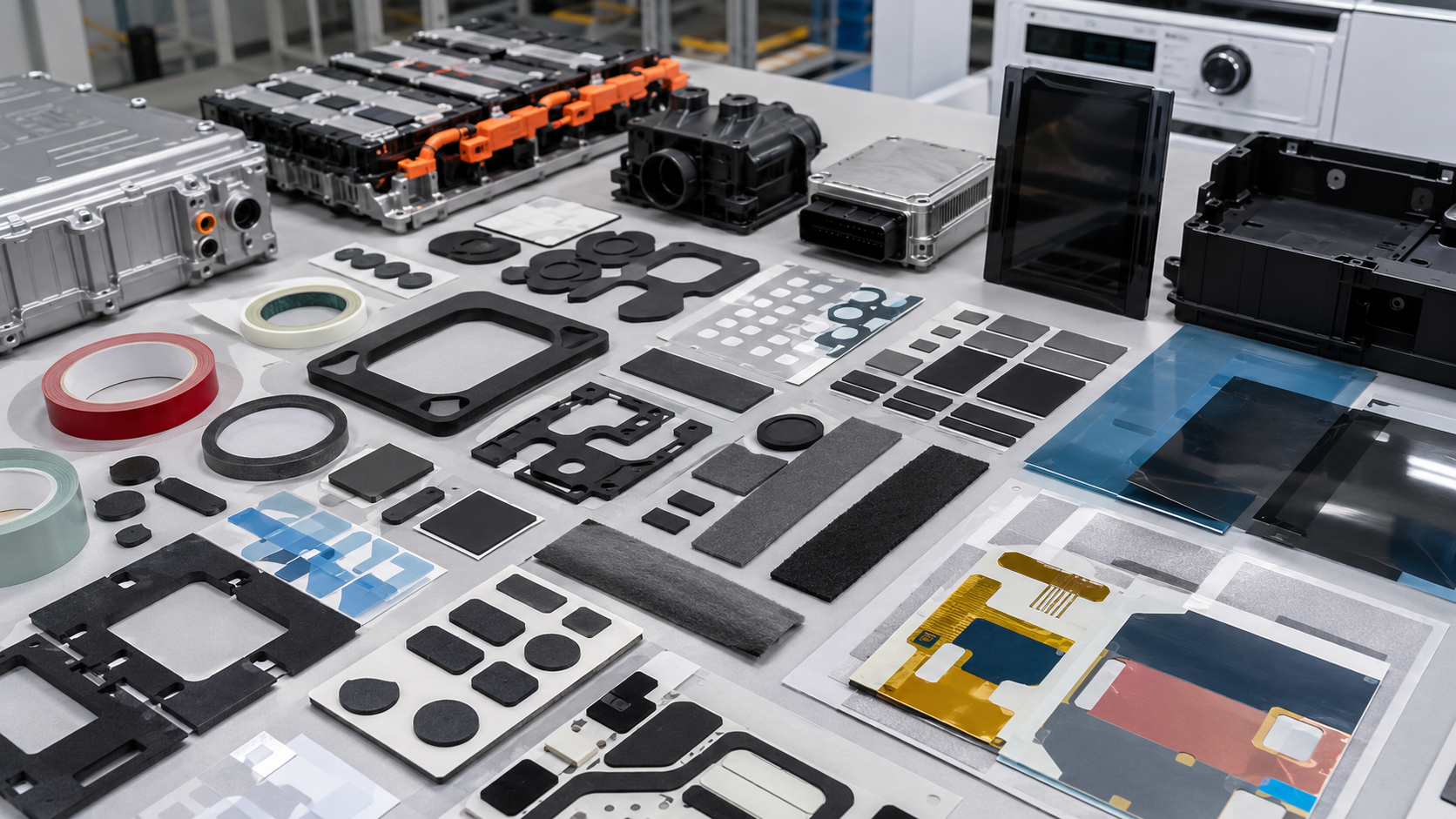
Custom die cut parts are used for many different functions. The correct material depends on what the part needs to do inside the final product.
| Function | Common Materials | Typical Use |
|---|---|---|
| Sealing | Foam, rubber, silicone foam, EPDM foam | Dust sealing, water resistance, housing gaskets |
| Bonding | Double-sided tape, transfer adhesive, foam tape | Display bonding, module assembly, component mounting |
| Insulation | PET film, PI film, PC film | Battery, electronics, circuit protection |
| Cushioning | PE foam, PU foam, EVA foam, rubber | Shock absorption, surface protection, gap filling |
| NVH control | Non-woven felt, foam, rubber | Anti-rattle, anti-squeak, vibration reduction |
| Light blocking | Black PET, black foam, light-shielding tape | Displays, sensors, optical modules |
| Surface protection | Protective film, PET film | Screens, lenses, panels, covers |
| Spacing | Foam, film, rubber, adhesive pads | Gap control and assembly positioning |
A single product may use many die cut parts at the same time. For example, an automotive electronic module may need a foam gasket, PET insulation film, adhesive tape pad, protective film, and rubber damping pad.
Automotive Applications of Custom Die Cut Parts
In automotive manufacturing, custom die cut parts are used in interiors, electronics, battery modules, sensors, lighting systems, displays, wire harness areas, and body-related assemblies.
Common automotive die cut applications include:
- Foam gaskets for electronic housings
- Non-woven felt pads for NVH noise reduction
- Rubber damping pads for vibration control
- Adhesive-backed sealing strips
- PET and PI insulation films for battery and electronics
- Protective films for interior trim and display surfaces
- Foam pads for anti-rattle and cushioning
- Light-blocking films for display and sensor areas
- Double-sided tape parts for component mounting
Automotive components must often resist vibration, temperature changes, compression, dust, humidity, and long-term use. This means material selection is very important.
For example, an automotive foam gasket must match the housing gap and compression range. A felt strip must reduce squeak or rattle without shedding fibers. A PET insulation film must have clean holes and stable dimensions. A tape part must bond well to plastic, metal, painted surfaces, or coated materials.
Electronics Applications of Custom Die Cut Parts
In electronics manufacturing, custom die cut parts are used in displays, batteries, sensors, camera modules, speakers, circuit boards, housings, connectors, and consumer electronic assemblies.
Common electronics die cut applications include:
- PET insulation films
- PI high-temperature insulation films
- Protective films for screens and lenses
- Display bonding tapes
- Foam gaskets for dust sealing
- Light-blocking films for sensors and optical modules
- Double-sided adhesive pads
- Rubber cushioning pads
- Thin foam spacers
- Battery insulation and protection films
- Masking and temporary protection films
Electronic products often require clean edges, accurate dimensions, low contamination, stable adhesive behavior, and easy assembly. Dust, fibers, scratches, adhesive strings, or film curling can create defects during production.
For display and optical applications, surface cleanliness is especially important. For battery and circuit applications, insulation, hole alignment, and edge quality are critical.
Foam Die Cut Parts for Sealing and Cushioning
Foam is widely used in both automotive and electronics manufacturing because it can compress, cushion, seal, fill gaps, and reduce vibration.
Common foam materials include PE foam, PU foam, EVA foam, EPDM foam, silicone foam, and CR foam.
Foam die cut parts are often used as:
- Housing gaskets
- Dust sealing pads
- Cushioning pads
- Anti-rattle pads
- Gap fillers
- Display spacers
- Battery module support pads
- Protective foam inserts
The correct foam depends on thickness, density, compression force, rebound, cell structure, adhesive backing, and working environment.
A foam gasket that is too soft may collapse. A foam pad that is too hard may create assembly stress. A foam part with poor edge quality may generate dust or fail inspection.
Adhesive Tape Die Cut Parts for Bonding and Positioning
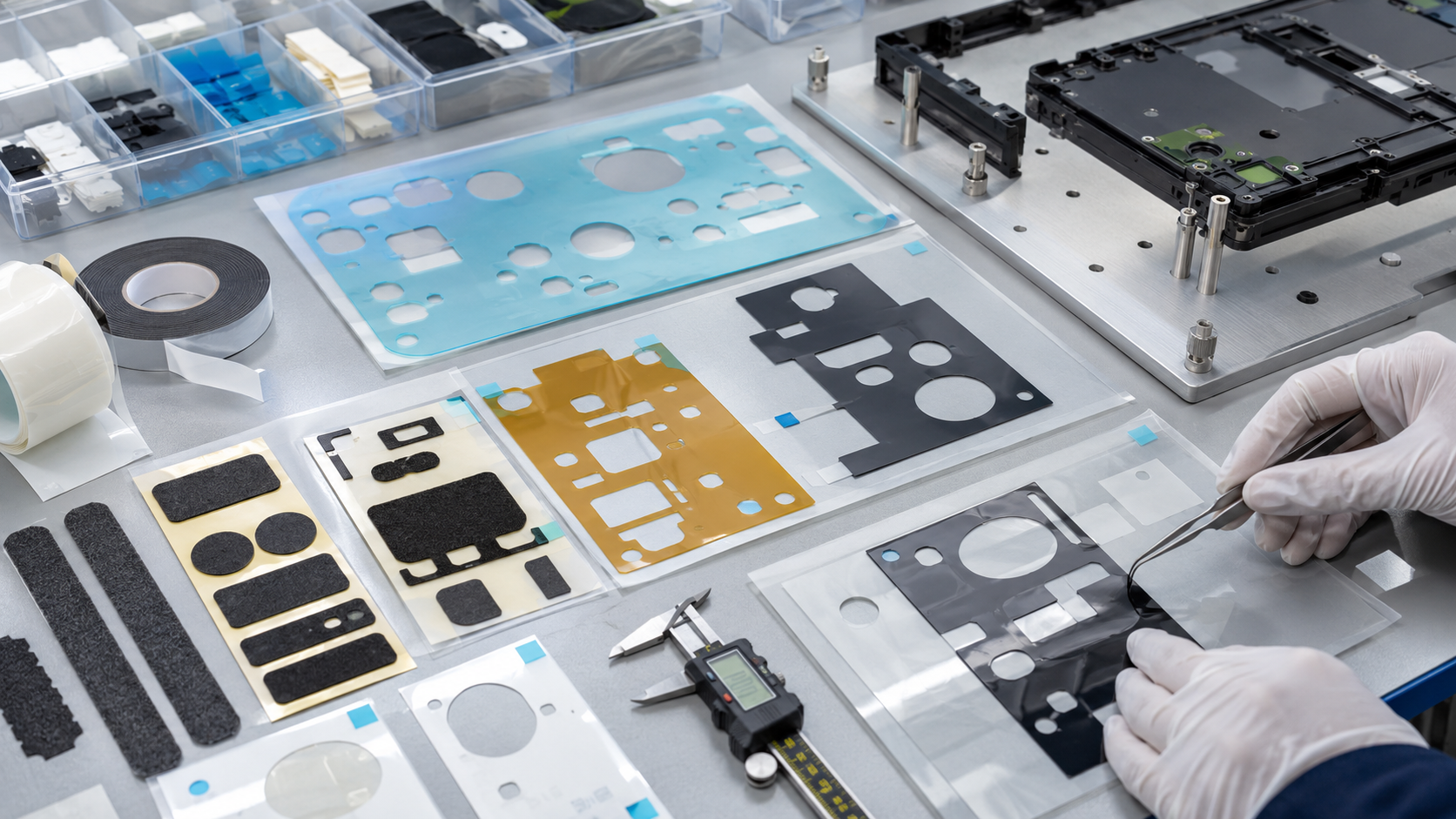
Adhesive tape parts are used when OEM assembly needs clean, fast, and repeatable bonding.
Common adhesive materials include double-sided tape, transfer adhesive, PET carrier tape, foam tape, acrylic foam tape, and removable adhesive film.
Adhesive die cut parts are used for:
- Display bonding
- Sensor assembly
- Foam gasket attachment
- Protective film tabs
- Battery insulation film bonding
- Automotive electronic module assembly
- Plastic housing bonding
- Component positioning
Adhesive selection must match the bonding surface. Automotive and electronics parts may use ABS, PC, PP, PE, metal, glass, painted surfaces, rubber, coating, or powder-coated surfaces.
Liner release is also important. If the part is hard to peel, operators may stretch or damage it. If the liner is too loose, parts may shift during packaging or transportation.
PET and PI Films for Insulation and Protection
PET and PI films are commonly used for electrical insulation, spacing, and protection in automotive electronics, EV battery packs, circuit assemblies, displays, and industrial electronics.
PET film is often selected for stable insulation and clean die cutting. PI film is used when higher heat resistance is needed.
Common film applications include:
- Battery insulation films
- Circuit protection films
- Connector insulation parts
- PET spacers
- PI high-temperature insulation parts
- Protective film windows
- Display module films
- Light-blocking film components
Film die cut parts usually require accurate holes, clean edges, stable flatness, and scratch-free handling. Thin films may curl or shift if tension, cutting pressure, or packaging is not controlled.
Non-Woven Felt Parts for Automotive NVH
Non-woven felt is commonly used in automotive applications for NVH control, anti-rattle performance, friction reduction, and soft separation between contact surfaces.
Felt die cut parts may be used in:
- Door trim
- Dashboard areas
- Pillar trim
- Center consoles
- Seat components
- Wire harness contact areas
- Speaker housings
- Interior plastic contact points
Felt can help reduce squeaks, rattles, and rubbing noise. Adhesive-backed felt strips make assembly easier and more repeatable.
For automotive felt parts, edge cleanliness, fiber shedding, thickness, density, adhesive bonding, and compression behavior should be reviewed before mass production.
Rubber Die Cut Parts for Damping and Durability
Rubber die cut parts are used when stronger durability, damping, impact resistance, sealing pressure, or anti-slip function is needed.
Common rubber applications include:
- Rubber pads
- Sealing washers
- Damping pads
- Anti-slip feet
- Cushioning spacers
- Vibration control parts
- Electronic housing support pads
Rubber is usually stronger than foam, but it may require higher compression force. Engineers should review hardness, thickness, rebound, heat resistance, oil resistance, and tolerance behavior.
For precision die cut rubber parts, material rebound and edge quality are important because rubber can change slightly after cutting.
Multilayer Die Cut Parts for Assembly Efficiency
Many automotive and electronics components use multilayer structures instead of single materials.
Examples include:
- Foam plus double-sided tape
- PET film plus adhesive backing
- Felt plus pressure-sensitive adhesive
- Rubber plus adhesive liner
- Protective film plus pull tab
- PI film plus release liner
- Foam gasket plus PET carrier layer
- Light-blocking film plus adhesive tape
Multilayer die cut parts can reduce customer assembly steps because the finished part arrives ready to use. However, they require good control of lamination, layer alignment, adhesive position, kiss cutting depth, liner release, and waste removal.
Common Problems Custom Die Cut Parts Help Solve
Custom die cut parts help OEM manufacturers prevent many production and product problems.
| Problem | Die Cut Solution |
|---|---|
| Dust entering housing | Foam gasket or sealing strip |
| Vibration noise | Foam, rubber, or felt pad |
| Electrical contact risk | PET or PI insulation film |
| Surface scratches | Protective film |
| Poor bonding consistency | Die cut adhesive tape |
| Display light leakage | Black film or light-blocking gasket |
| Rattle in automotive interior | Non-woven felt or foam pad |
| Assembly positioning error | Custom adhesive spacer or liner-backed part |
| Component damage during handling | Foam cushioning pad |
The best die cut part should solve the real application problem, not only match the drawing.
How Sanken Supports Automotive and Electronics OEM Projects
Sanken Manufacturing Co., Ltd. supports OEM customers with precision die cutting, adhesive lamination, material converting, clean handling, inspection, and assembly-ready packaging.
For automotive projects, we support foam gaskets, non-woven felt NVH parts, rubber pads, adhesive strips, protective films, PET insulation films, and sealing components.
For electronics projects, we support PET and PI films, protective films, display tapes, light-blocking films, foam spacers, adhesive pads, rubber cushioning parts, and multilayer converted components.
For each project, we review:
- Part function
- Material type
- Thickness and tolerance
- Foam compression
- Rubber hardness
- Film stability
- Adhesive structure
- Bonding surface
- Liner release
- Edge cleanliness
- Hole alignment
- Packaging format
- Assembly method
- Testing requirement
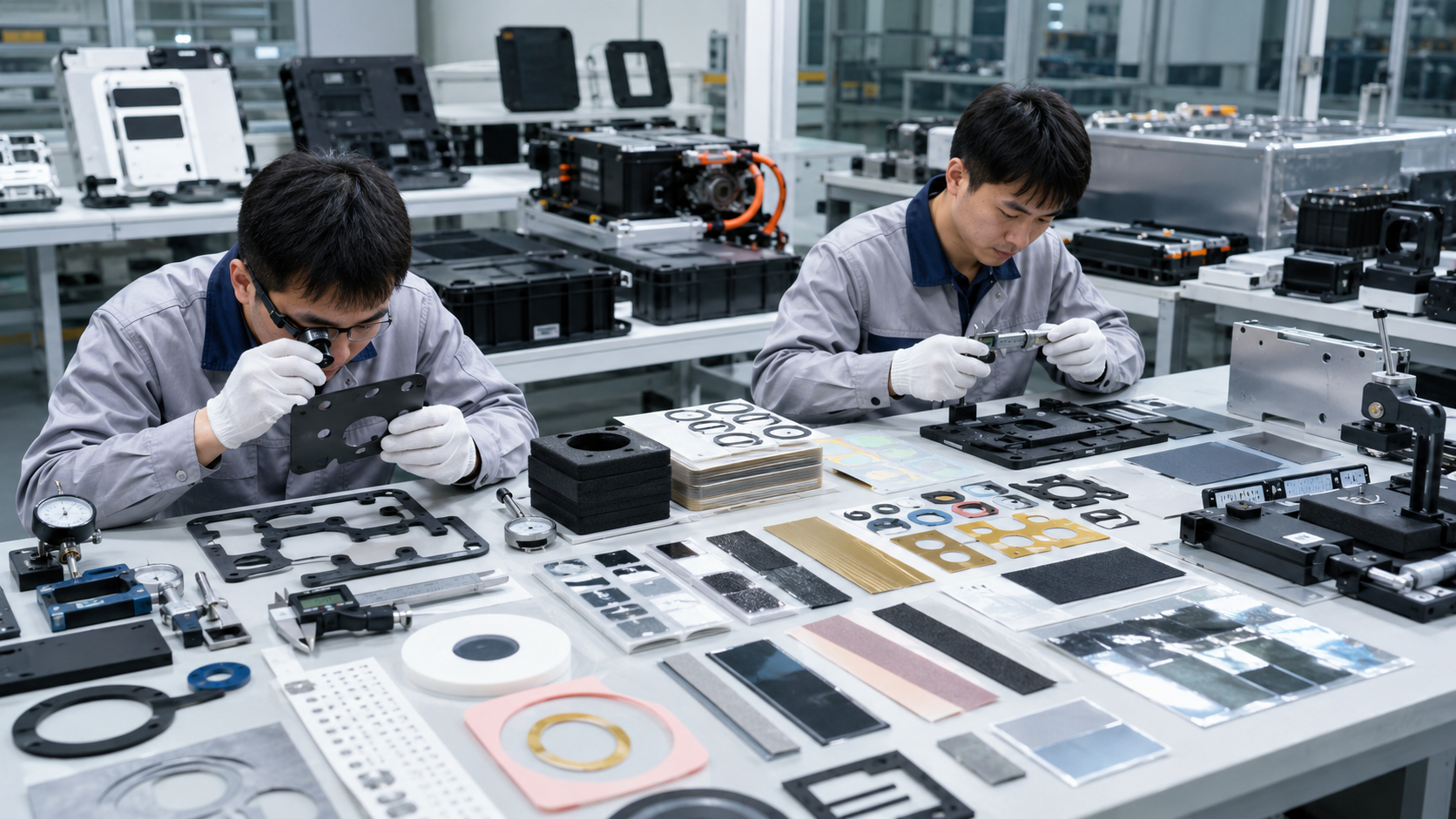
Our goal is to help customers reduce poor fit, adhesive lifting, liner release problems, fiber shedding, contamination, inspection failure, repeated samples, and unstable mass production.
FAQ
What are custom die cut parts used for in automotive manufacturing?
They are used for sealing, cushioning, NVH noise reduction, vibration damping, insulation, bonding, surface protection, and assembly support in automotive interiors, electronics, battery modules, displays, sensors, and housings.
What are custom die cut parts used for in electronics manufacturing?
They are used for PET insulation films, PI films, protective films, display bonding tapes, foam gaskets, light-blocking films, rubber pads, adhesive spacers, and battery protection components.
What materials can be used for custom die cut parts?
Common materials include foam, rubber, PET film, PI film, PC film, protective film, double-sided tape, transfer adhesive, non-woven felt, light-blocking film, and multilayer laminated materials.
Why do OEM manufacturers use custom die cut parts?
OEM manufacturers use custom die cut parts because they fit the product design, improve assembly speed, reduce manual cutting, improve consistency, and support functions such as sealing, bonding, insulation, cushioning, and protection.
Can adhesive-backed materials be die cut?
Yes. Adhesive-backed foam, tape, film, rubber, and felt can be kiss cut or through cut into custom shapes with release liners for easy assembly.
Why is cleanliness important for electronics die cut parts?
Dust, fibers, scratches, and adhesive residue can affect bonding, insulation, display appearance, optical quality, and final assembly yield.
Can Sanken make custom die cut parts for automotive and electronics OEM projects?
Yes. Sanken supports custom die cut foam gaskets, adhesive tape parts, PET and PI films, protective films, rubber pads, non-woven felt NVH parts, light-blocking materials, and multilayer components for automotive and electronics manufacturing.
Conclusion
Custom die cut parts are widely used in automotive and electronics manufacturing because they solve practical assembly and performance problems. They help products seal, bond, insulate, cushion, protect, reduce vibration, control noise, block light, and improve production efficiency.
The right die cut part depends on material selection, tolerance, adhesive structure, edge quality, cleanliness, packaging, and final assembly conditions.
At Sanken, we help OEM customers convert foam, rubber, PET film, PI film, protective film, adhesive tape, non-woven felt, and multilayer materials into reliable custom die cut components for automotive and electronics applications.