
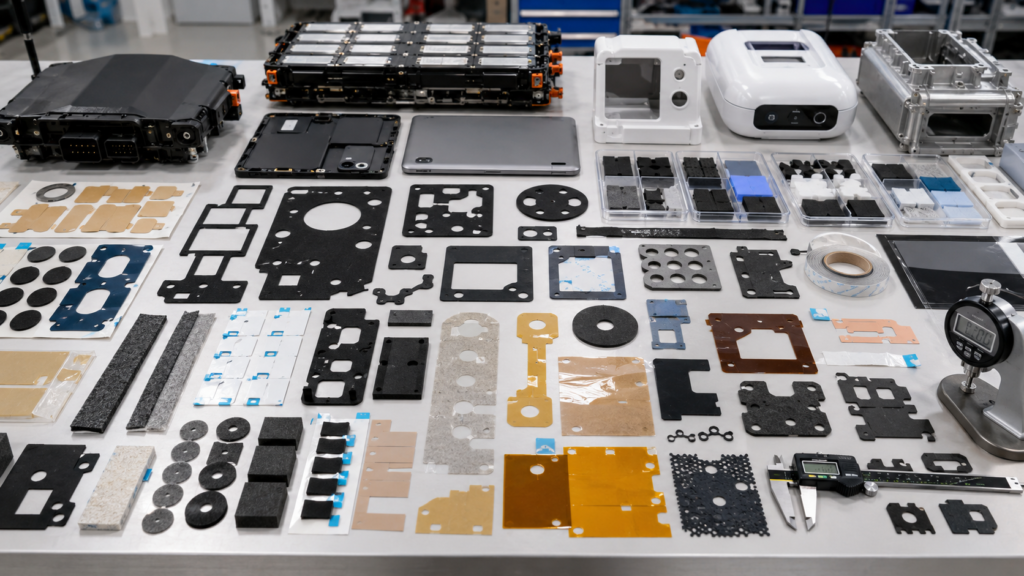
Custom die cut parts are used in OEM manufacturing to help products seal, bond, insulate, cushion, protect, reduce vibration, block light, control noise, and improve assembly efficiency. They are often small, thin, and hidden inside the final product, but they play an important role in how the product performs during use.
For OEM engineers and purchasing teams, custom die cut parts are not just “cut materials.” They are functional components made from foam, rubber, adhesive tape, PET film, PI film, protective film, non-woven felt, sponge, insulation materials, and multilayer laminated materials.
At Sanken, we help OEM customers develop custom die cut foam gaskets, adhesive tape components, PET insulation films, protective films, rubber pads, non-woven felt parts, acoustic pads, sealing strips, and multilayer converting parts for automotive, electronics, battery, medical, appliance, and industrial applications.
Why OEM Manufacturers Use Custom Die Cut Parts
OEM products often contain many small areas that need sealing, cushioning, bonding, insulation, or protection. These areas may be difficult to handle with standard parts because each product has a different shape, gap, surface, tolerance, and assembly requirement.
Custom die cutting allows materials to be converted into exact shapes that fit the product design.
A custom die cut part may be designed with:
- Holes
- Slots
- Windows
- Pull tabs
- Adhesive backing
- Release liner
- Rounded corners
- Narrow sealing walls
- Multilayer structures
- Special packaging format
This makes the part easier to assemble and more reliable than manually cut materials or standard sheets.
Common Uses of Custom Die Cut Parts
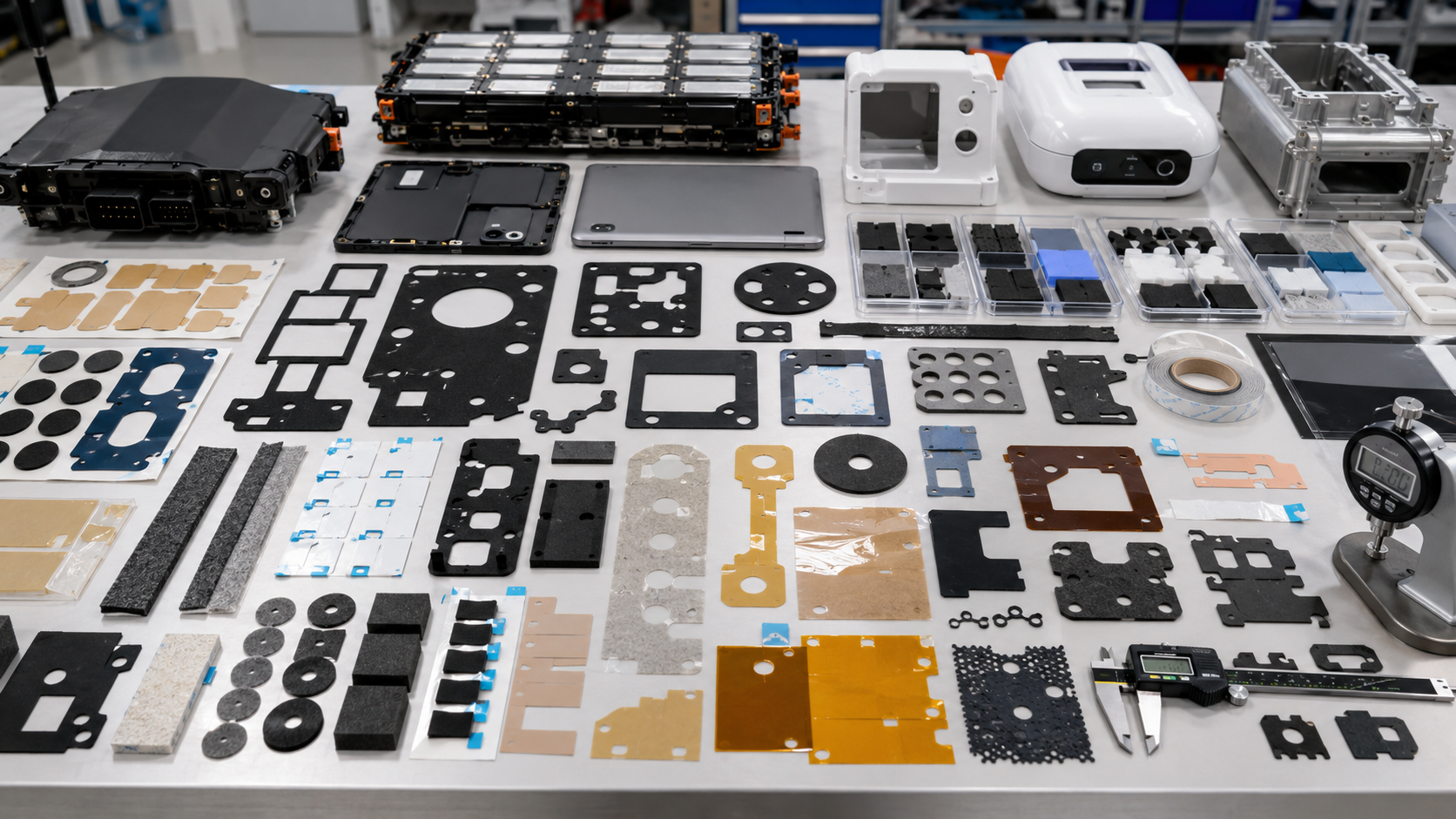
Custom die cut parts are used across many OEM applications because they can be designed for different material functions.
| Function | Common Materials | Typical OEM Use |
|---|---|---|
| Sealing | Foam, rubber, silicone foam, EPDM foam | Dust sealing, water resistance, housing gaskets |
| Bonding | Double-sided tape, transfer adhesive, foam tape | Mounting, positioning, assembly support |
| Insulation | PET film, PI film, PC film | Battery modules, electronics, electrical isolation |
| Cushioning | PE foam, PU foam, EVA foam, rubber | Shock absorption, surface protection |
| Protection | Protective film, PET film, foam | Scratch prevention, temporary protection |
| NVH control | Non-woven felt, foam, rubber | Anti-rattle, noise reduction, vibration control |
| Light blocking | Black PET, black foam, light-shielding tape | Display, sensor, optical module applications |
| Spacing | Foam, film, rubber, adhesive pads | Gap control and assembly positioning |
The same die cutting process can serve many industries, but the material and design must match the application.
Foam Gaskets for Sealing and Cushioning
Foam is one of the most common materials used for custom die cut parts. It is often selected when the part needs to compress, seal, cushion, fill a gap, or reduce vibration.
Custom die cut foam parts are used in:
- Automotive electronic housings
- Battery covers
- Display modules
- Speaker assemblies
- Appliance panels
- Medical device housings
- Industrial enclosures
- Consumer electronics
Foam gaskets can help prevent dust, air, moisture, and vibration from affecting the final product. They can also protect delicate surfaces during assembly.
Common foam materials include PE foam, PU foam, EVA foam, EPDM foam, silicone foam, and CR foam.
The right foam should be selected based on thickness, density, compression force, cell structure, rebound, adhesive requirement, and working environment.
Rubber Pads for Damping and Durability
Rubber die cut parts are used when the component needs stronger durability, vibration damping, sealing pressure, impact resistance, or anti-slip performance.
Custom rubber die cut parts may be used as:
- Rubber pads
- Sealing washers
- Anti-slip feet
- Vibration damping pads
- Cushioning spacers
- Mechanical contact pads
- Industrial equipment gaskets
Rubber is often stronger than foam, but it usually requires higher compression force. Engineers should review hardness, thickness, rebound, oil resistance, heat resistance, and edge quality before selecting rubber for an OEM part.
Rubber pads are especially useful in automotive, appliance, industrial, and electronic equipment where repeated contact or vibration is expected.
Adhesive Tape Parts for Bonding and Assembly
Many OEM products use custom die cut adhesive tape parts to improve assembly speed and bonding consistency.
Adhesive die cut parts can be made from double-sided tape, transfer adhesive, foam tape, PET carrier tape, acrylic foam tape, tissue tape, or specialty adhesive materials.
They are used for:
- Mounting displays
- Attaching foam gaskets
- Bonding plastic housings
- Fixing insulation films
- Holding protective films
- Positioning small components
- Sealing automotive electronics
- Supporting battery module assembly
For adhesive-backed parts, the adhesive must match the bonding surface. Common surfaces include ABS, PC, PP, PE, metal, glass, painted surfaces, rubber, and coated plastic.
Liner release is also important. If the part is difficult to peel, operators may stretch, bend, or damage it during assembly.
PET and PI Films for Electrical Insulation
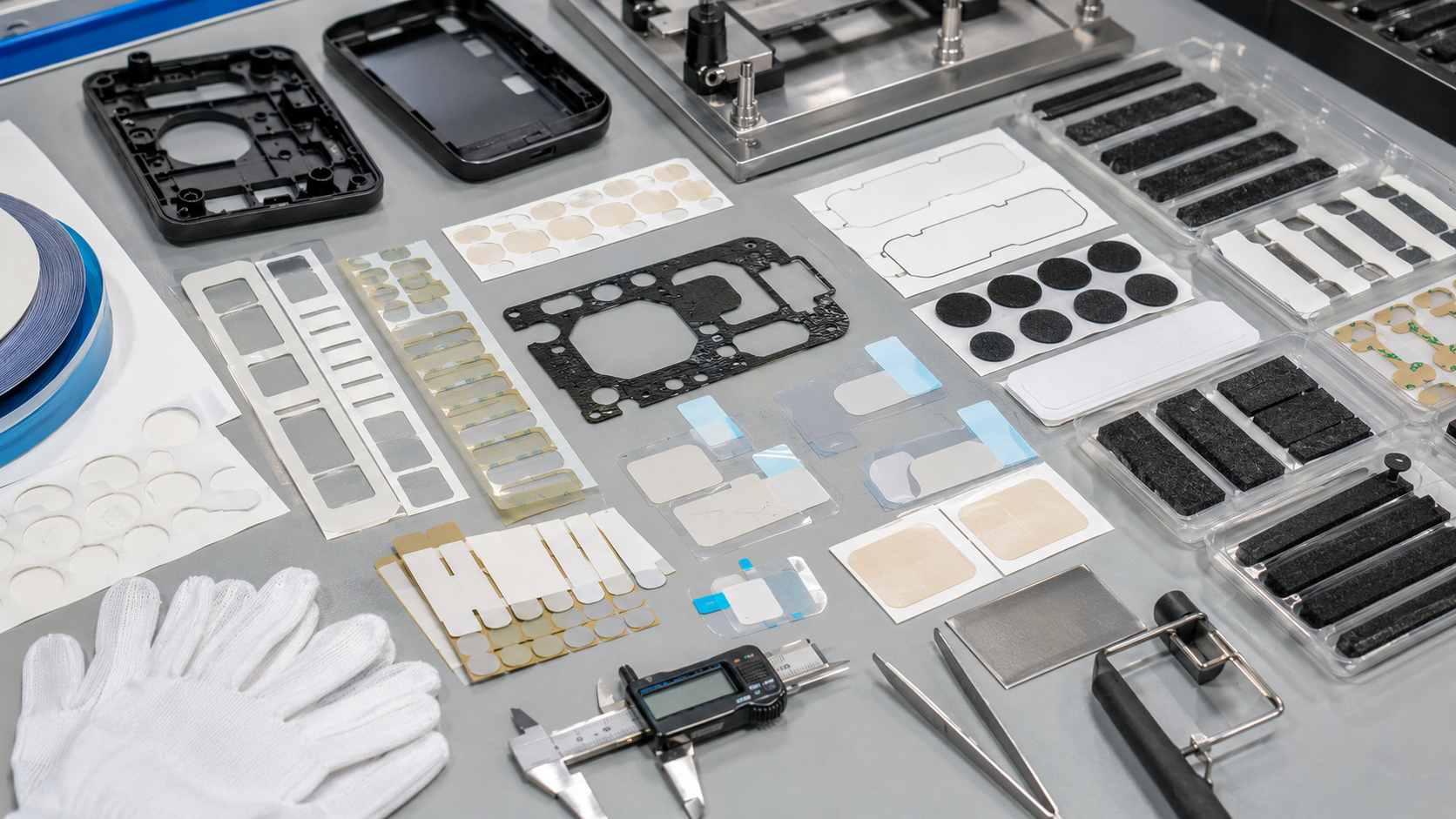
PET and PI film die cut parts are widely used in electronics, battery modules, displays, sensors, and industrial devices.
These materials are commonly used for:
- Electrical insulation
- Battery cell protection
- Spacer films
- Circuit protection
- Connector insulation
- Shielding support
- Heat-resistant insulation
- Surface separation
PET film is stable, clean, and suitable for many insulation and spacing applications. PI film is often used when higher heat resistance is required.
Film die cut parts usually require clean edges, accurate holes, stable dimensions, and controlled surface quality. In electronics and battery applications, small defects can create assembly or reliability risks.
Protective Films for Surface Protection
Protective film die cut parts are used to protect surfaces during manufacturing, transportation, or final assembly.
They may be applied to:
- Display screens
- Lens covers
- Plastic housings
- Metal panels
- Medical device surfaces
- Appliance parts
- Automotive interior parts
A custom die cut protective film may include a pull tab, easy-peel area, special shape, or adhesive-free handling zone.
The adhesive should protect the surface without leaving residue. The film should also be easy to remove without tearing or damaging the product.
Non-Woven Felt Parts for Automotive NVH
Non-woven felt is commonly used in automotive NVH applications to reduce noise, vibration, harshness, friction, squeaks, and rattles.
Custom die cut felt parts may be used in:
- Door trims
- Dashboard contact points
- Pillar trim
- Center consoles
- Wire harness areas
- Seat components
- Speaker housings
- Interior plastic contact areas
Felt parts can provide soft separation between hard surfaces and reduce friction noise. Adhesive-backed felt strips are especially useful for automotive interior assembly.
For felt die cut parts, edge cleanliness, fiber shedding, adhesive bonding, thickness, and compression behavior should be reviewed carefully.
Multilayer Die Cut Parts
Many OEM components use more than one material layer.
A multilayer die cut part may combine:
- Foam plus adhesive tape
- PET film plus double-sided tape
- Rubber plus liner
- Felt plus adhesive backing
- Protective film plus pull tab
- Foam plus PET carrier
- Insulation film plus adhesive spacer
Multilayer structures can improve assembly efficiency because the customer receives one ready-to-use component instead of applying several materials separately.
However, multilayer parts require good control of lamination, layer alignment, adhesive position, cutting depth, liner release, and waste removal.
Industries That Use Custom Die Cut Parts
Custom die cut parts are used in many OEM industries.
| Industry | Common Die Cut Applications |
|---|---|
| Automotive | Foam gaskets, felt NVH pads, rubber pads, adhesive strips, insulation films |
| Electronics | PET films, protective films, display tapes, foam pads, bonding components |
| Battery | Insulation films, foam pads, adhesive spacers, protective layers |
| Medical devices | Clean protective films, adhesive components, foam pads, insulation parts |
| Appliances | Sealing strips, cushioning pads, protective films, rubber parts |
| Industrial equipment | Gaskets, vibration pads, insulation films, protective components |
| Optical and display | Light-blocking parts, protective films, adhesive spacers, PET films |
The best die cut part design depends on the product’s working environment, assembly process, tolerance, surface condition, and testing needs.
Why Custom Die Cut Parts Improve OEM Assembly
Custom die cut parts help OEM manufacturers reduce manual cutting, improve repeatability, and make assembly faster.
They can help with:
- Faster part placement
- Better dimensional consistency
- Cleaner edges
- Lower assembly variation
- Reduced material waste
- Easier peeling and handling
- Better product appearance
- More stable sealing or bonding
- Lower rework risk
- Better mass production control
A good custom die cut component should not only fit the drawing. It should fit the assembly process.
Common Problems When Die Cut Parts Are Not Designed Correctly
Poorly designed or poorly manufactured die cut parts can create many production issues.
| Problem | Possible Cause |
|---|---|
| Poor fit | Wrong tolerance or material deformation |
| Adhesive lifting | Wrong adhesive or sharp corners |
| Hard peeling | Poor liner release or kiss cutting depth |
| Foam collapse | Wrong density or over-compression |
| Film curling | Material tension or packaging issue |
| Rough edges | Wrong blade, tooling, or material control |
| Hole mismatch | Poor registration or unstable material |
| Rework | Weak design review before production |
These problems are easier to prevent during material and drawing review than to fix after mass production starts.
How Sanken Supports Custom Die Cut OEM Parts
Sanken Manufacturing Co., Ltd. supports OEM customers with precision die cutting, adhesive lamination, material converting, foam and rubber components, PET and PI insulation films, protective films, non-woven felt parts, sealing gaskets, and custom adhesive-backed components.
For each project, we review:
- Part function
- Material type
- Thickness
- Foam compression
- Rubber hardness
- Film stability
- Adhesive structure
- Bonding surface
- Liner release
- Die cut tolerance
- Edge quality
- Waste removal
- Packaging format
- Assembly method
- Testing requirements
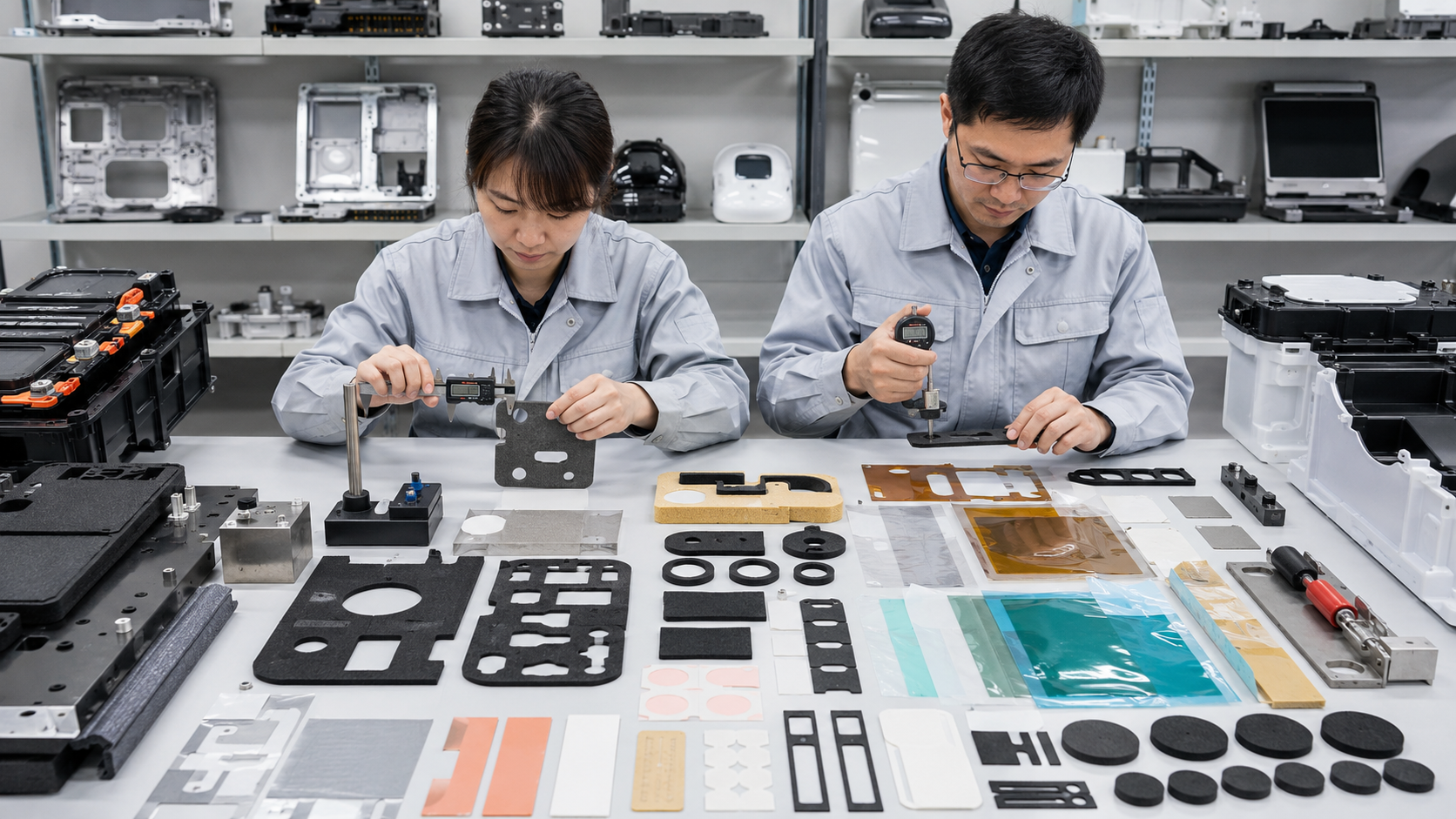
Our goal is to help customers reduce repeated samples, poor fit, adhesive lifting, liner release problems, rough edges, material waste, and unstable mass production.
A reliable custom die cut part should be clean, accurate, easy to handle, easy to assemble, and stable in the final OEM product.
FAQ
What are custom die cut parts?
Custom die cut parts are components cut from foam, rubber, film, tape, felt, or multilayer materials into specific shapes for sealing, bonding, insulation, cushioning, protection, spacing, or assembly support.
What are custom die cut parts used for in OEM manufacturing?
They are used for sealing housings, bonding parts, insulating electronics, protecting surfaces, reducing vibration, controlling noise, blocking light, and improving assembly efficiency.
What materials can be die cut?
Common die cut materials include foam, rubber, PET film, PI film, PC film, protective film, double-sided tape, transfer adhesive, non-woven felt, sponge, and multilayer laminated materials.
Are die cut parts only used for packaging?
No. Packaging is only one use. In OEM manufacturing, die cut parts are also used in automotive, electronics, battery, medical, appliance, display, and industrial products.
Why do OEM manufacturers use custom shapes?
Custom shapes help parts fit the product design, avoid interference, improve assembly speed, and meet functional requirements such as sealing, insulation, bonding, and cushioning.
Can adhesive-backed materials be die cut?
Yes. Adhesive-backed foam, tape, film, rubber, and felt can be kiss cut or through cut into custom shapes with release liners for easy assembly.
Can Sanken make custom die cut parts for OEM projects?
Yes. Sanken supports custom die cut foam gaskets, rubber pads, adhesive tape parts, PET and PI films, protective films, non-woven felt parts, and multilayer components for OEM manufacturing.
Conclusion
Custom die cut parts are used in OEM manufacturing to solve practical product and assembly problems. They help products seal, bond, insulate, cushion, protect, reduce noise, control vibration, block light, and improve assembly efficiency.
The right die cut part depends on the material, function, tolerance, adhesive structure, packaging format, and final application environment.
At Sanken, we help OEM customers convert foam, rubber, film, tape, felt, and multilayer materials into reliable custom die cut components for automotive, electronics, battery, medical, appliance, and industrial manufacturing.