
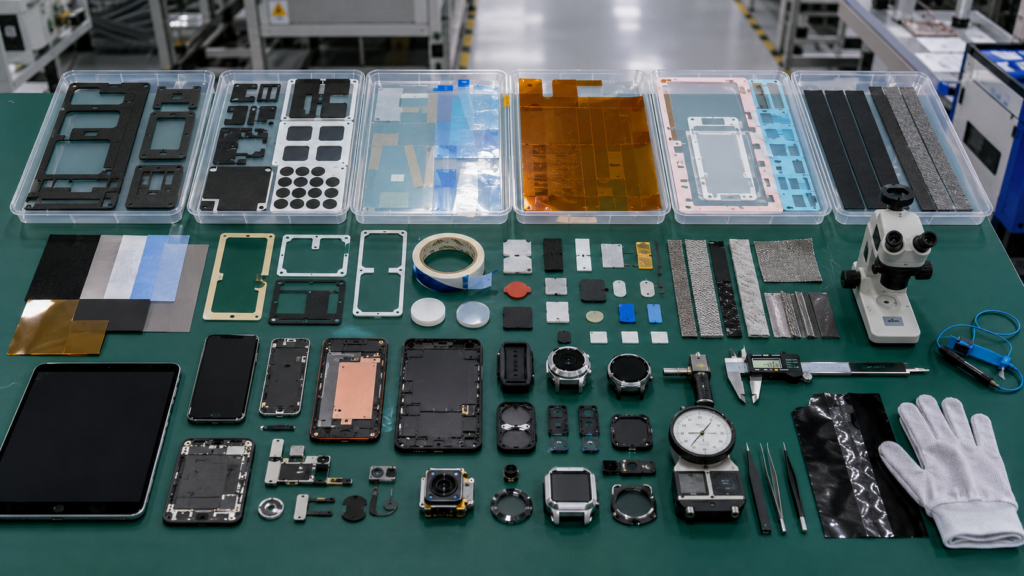
Die cut parts are widely used in consumer electronics assembly to support bonding, insulation, cushioning, sealing, surface protection, light blocking, dust control, vibration reduction, and clean assembly. Although many of these parts are thin and small, they are critical to product performance, appearance, and production stability.
In smartphones, tablets, laptops, smart speakers, wearable devices, cameras, headphones, chargers, display modules, sensors, and home electronics, die cut components help different materials fit together accurately. They may be made from foam, rubber, PET film, PI film, PC film, protective film, adhesive tape, non-woven material, conductive material, or multilayer laminated structures.
For OEM engineers and purchasing teams, the key is not only choosing a material name. The part must match the product structure, bonding surface, thickness requirement, tolerance, cleanliness level, assembly process, packaging format, and mass production conditions.
At Sanken, we support OEM customers with precision die cutting, adhesive lamination, PET and PI insulation films, protective films, foam gaskets, rubber pads, double-sided tape parts, light-blocking films, non-woven felt components, EMI shielding materials, and multilayer converted parts for electronics, display modules, automotive electronics, sensors, and industrial devices.
Why Consumer Electronics Need Die Cut Parts
Consumer electronics are compact, lightweight, and highly integrated. Inside one product, there may be plastic housings, display modules, batteries, PCB assemblies, connectors, cameras, speakers, microphones, sensors, buttons, covers, foam cushions, adhesive layers, insulation films, and protective surfaces.
Die cut parts help these components work together.
They are commonly used to:
- Bond parts together
- Protect display and housing surfaces
- Provide electrical insulation
- Reduce vibration and noise
- Seal dust-sensitive areas
- Cushion fragile components
- Block unwanted light
- Support thermal and EMI-related structures
- Improve assembly positioning
- Protect components during shipping and handling
A small die cut part can cause a large problem if it is not designed correctly. Poor adhesive selection may cause lifting. A foam gasket that is too thick may create pressure. A protective film with the wrong adhesion may leave residue. A PET insulation film with poor hole alignment may interfere with connectors.
Adhesive Tape Parts for Bonding and Positioning
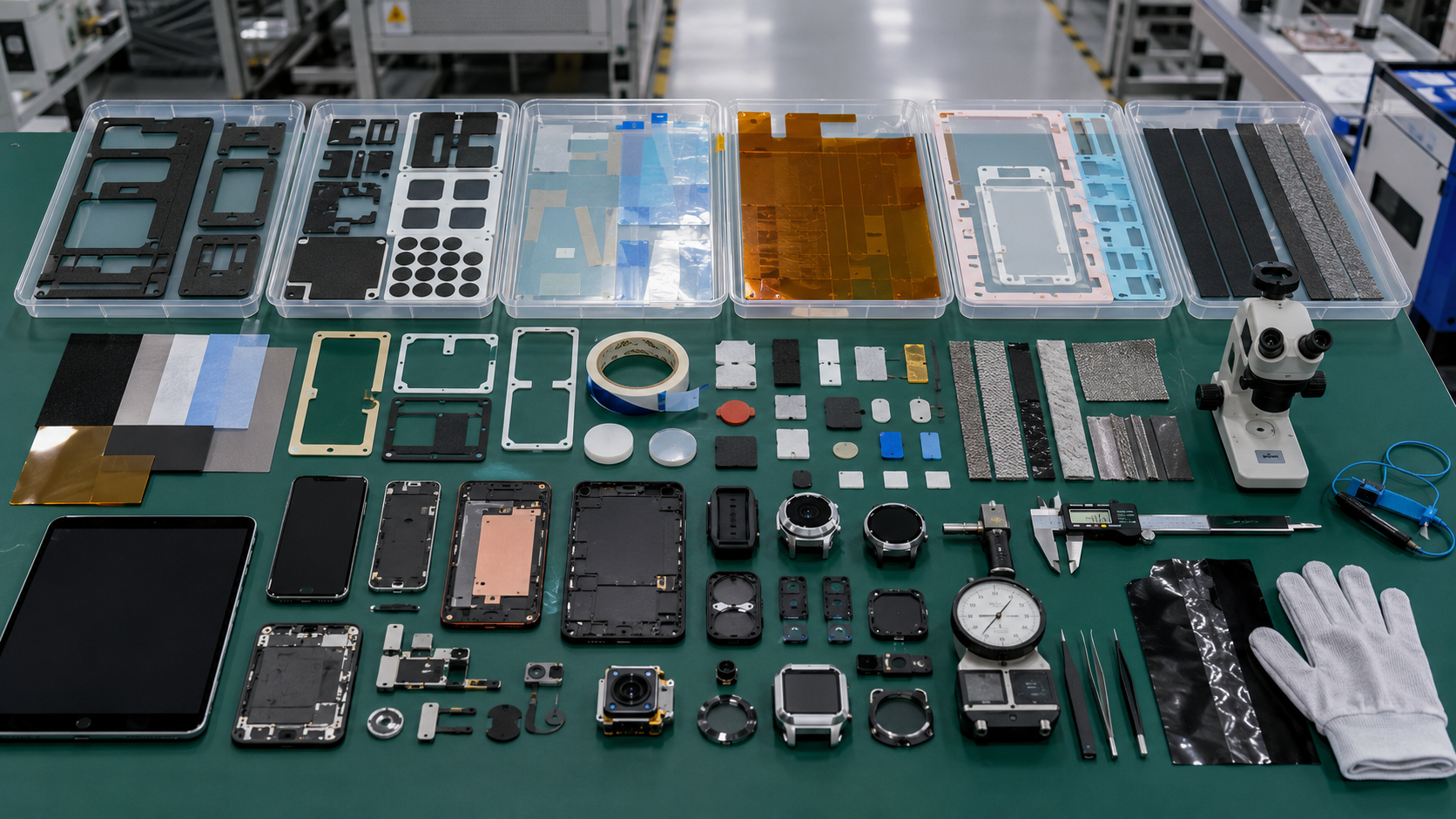
Adhesive tape parts are some of the most common die cut components in consumer electronics. They are used to bond plastic housings, metal frames, display modules, speaker covers, battery covers, lens windows, and internal components.
Common adhesive die cut parts include:
- Double-sided tape frames
- Transfer adhesive parts
- PET carrier adhesive tapes
- Foam adhesive tapes
- Thin bonding strips
- Pull-tab adhesive structures
- Liner-backed adhesive sheets
- Custom adhesive rings and windows
Important selection factors include adhesive thickness, bonding strength, surface compatibility, liner release, die cut tolerance, and packaging cleanliness.
The adhesive must match the bonding surface. Smooth glass, PC plastic, ABS housing, painted metal, coated surfaces, rubber, and textured plastic may require different adhesive solutions.
Foam Gaskets and Foam Pads
Foam die cut parts are used for cushioning, sealing, spacing, vibration reduction, and dust control. They are common in smartphones, tablets, laptops, speakers, cameras, chargers, displays, and wearable devices.
Typical foam parts include:
| Foam Part | Common Function |
|---|---|
| Foam gasket | Dust sealing and gap filling |
| Foam pad | Cushioning and shock absorption |
| Foam spacer | Maintains assembly gap |
| Foam tape | Bonding and cushioning |
| Speaker foam | Reduces vibration and air leakage |
| Camera foam | Protects lens and module area |
| Battery foam pad | Cushions battery contact areas |
Foam selection should consider thickness, density, compression force, recovery, adhesive backing, and long-term aging behavior.
If foam is too soft, it may not support the structure. If it is too hard, it may create pressure marks or assembly stress. If the foam thickness is wrong, the product may not close properly.
PET, PI, and PC Insulation Films
Insulation films are widely used in electronics assembly to prevent electrical contact, separate layers, protect PCB areas, and support safe component spacing.
Common insulation films include:
- PET film
- PI film
- PC film
- Adhesive-backed PET film
- Adhesive-backed PI film
- Die cut insulating sheets
- Connector insulation films
- Battery-related insulation pieces
PET film is often used for general electrical insulation, spacing, and support. PI film is selected when higher temperature resistance or stronger insulation performance is required. PC film may be used when stiffness, transparency, or structural support is needed.
For die cut insulation films, hole alignment and edge cleanliness are very important. Rough edges, burrs, particles, or misaligned holes can create assembly problems in compact electronic devices.
Protective Films for Surfaces and Displays
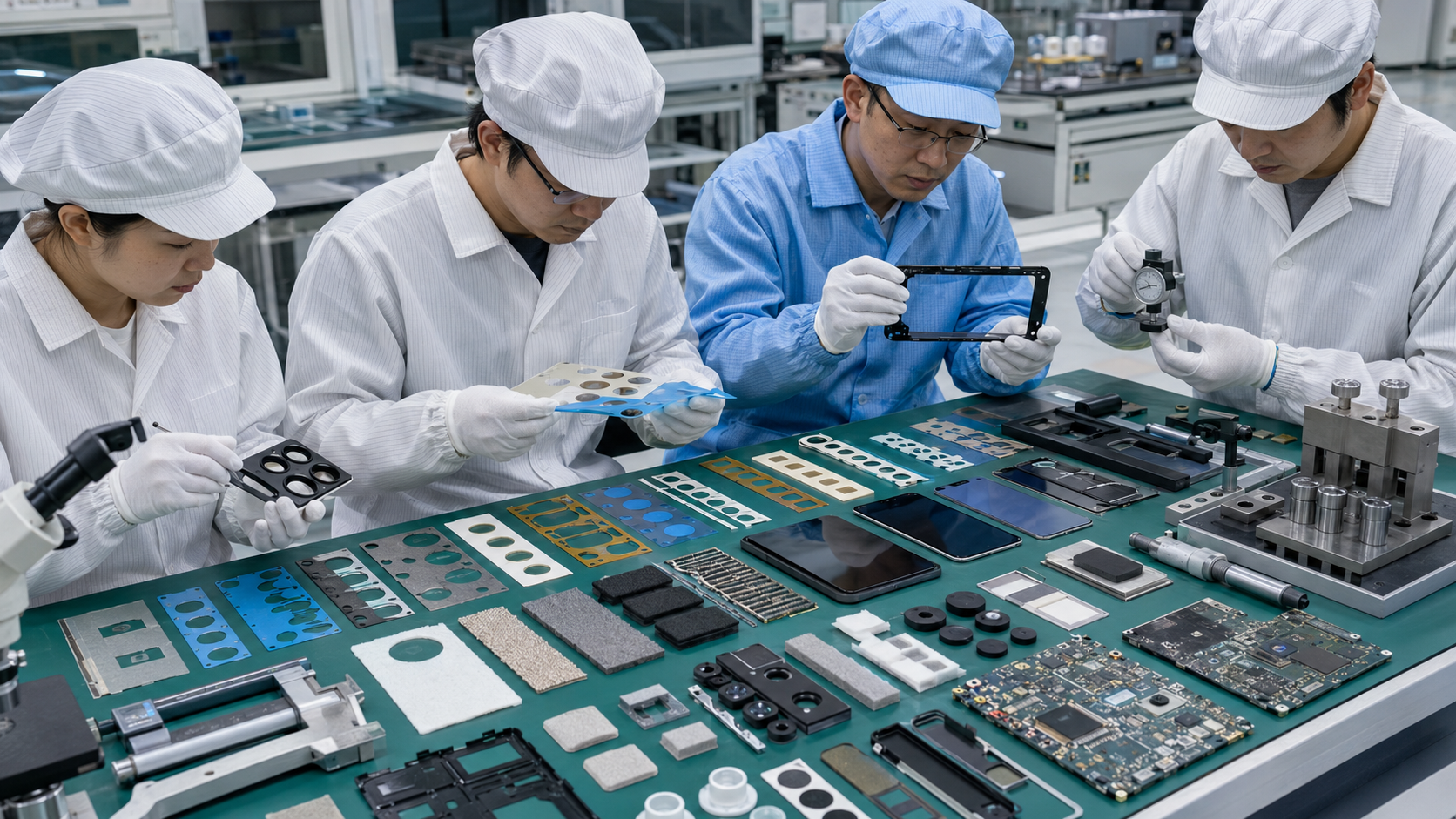
Protective films help prevent scratches, fingerprints, dust, and handling damage during production, inspection, transport, and assembly.
They are commonly used on:
- Display glass
- Touch panels
- Camera lens covers
- Sensor windows
- Plastic housings
- Metal covers
- Coated surfaces
- Finished electronic modules
Protective films must have the right adhesion level. If adhesion is too low, the film may lift or fall off. If adhesion is too high, it may leave residue or become difficult to remove.
Custom die cut protective films may include pull tabs, windows, holes, split liners, or extended liners to improve assembly handling.
Light-Blocking Films and Shading Parts
Light leakage can affect displays, sensors, cameras, LED areas, and optical modules. Black die cut films and light-blocking adhesive parts are used to control unwanted light.
They may be used around:
- Display borders
- Camera holes
- Sensor windows
- LED openings
- Backlight edges
- Optical module frames
- Wearable sensing areas
- Touch panel borders
The die cut shape must be accurate. If the black film is too small, light leakage may remain. If it is too large, it may block the active display or sensor area.
Edge cleanliness is also important because particles near optical areas may cause visible defects.
Rubber Pads and Silicone Components
Rubber and silicone die cut parts are used for damping, cushioning, sealing, anti-slip support, and stable contact.
Common examples include:
- Rubber damping pads
- Silicone pads
- Anti-slip feet
- Button support pads
- Shock-absorbing pads
- Sealing rings
- Connector cushions
- Speaker damping parts
Rubber parts are often chosen when stronger rebound, damping, or sealing performance is needed compared with foam. Important selection factors include hardness, thickness, compression behavior, surface finish, and adhesive backing.
Non-Woven Felt and Dust Control Parts
Non-woven felt and fabric-based die cut parts are used in consumer electronics for soft contact, anti-rattle, dust control, cushioning, and acoustic support.
They may be used in:
- Speaker areas
- Internal housing contact points
- Display frame support
- Camera module areas
- Wearable devices
- Small appliance electronics
- Anti-scratch contact areas
Non-woven felt can help reduce noise between plastic or metal parts. However, fiber shedding must be controlled, especially near optical or electronic areas.
EMI Shielding and Conductive Die Cut Parts
Some consumer electronics need EMI shielding to reduce electromagnetic interference between components.
Common EMI-related die cut materials may include:
- Conductive fabric tape
- Conductive foam
- Copper foil tape
- Aluminum foil tape
- Conductive gasket materials
- Shielding pads
- Grounding contact parts
These parts are used around PCB areas, connectors, antennas, battery areas, and electronic housings. The material must maintain proper contact while fitting into compact spaces.
For EMI-related die cut parts, thickness, conductivity, compression, adhesive backing, and placement accuracy are important.
Multilayer Laminated Die Cut Components
Many consumer electronics parts are not single-layer materials. They may combine film, adhesive, foam, liner, rubber, conductive material, or protective film into one converted structure.
Examples include:
| Multilayer Structure | Function |
|---|---|
| PET film + adhesive + liner | Insulation and positioning |
| Foam + adhesive + liner | Cushioning and bonding |
| Black film + adhesive + liner | Light blocking and bonding |
| Protective film + pull tab + liner | Surface protection |
| Conductive fabric + adhesive | EMI shielding and grounding |
| PI film + adhesive + liner | Heat-resistant insulation |
| Rubber pad + adhesive | Damping and stable contact |
Multilayer parts require controlled lamination, die cutting depth, liner release, waste removal, and packaging. If layers shift during converting, the final part may not fit the product.
Quality Control for Consumer Electronics Die Cut Parts
Consumer electronics die cut parts often require strict dimensional and visual control because the parts are small and assembly spaces are limited.
Important inspection items include:
| Inspection Item | Why It Matters |
|---|---|
| Outer dimension | Confirms product fit |
| Hole alignment | Matches screws, posts, sensors, and connectors |
| Thickness | Controls gap, insulation, or compression |
| Adhesive position | Prevents lifting or contamination |
| Liner release | Supports smooth application |
| Edge cleanliness | Reduces burrs and particles |
| Surface scratches | Protects product appearance |
| Foam compression | Confirms cushioning performance |
| Rubber hardness | Confirms damping function |
| Film flatness | Reduces curling and assembly issues |
| Packaging condition | Prevents damage before use |
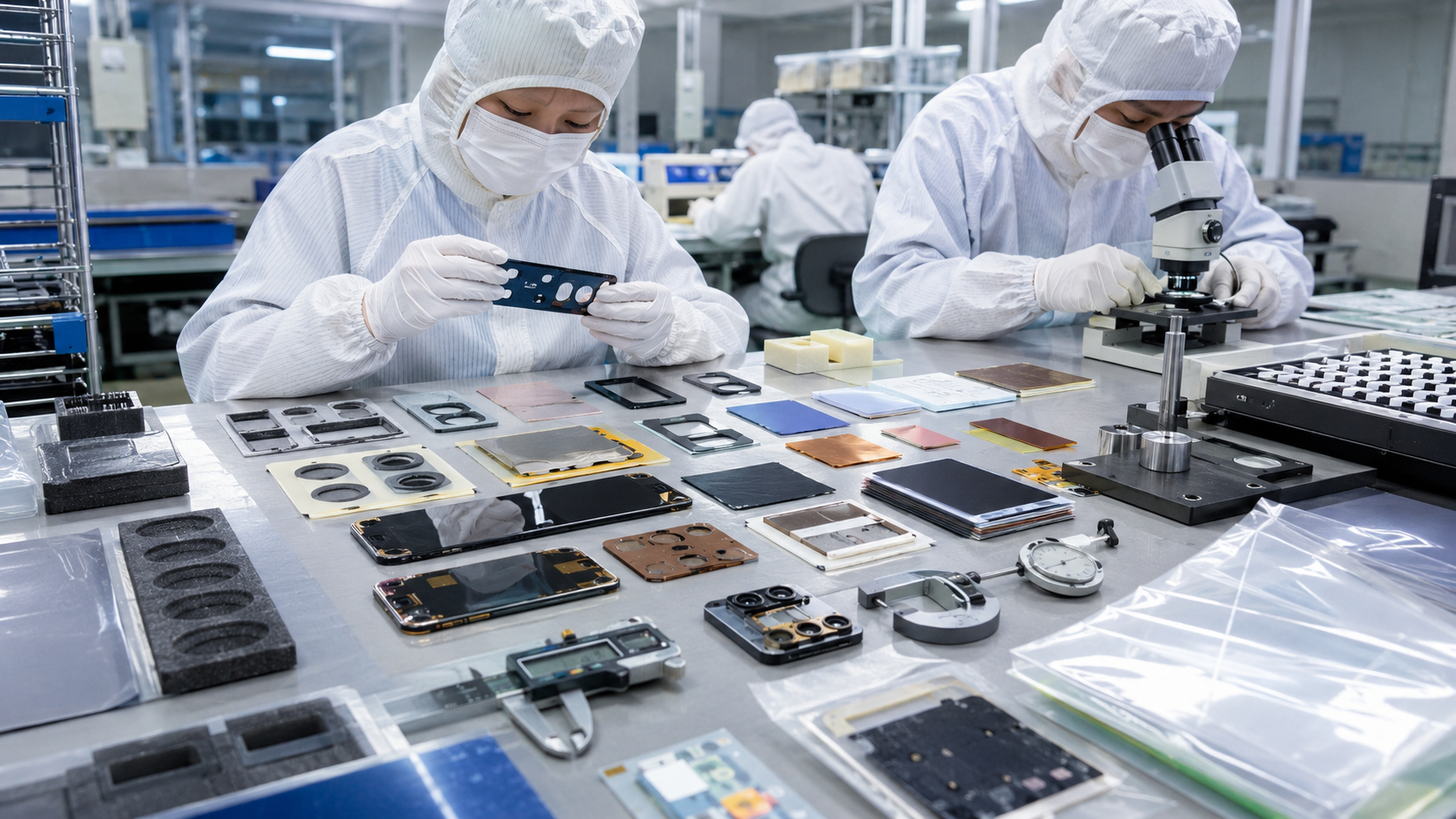
For parts used near displays, cameras, sensors, or optical windows, cleanliness should be reviewed carefully before mass production.
How Sanken Supports Consumer Electronics Die Cut Projects
Sanken Manufacturing Co., Ltd. supports OEM customers with precision die cut parts for consumer electronics assembly.
Our support includes:
- Double-sided adhesive tape parts
- PET and PI insulation films
- Protective films
- Foam gaskets and foam pads
- Rubber pads and silicone components
- Light-blocking films
- Non-woven felt parts
- EMI shielding materials
- Release liner structures
- Multilayer laminated components
- Adhesive lamination
- Kiss cutting and through cutting
- Sample development
- Quality inspection
- Assembly-ready packaging
For each project, we review material function, thickness, adhesive structure, bonding surface, hole alignment, cleanliness risk, liner release, packaging method, and final assembly process.
Our goal is to help customers reduce scratches, dust contamination, adhesive lifting, poor fit, foam compression issues, light leakage, poor liner release, repeated sampling, and unstable mass production.
Buyer Checklist Before Starting a Project
To develop reliable die cut parts for consumer electronics, buyers should provide:
- 2D drawing
- Product application
- Material preference
- Thickness requirement
- Adhesive requirement
- Bonding surface
- Critical dimensions
- Cleanliness requirement
- Assembly method
- Liner preference
- Packaging format
- Expected quantity
- Sample or reference part if available
- Testing or inspection requirement
Clear information helps the supplier recommend the right material structure and reduce unnecessary trial-and-error.
FAQ
What die cut parts are used in consumer electronics?
Common die cut parts include adhesive tapes, foam gaskets, foam pads, PET and PI insulation films, protective films, light-blocking films, rubber pads, non-woven felt parts, EMI shielding parts, and multilayer laminated components.
Why are foam gaskets used in electronics?
Foam gaskets are used for cushioning, dust sealing, spacing, vibration reduction, and gap filling inside compact electronic assemblies.
What are PET and PI films used for?
PET and PI films are used for electrical insulation, connector protection, PCB protection, display module insulation, battery-related insulation, and thin protective structures.
Why are protective films important in electronics assembly?
Protective films help prevent scratches, dust, fingerprints, and handling damage on display glass, lens covers, sensor windows, housings, and coated surfaces.
Why is adhesive selection important?
Adhesive selection affects bonding strength, surface compatibility, liner release, assembly efficiency, and long-term stability.
Can Sanken support custom die cut parts for consumer electronics?
Yes. Sanken supports custom die cut foam, rubber, PET and PI films, protective films, adhesive tapes, light-blocking films, non-woven felt, EMI shielding materials, and multilayer converted parts for consumer electronics assembly.
Conclusion
Die cut parts are essential in consumer electronics assembly. They support bonding, insulation, cushioning, sealing, surface protection, light blocking, EMI shielding, dust control, and clean assembly. These parts may be small, but they directly affect product quality, appearance, assembly efficiency, and production stability.
For OEM projects, the best die cut solution should be selected based on material function, thickness, tolerance, adhesive behavior, bonding surface, cleanliness, liner release, packaging, and final assembly needs.
At Sanken, we help OEM customers develop clean, accurate, assembly-ready die cut parts for consumer electronics, from sample development to stable mass production.