
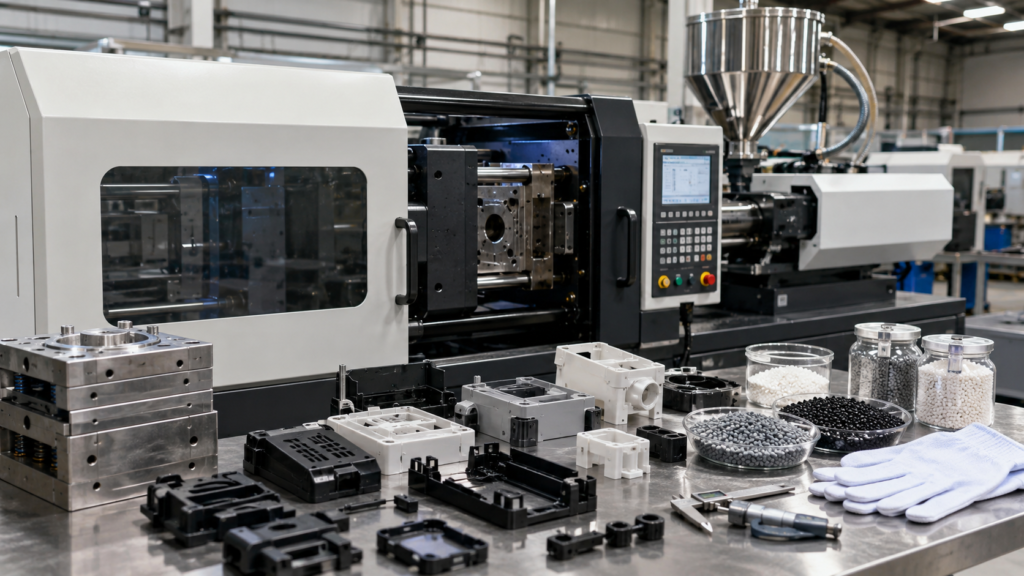
Injection molding is a high-volume manufacturing process used to produce custom plastic parts with consistent shape, stable dimensions, and repeatable quality. It is widely used in OEM plastic parts manufacturing for automotive electronics, consumer electronics, appliances, medical devices, battery-related components, industrial equipment, and custom assembly systems.
For OEM engineers and purchasing teams, injection molding is not only about making a plastic shape. A molded part often needs to fit with foam gaskets, adhesive tape components, PET insulation films, rubber pads, protective films, sealing parts, and other functional materials. If the molded part is not designed and controlled correctly, the whole assembly may face problems such as poor fit, sealing failure, adhesive lifting, warpage, or inspection rejection.
At Sanken, we support OEM customers with custom injection molded plastic parts, precision die cut foam gaskets, adhesive tape parts, PET and PI insulation films, rubber pads, protective films, non-woven felt components, sealing parts, and multilayer material converting for automotive, electronics, battery, appliance, medical device, and industrial applications.
What Is Injection Molding?
Injection molding is a process where plastic resin is heated until it melts, injected into a mold cavity, cooled, and then ejected as a finished plastic part.
The mold is designed according to the customer’s part drawing or 3D model. Once the mold is completed and the process is stable, injection molding can produce thousands or millions of identical parts with high repeatability.
Common injection molded OEM parts include:
- Plastic housings
- Covers
- Brackets
- Clips
- Enclosures
- Frames
- Connectors
- Panels
- Sensor housings
- Appliance components
- Automotive electronic shells
- Industrial plastic parts
Injection molding is especially suitable when the product requires stable dimensions, functional strength, good appearance, repeatable assembly fit, and lower unit cost at high volume.
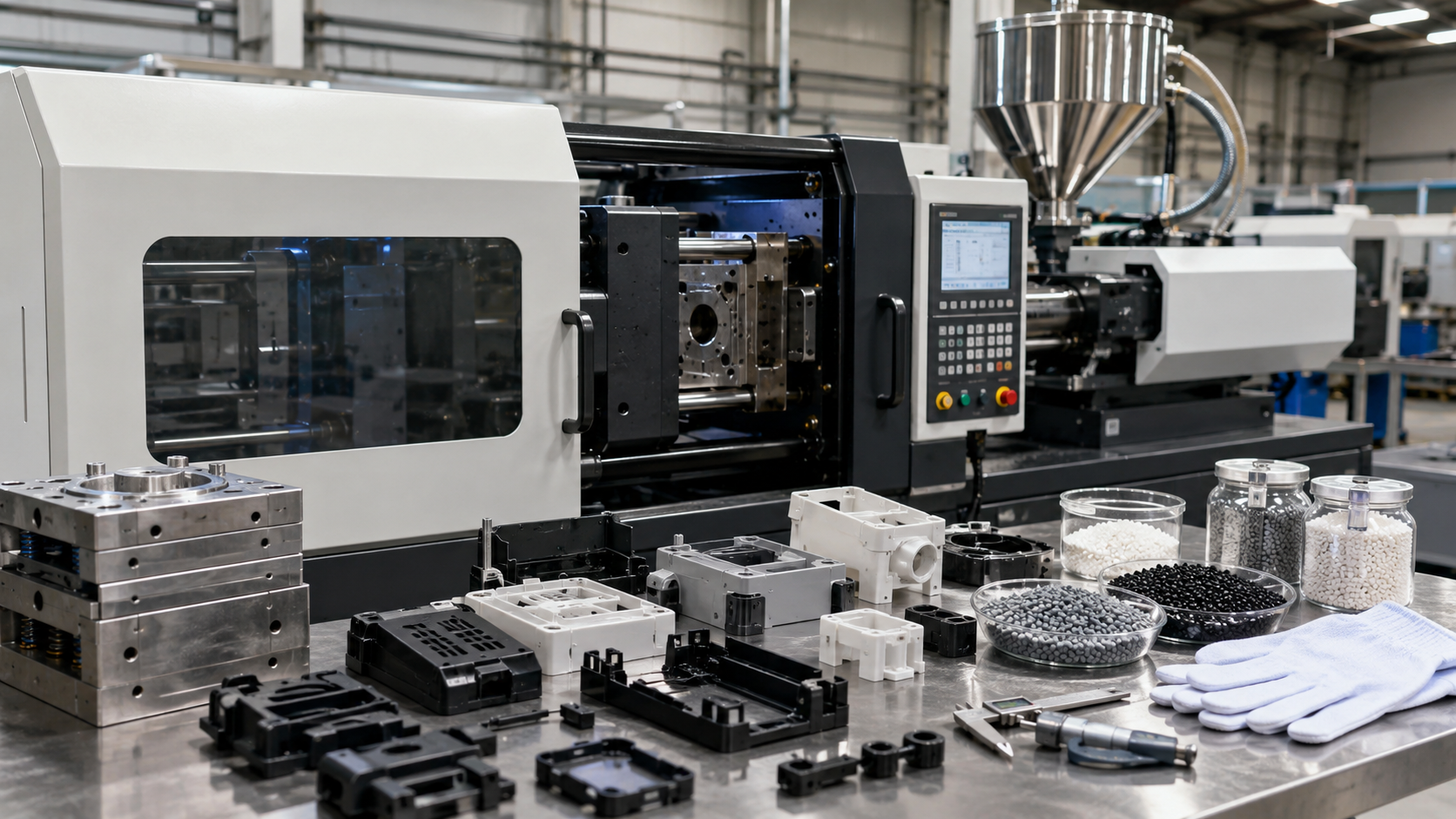
Why OEM Manufacturers Use Injection Molding
OEM manufacturers choose injection molding because it supports mass production with stable quality. Compared with manual fabrication or prototype methods, injection molding is more suitable for final production parts.
Key advantages include:
| Advantage | Why It Matters for OEM Projects |
|---|---|
| High repeatability | Parts remain consistent across production batches |
| Lower unit cost at volume | Mold cost is spread across many parts |
| Good material performance | Production-grade plastics can be selected |
| Stable assembly fit | Parts can match screws, clips, gaskets, films, and tapes |
| Better surface quality | Suitable for visible and functional parts |
| Complex geometry | Supports ribs, bosses, clips, holes, and structural features |
| Scalable production | Suitable for medium and high-volume OEM demand |
For OEM projects, consistency is often more important than making one perfect sample. Injection molding helps customers move from design approval to stable mass production.
The Basic Injection Molding Process
A typical injection molding project includes several steps.
1. Product Design Review
Before mold making, the supplier reviews the part design. This includes wall thickness, ribs, bosses, clips, holes, draft angles, surface finish, shrinkage, and assembly requirements.
Good design review helps prevent defects such as warpage, sink marks, flash, weak clips, poor ejection, and assembly mismatch.
2. Material Selection
The plastic material must match the final application. Different materials offer different strength, flexibility, heat resistance, impact resistance, chemical resistance, and appearance.
Material selection should consider:
- Part function
- Mechanical strength
- Temperature exposure
- Surface appearance
- Assembly stress
- Chemical exposure
- Flame resistance if required
- Adhesive bonding compatibility
- Fit with related die cut parts
3. Mold Design and Tooling
The mold determines the final shape of the part. A good mold must control material flow, cooling, ejection, shrinkage, venting, and surface quality.
Tooling quality has a direct impact on part stability and mass production reliability.
4. Trial Molding and Sample Approval
After the mold is completed, trial samples are produced. These samples should be checked for dimensions, appearance, assembly fit, surface defects, warpage, and compatibility with related components.
For OEM projects, sample approval should include real assembly testing whenever possible.
5. Mass Production
Once the sample is approved, the supplier controls molding parameters such as temperature, pressure, injection speed, cooling time, and cycle time to maintain stable production.
6. Inspection and Packaging
Finished parts are inspected according to the customer’s requirements. Packaging should protect the parts from scratches, deformation, dust, and transport damage.
Common Plastic Materials Used in Injection Molding
OEM plastic parts can be made from many thermoplastic materials. The best material depends on function, environment, cost, and assembly requirements.
| Material | General Features | Common OEM Use |
|---|---|---|
| ABS | Good toughness and appearance | Housings, covers, appliance parts |
| PC | High impact resistance and clarity options | Electronics, protective covers, structural parts |
| PP | Lightweight and chemical resistant | Clips, containers, automotive parts |
| PA / Nylon | Strong and wear resistant | Mechanical parts, brackets, connectors |
| POM | Low friction and good dimensional stability | Gears, precision moving parts |
| PE | Chemical resistant and flexible | Industrial and protective parts |
| TPE / TPU | Soft, flexible, rubber-like behavior | Grip areas, seals, flexible components |
A good injection molding partner should help review not only the resin name, but also the part’s final use. For example, a plastic housing that needs adhesive tape bonding may require surface compatibility testing. A part that works with a foam gasket may need stable groove dimensions. A cover that uses protective film may need clean surface quality.
Key Design Factors for Injection Molded Parts
Injection molded parts should be designed for manufacturability. A drawing may look correct, but if the design is not suitable for molding, the part may fail during production.
Important design factors include:
- Uniform wall thickness
- Proper draft angle
- Correct rib design
- Suitable boss and screw post design
- Good gate location
- Enough venting
- Controlled shrinkage
- Proper clip strength
- Avoiding thick sections
- Avoiding sharp internal stress points
- Assembly clearance for related parts
Poor design can create sink marks, warpage, weak structures, surface defects, and difficult assembly.
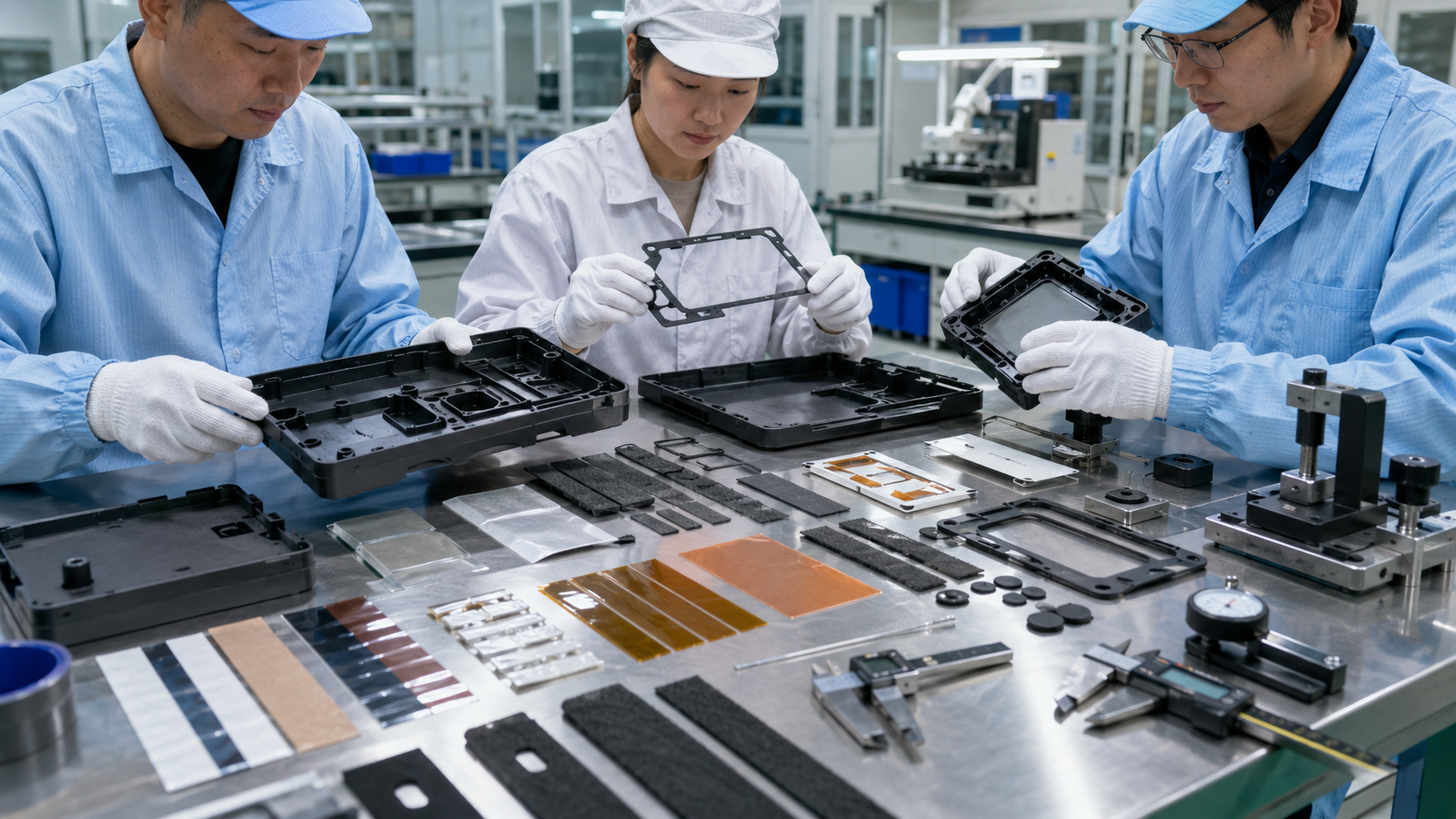
Injection Molded Parts Often Work With Die Cut Components
In many OEM products, injection molded plastic parts do not work alone. They are assembled with flexible functional components.
Examples include:
| Injection Molded Part | Related Die Cut Component | Function |
|---|---|---|
| Automotive electronic housing | Foam gasket | Dust sealing and vibration reduction |
| Battery cover | PET or PI insulation film | Electrical insulation |
| Sensor housing | Light-blocking film | Optical shielding |
| Appliance panel | Rubber pad | Cushioning and damping |
| Display frame | Double-sided tape | Bonding and positioning |
| Medical device shell | Protective film | Surface protection |
| Interior plastic trim | Non-woven felt strip | Anti-rattle and anti-squeak control |
This is why molded plastic parts and die cut parts should be reviewed together. If the molded housing changes slightly, the foam gasket may not fit. If the plastic surface is not compatible with adhesive tape, the tape may lift. If screw posts shift, PET insulation films may not align.
At Sanken, we support both injection molded parts and related die cut components, helping customers reduce assembly mismatch and repeated sampling.
Common Injection Molding Defects
Injection molding defects can increase inspection cost, rework, and production delay.
Common defects include:
| Defect | Possible Cause |
|---|---|
| Warpage | Uneven cooling, poor wall thickness, material shrinkage |
| Sink marks | Thick sections or insufficient packing |
| Flash | Poor mold fit, high pressure, tool wear |
| Short shot | Incomplete filling or poor venting |
| Weld lines | Flow fronts meeting in weak areas |
| Flow marks | Unstable material flow |
| Burn marks | Poor venting or excessive temperature |
| Color variation | Material or pigment inconsistency |
| Surface scratches | Handling or packaging damage |
| Poor assembly fit | Tolerance, shrinkage, or design issues |
Most defects can be reduced through early design review, suitable material selection, proper mold design, stable process control, and clear inspection standards.
Quality Control for OEM Plastic Parts
Quality control should begin before mass production, not only after parts are molded.
Important inspection items include:
- Overall dimensions
- Hole position
- Screw boss dimensions
- Clip strength
- Surface appearance
- Color consistency
- Warpage
- Flash
- Shrinkage
- Assembly fit
- Packaging condition
- Compatibility with gaskets, tapes, films, and pads
For OEM projects, the supplier should understand which dimensions are critical to function. For example, gasket grooves, screw posts, connector openings, clip areas, and adhesive bonding surfaces may need special control.
How to Choose an Injection Molding Supplier
A reliable injection molding supplier should provide more than a quotation. The supplier should understand design, material, tooling, quality control, assembly, and related components.
Buyers should ask:
| Question | Why It Matters |
|---|---|
| Can you review the design before tooling? | Prevents mold and assembly problems |
| What material do you recommend? | Confirms application knowledge |
| How do you control shrinkage and warpage? | Protects dimensional stability |
| Can you support sample improvement? | Reduces development risk |
| What inspection items do you check? | Confirms quality control depth |
| Can you support related die cut components? | Improves assembly fit |
| How will parts be packed? | Prevents scratches and deformation |
The best supplier should help reduce total project risk, not only offer the lowest initial price.
How Sanken Supports OEM Plastic Parts Manufacturing
Sanken Manufacturing Co., Ltd. supports OEM customers with custom injection molding and related precision die cut components.
Our support includes:
- Custom plastic housings
- Molded covers and brackets
- Injection molded OEM parts
- Foam sealing gaskets
- Adhesive tape components
- PET and PI insulation films
- Rubber pads and sealing parts
- Protective films
- Non-woven felt components
- Multilayer converted materials
- Sample development
- Quality inspection
- Assembly-ready packaging
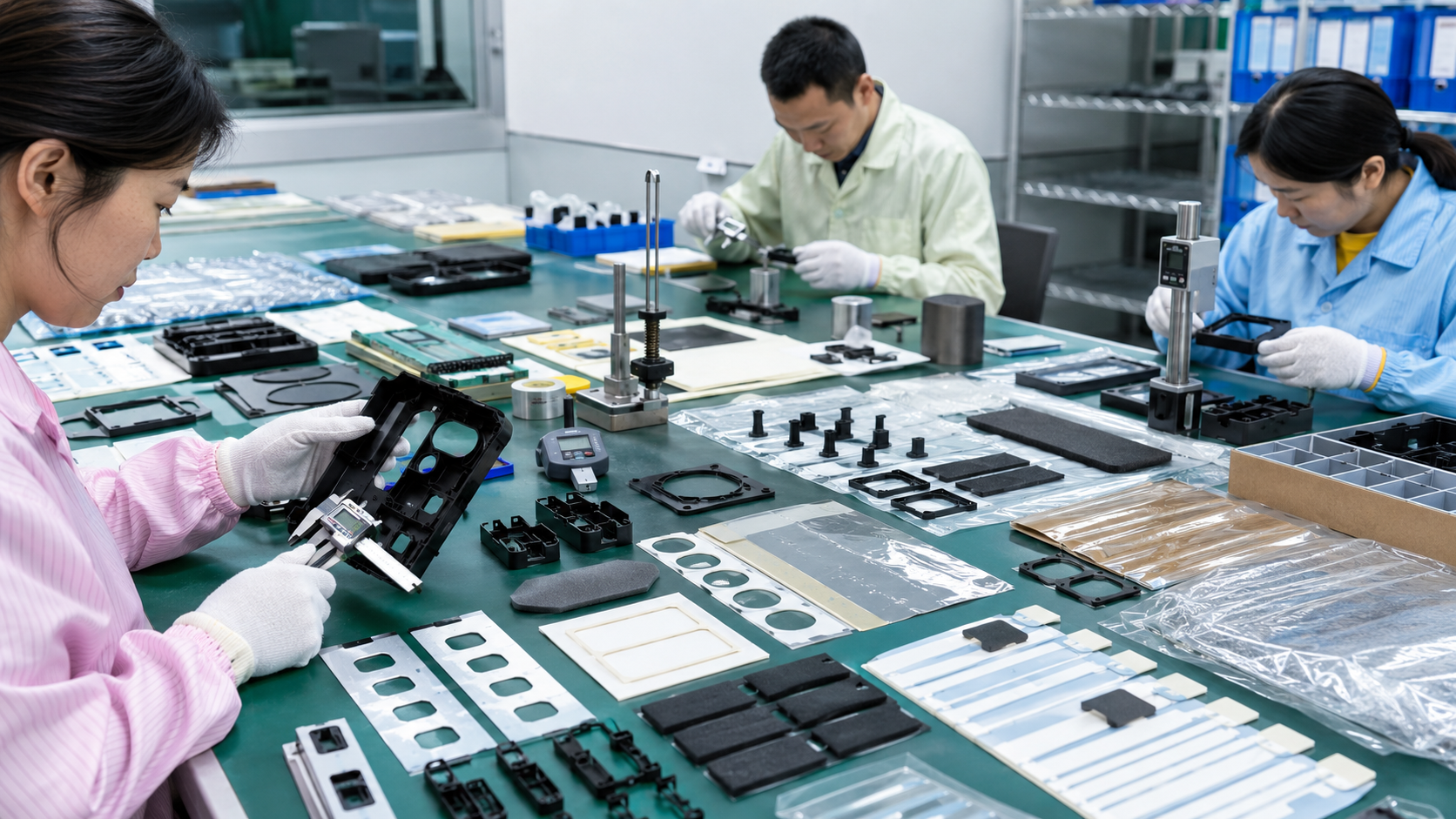
For each project, we review plastic material, mold feasibility, part tolerance, surface quality, foam gasket fit, adhesive bonding surface, PET film alignment, rubber compression, protective film coverage, packaging, and final assembly method.
Our goal is to help customers reduce poor fit, repeated samples, adhesive lifting, gasket mismatch, film misalignment, inspection failure, and unstable mass production.
FAQ
What is injection molding?
Injection molding is a manufacturing process that melts plastic resin, injects it into a mold cavity, cools it, and ejects the finished plastic part.
What products are made by injection molding?
Injection molding is used to make plastic housings, covers, brackets, clips, enclosures, connectors, panels, appliance parts, automotive electronic housings, medical device shells, and industrial plastic components.
Is injection molding suitable for OEM custom parts?
Yes. Injection molding is suitable for OEM custom parts when the project requires stable dimensions, repeatable quality, production-grade materials, and medium to high-volume production.
What affects the quality of injection molded parts?
Quality is affected by material selection, mold design, wall thickness, cooling, injection pressure, temperature, shrinkage, tooling accuracy, inspection standards, and packaging.
Why should molded plastic parts be reviewed with die cut components?
Molded parts often work with foam gaskets, adhesive tapes, PET films, rubber pads, protective films, and felt strips. Reviewing them together helps prevent assembly mismatch.
What should buyers provide before starting an injection molding project?
Buyers should provide 2D drawings, 3D models, material requirements, surface requirements, critical dimensions, assembly information, testing requirements, packaging needs, and expected quantity.
Can Sanken support injection molding and die cutting together?
Yes. Sanken supports custom injection molded plastic parts together with precision die cut foam gaskets, adhesive tape parts, PET and PI films, protective films, rubber pads, non-woven felt parts, and multilayer components.
Conclusion
Injection molding is one of the most important processes in OEM plastic parts manufacturing. It allows manufacturers to produce custom plastic housings, covers, brackets, clips, and functional components with repeatable quality and stable production efficiency.
For successful OEM projects, injection molding should be reviewed together with material selection, mold design, tolerance, surface quality, packaging, and related die cut components. A molded part must not only match the drawing. It must fit the final assembly and perform reliably in mass production.
At Sanken, we help OEM customers develop custom injection molded plastic parts and related die cut foam, tape, film, rubber, felt, and protective components for reliable, assembly-ready manufacturing.