
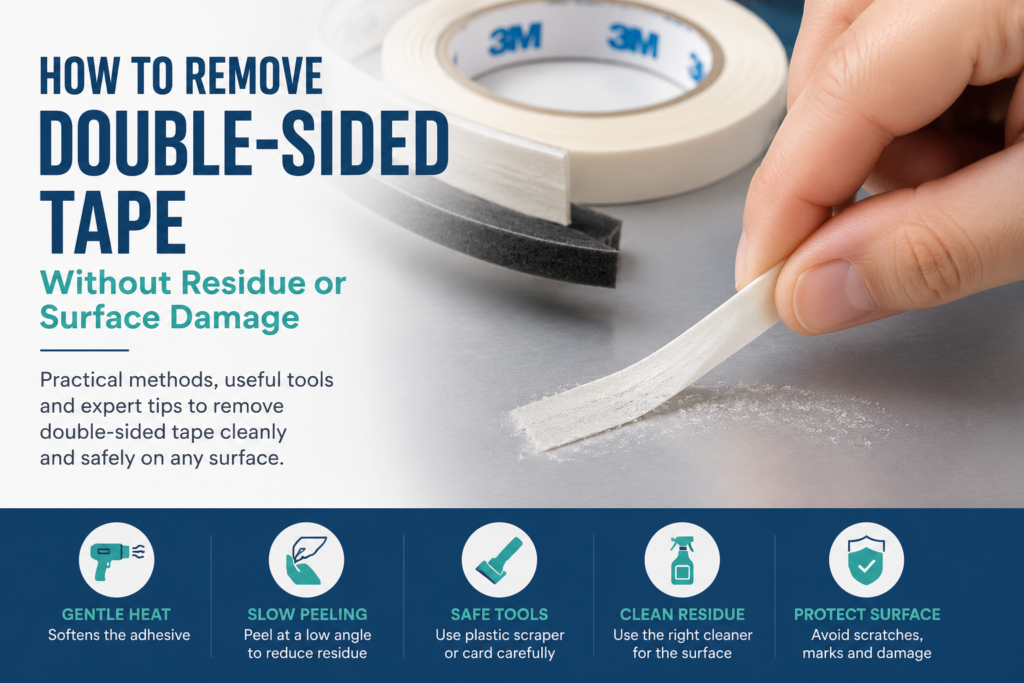
The easiest way to remove double-sided tape is to soften the adhesive first, lift the tape slowly, and then clean the residue with a suitable remover for the surface. For most home and industrial situations, gentle heat from a hair dryer, slow peeling, and adhesive residue cleaning will work better than pulling the tape off by force.
But there is no single method that works for every tape and every surface.
Double-sided tape may be applied to glass, metal, plastic, painted parts, rubber, foam, PET film, display panels, automotive trim, electronics housings, or packaging materials. Each surface reacts differently to heat, solvents, scraping, and peeling force.
For OEM buyers, the bigger question is not only “How do I remove double-sided tape?” It is:
“Why is the tape so hard to remove, and how can we choose the right adhesive structure so removal does not damage the product?”
This matters especially for electronics, automotive interiors, display protection, medical devices, packaging, and industrial assembly, where tape residue, surface scratches, coating damage, and adhesive transfer can create serious quality problems.
The Simple Removal Method
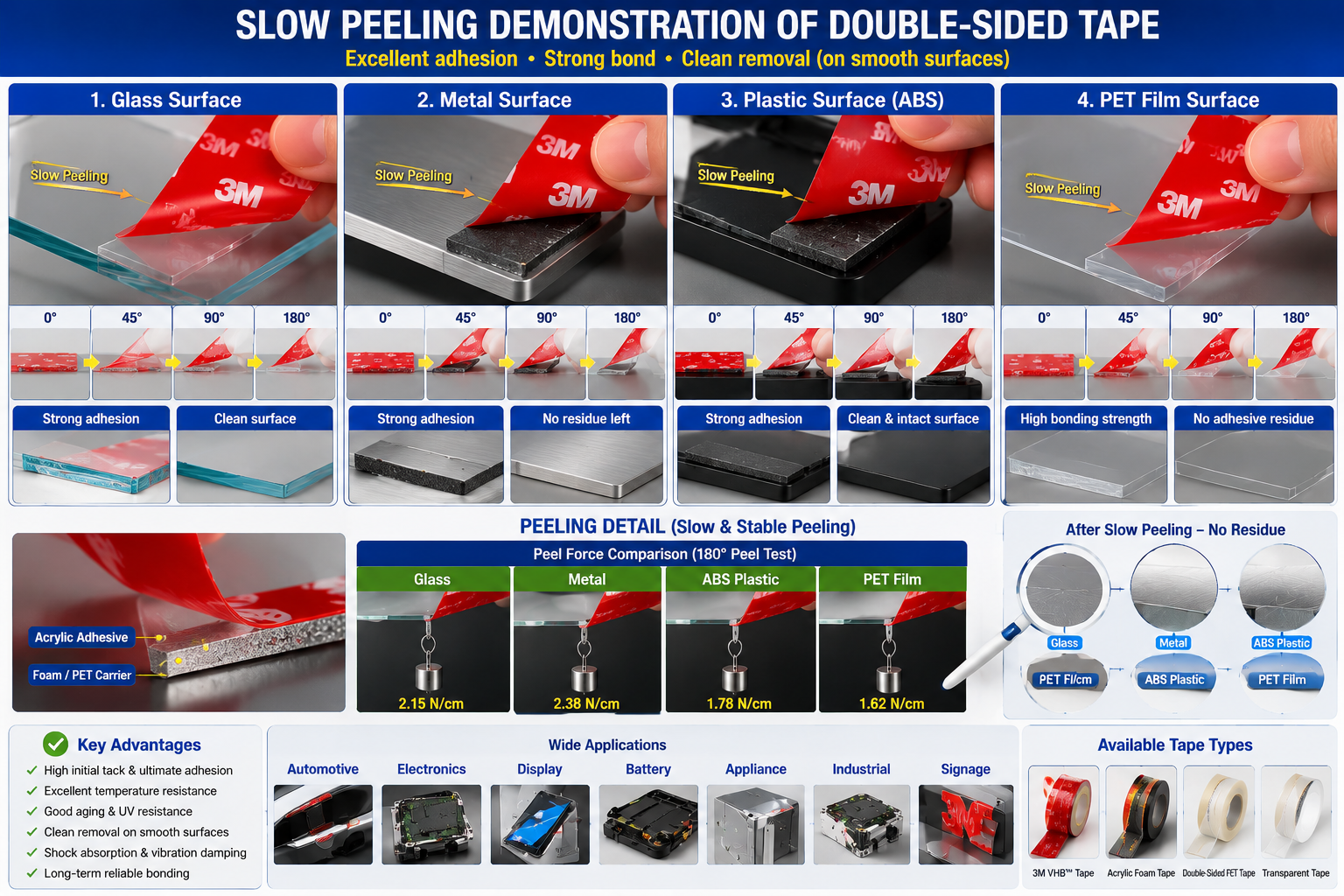
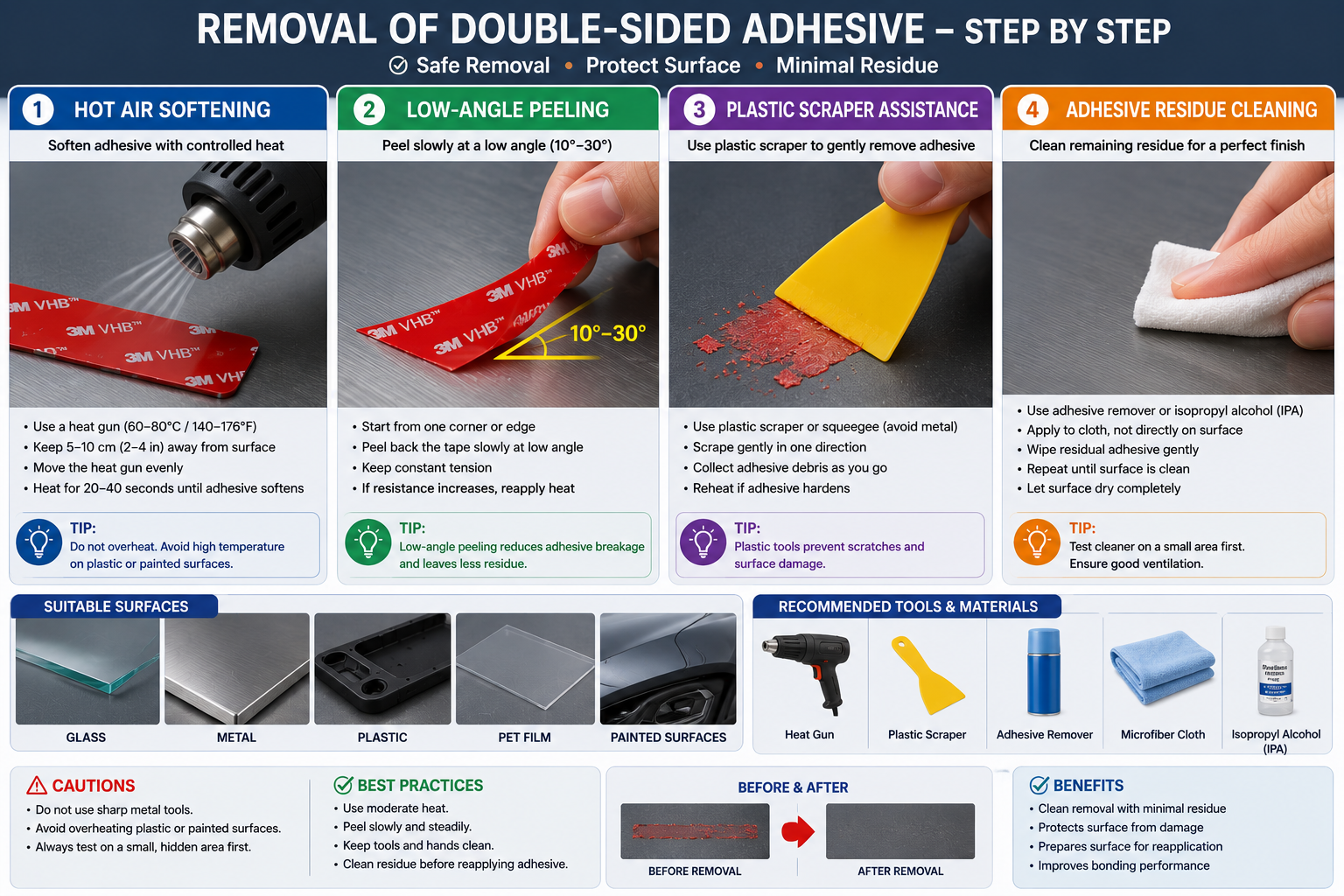
For most double-sided tape, the easiest removal process is:
- Warm the tape with a hair dryer.
- Lift one corner slowly.
- Peel the tape back at a low angle.
- Remove remaining adhesive residue.
- Clean the surface with a safe cleaner.
- Check whether the surface is scratched, stained, or softened.
The key is patience.
If you pull too fast, the tape may tear.
If you scrape too hard, the surface may scratch.
If you use the wrong solvent, the surface may become cloudy, discolored, or damaged.
Why Heat Helps Remove Double-Sided Tape
Many double-sided tapes use pressure-sensitive adhesive. This adhesive is designed to bond when pressure is applied.
Heat can soften the adhesive and reduce its holding force temporarily.
A hair dryer is usually safer than a heat gun because it provides gentler heat. A heat gun can damage plastic, paint, coatings, films, and electronic parts if used carelessly.
Heat works well for:
- Glass
- Metal
- Some hard plastics
- Ceramic surfaces
- Painted metal if heat is controlled
- Automotive trim if the surface is heat-resistant
Heat should be used carefully on:
- Thin plastic
- Display surfaces
- Coated panels
- Decorative films
- Painted parts
- PET protective films
- Rubber parts
- Foam materials
- Electronic assemblies
For sensitive products, test a small hidden area first.
Peel Slowly at a Low Angle
After heating, lift the tape corner with a fingernail, plastic scraper, or soft card.
Do not use a sharp metal blade unless the surface is glass and you are sure it will not scratch.
The best peeling method is to pull the tape slowly and close to the surface, not straight upward.
A low-angle peel helps reduce:
- Tape tearing
- Adhesive residue
- Surface stress
- Coating damage
- Paint lifting
- Film stretching
This is similar to removing labels or protective films. Slow peeling gives the adhesive time to release.
Fast peeling often leaves more residue.
Best Tools for Removing Double-Sided Tape
The safest tools are usually soft and non-metallic.
Useful tools include:
| Tool | Best Use |
|---|---|
| Hair dryer | Softening adhesive |
| Plastic scraper | Lifting tape edge |
| Old credit card | Scraping residue gently |
| Microfiber cloth | Cleaning residue |
| Isopropyl alcohol | Cleaning many hard surfaces |
| Citrus adhesive remover | Removing sticky residue |
| Warm soapy water | Mild cleaning |
| Adhesive eraser wheel | Automotive painted surfaces, used carefully |
Avoid using knives, steel blades, rough sandpaper, or aggressive solvents on delicate surfaces.
They may remove the tape, but they may also damage the product.
How to Remove Residue After the Tape Is Gone
Double-sided tape often leaves adhesive residue behind.
The best residue remover depends on the surface.
For Glass
Glass is usually the easiest surface.
You can use:
- Isopropyl alcohol
- Citrus adhesive remover
- Warm soapy water
- Plastic scraper
- Glass-safe razor scraper if used carefully
Glass can handle more cleaning methods than plastic or paint, but scratches are still possible if dirt or hard particles are dragged across the surface.
For Metal
Metal surfaces can usually tolerate alcohol and mild adhesive removers.
However, coated or painted metal should be treated carefully. Some solvents may dull the finish or damage coating.
For Plastic
Plastic is more sensitive.
Some solvents can cause plastic to become cloudy, cracked, softened, or discolored.
For plastic, start with:
- Warm soapy water
- Gentle heat
- Isopropyl alcohol test
- Mild adhesive remover tested first
Avoid strong solvents unless the material is confirmed safe.
For Painted Surfaces
Painted surfaces require care.
Too much heat, strong solvent, or aggressive scraping can lift or dull paint.
Use mild heat, slow peeling, and a surface-safe adhesive remover. For automotive paint, use products intended for automotive finishes.
For Electronics and Displays
Electronics and display surfaces are high-risk.
Do not allow liquid to enter openings, speakers, buttons, ports, or screen edges.
Use minimal cleaner on a cloth, not directly on the device.
Avoid excessive heat and harsh solvents. If the tape is near a screen, camera lens, optical film, sensor, or coating, removal should be done very carefully.
Why Some Double-Sided Tape Is Hard to Remove
Not all double-sided tape is designed to be removable.
Some tapes are made for temporary protection. Others are made for permanent bonding.
Permanent tapes are often harder to remove because they are designed to resist:
- Heat
- Aging
- Vibration
- Humidity
- Peeling force
- Long-term load
- Surface movement
For example, strong acrylic foam tapes, automotive attachment tapes, and industrial mounting tapes are not meant to peel away easily after bonding.
If a permanent tape is used where clean removal is required, residue and surface damage become more likely.
This is a common mistake in product design.
The Easiest Method by Tape Type
Different tapes need different removal approaches.
| Tape Type | Easier Removal Method |
|---|---|
| Thin double-sided tape | Heat, slow peeling, alcohol cleaning |
| Foam tape | Cut or roll off foam, then remove adhesive residue |
| VHB-style tape | Heat, stretching, slow peeling, adhesive remover |
| Removable tape | Slow peeling, mild cleaning |
| PET-backed adhesive tape | Low-angle peel, avoid stretching |
| Rubber-based tape | Mild heat and residue remover |
| Acrylic adhesive tape | Heat and patient residue cleaning |
Foam tape often separates into layers. The foam may tear, leaving adhesive on the surface. In that case, remove the foam body first, then clean the adhesive layer.
Can Oil Remove Double-Sided Tape?
Some people use cooking oil, mineral oil, or baby oil to soften adhesive residue.
Oil can help on some non-porous surfaces, but it is not always ideal.
Oil may stain porous materials, contaminate bonding surfaces, or leave a film that is hard to clean. If the surface will later receive another adhesive part, oil residue can reduce bonding strength.
For industrial parts, oil is usually not the best choice unless it can be fully cleaned afterward.
Can Alcohol Remove Double-Sided Tape?
Isopropyl alcohol can help remove adhesive residue from many hard surfaces.
It is often safer than stronger solvents, but it is not safe for every material.
Alcohol may affect some coatings, printed surfaces, plastics, inks, and protective layers.
Always test first, especially on:
- Painted plastic
- Screen coatings
- Printed labels
- Decorative films
- Soft-touch coatings
- Optical surfaces
Use alcohol on a cloth instead of pouring it directly onto the product.
What Should You Avoid?
Avoid these common mistakes:
- Pulling the tape off quickly
- Using a metal blade on plastic or paint
- Applying too much heat
- Soaking electronics with liquid
- Using strong solvent without testing
- Scrubbing with rough materials
- Removing tape at a steep angle
- Ignoring the surface material
- Reapplying new tape on oily residue
The wrong removal method may cause more damage than the tape itself.
Why Tape Removal Matters in Manufacturing
In industrial production, tape removal is not only a cleaning task.
It affects:
- Product appearance
- Assembly speed
- Rework cost
- Surface quality
- Adhesive bonding reliability
- Customer experience
- Final inspection yield
For example, a protective film used on a display must peel away cleanly. If it leaves residue, the screen may need extra cleaning or may be rejected.
A temporary masking tape on a painted part must protect the surface without damaging the coating.
A removable double-sided tape used for positioning must hold during assembly but release without tearing the surface.
This is why removable performance should be designed at the beginning, not solved after problems appear.
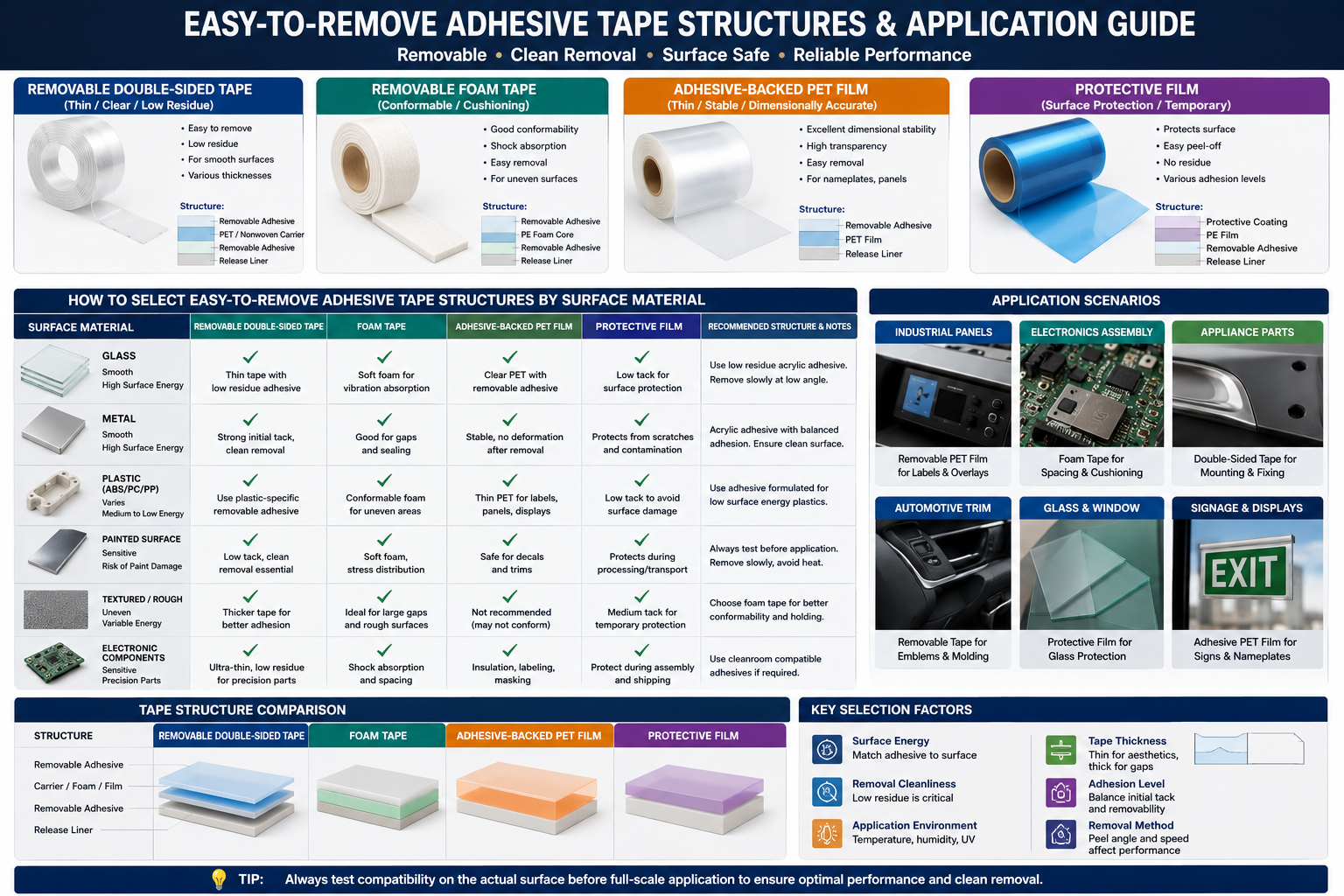
How to Choose Tape That Is Easier to Remove Later
If removal is required, buyers should tell the supplier before selecting tape.
Important questions include:
- Is the tape permanent or temporary?
- What surface will it bond to?
- How long will it stay attached?
- Will it face heat, humidity, sunlight, or pressure?
- Should it remove without residue?
- Is the surface painted, coated, plastic, glass, metal, or rubber?
- Will another adhesive be applied later?
- Does the part need a pull tab?
- Will removal be manual or automated?
- What residue level is acceptable?
These questions help avoid using a tape that bonds well but becomes difficult to remove.
How Sanken Supports Custom Double-Sided Tape Solutions
For OEM projects, Sanken Manufacturing helps customers convert double-sided tape into practical die-cut parts for electronics, displays, automotive, medical devices, packaging, and industrial assembly.
We support:
- Double-sided tape die cutting
- Foam tape converting
- PET-backed adhesive film converting
- Protective film processing
- Adhesive lamination
- Kiss cutting
- Pull-tab design
- Release liner control
- Custom shape cutting
- Prototype and mass production support
The key is not only making tape stick. The key is making the tape work for the full product life cycle: application, bonding, handling, protection, removal, and final surface quality.
For temporary protection or removable bonding, we can help customers review adhesive strength, liner format, residue risk, surface compatibility, and peeling method before mass production.
Conclusion
The easiest way to remove double-sided tape is to warm it gently, peel it slowly at a low angle, and clean the remaining residue with a surface-safe remover. Heat, patience, and the correct cleaning method are more effective than force.
However, the best removal method depends on the tape type and surface material. Glass, metal, plastic, paint, electronics, and display surfaces all require different levels of care.
For manufacturers, the best solution is to choose the correct adhesive tape structure from the beginning. If a product needs clean removal, the tape should be designed for removable performance, suitable liner release, proper die-cut shape, and safe surface compatibility.