
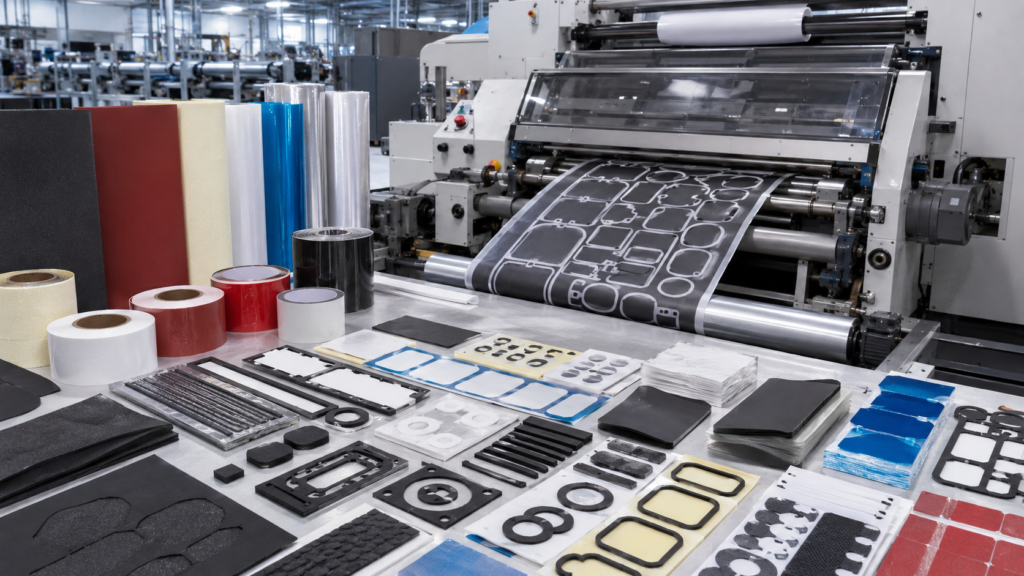
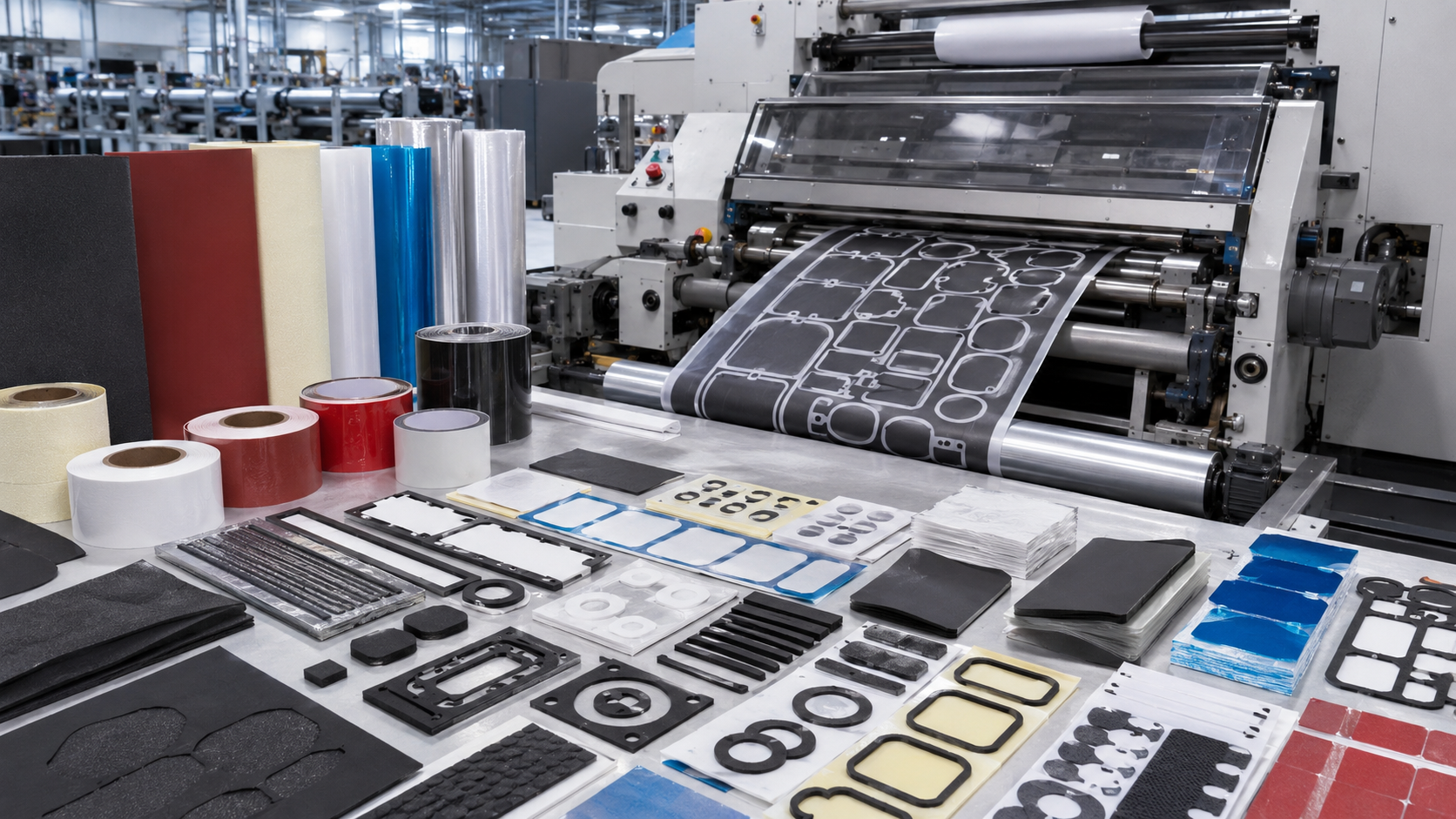
An industrial die cutting machine is used to convert flat or roll-fed materials into accurate custom shapes for mass production. It can cut, kiss cut, score, perforate, slit, laminate, and shape materials such as foam, rubber, adhesive tape, PET film, protective film, non-woven felt, insulation materials, and gasket sheets.
For OEM buyers and engineers, the purpose of an industrial die cutting machine is not only to “cut materials.” Its real purpose is to make repeatable, functional, assembly-ready components that support sealing, bonding, insulation, cushioning, protection, vibration control, and production efficiency.
At Sanken, we use industrial die cutting and material converting processes to help customers produce custom foam gaskets, adhesive-backed components, PET insulation films, rubber pads, protective films, non-woven felt parts, and multilayer precision parts for automotive, electronics, battery, medical, appliance, and industrial applications.
What Does an Industrial Die Cutting Machine Do?
An industrial die cutting machine uses a cutting tool, die, blade, rotary cylinder, or steel rule tool to cut materials into a required shape. The shape may be simple, such as a square pad or round washer. It may also be complex, with holes, slots, narrow walls, windows, adhesive layers, tabs, or multilayer structures.
Industrial die cutting machines can perform several functions:
- Full cutting
- Kiss cutting
- Half cutting
- Through cutting
- Scoring
- Perforation
- Slitting
- Creasing
- Laminating support
- Waste removal
- Roll-to-roll converting
- Sheet-format cutting
The final purpose depends on the product. A foam gasket may need accurate sealing width. A PET insulation film may need clean holes. A double-sided tape part may need kiss cutting on release liner. A protective film may need a pull tab for easy removal.
Why Industrial Die Cutting Matters in Manufacturing
Many components inside finished products are made from flexible materials. They may not be visible to the final customer, but they help the product work correctly.
Industrial die cutting is widely used because it helps manufacturers produce parts with stable dimensions, clean edges, and repeatable quality.
Die cut components can provide:
- Sealing
- Bonding
- Cushioning
- Electrical insulation
- Surface protection
- Gap filling
- Light blocking
- Dust protection
- Noise reduction
- Vibration control
- EMI shielding support
- Assembly positioning
In automotive electronics, die cut parts may seal a housing, reduce rattle noise, protect a sensor, or insulate a battery module.
In consumer electronics, they may bond a display, protect a lens, cushion a speaker, or insulate a circuit board.
In medical and industrial devices, they may support clean assembly, protective spacing, sealing, or adhesive positioning.
The purpose of industrial die cutting is to make these parts more accurate, easier to assemble, and more reliable in production.
Common Materials Processed by Industrial Die Cutting Machines
Industrial die cutting machines can process many flexible and semi-flexible materials. The machine setup must match the material behavior.
| Material | Common Die Cut Parts | Main Purpose |
|---|---|---|
| Foam | Gaskets, pads, spacers, inserts | Sealing, cushioning, gap filling |
| Rubber | Washers, seals, pads, gaskets | Sealing and vibration control |
| PET film | Insulation films, protective layers, spacers | Electrical insulation and protection |
| PI film | Heat-resistant insulation parts | High-temperature electrical insulation |
| Adhesive tape | Bonding pads, mounting strips, tape shapes | Fast assembly and bonding |
| Protective film | Surface protection covers and tabs | Scratch and dust protection |
| Non-woven felt | NVH pads, anti-rattle strips | Noise reduction and cushioning |
| Conductive materials | Shielding pads and grounding parts | EMI shielding support |
| Paperboard | Packaging inserts, boxes, display cards | Packaging and presentation |
Each material behaves differently during cutting.
Foam can compress. Rubber can rebound. Thin film may stretch. Adhesive tape may overflow if pressure is too high. Non-woven felt may shed fibers if the cutting edge is not controlled.
A good industrial die cutting process must consider both the machine and the material.
Main Purpose 1: Producing Accurate Custom Shapes
The most basic purpose of an industrial die cutting machine is to produce accurate custom shapes repeatedly.
Manual cutting may work for rough samples, but it is not suitable for mass production. Manual cutting can cause size variation, rough edges, poor hole alignment, slow output, and high labor cost.
Industrial die cutting improves:
- Shape consistency
- Hole accuracy
- Edge quality
- Production speed
- Material utilization
- Assembly fit
- Batch repeatability
For OEM components, accuracy directly affects final assembly.
A foam gasket with a shifted hole may not fit the housing. A PET insulation film with poor edge quality may create assembly risk. A tape component with the wrong size may reduce bonding area.
Industrial die cutting helps reduce these risks before mass production.
Main Purpose 2: Improving Assembly Efficiency
Industrial die cutting allows materials to be supplied in assembly-ready formats.
Instead of asking operators to cut or trim raw material by hand, the customer receives parts in the correct shape. These parts can be supplied in rolls, sheets, trays, kits, or liner-backed formats.
This helps OEM factories reduce:
- Manual cutting time
- Operator variation
- Assembly mistakes
- Material waste
- Rework
- Production delay
For adhesive-backed components, kiss cutting is especially important. The machine cuts the top material and adhesive layer without cutting through the release liner. This allows operators to peel and apply the finished part quickly.
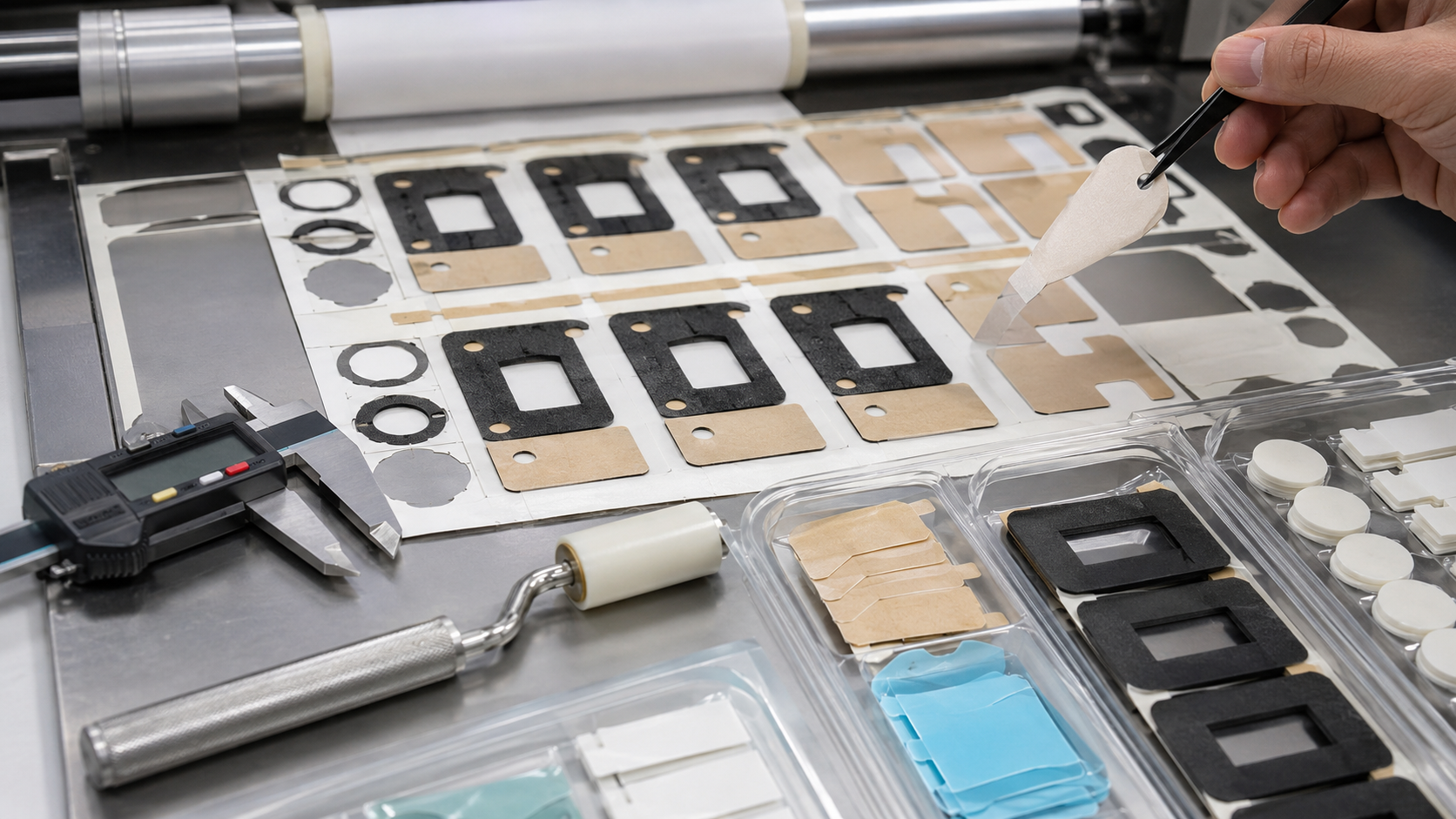
This format is commonly used for foam tape gaskets, double-sided tape pads, PET adhesive films, protective film tabs, and medical adhesive components.
Main Purpose 3: Supporting Functional Product Performance
Industrial die cutting does not only create neat shapes. It helps create functional parts that affect product performance.
For example:
- A foam gasket must seal a gap.
- A rubber pad must absorb vibration.
- A PET film must provide insulation.
- A felt strip must reduce noise.
- A protective film must peel cleanly.
- A tape component must bond reliably.
- A light-blocking gasket must prevent light leakage.
The shape, thickness, edge quality, adhesive position, and tolerance all affect how the part performs.
If the sealing wall is too narrow, the gasket may fail.
If the adhesive is squeezed to the edge, the part may lift or contaminate nearby components.
If the hole position is inaccurate, the part may interfere with screws, connectors, sensors, or housing features.
This is why industrial die cutting is closely connected to product reliability.
Main Purpose 4: Reducing Waste and Total Cost
Industrial die cutting machines help improve material utilization by arranging parts efficiently on the raw material.
This is important because many technical materials are expensive, especially silicone foam, high-performance adhesive tape, PET film, PI film, optical film, conductive materials, and specialty rubber.
Cost is affected by:
- Material width
- Part layout
- Cutting spacing
- Waste removal method
- Tooling cost
- Production speed
- Defect rate
- Packaging format
- Assembly efficiency
A low unit price is not always the lowest total cost. A stable die cutting process can reduce waste, defects, rework, and assembly delays.
For OEM buyers, this often matters more than only comparing material price.
Main Purpose 5: Enabling Repeatable Mass Production
A sample can often be made by many methods. Mass production requires repeatability.
Industrial die cutting machines are used because they can produce the same shape again and again with controlled quality.
Repeatability includes:
- Outer dimensions
- Hole position
- Cut depth
- Edge cleanliness
- Adhesive position
- Liner release
- Material thickness
- Waste removal
- Part spacing
- Packaging condition
For automotive, electronics, battery, medical, and industrial products, small variations can create assembly problems or long-term reliability risks.
A professional die cutting supplier should control process stability from sample stage to mass production, not only deliver one acceptable prototype.
Rotary, Flatbed, and Kiss Cutting Machines
Industrial die cutting machines come in different types. The right machine depends on material, thickness, shape, quantity, and application.
| Machine Type | Best For | Main Advantage |
|---|---|---|
| Rotary die cutting machine | Roll-fed films, tapes, thin foams, labels | High speed and repeatability |
| Flatbed die cutting machine | Thick foam, rubber, sheet parts, prototypes | Flexibility and material thickness |
| Kiss cutting machine/process | Adhesive-backed materials on liner | Easy peeling and assembly |
| Laser cutting | Prototypes, special shapes, tooling support | Digital flexibility |
| Slitting and laminating line | Roll materials and multilayer structures | Material converting efficiency |
Rotary die cutting is often suitable for high-volume adhesive tape, PET film, protective film, and foam tape parts.
Flatbed die cutting is often suitable for thick foam, rubber pads, larger sheet-format parts, and sample production.
Kiss cutting is critical for adhesive-backed components that need to remain on release liner for later use.
Common Problems If Industrial Die Cutting Is Not Controlled
A die cutting machine can improve production, but poor process control can still create defects.
| Problem | Common Cause | OEM Risk |
|---|---|---|
| Rough edges | Wrong tool or worn blade | Poor fit and poor appearance |
| Adhesive overflow | Excessive pressure or soft adhesive | Contamination and lifting |
| Liner damage | Kiss cut too deep | Difficult peeling |
| Poor release | Kiss cut too shallow | Slow assembly |
| Hole misalignment | Material movement or registration error | Assembly mismatch |
| Foam deformation | Incorrect cutting pressure | Poor sealing performance |
| Film stretching | Poor web tension control | Dimensional variation |
| Fiber shedding | Poor felt cutting process | Cleanliness concern |
These issues show why machine capability alone is not enough. Material selection, tooling, lamination, cutting depth, waste removal, inspection, and packaging must work together.
What Buyers Should Provide Before Industrial Die Cutting
Before requesting industrial die cutting, buyers should provide clear project information.
| Information Needed | Why It Matters |
|---|---|
| Drawing or sample | Defines shape, holes, tolerance, and design intent |
| Material requirement | Helps select foam, rubber, tape, film, or felt |
| Thickness | Affects tooling and cutting pressure |
| Adhesive requirement | Determines lamination and liner control |
| Application | Defines sealing, bonding, insulation, or protection needs |
| Bonding surface | Helps choose adhesive type |
| Quantity | Determines rotary, flatbed, or prototype process |
| Delivery format | Roll, sheet, individual piece, kit, or liner-backed |
| Testing requirement | Confirms reliability and production suitability |
| Assembly method | Helps improve usability and packaging |
The clearer the application information, the easier it is to avoid repeated sample changes.
How Sanken Uses Industrial Die Cutting for OEM Components
Sanken Manufacturing Co., Ltd. supports OEM customers with precision die cutting, rotary die cutting, flatbed die cutting, adhesive lamination, material converting, foam and rubber components, PET insulation films, protective films, non-woven felt parts, sealing gaskets, and custom adhesive-backed components.
For each project, we review:
- Material type
- Part function
- Thickness
- Adhesive structure
- Bonding surface
- Liner release
- Die cut tolerance
- Cutting depth
- Edge quality
- Waste removal
- Packaging format
- Assembly condition
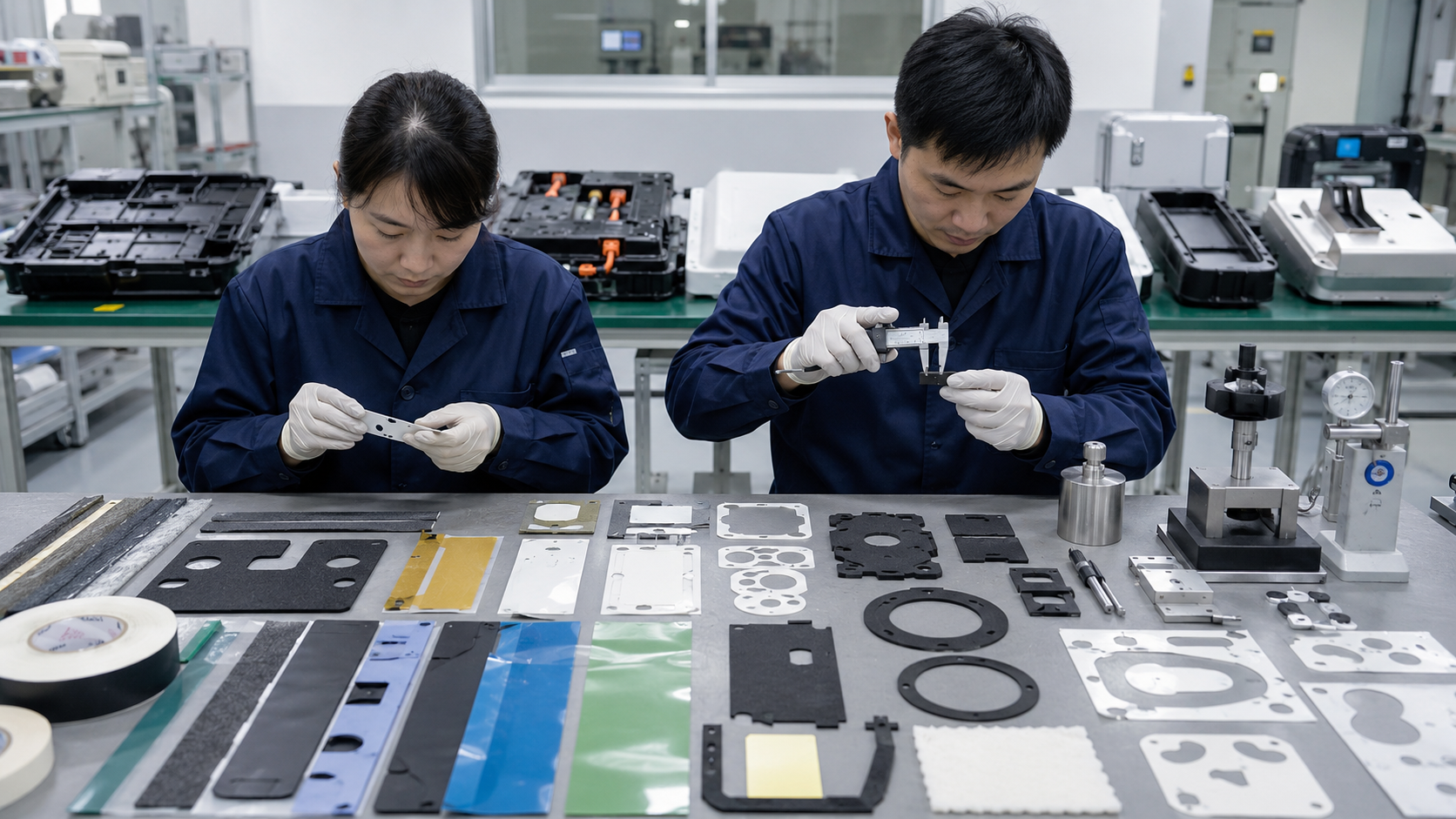
For automotive applications, we support foam gaskets, anti-rattle felt parts, sealing strips, adhesive pads, insulation films, and sensor assembly components.
For electronics and battery applications, we support PET insulation films, protective films, adhesive spacers, display bonding components, and masking films.
For medical, appliance, and industrial applications, we focus on clean cutting, stable release, dimensional accuracy, and assembly-friendly delivery.
Our goal is to help customers reduce manual work, sampling failures, adhesive lifting, poor fit, material waste, and unstable mass production.
FAQ
What is the purpose of an industrial die cutting machine?
The purpose of an industrial die cutting machine is to cut, shape, kiss cut, score, perforate, slit, or convert materials into accurate custom parts for sealing, bonding, insulation, cushioning, protection, packaging, and assembly.
What materials can an industrial die cutting machine process?
It can process foam, rubber, adhesive tape, PET film, PI film, protective film, non-woven felt, paperboard, labels, insulation materials, and many flexible or semi-flexible materials.
Why is industrial die cutting used in OEM manufacturing?
Industrial die cutting is used because it creates repeatable, accurate, assembly-ready components that reduce manual cutting, improve production efficiency, and support stable product performance.
What is the difference between industrial die cutting and manual cutting?
Manual cutting is slower and less consistent. Industrial die cutting is faster, more repeatable, and better for controlled dimensions, clean edges, and mass production.
Is industrial die cutting only used for packaging?
No. It is used for packaging, labels, foam gaskets, rubber pads, adhesive tapes, protective films, insulation films, electronics components, automotive parts, medical components, and industrial products.
What is kiss cutting in industrial die cutting?
Kiss cutting means cutting the top material and adhesive layer while keeping the release liner intact. This allows adhesive-backed parts to stay on the liner until assembly.
What should buyers check before ordering industrial die cut parts?
Buyers should confirm material, thickness, adhesive requirement, tolerance, application, bonding surface, quantity, delivery format, and testing needs before ordering.
Conclusion
The purpose of an industrial die cutting machine is to convert flat or roll-fed materials into accurate, repeatable, functional components. It helps manufacturers produce foam gaskets, adhesive tape parts, PET insulation films, rubber pads, protective films, non-woven felt components, packaging parts, and many other custom shapes efficiently.
For OEM buyers, the value of industrial die cutting is not only speed. The real value is stable quality, better assembly, reduced waste, accurate dimensions, clean edges, and reliable mass production.
At Sanken, we help customers turn foam, rubber, PET film, adhesive tape, protective film, non-woven felt, and multilayer materials into custom die cut components that support real product performance and efficient OEM assembly.