
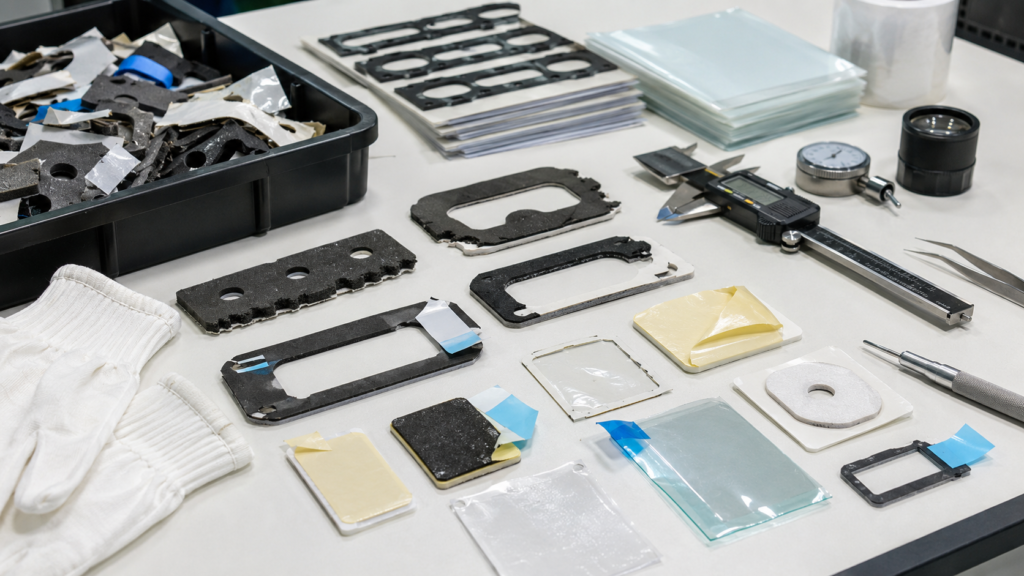
Die cut foam and tape parts often need rework when the material, adhesive, tolerance, liner release, cutting depth, packaging, or assembly process is not controlled correctly. A foam gasket may look acceptable after cutting but fail during installation. A double-sided tape part may stay flat on the liner but lift after bonding. A PET adhesive film may pass a simple visual check but cause problems when the operator peels and applies it on the production line.
For OEM buyers and engineers, rework is more than a quality issue. It increases labor cost, delays shipments, wastes material, slows assembly, and creates risk before mass production.
At Sanken, we help OEM customers develop custom die cut foam gaskets, adhesive tape components, PET films, protective films, rubber pads, non-woven felt parts, and multilayer converting parts for automotive, electronics, battery, medical, appliance, and industrial applications. The best way to reduce rework is to review the part as a functional assembly component, not just a cut shape.
Why Rework Happens in Die Cut Foam and Tape Parts
Rework usually happens when a part cannot be used directly in assembly. It may need trimming, cleaning, repositioning, relamination, repacking, sorting, or replacement.
Common rework situations include:
- Foam gasket edges are torn or compressed
- Adhesive tape parts lift from the liner
- Holes do not align with the housing
- Release liner is difficult to peel
- Adhesive overflows at the edge
- Parts curl after cutting
- Protective film leaves residue
- Foam thickness is inconsistent
- Tape pads shift during packaging
- Operators need to manually separate waste
- Finished parts are contaminated with dust or particles
These problems often appear after the sample stage because mass production adds more variables: material batches, tool wear, machine setting changes, operator handling, packaging pressure, storage time, and assembly speed.
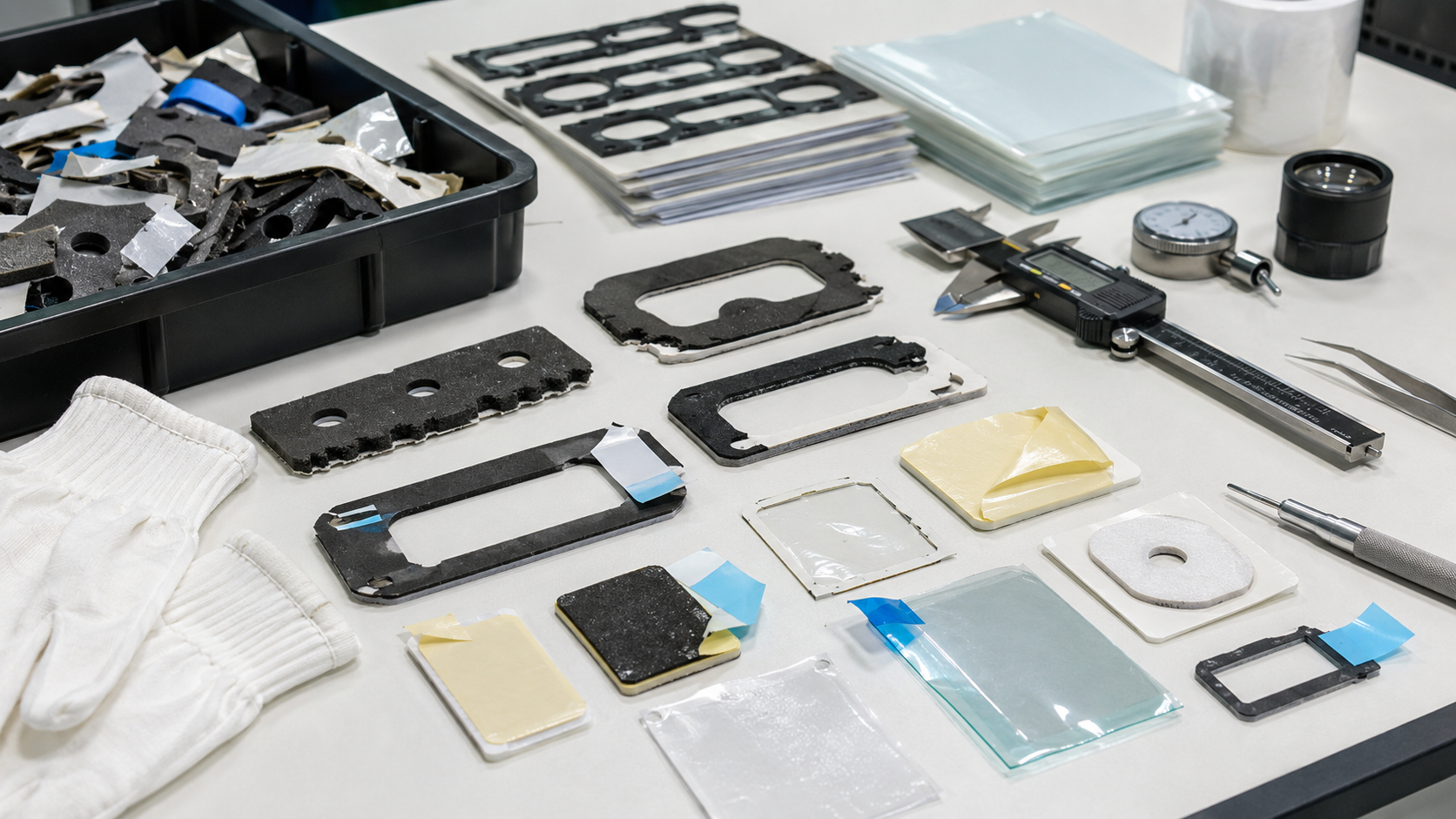
Common Causes of Rework
| Rework Problem | Common Cause | Production Impact |
|---|---|---|
| Edge lifting | Wrong adhesive, poor surface contact, sharp corners | Peeling and assembly failure |
| Liner damage | Kiss cut depth too deep | Slow peeling and damaged parts |
| Poor release | Kiss cut too shallow or wrong liner | Manual rework and line delay |
| Foam deformation | Excessive cutting pressure or wrong foam density | Poor sealing and fit |
| Adhesive overflow | Soft adhesive or high pressure | Contamination and sticking issues |
| Hole misalignment | Material movement or weak registration control | Assembly mismatch |
| Rough edges | Dull tool or unsuitable cutting process | Poor appearance and fit |
| Curling parts | Material tension, thin film, poor packaging | Difficult placement |
| Dust or particles | Poor handling or edge shedding | Cleanliness risk |
| Wrong packaging | Compression, bending, or poor part separation | Damaged parts before use |
A part may need rework for one reason or several reasons at the same time. For example, an adhesive-backed foam gasket may have correct dimensions but still fail because the liner is too difficult to peel. A PET tape component may be cleanly cut but curl during storage because web tension and packaging were not controlled.
Material Selection Problems
Material selection is one of the biggest causes of rework.
Foam, tape, film, rubber, and felt all behave differently during cutting and assembly. A material that looks suitable in a catalog may not perform well in the final product.
For foam parts, engineers should check density, compression force, thickness tolerance, cell structure, rebound, and aging performance.
For tape parts, engineers should check adhesive type, carrier material, liner release, bonding surface, peel strength, temperature resistance, and adhesive flow.
For PET or PI films, engineers should check thickness, dimensional stability, hole accuracy, edge cleanliness, and insulation performance.
For non-woven felt, engineers should check fiber shedding, density, thickness, and adhesive lamination behavior.
If the material is too soft, it may deform during die cutting.
If the adhesive is too aggressive, the liner may be hard to remove.
If the adhesive is too weak, the part may lift after bonding.
If the foam is too thick or too hard, the final assembly may not close correctly.
A correct material choice must match the real product structure and assembly environment.
Adhesive and Liner Issues
Adhesive-backed parts are especially sensitive to rework because they must perform well in both converting and assembly.
The adhesive must bond to the final surface, but it must also release correctly from the liner.
Common adhesive-related rework includes:
- Edge lifting
- Adhesive residue
- Poor initial tack
- Adhesive transfer to liner
- Tape stretching during peeling
- Adhesive overflow after cutting
- Difficult liner removal
- Part deformation during application
The release liner is often underestimated. If the liner is too tight, operators may damage the part during peeling. If the liner is too loose, parts may shift during handling. If the liner is cut too deeply during kiss cutting, it may tear during assembly.
For OEM production, the liner should be tested together with the adhesive and final part shape.
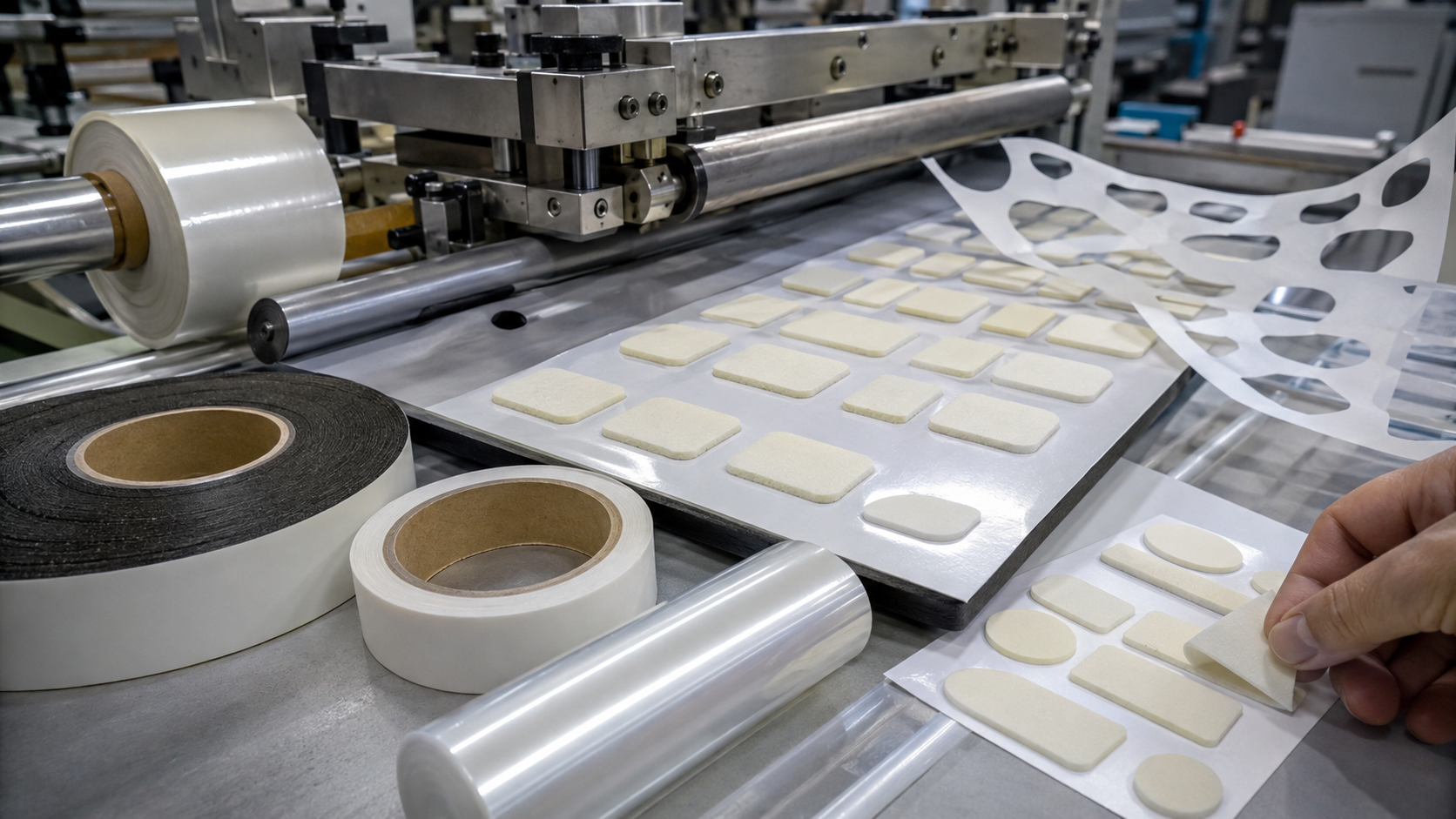
Die Cutting Process Problems
Even when the material is correct, poor process control can still create rework.
Die cutting quality depends on tooling, cutting pressure, machine stability, material tension, lamination quality, waste removal, and inspection.
Common process causes include:
- Incorrect cutting depth
- Worn or unsuitable tool
- Excessive pressure
- Unstable web tension
- Poor waste matrix removal
- Material stretching
- Foam compression
- Adhesive squeeze-out
- Poor registration
- Inconsistent part spacing
For kiss cut adhesive parts, cutting depth is critical. The blade must cut through the top material and adhesive layer without damaging the liner.
For foam gaskets, cutting pressure must be controlled to avoid crushing the foam.
For PET insulation films, edge quality and hole position are important.
For rubber pads, material rebound must be considered.
For felt parts, fiber shedding must be controlled.
The process should be adjusted according to material behavior, not only the drawing.
Design and Tolerance Problems
Some rework begins with the design.
A part may be difficult to produce if the walls are too narrow, holes are too small, corners are too sharp, or tolerance is tighter than the material can realistically hold.
Common design-related problems include:
| Design Issue | Possible Result |
|---|---|
| Very narrow foam walls | Tearing during waste removal |
| Sharp corners | Adhesive lifting or tearing |
| Small holes | Poor waste removal and blocked holes |
| Tight tolerance on soft foam | High rejection rate |
| Large unsupported tape areas | Curling or stretching |
| No pull tab | Slow liner removal |
| No assembly clearance | Difficult product fit |
| Overly complex shape | High tooling and inspection cost |
A small design change can often reduce rework significantly.
Rounded corners can reduce peeling risk. Wider walls can improve foam strength. Pull tabs can improve assembly speed. More realistic tolerances can reduce unnecessary sorting and rejection.
Packaging and Handling Problems
Many die cut foam and tape parts are damaged after they are already produced correctly.
Packaging and handling can cause curling, compression marks, dust contamination, liner separation, part shifting, and adhesive exposure.
Foam parts may deform if stacked under too much pressure.
Adhesive parts may shift if the liner is too slippery.
Thin films may curl if stored with tension.
Small parts may be difficult to count or pick if the packaging format is not designed for assembly.
For OEM customers, delivery format matters.
Parts can be supplied as:
- Roll format
- Sheet format
- Individual pieces
- Liner-backed parts
- Kiss cut sheets
- Tray-packed parts
- Kitted sets
- Protective bag packaging
The best packaging format depends on how operators will use the part on the production line.
How to Prevent Rework Before Mass Production
The best way to prevent rework is to review the full process before mass production.
| Prevention Step | What to Check | Benefit |
|---|---|---|
| Application review | Sealing, bonding, insulation, cushioning, protection | Selects the right material |
| Material validation | Foam density, adhesive, liner, film thickness | Reduces mismatch |
| Drawing review | Holes, corners, narrow walls, tolerance | Improves manufacturability |
| Adhesive testing | Bonding surface, pressure, dwell time | Prevents lifting |
| Kiss cut control | Cutting depth and liner release | Improves assembly |
| Sample testing | Peel, fit, compression, aging, handling | Finds risks early |
| Packaging review | Stack pressure, trays, sheets, roll format | Prevents shipping damage |
| Production inspection | Dimensions, edge, liner, adhesive, thickness | Controls batch stability |
The goal is not only to make a sample. The goal is to prove that the part can be produced, handled, shipped, peeled, installed, and used without repeated correction.
What Buyers Should Provide to Reduce Rework
Buyers can help suppliers prevent rework by providing complete project information.
Important details include:
- Drawing or sample
- Material requirement
- Total thickness
- Foam density or hardness requirement
- Adhesive type or bonding surface
- Release liner preference
- Tolerance requirement
- Application environment
- Assembly method
- Packaging format
- Quantity
- Testing requirement
- Critical-to-quality areas
For example, if the part bonds to PP plastic, the supplier needs to know that before adhesive selection. If the part is compressed inside an automotive housing, the supplier needs to know the gap and compression requirement. If operators need to peel the part quickly, liner release must be tested before production.
Clear information reduces repeated samples and unnecessary rework.
How Sanken Helps Prevent Rework
Sanken Manufacturing Co., Ltd. helps OEM customers reduce rework by reviewing material, adhesive, tooling, cutting depth, tolerance, packaging, and assembly requirements before production.
For foam components, we review foam type, density, thickness, compression behavior, adhesive backing, and die cut geometry.
For tape components, we review adhesive structure, carrier material, liner release, kiss cutting depth, waste removal, and bonding surface.
For PET, PI, and protective film parts, we review edge cleanliness, hole alignment, film tension, adhesive control, and packaging.
For automotive, electronics, battery, medical, appliance, and industrial applications, we focus on stable quality from sample to mass production.
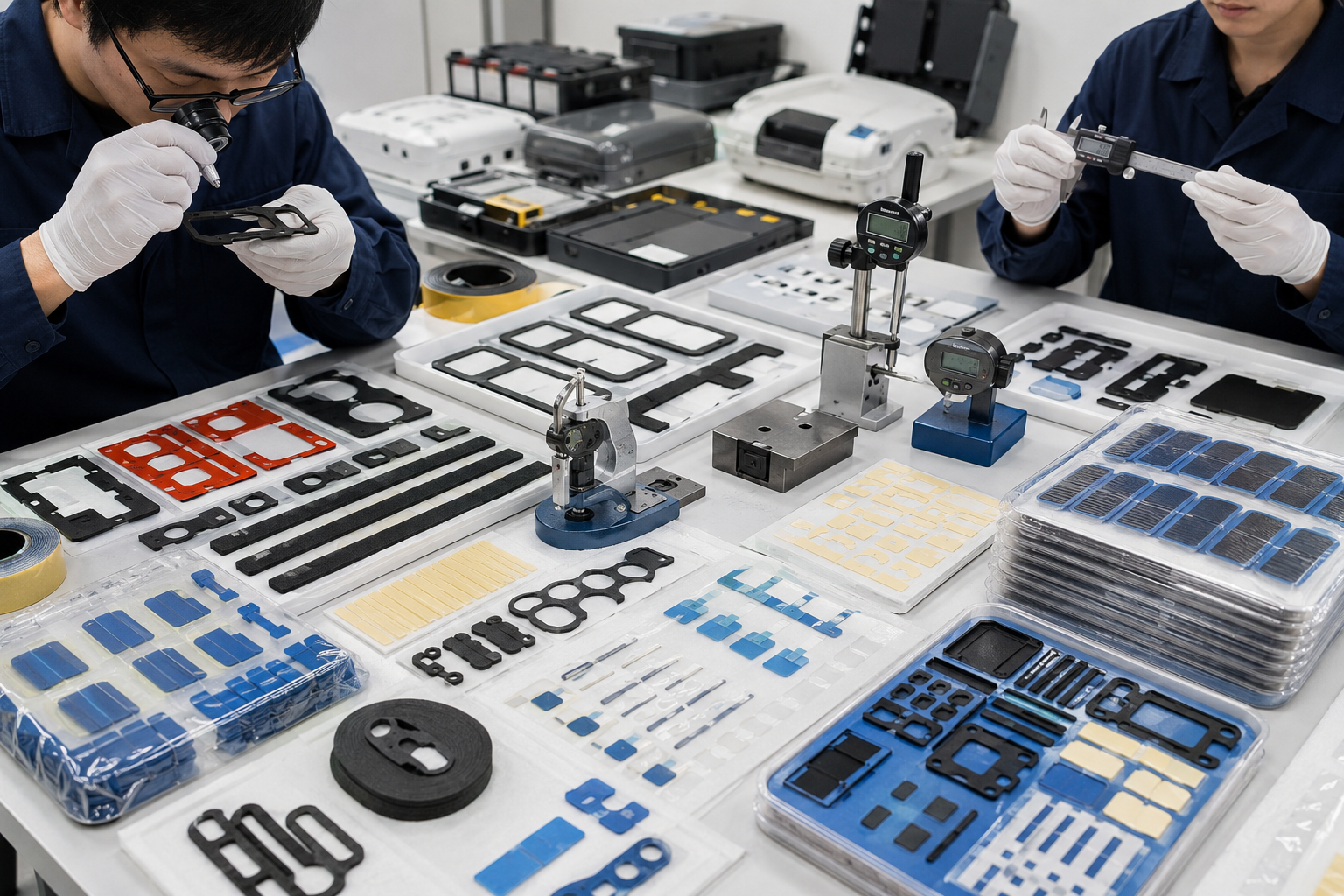
Our goal is to help customers reduce manual trimming, sorting, relamination, rejected parts, assembly delay, adhesive lifting, poor fit, and unstable batch quality.
A good die cut foam or tape part should not need extra correction before use. It should arrive clean, accurate, easy to peel, easy to assemble, and stable in the final product.
FAQ
Why do die cut foam parts need rework?
Die cut foam parts may need rework because of torn edges, poor thickness control, wrong foam density, deformation, rough cutting, poor adhesive backing, or unsuitable packaging.
Why do die cut tape parts lift from the liner?
Tape parts may lift because of wrong adhesive, poor liner selection, incorrect kiss cutting depth, material tension, sharp corners, or poor waste removal.
How can adhesive overflow be prevented?
Adhesive overflow can be reduced by controlling cutting pressure, choosing suitable adhesive hardness, optimizing tooling, and testing the adhesive structure before mass production.
Why is kiss cutting important for adhesive-backed parts?
Kiss cutting allows the top material and adhesive layer to be cut while the release liner remains intact. Correct kiss cutting makes parts easier to peel and apply during assembly.
Can design changes reduce rework?
Yes. Rounded corners, wider foam walls, proper pull tabs, realistic tolerances, and better hole sizes can reduce tearing, lifting, poor release, and assembly problems.
What should buyers check before ordering die cut foam and tape parts?
Buyers should check material, adhesive, bonding surface, thickness, tolerance, die cut shape, liner release, packaging format, assembly method, and testing requirements.
Can Sanken help reduce rework in die cut components?
Yes. Sanken supports material selection, adhesive lamination, precision die cutting, kiss cutting, liner release control, inspection, and packaging review for custom foam, tape, film, rubber, felt, and multilayer die cut components.
Conclusion
Die cut foam and tape parts usually need rework when material selection, adhesive behavior, liner release, cutting depth, tolerance, design, packaging, or assembly conditions are not controlled. Rework increases cost, delays production, and creates risk for OEM assembly.
The best prevention method is to review the full component system before mass production: material, adhesive, drawing, tooling, cutting process, liner, packaging, testing, and final use.
At Sanken, we help OEM buyers and engineers develop custom die cut foam and tape components that are cleaner, more stable, easier to assemble, and less likely to require rework in production.