
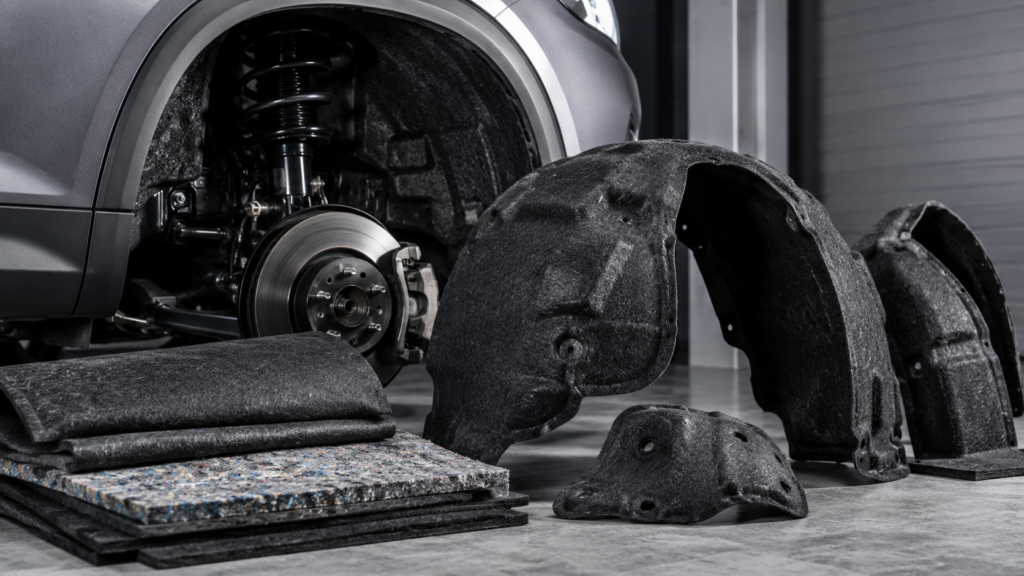
Needle-punched PET nonwoven felt, recycled PET nonwoven, thermoformed nonwoven composites and multilayer acoustic nonwoven structures are commonly used for car wheel arch fender liners. These materials help reduce tire noise, splash noise, vibration and road impact while supporting lightweight vehicle design.
For automotive OEMs, the best nonwoven material depends on acoustic absorption, water resistance, stone impact resistance, temperature stability, weight target, forming process and long-term durability.
At Sanken Manufacturing, we support automotive nonwoven material converting, precision die cutting, lamination and custom component production for wheel arch liners, acoustic pads, anti-rattle parts and other NVH applications.
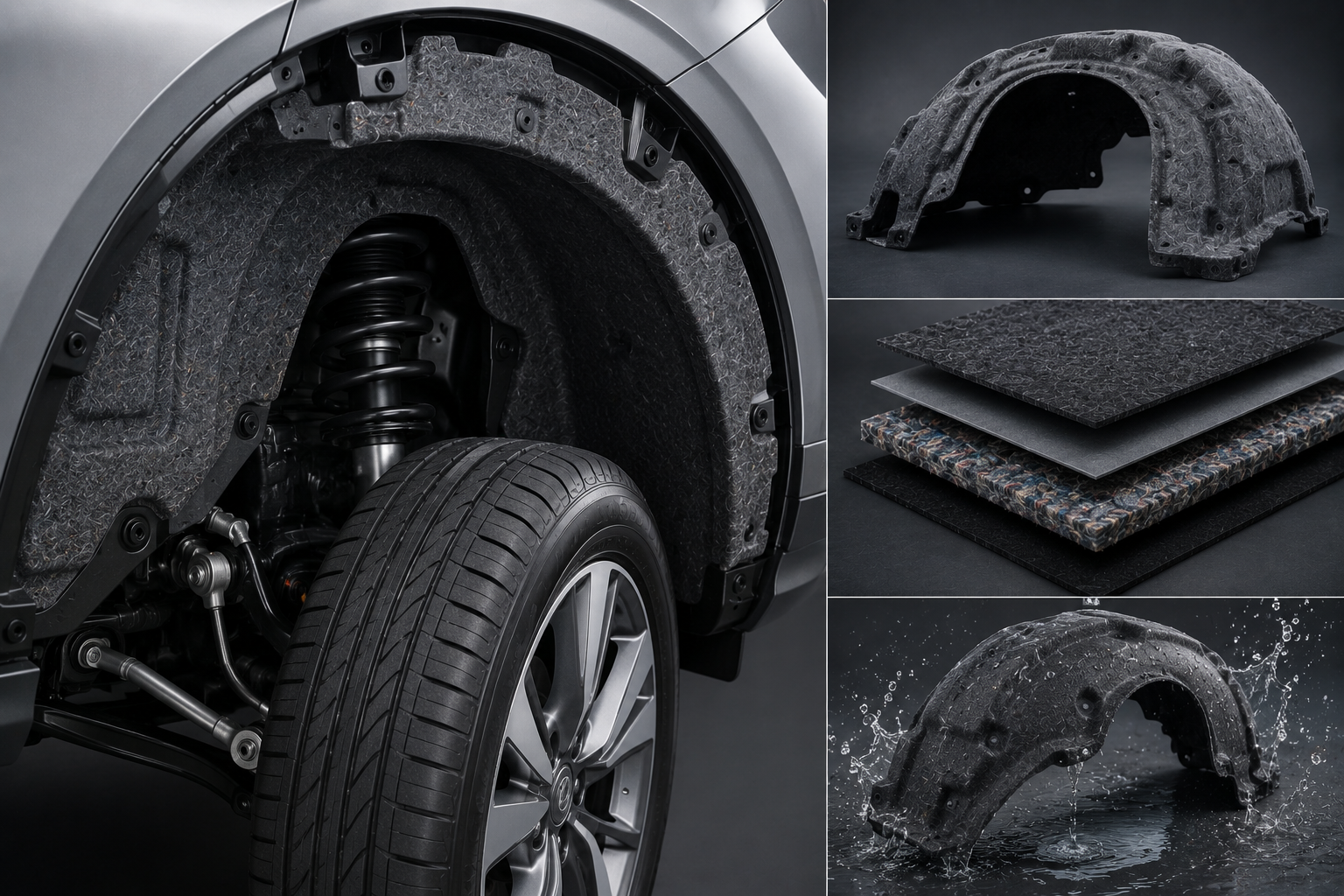
Why Are Nonwoven Materials Used in Automotive Fender Liners?
Traditional plastic fender liners provide excellent protection against mud and road debris.
However, plastic alone has limited sound absorption capability.
Modern vehicles require more.
OEMs now expect wheel arch liners to:
- Reduce tire noise
- Absorb road vibration
- Minimize splash noise
- Support lightweight vehicle design
- Improve overall NVH performance
Nonwoven materials help achieve these goals because their fiber structures absorb sound energy rather than simply reflecting it.
As a result, many modern wheel arch liners are now produced using nonwoven composites instead of conventional hard plastic designs.
Key Requirements for Fender Liner Nonwovens
Wheel arch environments are harsh.
Materials must withstand:
- Water exposure
- Road salt
- Stone impact
- Mud contamination
- Temperature fluctuations
- Long-term vibration
Therefore, the ideal nonwoven material must provide:
- Acoustic absorption
- Mechanical durability
- Moisture resistance
- Lightweight construction
- Consistent long-term performance
Only a few nonwoven material families consistently meet these requirements.
Common Nonwoven Materials for Wheel Arch Fender Liners
| Nonwoven Material | Main Advantage | Typical Use |
|---|---|---|
| Needle-punched PET nonwoven felt | Good acoustic absorption and durability | Standard automotive wheel arch liners |
| Recycled PET nonwoven | Lightweight and more sustainable | EV and lightweight vehicle platforms |
| Thermoformed nonwoven composite | Better dimensional stability and fit | Complex 3D fender liner shapes |
| Multilayer acoustic nonwoven | Improved noise control across frequencies | Premium vehicles and higher NVH targets |
| Nonwoven with protective surface treatment | Better moisture and debris resistance | Harsh wheel arch environments |
1. Needle-Punched PET Nonwoven Felt
Needle-punched PET felt is one of the most common materials used in modern acoustic fender liners.
The manufacturing process mechanically entangles fibers to create a dense, durable structure.
Advantages include:
- Excellent sound absorption
- Good impact resistance
- Lightweight design
- Recyclable material options
- Stable performance in automotive environments
Because of its balance of performance and cost, many global OEMs specify needle-punched PET felt for wheel arch applications.
2. Recycled PET Nonwoven Materials
Sustainability is becoming increasingly important throughout the automotive industry.
As a result, recycled PET nonwoven materials have gained significant popularity.
Benefits include:
- Reduced environmental impact
- Lightweight structure
- Good acoustic performance
- High material utilization efficiency
Many electric vehicle manufacturers use recycled PET nonwovens as part of their sustainability initiatives while still meeting NVH requirements.
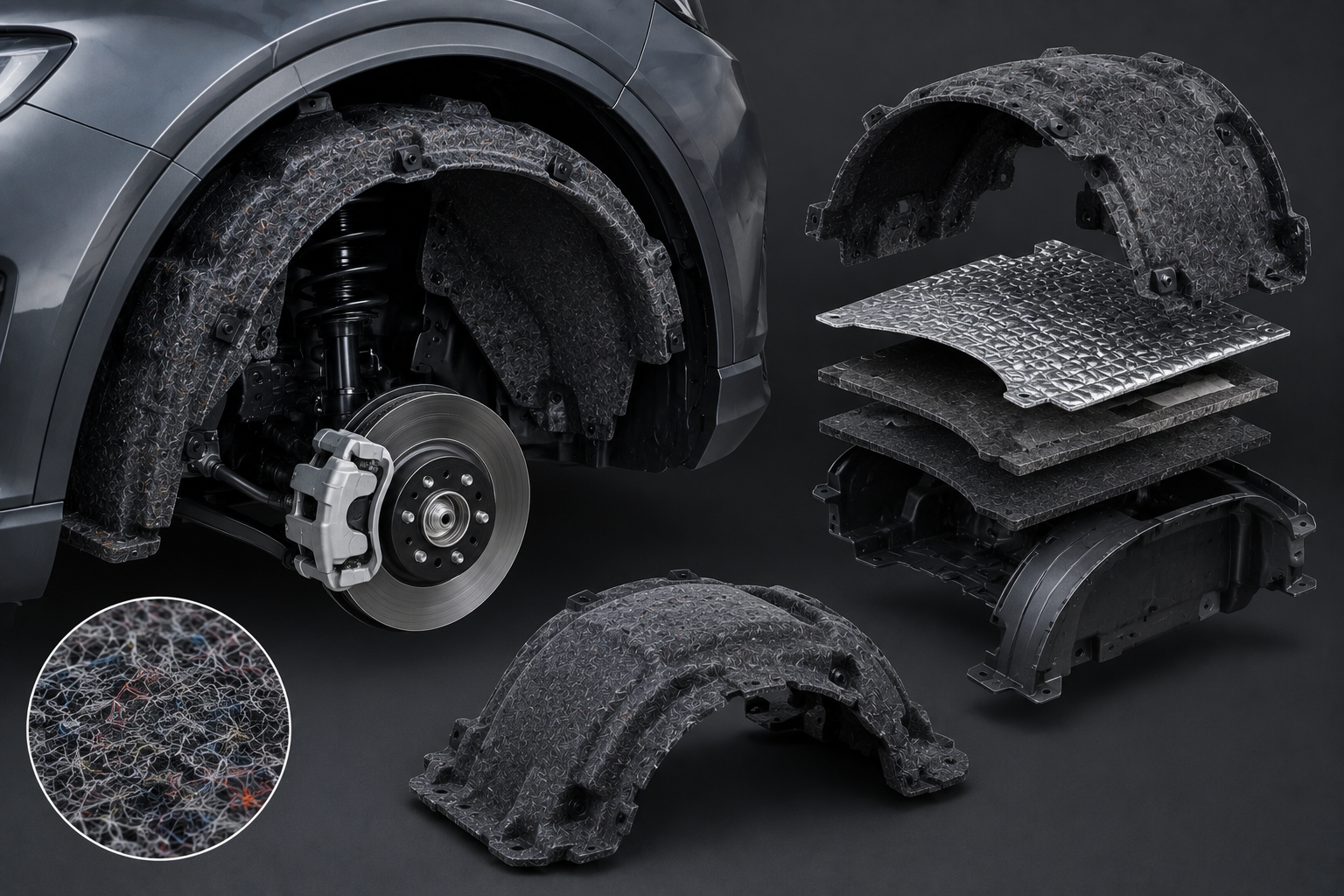
3. Thermoformed Nonwoven Composite Systems
For more demanding applications, OEMs often select thermoformed nonwoven composites.
These systems combine:
- Nonwoven acoustic layers
- Structural reinforcement layers
- Water-resistant surfaces
The result is a component capable of delivering:
- Better dimensional stability
- Enhanced durability
- Improved road noise reduction
- Consistent fitment
Thermoformed structures are particularly common in premium vehicles and EV platforms where acoustic comfort is a major selling point.
4. Multi-Layer Acoustic Nonwoven Structures
Some vehicle platforms require more than simple sound absorption.
They require targeted noise management across multiple frequency ranges.
To achieve this, manufacturers may use multi-layer structures incorporating:
- Needle-punched nonwoven felt
- Foam damping layers
- Reinforcement substrates
- Protective surface treatments
These layered systems can significantly improve:
- Tire noise reduction
- Splash noise control
- Vibration damping
while maintaining acceptable weight targets.
Why Weight Matters in Fender Liner Design
Every component contributes to vehicle mass.
For modern OEMs, reducing weight remains a major objective.
Lightweight nonwoven materials help:
- Improve fuel efficiency
- Extend EV driving range
- Reduce overall vehicle mass
- Maintain acoustic performance
Compared with some traditional solutions, advanced nonwoven composites often provide better NVH performance at lower weight.
This combination makes them highly attractive for modern vehicle programs.
Common Fender Liner Applications
Nonwoven wheel arch liners are commonly found in:
Passenger Vehicles
Used to improve ride comfort and reduce road noise.
Electric Vehicles
Help compensate for the absence of engine noise by controlling tire and road-generated sounds.
SUVs and Crossovers
Provide additional protection against gravel impact and road debris while improving cabin quietness.
Premium Vehicle Platforms
Support luxury-level NVH targets and enhanced passenger comfort.
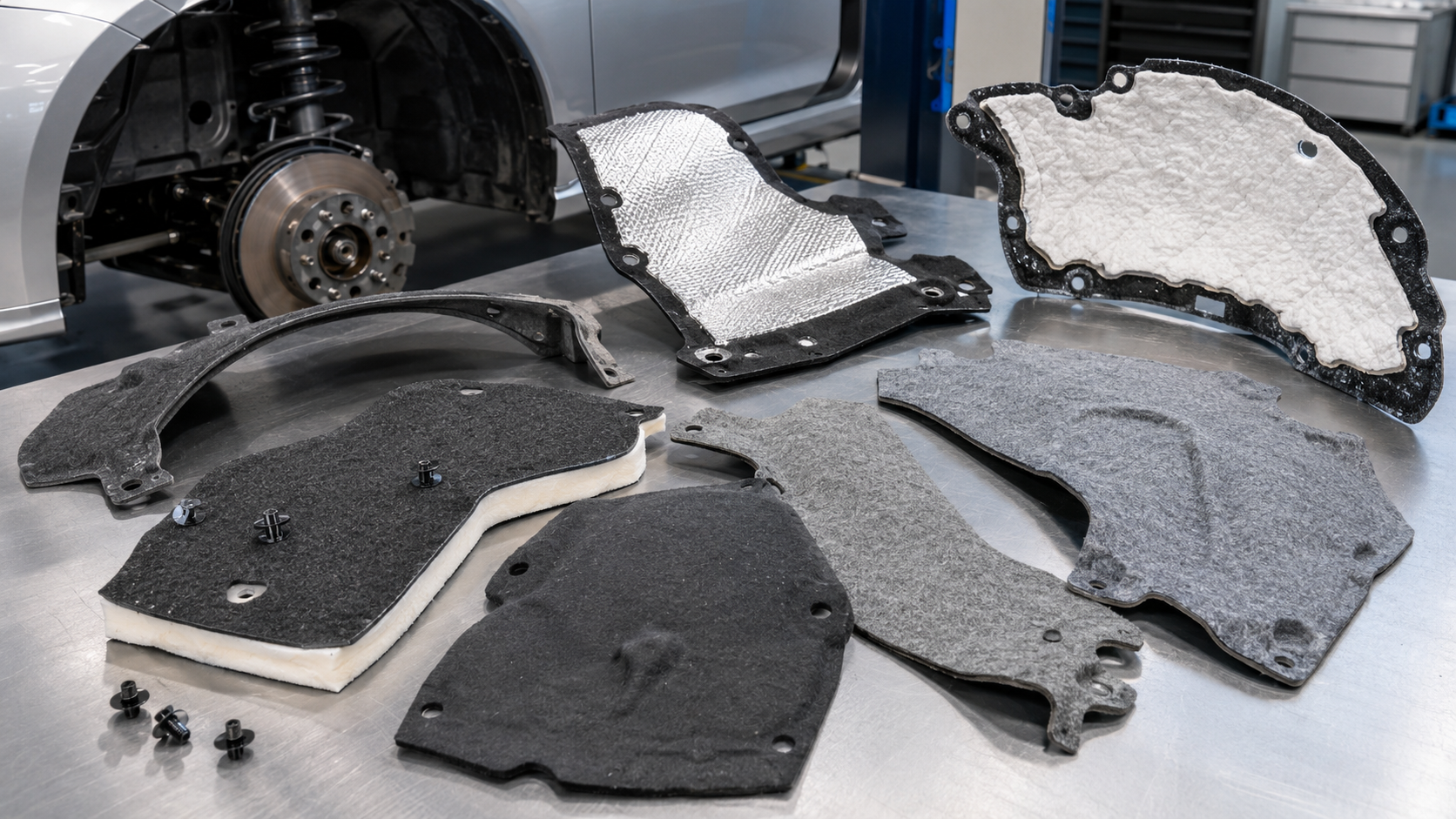
Why Precision Converting Is Critical
Material selection is only half the equation.
The converting process directly affects final performance.
Wheel arch liners often require:
- Complex three-dimensional shapes
- Precise mounting features
- Consistent thickness control
- High-volume repeatability
Poor converting can result in:
- Installation issues
- Noise leakage
- Reduced durability
- Inconsistent acoustic performance
This is why OEMs increasingly evaluate both material suppliers and converting capabilities during supplier selection.
How Sanken Supports Fender Liner Programs
At Sanken, we help automotive OEMs and Tier suppliers convert nonwoven materials into production-ready wheel arch liner components and related NVH parts. Our work may include material selection support, lamination, precision die cutting, thickness control, sample development and mass production support.
We support nonwoven felt, recycled PET, foam-nonwoven composites, adhesive-backed acoustic layers and multilayer structures used in automotive interiors, wheel arch areas, underbody parts and other noise-control applications.
Our capabilities include:
- Precision die cutting
- Nonwoven material converting
- Multi-layer lamination
- Acoustic component manufacturing
- Automotive-grade process control
We work closely with customers to optimize:
- Material selection
- Acoustic performance
- Weight reduction
- Manufacturability
The goal is not simply to supply a part.
It is to deliver a wheel arch liner solution that performs reliably throughout the vehicle lifecycle.
Conclusion
Car wheel arch fender liners require nonwoven materials that can balance acoustic absorption, impact resistance, moisture resistance, lightweight design and long-term durability. Common choices include needle-punched PET nonwoven felt, recycled PET nonwoven, thermoformed nonwoven composites and multilayer acoustic structures.
For automotive OEMs and Tier suppliers, material choice is only one part of the project. Converting accuracy, lamination quality, forming stability, thickness control and repeatable mass production also affect final NVH performance.
Sanken supports automotive nonwoven material converting, precision die cutting, lamination and custom acoustic component production for wheel arch liners, automotive interiors, underbody parts and other NVH applications. If you need custom nonwoven felt parts, acoustic pads or multilayer NVH components, Sanken can help from material selection and prototyping to stable mass production.