
How to Tune Nonwoven Density for Lightweight & Noise Control?
Automotive engineers face a challenge that seems simple but is surprisingly difficult to solve:
How do you make a vehicle quieter without making it heavier?
For decades, the easiest answer was to add more material. Thicker insulation. Heavier barriers. Larger acoustic packages.
But modern vehicles, especially EVs, cannot afford unnecessary weight.
Every gram matters.
This is where nonwoven density tuning becomes one of the most important engineering tools in automotive NVH design.
At Sanken, we frequently work with OEMs and Tier 1 suppliers developing acoustic components where success depends on finding the right balance between lightweight construction and effective noise control.
The key is not simply choosing a nonwoven material.
The key is choosing the right density.
What Is Nonwoven Density?
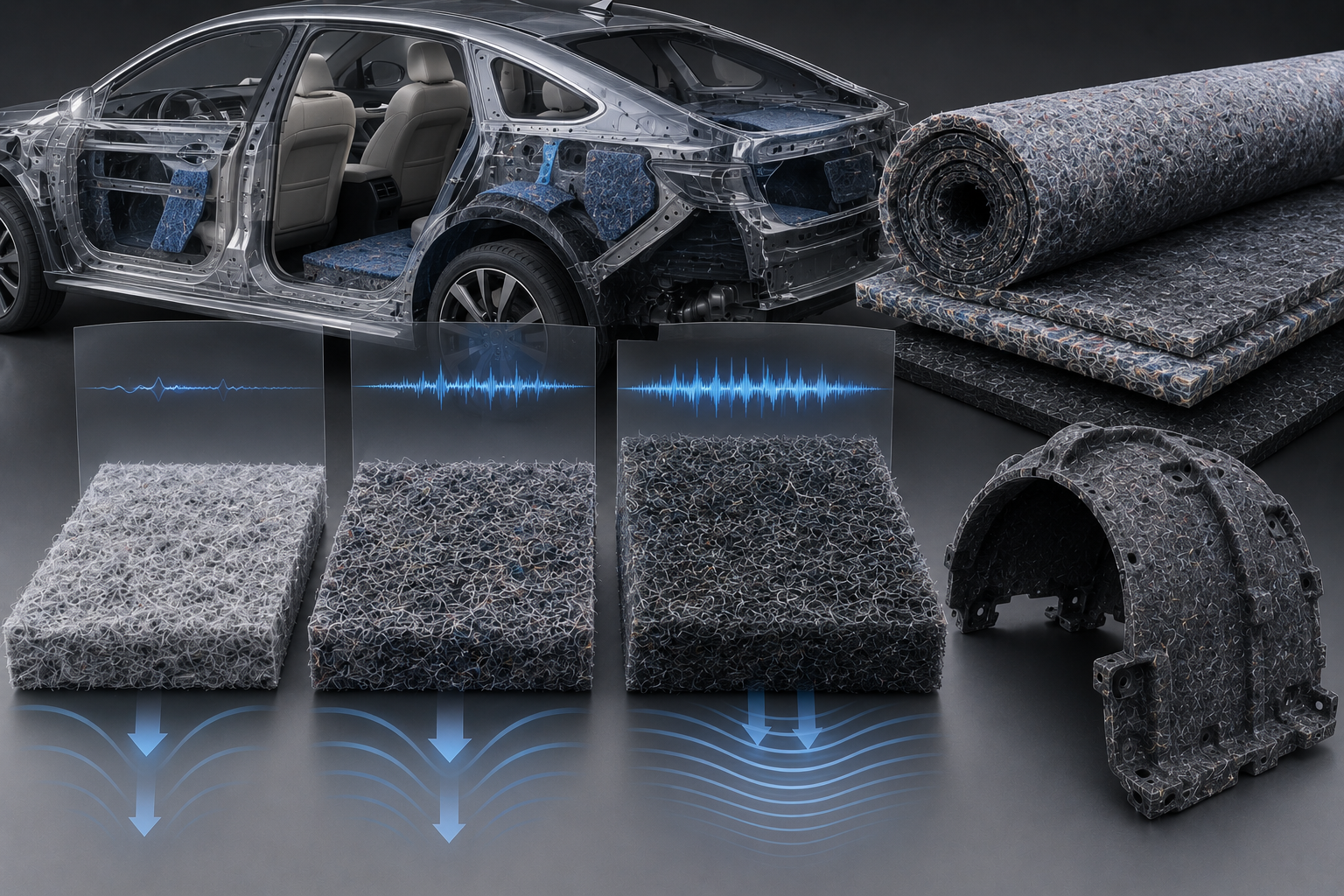
Nonwoven density refers to the amount of fiber contained within a specific volume of material.
In simple terms:
- Low density = more air, less fiber
- High density = more fiber, less air
Density directly affects:
- Sound absorption
- Weight
- Compression behavior
- Durability
- Formability
- Cost
Because automotive nonwoven materials are often used for NVH applications, density becomes one of the most important performance variables.
Why Density Matters for Noise Control
Many people assume that heavier materials always absorb more sound.
This is only partially true.
Different noise frequencies behave differently.
For example:
| Noise Type | Frequency Range | Density Preference |
|---|---|---|
| Road Noise | Low-Mid Frequency | Medium Density |
| Tire Noise | Mid Frequency | Medium-High Density |
| Wind Noise | High Frequency | Lower Density |
| Cabin Resonance | Broad Range | Multi-Layer Design |
If density is too low:
- Sound passes through easily
- Acoustic performance drops
If density is too high:
- Airflow resistance increases excessively
- Certain frequencies may reflect instead of absorb
- Weight increases unnecessarily
The goal is optimization, not maximization.
The Relationship Between Density and Weight
Lightweighting remains one of the automotive industry's highest priorities.
Every kilogram removed from a vehicle can contribute to:
- Improved fuel efficiency
- Extended EV range
- Lower emissions
- Better overall vehicle performance
Increasing density generally increases:
- Material mass
- Transportation cost
- Assembly weight
This means engineers cannot simply specify the densest material available.
Instead, they must determine the minimum density required to achieve NVH targets.
This approach creates the best balance between performance and weight.
How OEMs Typically Select Density Ranges
Although every project is unique, most automotive nonwoven applications follow similar design principles.
Low Density Structures
Typical characteristics:
- Excellent lightweight properties
- Good high-frequency absorption
- Easy thermoforming
- Lower material cost
Common applications:
- Headliners
- Sunroof shade systems
- Interior trim backing
Medium Density Structures
Typical characteristics:
- Balanced acoustic performance
- Good stiffness
- Moderate weight
Common applications:
- Door panels
- Dash insulators
- Trunk trim assemblies
This density range is often considered the "sweet spot" for many automotive acoustic components.
High Density Structures
Typical characteristics:
- Better structural support
- Improved low-frequency performance
- Higher durability
- Increased weight
Common applications:
- Trunk floor systems
- Fender liners
- Load-bearing interior structures
High density materials are usually selected when mechanical performance is equally important as acoustic performance.
Why Fiber Structure Is Just as Important as Density
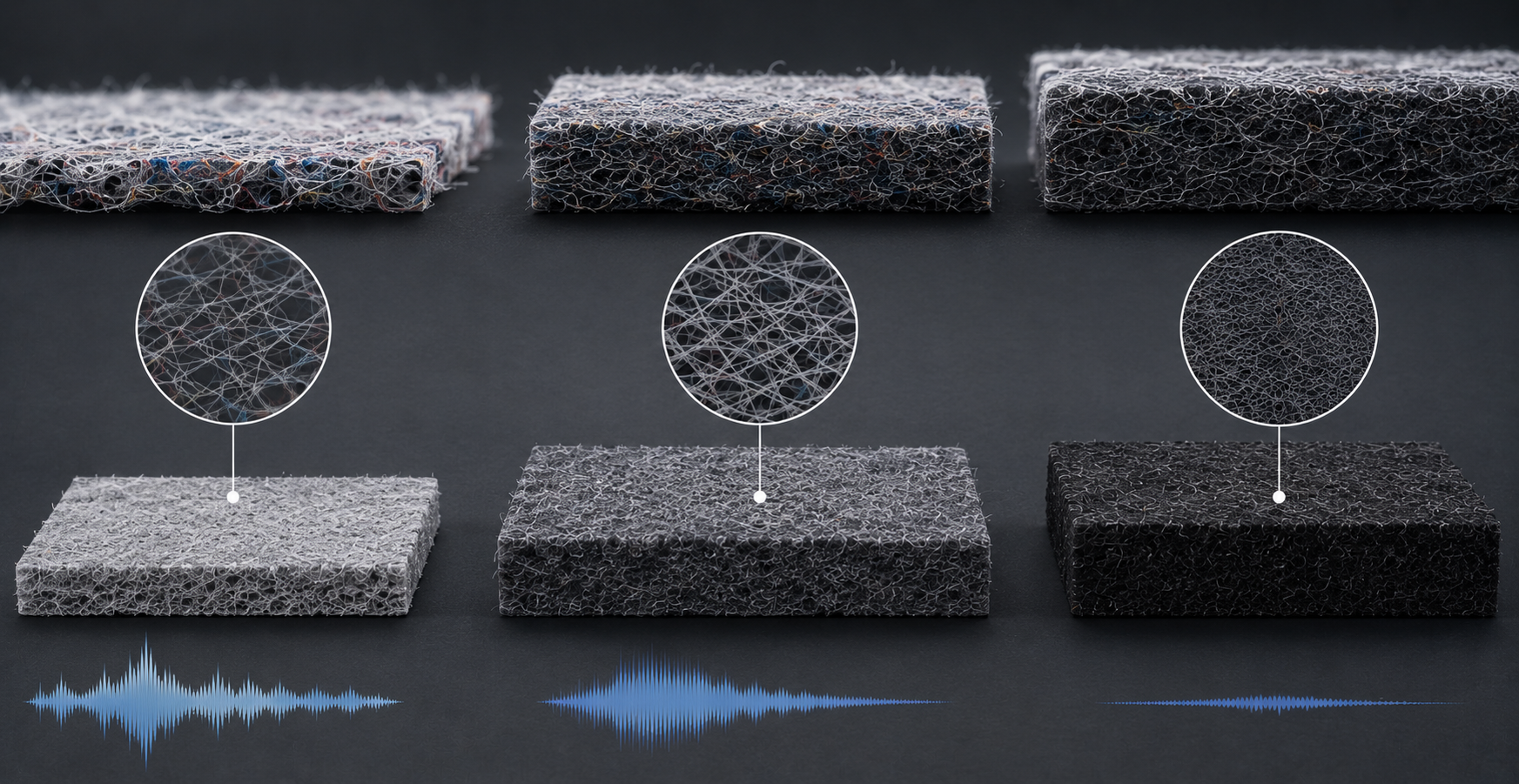
Density alone does not determine acoustic performance.
Two materials with identical density can perform very differently.
Why?
Because fiber structure also matters.
Factors include:
- Fiber diameter
- Fiber orientation
- Fiber blend composition
- Layer arrangement
- Airflow resistance
For example:
A properly engineered low-density needle-punched material may outperform a poorly designed higher-density material.
This is why experienced material suppliers focus on overall material architecture rather than density alone.
The EV Challenge: Quiet Vehicles Need Smarter Materials
Electric vehicles have changed NVH engineering dramatically.
In traditional vehicles:
Engine noise masks many unwanted sounds.
In EVs:
Passengers hear:
- Tire noise
- Road texture
- Wind turbulence
- Interior rattles
Much more clearly.
As a result, OEMs often require more sophisticated density tuning strategies.
Rather than using a single material density throughout the vehicle, engineers increasingly use:
- Variable density layers
- Multi-density composites
- Hybrid acoustic structures
This approach delivers better acoustic performance without excessive weight gain.
Multi-Layer Design Often Beats Higher Density
One of the biggest misconceptions in NVH engineering is that increasing density is always the solution.
In reality, multi-layer systems often outperform single dense layers.
For example:
Layer 1:
- Low-density absorption layer
Layer 2:
- Medium-density damping layer
Layer 3:
- Structural reinforcement layer
This configuration can:
- Improve broadband noise absorption
- Reduce overall weight
- Enhance durability
- Improve manufacturability
Modern OEM programs increasingly favor this strategy.
Common Automotive Components Requiring Density Optimization
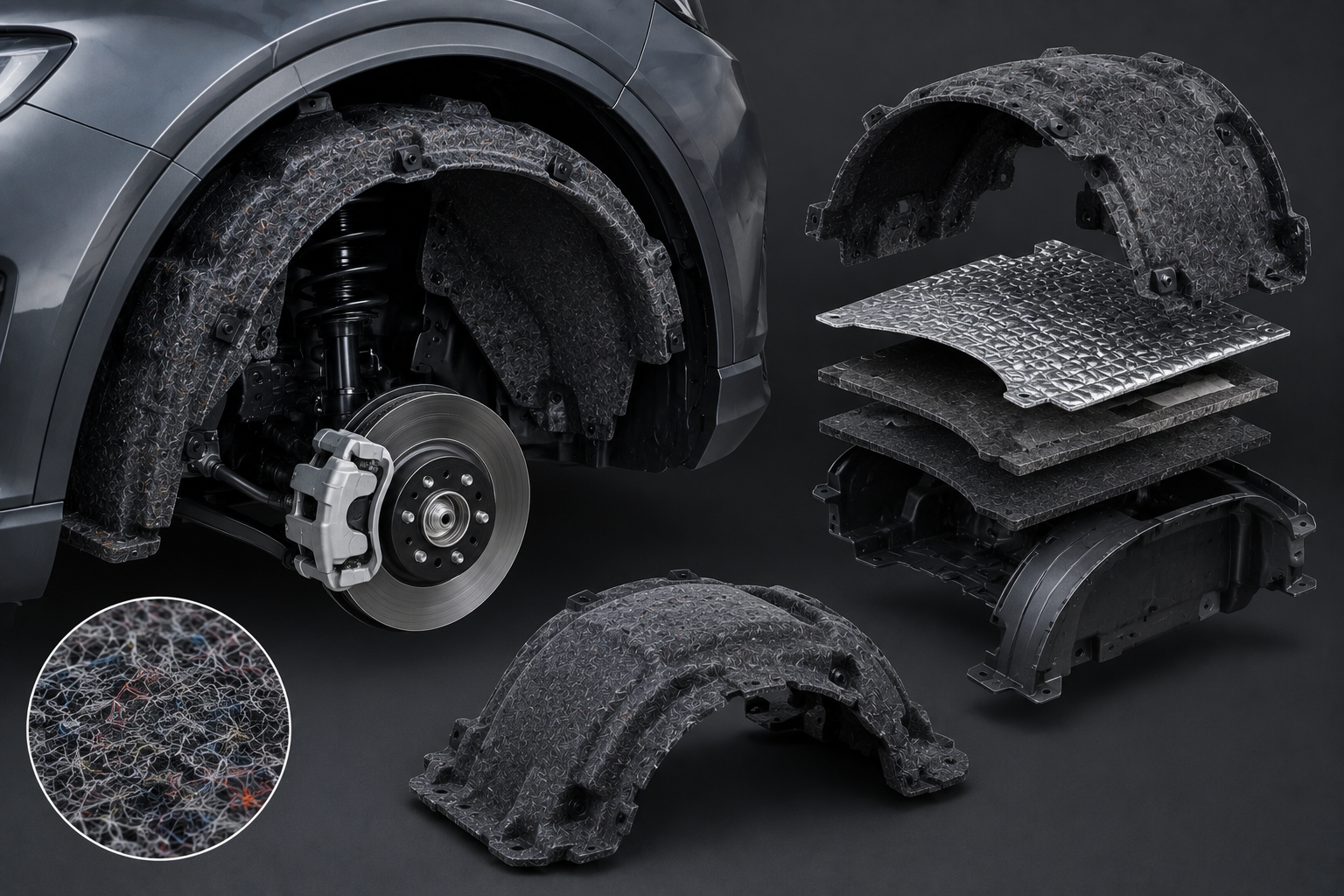
Fender Liners
Must balance:
- Stone impact resistance
- Water resistance
- Tire noise reduction
- Lightweight requirements
Trunk Floor Systems
Require:
- Structural support
- Acoustic insulation
- Weight optimization
Door Panels
Need:
- Vibration control
- Rattle prevention
- Assembly stability
Headliners
Focus on:
- High-frequency noise absorption
- Lightweight construction
- Surface appearance
Each application requires a unique density strategy.
Why Converting Quality Influences Density Performance
Even the best material can fail if it is processed incorrectly.
Converting operations such as:
- Die cutting
- Lamination
- Compression forming
- Thermoforming
can alter material behavior.
Potential problems include:
- Density compression variation
- Uneven thickness
- Reduced acoustic effectiveness
- Dimensional instability
At Sanken, we focus not only on material selection but also on maintaining material integrity throughout the converting process.
This helps customers achieve consistent NVH performance from prototype through mass production.
How Sanken Helps Optimize Nonwoven Density
Choosing the correct density is rarely straightforward.
At Sanken, we help customers evaluate:
- Acoustic targets
- Weight requirements
- Environmental conditions
- Manufacturing constraints
- Cost objectives
Our capabilities include:
- Precision die cutting
- Multi-layer lamination
- Nonwoven converting
- Acoustic component development
- Automotive NVH material integration
By combining material expertise with converting experience, we help OEMs and Tier 1 suppliers find the right balance between lightweight construction and acoustic performance.
Conclusion
Tuning nonwoven density is one of the most effective ways to balance lightweight design and noise control in modern vehicles.
The best solution is rarely the lightest material or the densest material.
Instead, successful OEM programs focus on optimizing density, fiber structure, and component design together.
At Sanken, we help automotive manufacturers transform nonwoven materials into precision-engineered acoustic solutions that meet demanding NVH targets while supporting lightweight vehicle design.