
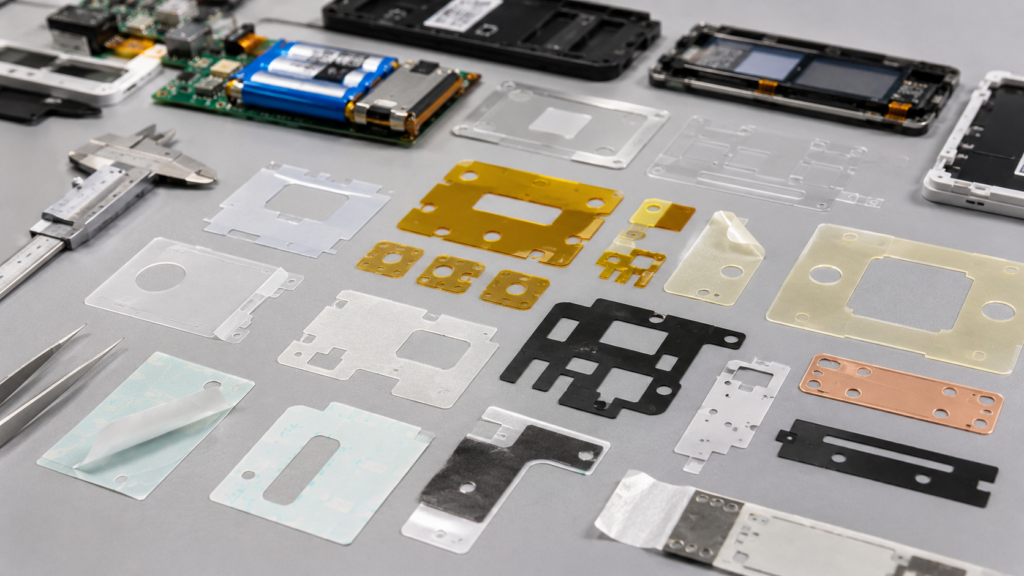
Insulation films must be precision die cut for electronics because even a small dimensional error, burr, misaligned hole, rough edge, or adhesive shift can affect electrical safety, assembly fit, and long-term product reliability. In electronic products, insulation film is not just a thin plastic sheet. It is often a functional barrier that prevents short circuits, protects components, separates conductive areas, controls spacing, and supports stable assembly.
For OEM engineers and purchasing managers, the key question is not only which insulation film material to choose. The more important question is whether the film can be converted into accurate, clean, repeatable, and assembly-ready parts.
At Sanken, we help OEM customers develop custom die cut insulation films, PET films, PI films, PC films, adhesive-backed films, protective films, foam pads, rubber components, and multilayer die cut parts for electronics, automotive electronics, battery modules, appliances, medical devices, and industrial equipment.
Why Insulation Films Are Critical in Electronics
Modern electronic products are becoming smaller, thinner, and more integrated. Components are placed closer together, and assembly space is limited. This makes insulation control more important than ever.
Insulation films are commonly used in:
- Circuit board protection
- Battery module insulation
- Display module assembly
- Sensor components
- Power supply units
- Consumer electronics
- Automotive electronics
- Connectors and terminals
- Control modules
- Wearable devices
- Medical electronic devices
- Industrial electronic equipment
These films help prevent electrical contact between conductive parts. They may also provide protection against dust, scratches, heat, adhesive contact, or mechanical wear.
If the insulation film is cut incorrectly, the risk is not only a poor appearance. The part may expose a conductive area, block a hole, interfere with assembly, shift during use, or fail after heat and vibration.
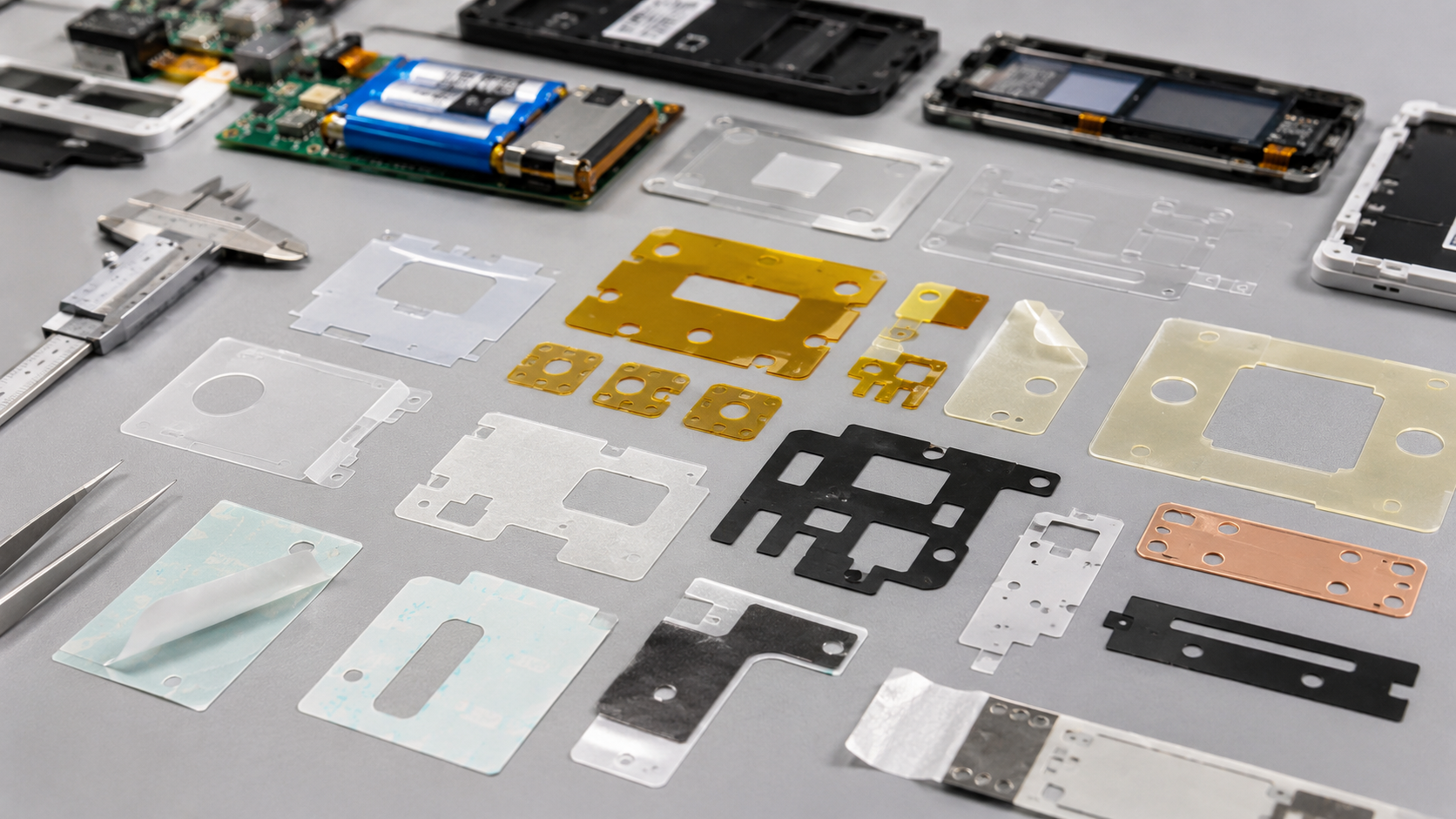
Common Insulation Film Materials
Different electronic applications require different insulation film materials. Each material has its own strengths, limitations, and converting requirements.
| Material | Common Features | Typical Electronics Use |
|---|---|---|
| PET film | Good dimensional stability and insulation | Battery insulation, electronic spacers, protective layers |
| PI film | High temperature resistance and strong insulation | Power electronics, battery areas, heat-resistant insulation |
| PC film | Good toughness and impact resistance | Display modules, covers, electronic separators |
| PP film | Lightweight and chemical resistance | General insulation and separation |
| PVC film | Flexible and cost-effective | Some low-voltage insulation applications |
| Flame-retardant film | Improved safety performance | Power supply and battery-related electronics |
| Adhesive-backed film | Easy positioning and assembly | Insulation stickers, protective pads, bonding layers |
PET and PI films are especially common in electronics because they offer stable insulation performance, clean converting potential, and reliable dimensional control.
However, choosing the film material is only the first step. The film must also be die cut correctly according to the drawing, tolerance, adhesive structure, and assembly environment.
Why Precision Die Cutting Is Necessary
Insulation films are often placed in small and critical areas. They may need holes, slots, windows, tabs, narrow bridges, or complex outlines.
Manual cutting or low-precision cutting is not suitable for these parts because the risks are too high.
Precision die cutting can help control:
- Outer profile accuracy
- Hole position
- Slot width
- Edge cleanliness
- Burr control
- Adhesive position
- Liner release
- Part spacing
- Repeatability across batches
- Assembly-friendly delivery format
For example, a PET insulation film inside a battery pack may need accurate hole alignment around terminals or screws. If the hole shifts, the part may interfere with assembly or expose a conductive area.
A PI insulation film near a heat source may need clean edges and stable dimensions. If the edge is rough or the part curls, it may not sit correctly.
A display module insulation film may need very clean cutting to avoid particles and poor appearance.
In electronics, small errors can create large reliability risks.
Common Problems When Insulation Films Are Not Cut Precisely
Poorly converted insulation films can create many production and quality problems.
| Problem | Common Cause | Electronics Risk |
|---|---|---|
| Hole misalignment | Poor cutting accuracy or material shifting | Assembly failure or exposed conductive area |
| Rough edges | Wrong tool or worn cutting blade | Particles, poor fit, insulation risk |
| Burrs | Poor cutting pressure or unsuitable process | Electrical safety concern |
| Film curling | Material tension or poor storage | Difficult assembly |
| Adhesive overflow | Excessive cutting pressure | Contamination and poor fit |
| Liner damage | Kiss cutting depth too deep | Difficult peeling |
| Part deformation | Weak waste removal or thin bridges | Assembly mismatch |
| Batch variation | Unstable process control | Inconsistent product reliability |
A film part may look acceptable at first glance, but electronic assembly often reveals hidden problems.
If the operator needs extra time to peel the film, the production line slows down.
If the part curls, it may not align correctly.
If the adhesive shifts, it may contaminate nearby components.
If burrs or particles remain, they may affect cleanliness and electrical reliability.
What Buyers or Engineers Should Check First
Before ordering die cut insulation films, buyers should confirm the application details clearly.
| Checklist Item | What to Confirm | Why It Matters |
|---|---|---|
| Film material | PET, PI, PC, PP, flame-retardant film | Determines insulation and heat performance |
| Film thickness | Total thickness and tolerance | Affects fit and electrical spacing |
| Adhesive backing | With or without PSA adhesive | Affects positioning and liner release |
| Die cut shape | Holes, slots, tabs, windows, narrow bridges | Determines manufacturability |
| Tolerance | Hole position, edge width, profile accuracy | Controls assembly fit |
| Application area | Battery, PCB, display, sensor, connector | Defines risk level |
| Temperature exposure | Normal, high heat, thermal cycling | Guides material choice |
| Electrical requirement | Insulation, dielectric strength, short-circuit prevention | Confirms functional performance |
| Delivery format | Roll, sheet, individual part, kit | Affects assembly efficiency |
| Testing method | Dimension, peel, aging, fit, insulation check | Confirms production reliability |
This checklist helps the supplier choose the right film, adhesive, liner, cutting method, and inspection plan.
Adhesive-Backed Insulation Films Need Extra Control
Many insulation films are supplied with pressure-sensitive adhesive backing. Adhesive makes assembly faster because operators can peel and apply the film directly.
However, adhesive-backed insulation films also create additional converting risks.
The process must control:
- Adhesive thickness
- Adhesive position
- Liner release force
- Kiss cutting depth
- Adhesive overflow
- Waste removal
- Edge cleanliness
- Part flatness
Kiss cutting is especially important. The blade must cut the film and adhesive layer without cutting through the release liner. If the cut is too shallow, the part may not release cleanly. If the cut is too deep, the liner may tear during peeling.
For electronic assembly, a difficult-to-peel part can slow production and increase damage risk.
A good adhesive-backed insulation film should peel smoothly, stay flat, align accurately, and bond reliably to the target surface.
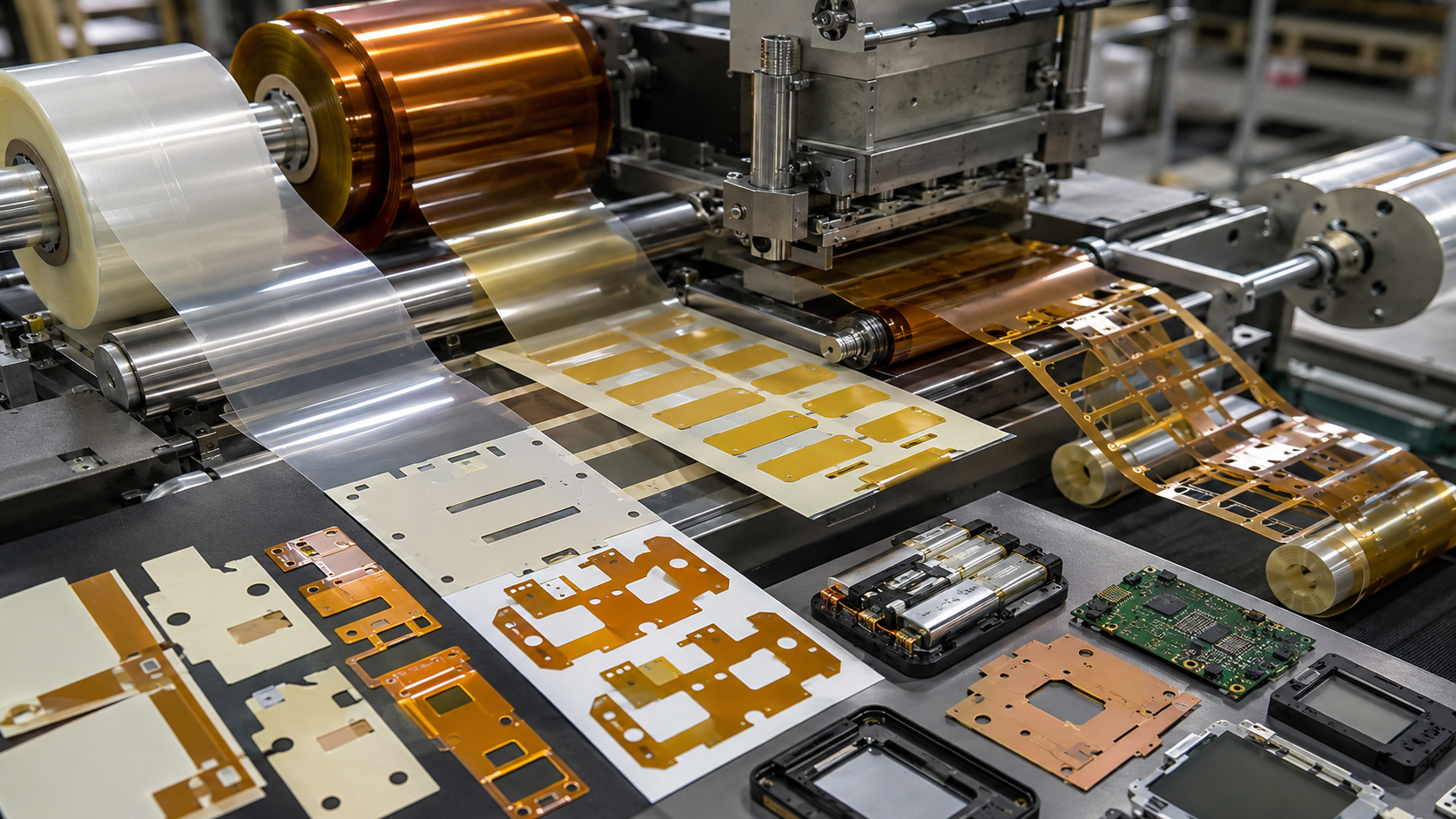
Material Behavior During Die Cutting
Different insulation films behave differently during cutting.
PET film offers good dimensional stability, but thin PET can still shift or stretch if tension is not controlled.
PI film has excellent heat resistance, but clean edge cutting and adhesive matching are important for high-reliability applications.
PC film is tougher, but the cutting process must avoid rough edges or stress marks.
Flame-retardant films may have special material structures that need proper tool selection.
Very thin films may wrinkle during feeding. Thick films may require more cutting force. Films with adhesive layers may show adhesive squeeze-out if pressure is too high.
This is why insulation film die cutting requires both material knowledge and process control.
Precision Die Cutting Supports Electronics Assembly
A well-designed die cut insulation film does more than prevent electrical contact. It can also improve assembly efficiency.
Precision die cut films can be supplied in formats such as:
- Individual pieces
- Kiss cut parts on release liner
- Roll format
- Sheet format
- Tabbed parts for easy peeling
- Layered film structures
- Kitted parts for assembly stations
Assembly-friendly design can reduce operator mistakes.
For example, adding a peel tab may help operators remove the film from the liner faster. Supplying parts in sheet format may fit manual assembly. Roll format may support automated application. Proper part spacing can make peeling easier.
These small design decisions can reduce labor time and improve production consistency.
How Sanken Helps OEM Customers Reduce Insulation Film Risk
Sanken Manufacturing Co., Ltd. supports OEM customers with precision die cut insulation films and related material converting solutions.
We work with PET film, PI film, PC film, adhesive-backed films, protective films, double-sided tapes, foam pads, rubber components, non-woven felt parts, and multilayer materials.
For insulation film projects, we review:
- Material type
- Film thickness
- Adhesive structure
- Liner release
- Die cut shape
- Hole accuracy
- Edge cleanliness
- Burr and particle control
- Cutting depth
- Packaging format
- Assembly method
- Testing requirements
For electronics and battery applications, we focus on clean cutting, dimensional stability, insulation reliability, and assembly-friendly delivery.
For automotive electronics, we also consider vibration, heat exposure, aging, adhesive stability, and long-term product reliability.
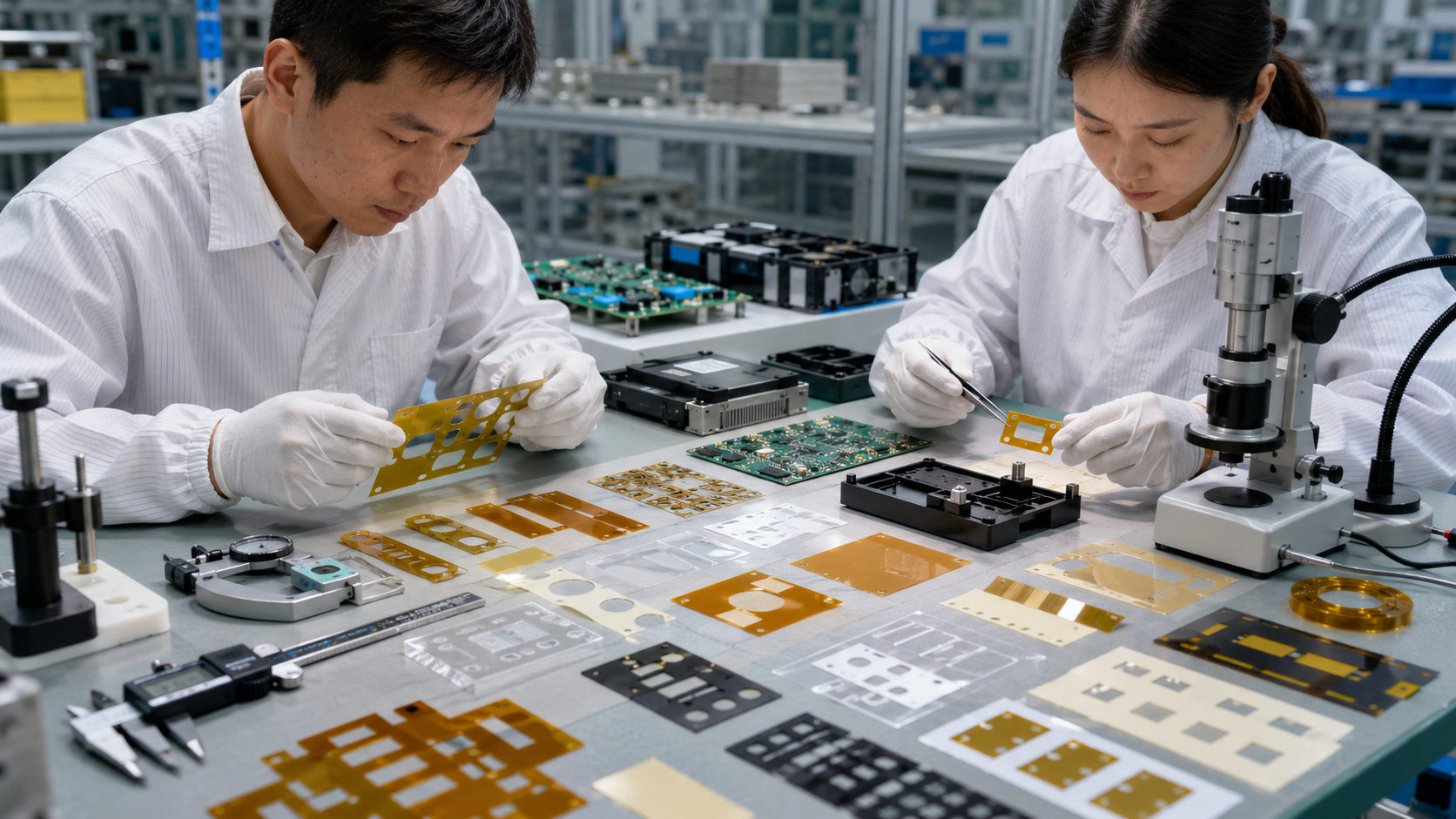
Our goal is to help customers reduce short-circuit risk, repeated sampling, poor fit, adhesive problems, liner release issues, and unstable mass production.
A good insulation film should be accurate, clean, stable, easy to assemble, and reliable in the final electronic product.
Conclusion
Insulation films must be precision die cut for electronics because they protect electrical safety, assembly fit, product reliability, and production efficiency. The correct material alone is not enough. The film must also be cut accurately, cleanly, and consistently.
For OEM buyers, important factors include film material, thickness, adhesive structure, liner release, hole accuracy, edge quality, burr control, delivery format, and final application conditions.
At Sanken, we help customers convert PET, PI, PC, adhesive films, protective films, and multilayer materials into precision die cut insulation components that support reliable electronics manufacturing and stable mass production.