
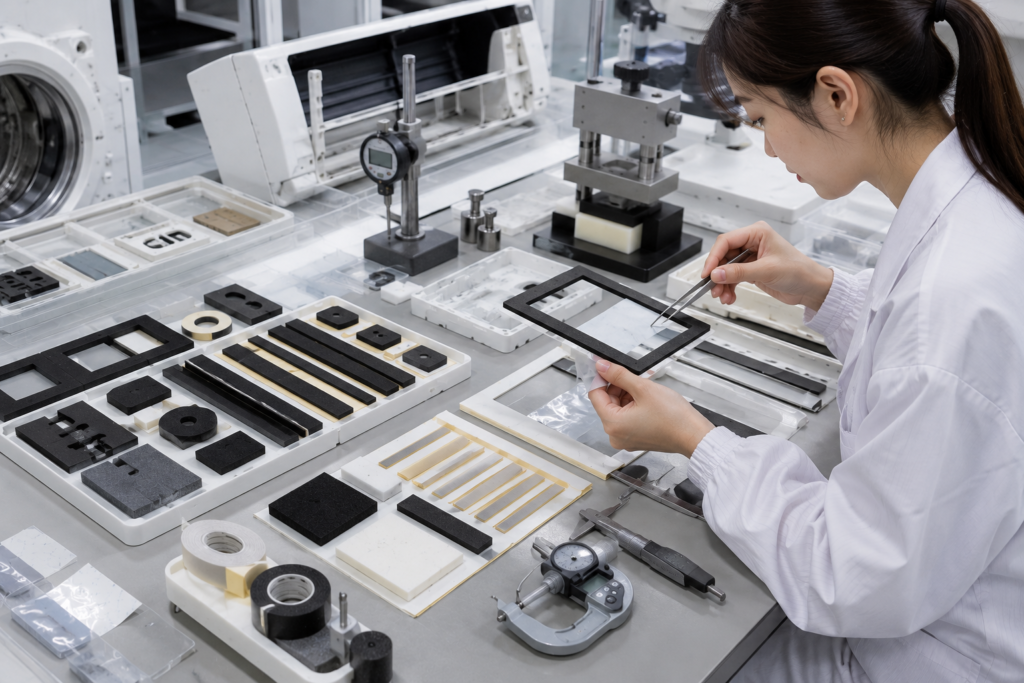
Kitting matters for custom die cut component delivery because many OEM assemblies do not use only one foam pad, one adhesive tape part, or one insulation film. A single product may require several die cut components with different shapes, materials, thicknesses, adhesives, liners, and assembly positions. If these parts are delivered separately without a clear kitting system, the customer may face missing parts, wrong part selection, slow assembly, material confusion, inventory pressure, and higher production risk.
For OEM engineers and purchasing managers, custom die cut parts are not only about cutting accuracy. The delivery format also affects assembly efficiency, quality control, line-side handling, and production stability.
At Sanken, we help OEM customers develop custom die cut components such as foam gaskets, adhesive tape parts, PET insulation films, PI films, rubber pads, protective films, non-woven felt parts, sealing components, and multilayer materials. For many projects, proper kitting can be just as important as material selection and die cutting quality.
What Is Kitting in Custom Die Cut Component Delivery?
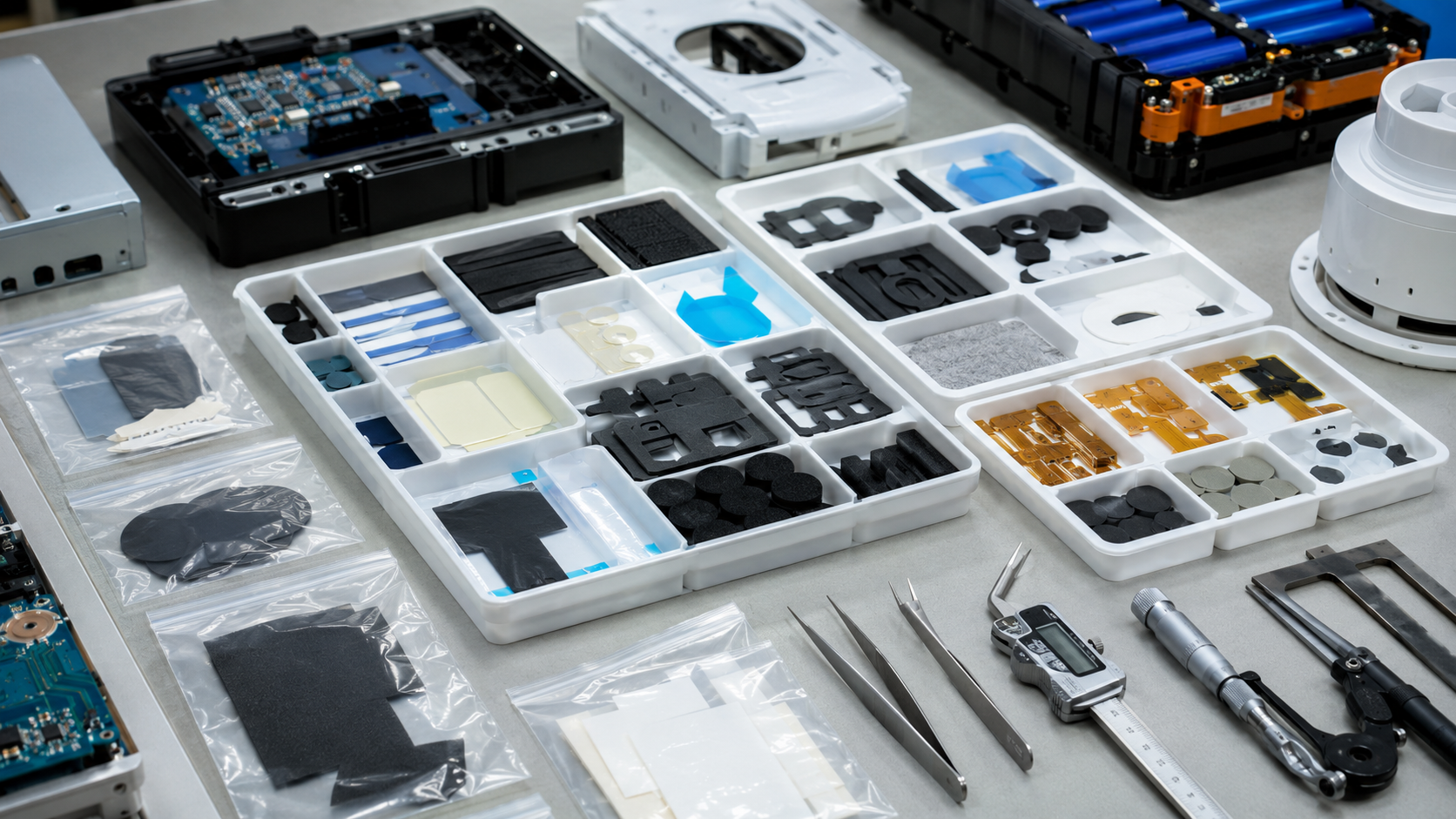
Kitting means organizing multiple components into a prepared set before delivery. Instead of shipping all parts in separate bulk packages, the supplier groups the required parts according to product model, assembly step, BOM structure, workstation, or customer packing requirement.
A kit may include:
- Foam gaskets
- Adhesive-backed pads
- PET insulation films
- Rubber sealing parts
- Protective films
- Non-woven felt pads
- Double-sided tape components
- Light-blocking gaskets
- Anti-rattle pads
- Spacers and cushioning parts
- Battery insulation parts
- Assembly support materials
For example, one automotive electronic module may require one foam seal, two PET insulation films, three adhesive tape pads, one rubber cushion, and one protective film. If these parts are supplied as one kit, the assembly operator can pick the correct set quickly instead of searching through several material boxes.
Kitting vs Bulk Delivery
Bulk delivery is suitable when the customer needs large quantities of one simple part. Kitting is more useful when several parts must be used together.
| Delivery Method | Best For | Main Limitation |
|---|---|---|
| Bulk delivery | One part number, simple storage, high-volume use | Requires customer to sort and manage parts |
| Sheet delivery | Adhesive-backed parts on liner sheets | Good for manual peeling, but still needs part control |
| Roll delivery | Automated or semi-automated application | Less suitable for mixed component sets |
| Individual packaging | Sensitive or delicate components | Higher packaging and handling cost |
| Kitting delivery | Multiple parts used in one assembly | Requires clear BOM and packing control |
Bulk delivery may look cheaper at first. But if the customer spends more labor time sorting, counting, checking, and correcting mistakes, the total cost may be higher.
Kitting can reduce hidden assembly cost.
Common Problems Without Kitting
Many production issues happen not because the die cut part is wrong, but because the part is delivered in a way that does not match the customer’s assembly process.
| Problem | Common Cause | OEM Risk |
|---|---|---|
| Missing components | Multiple parts packed separately | Line stoppage or incomplete assembly |
| Wrong part installed | Similar shapes or materials mixed | Product failure or rework |
| Slow picking | Operators search through many packages | Lower assembly efficiency |
| Inventory confusion | Too many small part numbers | Poor material control |
| Batch mixing | Parts from different lots combined | Traceability problem |
| Surface contamination | Parts handled too many times | Dust, fingerprints, or adhesive issues |
| Liner damage | Loose packing or poor stacking | Difficult peeling |
| Extra inspection time | Customer must count and verify parts | Higher labor cost |
For automotive, electronics, battery, medical device, appliance, and industrial assembly, these risks can affect both quality and delivery schedules.
A good die cutting supplier should understand how the customer will use the parts, not only how to produce them.
What Types of Die Cut Components Benefit Most from Kitting?
Kitting is especially useful when a product requires multiple functional materials.
Automotive Electronics
Automotive electronic modules may need foam seals, PET insulation films, anti-rattle felt pads, double-sided tape parts, rubber cushions, and protective films. Kitting can help operators apply the correct parts in the correct sequence.
Battery Modules
Battery assemblies may require insulation films, flame-retardant pads, PET or PI spacers, adhesive-backed protection parts, foam compression pads, and tab protection films. Kitting helps prevent missing insulation layers or wrong placement.
Consumer Electronics
Displays, cameras, speakers, sensors, and wearable devices often use many small die cut parts. Kitting can reduce confusion between similar thin films, black gaskets, foam pads, and adhesive frames.
Medical and Industrial Devices
Medical device assemblies and industrial control products may require clean handling, separated components, and clear assembly sets. Kitting can improve traceability and reduce handling contamination.
Packaging and Protection
Foam inserts, protective films, cushioning pads, and adhesive-backed protection parts can be delivered as complete packaging kits for faster product packing.
How Kitting Improves Quality Control
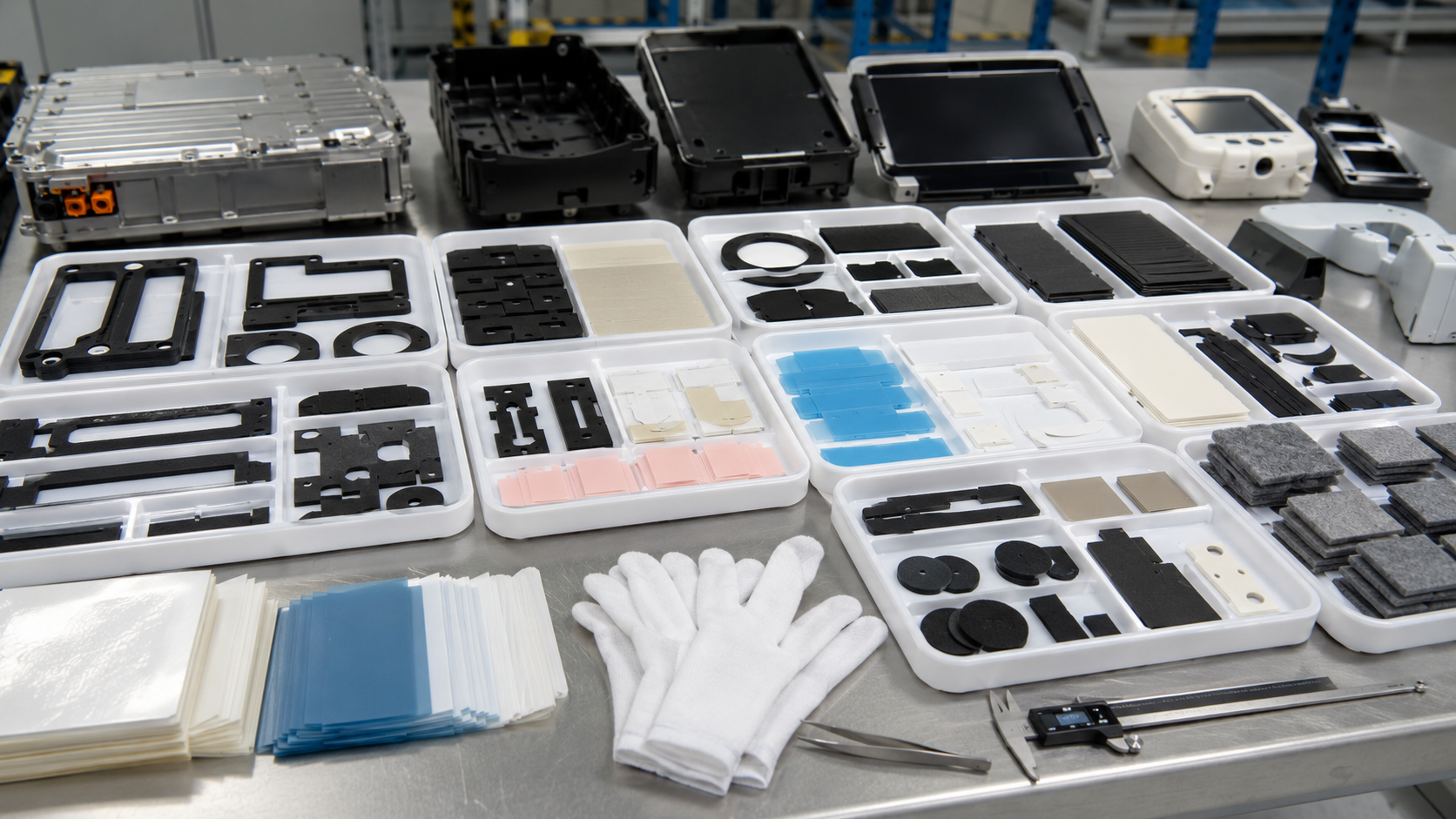
Kitting helps improve quality control because it creates another checkpoint before parts reach the customer’s assembly line.
During kitting, the supplier can verify:
- Correct part number
- Correct quantity
- Correct material
- Correct shape
- Correct adhesive side
- Correct liner format
- Correct batch
- Correct packing sequence
- Correct kit structure
- Correct customer requirement
This does not replace normal inspection. It adds practical control for delivery accuracy.
For example, a die cut PET insulation film may pass dimensional inspection. A foam gasket may pass thickness inspection. A protective film may pass peel test. But if these parts are packed in the wrong kit, the customer still has a production problem.
Kitting connects part quality with delivery quality.
Kitting and Traceability
Traceability is important for OEM manufacturing, especially in automotive electronics, battery systems, medical device components, and industrial equipment.
Kitting can support traceability by linking component batches to a specific kit structure or delivery lot. This makes it easier to identify which material batch, adhesive lot, liner type, or production run was used for a specific customer delivery.
Traceability can help when customers need to review:
- Material lot
- Production batch
- Inspection record
- Packaging date
- Delivery lot
- Part revision
- Engineering change status
Without good kitting and batch control, similar components can be mixed easily. This creates risk during engineering changes or quality review.
Kitting Reduces Assembly Time
Assembly efficiency is one of the biggest benefits of kitting.
If one product requires six die cut parts, the operator can take one prepared kit and complete the assembly step without searching, counting, or comparing parts.
This is especially useful when:
- Parts are small
- Parts look similar
- Multiple models are produced on one line
- Assembly sequence is important
- Operators need fast line-side picking
- Components must stay clean
- Parts are adhesive-backed and liner-sensitive
- The customer wants lean inventory control
A well-designed kit can reduce manual sorting time and improve workstation organization.
For adhesive-backed components, the delivery format can also affect peeling speed. Parts may be supplied on sheets, rolls, strips, trays, or grouped liners depending on the customer’s assembly process.
What Buyers Should Confirm Before Requesting Kitting
Kitting requires clear communication between the customer and supplier. Before confirming the kitting plan, buyers should prepare detailed information.
| Checklist Item | What to Confirm | Why It Matters |
|---|---|---|
| BOM structure | Which parts belong in one kit | Prevents missing or extra parts |
| Quantity per kit | One set, two sets, spare parts, model-specific quantity | Controls packing accuracy |
| Assembly sequence | Which part is used first, second, third | Supports line-side efficiency |
| Delivery format | Bag, tray, sheet, roll, box, liner set | Matches assembly process |
| Part identification | Part number, revision, model, batch | Supports traceability |
| Cleanliness need | Dust control, glove handling, separated packing | Protects sensitive parts |
| Adhesive direction | Exposed side, liner side, peel tab direction | Prevents assembly mistakes |
| Packaging protection | Flatness, anti-curling, anti-compression | Protects component quality |
| Inspection requirement | Counting, visual check, dimensional record | Confirms delivery accuracy |
| Engineering change control | Revision tracking and old batch control | Prevents mixed versions |
A kitting plan should be reviewed before mass production. If the kit structure changes after production begins, the supplier and customer should control the revision clearly.
Packaging Design for Kitted Die Cut Components
Good kitting is not only putting parts into a bag. Packaging must protect the components during transportation, storage, and handling.
Different die cut materials need different protection.
Foam parts may need compression control.
Thin films may need flat packaging to prevent curling.
Adhesive parts need liner protection and clean handling.
Rubber parts may need separation to prevent sticking or deformation.
Non-woven felt parts may need dust and fiber control.
Protective films must avoid scratches and contamination.
For some projects, kits may be packed in trays, cartons, sheet sets, or separated compartments. For other projects, one kit may be packed with all parts in a single bag or envelope.
The best choice depends on part sensitivity, assembly method, customer inventory system, and shipping condition.
How Sanken Supports Kitting for Die Cut Component Delivery
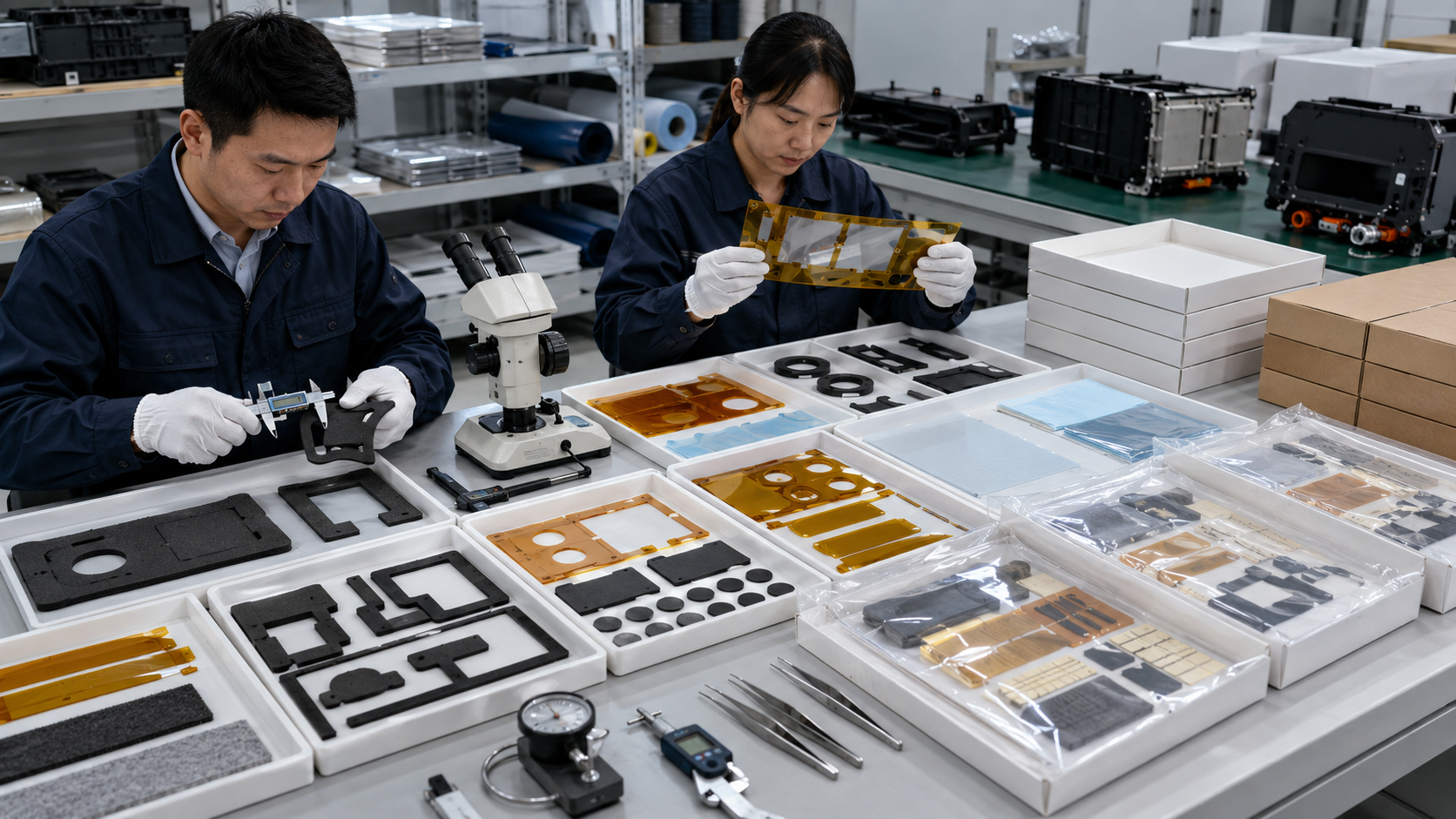
Sanken Manufacturing Co., Ltd. supports OEM customers with custom die cut component delivery formats that match real assembly needs.
We help review:
- Component quantity per kit
- Material sensitivity
- Adhesive liner direction
- Part stacking method
- Sheet or roll delivery
- Protective packaging
- Kit grouping
- Batch control
- Assembly sequence
- Customer packing requirements
For automotive customers, we support kitted foam gaskets, insulation films, felt pads, adhesive tapes, and sealing components used in electronic modules and interior assemblies.
For electronics and battery customers, we support kitted PET films, PI films, protective films, adhesive spacers, foam pads, and insulation components.
For medical, appliance, and industrial customers, we support clean delivery, grouped components, protective packing, and assembly-friendly formats.
Our goal is to help customers reduce missing parts, picking errors, packaging damage, liner problems, assembly delays, and inventory complexity.
Conclusion
Kitting matters for custom die cut component delivery because it connects manufacturing quality with real assembly efficiency. A precisely cut foam gasket, PET film, adhesive tape part, rubber pad, or protective film still needs to arrive in a format that operators can use quickly and correctly.
For OEM buyers, kitting can reduce missing parts, wrong part selection, inventory confusion, line-side delays, handling damage, and hidden assembly cost.
At Sanken, we help customers deliver custom die cut components in practical, organized, and assembly-friendly formats that support stable OEM production.