
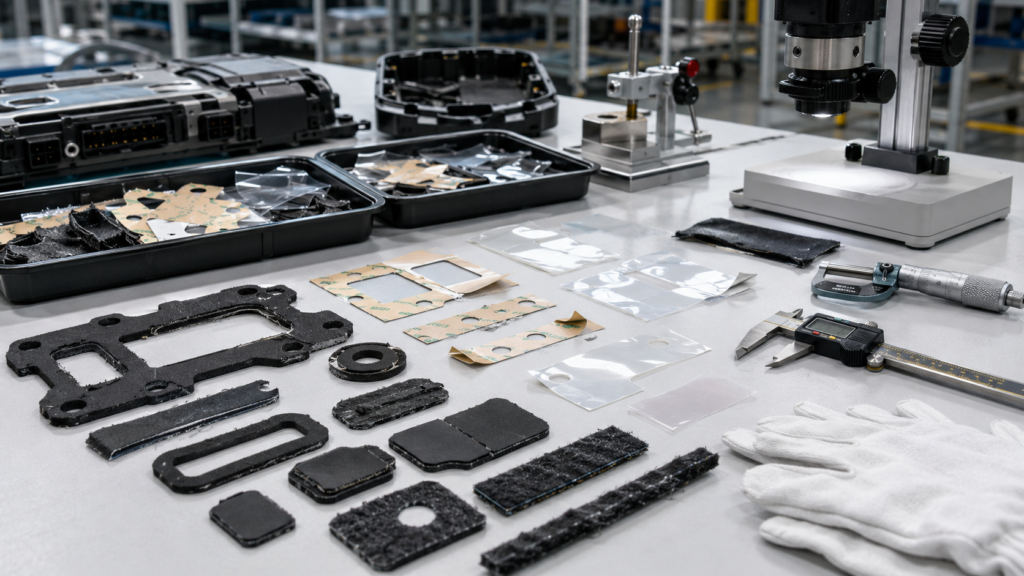
OEM die cut parts fail inspection when material, dimensions, adhesive behavior, liner release, edge quality, cleanliness, packaging, or functional performance does not match the drawing or assembly requirement. A part may look acceptable at first glance, but it can still fail inspection because of hole misalignment, rough edges, adhesive overflow, foam deformation, film curling, liner damage, contamination, or unstable thickness.
For OEM buyers and engineers, inspection failure is not only a quality problem. It can delay assembly, increase sorting work, cause rework, waste material, stop production lines, and create risk before mass production.
At Sanken, we help OEM customers develop custom die cut foam gaskets, adhesive tape components, PET insulation films, protective films, rubber pads, non-woven felt parts, and multilayer converted components for automotive, electronics, battery, medical, appliance, and industrial applications.
Why OEM Die Cut Parts Fail Inspection
Die cut parts are often small, thin, flexible, and hidden inside the final product. But they usually have a real function. They may seal a housing, bond two surfaces, insulate electronics, protect a display, reduce vibration, or support assembly positioning.
Inspection failure usually happens when the supplier treats the part as a simple cut shape instead of a functional OEM component.
Common inspection failures include:
- Dimensions outside tolerance
- Hole position mismatch
- Rough or torn edges
- Adhesive overflow
- Adhesive lifting
- Poor liner release
- Liner damage
- Foam compression deformation
- Film curling or wrinkling
- Rubber burrs
- Fiber shedding from felt
- Dust or particle contamination
- Wrong material thickness
- Wrong packaging format
- Poor fit during assembly testing
Many of these problems can be prevented before mass production if material, tooling, process, and inspection standards are reviewed early.
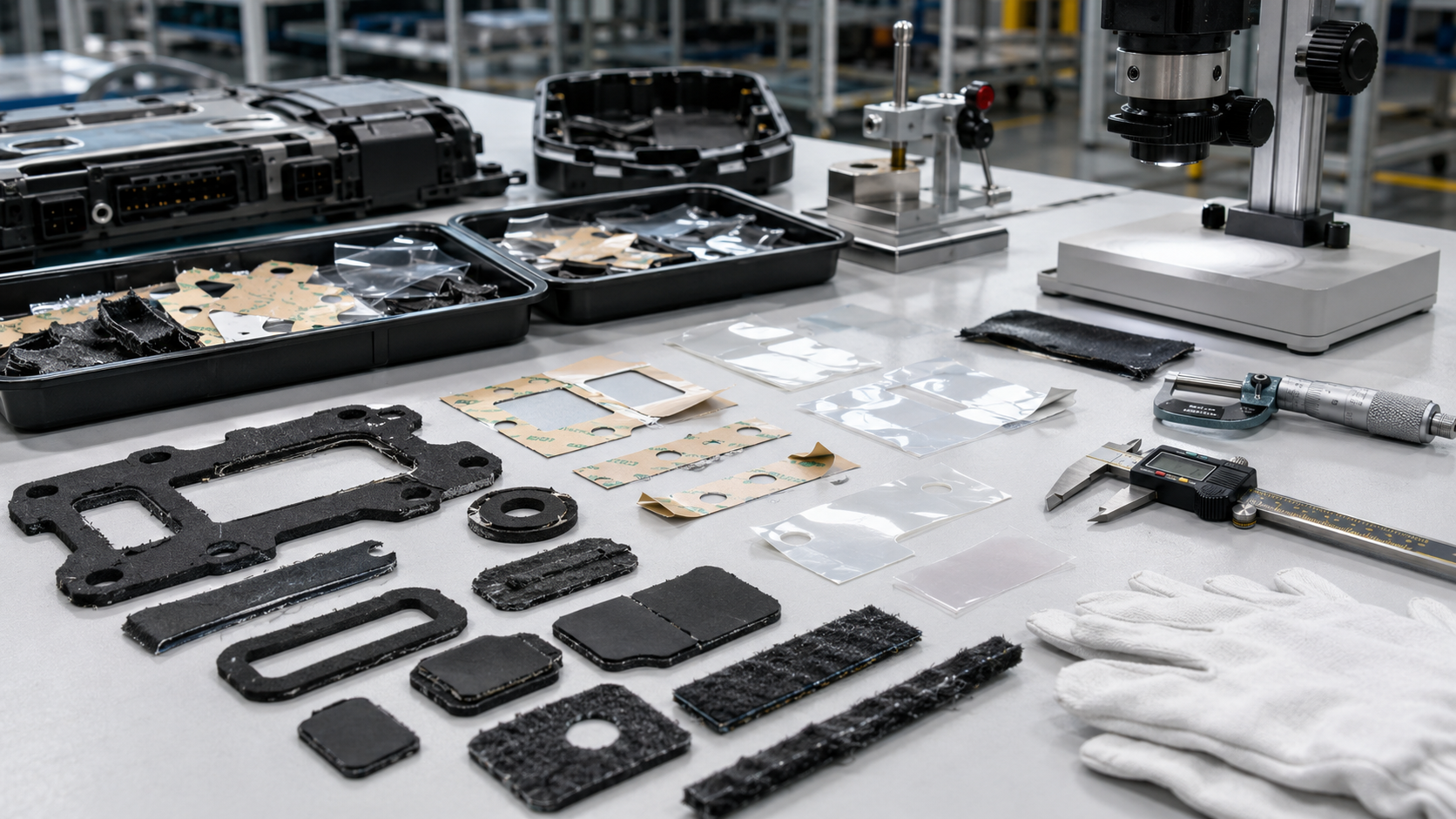
Common Inspection Failure Causes
| Inspection Failure | Common Cause | OEM Risk |
|---|---|---|
| Hole misalignment | Material movement, poor registration, weak tooling control | Assembly mismatch |
| Rough edges | Dull blade, wrong cutting method, unsuitable material | Poor fit and contamination |
| Adhesive overflow | Excess cutting pressure or soft adhesive | Sticking, contamination, lifting |
| Liner tearing | Kiss cutting too deep | Slow assembly and rejected parts |
| Poor liner release | Wrong liner or shallow cutting | Hard peeling and deformation |
| Foam deformation | Too much pressure or wrong foam density | Poor sealing and poor appearance |
| Film curling | Material tension or poor packaging | Difficult placement |
| Fiber shedding | Poor felt material or edge control | Cleanliness concern |
| Thickness variation | Unstable raw material | Poor fit and compression |
| Packaging damage | Stacking pressure or poor protection | Parts fail before assembly |
Inspection failure is often not caused by one single issue. For example, an adhesive-backed foam gasket may fail because the foam is too soft, the adhesive is too aggressive, the kiss cutting depth is unstable, and the packaging compresses the finished parts.
Material Selection Problems
Material selection is one of the most common reasons OEM die cut parts fail inspection.
A supplier may choose a cheaper foam, film, tape, rubber, or felt material that looks similar but behaves differently during production and assembly.
For foam parts, inspection problems may come from unstable thickness, poor compression recovery, weak density control, surface dust, or edge tearing.
For rubber parts, problems may include hardness variation, rebound, burrs, odor, or poor dimensional stability.
For PET, PI, PC, or protective film parts, problems may include curling, scratches, hole misalignment, static dust, or poor insulation performance.
For adhesive tape parts, problems may include edge lifting, liner release failure, adhesive overflow, or weak bonding.
For non-woven felt parts, problems may include fiber shedding, uneven density, rough cutting, or poor adhesive lamination.
The correct material should be selected based on the part function, not only price or thickness.
Tolerance and Drawing Issues
Some inspection failures begin at the drawing stage.
A drawing may request tight tolerance that is difficult to hold with soft foam, rubber, felt, or adhesive tape. A design may include narrow walls, small holes, sharp corners, or weak bridges that are difficult to cut and remove cleanly.
Common design risks include:
| Design Issue | Possible Inspection Problem |
|---|---|
| Very narrow gasket wall | Tearing, deformation, unstable dimensions |
| Sharp internal corners | Edge lifting or tearing |
| Small holes | Blocked waste or poor hole quality |
| Tight tolerance on soft foam | High rejection rate |
| Large thin film area | Curling or wrinkling |
| Complex adhesive shape | Poor waste removal |
| No pull tab | Difficult peeling and handling |
| Weak material bridges | Part damage during stripping |
A reliable die cutting manufacturer should review manufacturability before tooling. If the supplier simply accepts every drawing without warning, inspection risk increases.
Small design adjustments such as rounded corners, wider walls, better hole spacing, pull tabs, or more realistic tolerance can greatly reduce rejection.
Die Cutting Process Control
Even when material and drawing are correct, die cut parts can still fail inspection if the process is not controlled.
Key process factors include:
- Cutting pressure
- Tool sharpness
- Kiss cutting depth
- Web tension
- Material registration
- Lamination stability
- Waste removal
- Tool wear
- Operator handling
- Machine setup
- In-process inspection
For adhesive-backed parts, kiss cutting depth is especially important. The blade must cut through the top material and adhesive layer without damaging the release liner.
If the cut is too shallow, parts may not release cleanly.
If the cut is too deep, the liner may tear.
If pressure is too high, adhesive may squeeze out at the edge.
For foam parts, excessive pressure can crush the foam. For film parts, unstable web tension can cause hole shift. For rubber parts, material rebound can affect final dimensions.
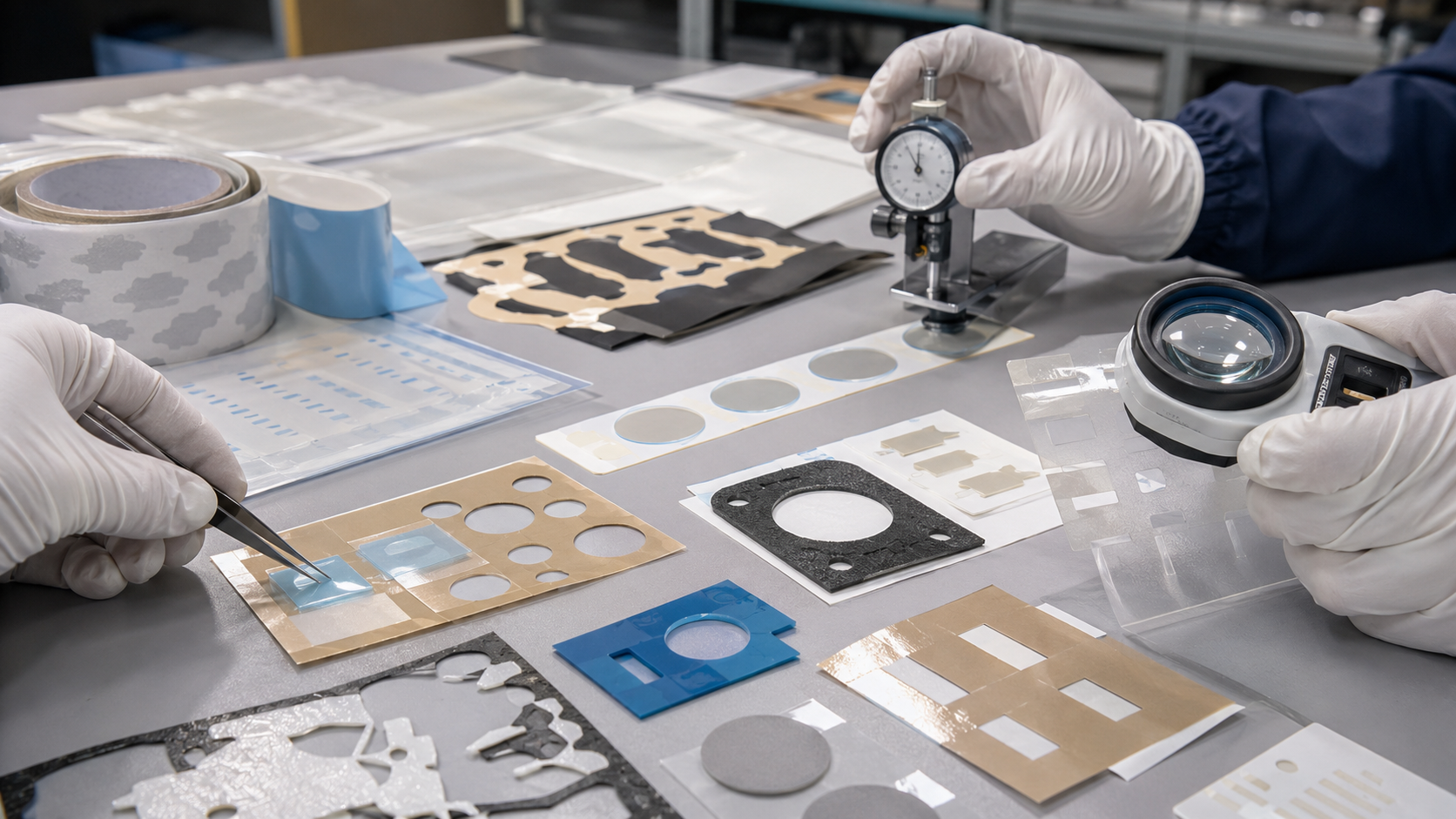
Adhesive and Liner Problems
Many OEM die cut parts are adhesive-backed, so adhesive and liner performance must be inspected together.
Common adhesive inspection failures include:
- Adhesive lifting at corners
- Adhesive overflow at the edge
- Poor adhesive position
- Adhesive transfer to liner
- Poor bonding to final surface
- Residue after removal
- Tape stretching during peeling
- Weak tack after storage
Common liner inspection failures include:
- Liner cut through
- Liner tearing during peeling
- Release force too high
- Release force too low
- Parts shifting on liner
- Poor liner flatness
- Curling after die cutting
A strong adhesive is not always the best adhesive. If it is too aggressive, the part may be difficult to peel. If it is too soft, it may overflow. If it does not match the bonding surface, the part may fail after application.
For OEM projects, adhesive should be tested on the real bonding surface whenever possible.
Cleanliness and Edge Quality
Clean edges are important for electronics, battery modules, medical devices, displays, automotive interiors, and precision industrial products.
Poor edge quality can create particles, fibers, burrs, dust, or adhesive strings.
These defects may cause inspection failure even when dimensions are correct.
For PET insulation films, rough edges may affect assembly or insulation reliability.
For protective films, scratches or dust can affect appearance.
For non-woven felt, loose fibers can contaminate nearby parts.
For foam gaskets, torn edges can reduce sealing performance.
For adhesive tape parts, adhesive strings can contaminate the product or cause sticking.
Inspection should not only check size. It should also check edge cleanliness, surface condition, and functional use.
Packaging Can Cause Inspection Failure
Some parts pass production inspection but fail incoming inspection at the customer side because packaging is wrong.
Packaging can cause:
- Foam compression marks
- Film curling
- Adhesive parts shifting
- Dust contamination
- Liner bending
- Edge damage
- Parts sticking together
- Mixed parts
- Difficult counting
- Surface scratches
Soft foam should not be compressed too tightly. Thin films should be protected from curling. Adhesive-backed parts should stay flat and stable on the liner. Small components may need trays, sheets, bags, or kitting formats.
Packaging is not only a shipping detail. It is part of the quality control system.
How to Prevent Inspection Failure
The best way to prevent inspection failure is to review the full part system before production.
| Prevention Step | What to Review | Benefit |
|---|---|---|
| Application review | Sealing, bonding, insulation, cushioning, protection | Selects correct material |
| Drawing review | Tolerance, holes, corners, narrow walls | Improves manufacturability |
| Material validation | Thickness, density, hardness, adhesive, liner | Reduces mismatch |
| Tooling review | Cutting method, pressure, blade, layout | Improves edge and dimension |
| Kiss cut control | Cut depth and liner condition | Prevents peeling issues |
| Adhesive testing | Bonding surface and assembly pressure | Prevents lifting |
| Sample testing | Fit, peel, compression, aging, handling | Finds risk early |
| Packaging review | Roll, sheet, tray, bag, kit | Prevents damage |
| Incoming inspection plan | Critical dimensions and functions | Improves batch stability |
A good inspection system should include first article inspection, in-process checks, final inspection, and packaging review.
What Buyers Should Provide Before Production
Buyers can help reduce inspection failure by providing complete project information.
Important details include:
- Drawing or sample
- Material requirement
- Thickness requirement
- Tolerance requirement
- Application function
- Bonding surface
- Adhesive requirement
- Assembly method
- Critical-to-quality areas
- Testing requirement
- Packaging format
- Quantity and production plan
For example, if a foam gasket will be compressed inside an automotive housing, the supplier should know the gap and compression requirement. If a PET film will be used for battery insulation, the supplier should know the hole accuracy and insulation risk. If an adhesive tape part will bond to PP plastic, adhesive selection must be reviewed early.
How Sanken Helps Prevent Inspection Failures
Sanken Manufacturing Co., Ltd. helps OEM customers reduce inspection failure by reviewing material, drawing, tolerance, adhesive, liner release, cutting depth, edge quality, packaging, and assembly method before mass production.
For foam gaskets, we review foam type, density, thickness, compression behavior, adhesive backing, sealing width, and die cut geometry.
For adhesive tape parts, we review adhesive structure, carrier material, liner release, kiss cutting depth, waste removal, and bonding surface.
For PET, PI, PC, and protective film components, we review edge cleanliness, film tension, hole alignment, surface quality, and packaging.
For rubber and felt parts, we review hardness, rebound, fiber shedding, edge quality, adhesive lamination, and final application.
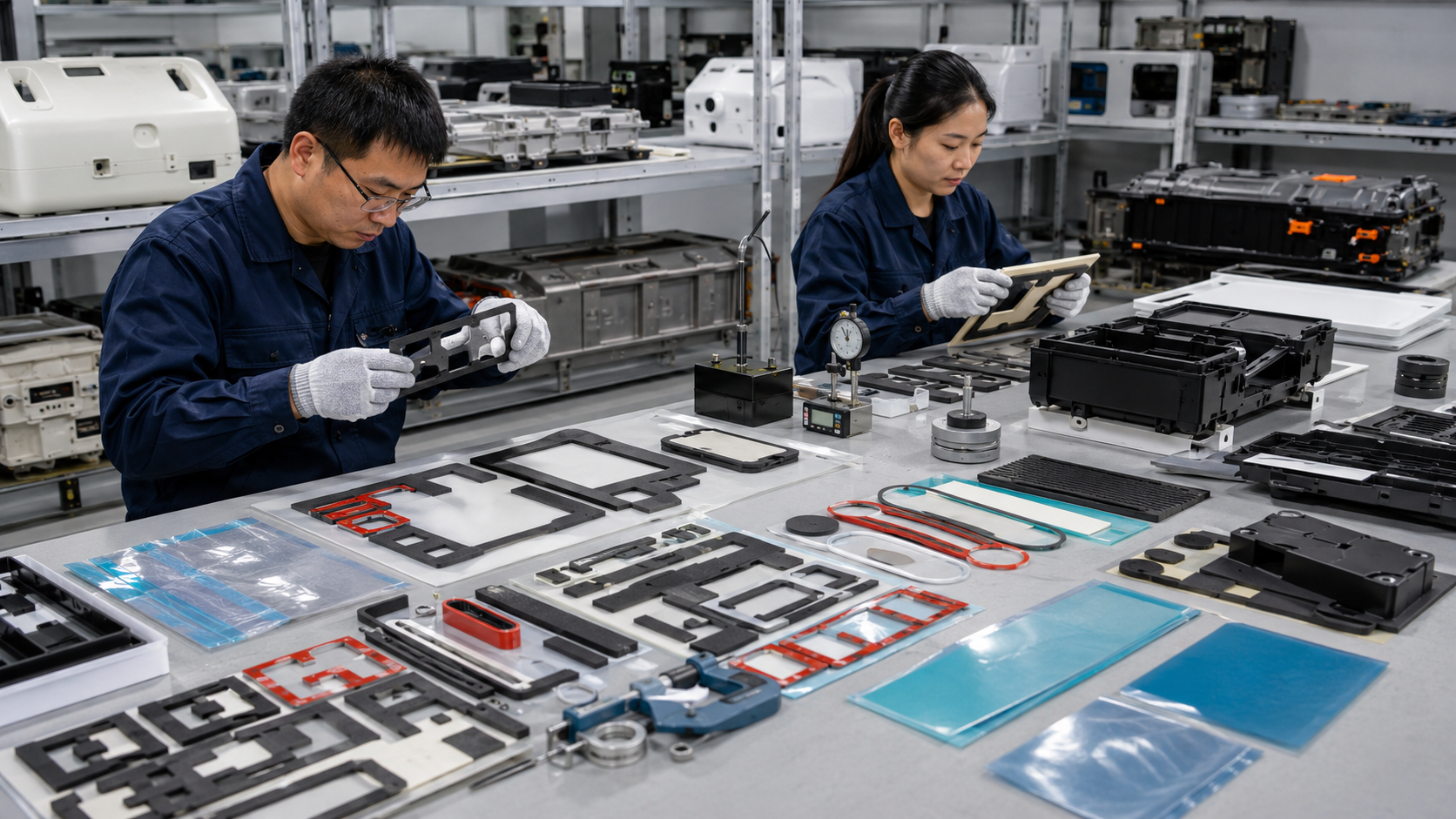
Our goal is to help customers reduce rejected parts, sorting work, rework, adhesive lifting, poor fit, liner tearing, rough edges, contamination, and unstable mass production.
A good OEM die cut part should pass inspection because it is designed, converted, packed, and tested for real assembly conditions.
FAQ
Why do OEM die cut parts fail inspection?
OEM die cut parts fail inspection because of dimensional variation, wrong material, rough edges, adhesive overflow, poor liner release, liner damage, foam deformation, film curling, contamination, or poor packaging.
How can inspection failures be prevented?
Inspection failures can be prevented by reviewing material, drawing, tolerance, adhesive, liner, die cutting process, packaging, and real assembly conditions before mass production.
Why do adhesive-backed die cut parts fail inspection?
They often fail because of adhesive lifting, adhesive overflow, poor liner release, liner tearing, incorrect kiss cutting depth, or poor bonding to the final surface.
Why do foam die cut parts fail inspection?
Foam parts may fail because of thickness variation, compression deformation, torn edges, wrong density, poor sealing width, or packaging pressure.
Why do film die cut parts curl or fail inspection?
Film parts may curl because of web tension, material memory, thin structure, poor packaging, or unstable lamination. They may also fail because of scratches, dust, or hole misalignment.
What should buyers check before ordering OEM die cut parts?
Buyers should check material, thickness, tolerance, application, adhesive requirement, bonding surface, assembly method, testing requirement, and packaging format.
Can Sanken help improve die cut part inspection pass rate?
Yes. Sanken supports material selection, drawing review, precision die cutting, kiss cutting, adhesive lamination, liner release control, inspection, and packaging optimization for custom OEM die cut parts.
Conclusion
OEM die cut parts fail inspection when material, tolerance, adhesive behavior, cutting process, liner release, edge quality, cleanliness, packaging, or assembly conditions are not controlled correctly. A part that looks simple may still fail if it is not designed and manufactured for real production use.
The best prevention method is early engineering review. Material selection, drawing design, tooling, cutting depth, adhesive testing, packaging, and inspection standards should be confirmed before mass production.
At Sanken, we help OEM buyers and engineers develop die cut foam, tape, film, rubber, felt, and multilayer components that are clean, accurate, easy to assemble, and more stable during inspection and mass production.